


More news on this day
Travelers killing time at the gate may soon be able to do more than scroll departure boards. A new federal proposal would allow regulated bets on how badly flights are running late, turning airport misery into a tradable market.
Get the latest news straight to your inbox!
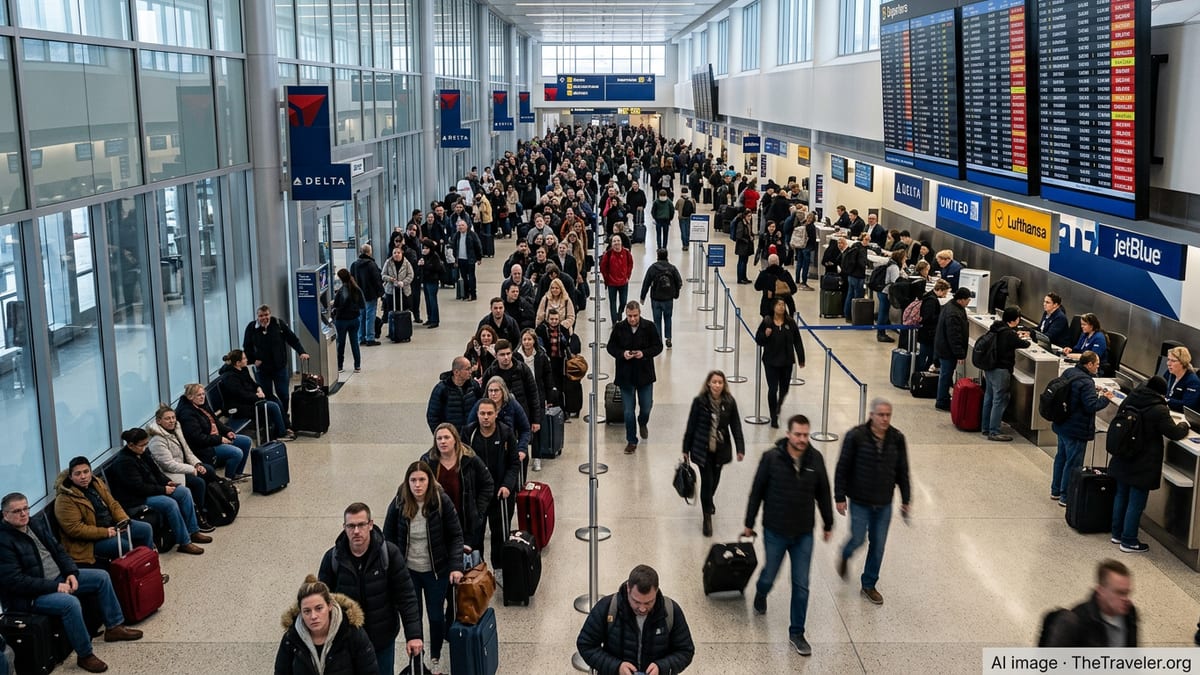
How betting on flight delays would work
The idea centers on so-called prediction markets, financial platforms where people trade contracts tied to real-world events. Instead of wagering on a single flight, the latest proposal focuses on aggregate cancellation or delay rates at major U.S. airports over set periods, such as a specific week or holiday window. Payouts would depend on whether those airport-wide statistics cross predetermined thresholds.
Under the plan described in recent business and travel coverage, a regulated exchange would list contracts linked to airline performance indicators, such as the percentage of flights canceled from a given airport in a particular week. Travelers, hedge funds and other traders could buy or sell positions based on their expectations of weather disruptions, staffing shortages or seasonal congestion. Prices in these markets would constantly adjust as new information emerged.
Supporters frame the contracts as a risk-management tool rather than a simple bet. A company with heavy exposure to air travel costs, for example, could attempt to offset the impact of widespread cancellations by taking the opposite side in the market. Individual travelers might also see the contracts as a way to partially cushion the financial sting of missed connections or rebooked itineraries, even though the products are not designed as conventional trip insurance.
The contracts would settle using third-party aviation data, with a predefined formula describing exactly how delays or cancellations are counted. For regulators, the reference data and the methodology for turning raw flight statistics into a binary outcome are central to determining whether the product is clear, measurable and resistant to manipulation.
Regulators weigh consumer risk and market integrity
In the United States, event-based prediction markets fall under the jurisdiction of the Commodity Futures Trading Commission. The agency treats these contracts as a form of derivative, subject to federal rules on market integrity, anti-fraud protections and position limits. Any platform seeking to offer flight delay or cancellation markets must either obtain prior approval or use a self-certification process that can still be challenged by the regulator.
Federal oversight has tightened in recent months as prediction markets move from niche economic indicators into politically and socially sensitive territory. Enforcement advisories highlight concerns about insider trading, particularly when participants have access to nonpublic information that could sway an outcome. For flight delay products, that risk could involve airline staff, air traffic controllers, data vendors or airport contractors with early knowledge of operational decisions.
Draft rule filings and public commentary indicate that any approved contracts would likely come with strict eligibility rules. Workers in roles that can directly influence cancellations or delays, and in some cases their households, could be barred from trading. Platforms are also expected to build surveillance systems to detect unusual activity around major storms, air traffic outages or labor disputes, then report suspicious patterns to regulators.
At the same time, federal officials are grappling with how to distinguish legitimate hedging from what critics describe as little more than legalized gambling on transportation chaos. Previous battles over political and sports-related markets show that, even under CFTC oversight, many state authorities and advocacy groups remain uneasy about normalizing bets on disruptive real-world events.
Ethical backlash and traveler unease
The prospect of monetizing airline disruption has triggered a sharp reaction from travelers and commentators. Social media debate in recent days has featured concerns that turning delays into a profit opportunity could erode public trust in both airlines and airports. Many critics argue that the mere appearance of financial incentives tied to operational failure is troubling in a sector where safety, punctuality and reliability are core obligations.
Commentary in travel outlets points out that, unlike a sports event or election, an airline schedule is also a critical layer of public infrastructure. Flights connect families, move medical personnel and deliver time-sensitive cargo. Turning on-time performance into an object of speculation, opponents argue, risks trivializing the real human and economic costs when airports grind to a halt.
Industry analysts note that the ethical questions cut in two directions. On one hand, markets could allow frustrated passengers and affected businesses to recoup some losses. On the other, they may deepen resentment if travelers come to believe that financial institutions and sophisticated traders are profiting from disruptions that ordinary flyers must simply endure. The possibility that some participants might cheer for cancellations to hit a payout threshold sits uneasily with many observers.
Advocacy groups focused on problem gambling have also begun to scrutinize the proposal. They warn that tying aviation chaos to potential windfalls could encourage impulsive behavior among travelers already stressed by delays and missed flights, particularly if contracts become accessible through retail trading apps rather than specialized platforms.
Data disputes highlight practical challenges
Beyond ethics, the feasibility of flight delay markets depends heavily on reliable, standardized data. Recent reporting describes how a planned product using statistics from a prominent flight-tracking service ran into obstacles when the data provider objected to its information being used to settle financial contracts. Without clear licensing agreements and transparent methodologies, exchanges risk disputes over outcomes and potential legal challenges from both traders and data firms.
Disagreements over what counts as a cancellation or delay are not merely academic. Definitions can vary across airlines, airports and tracking services, especially when flights are diverted, consolidated or rescheduled. For a financial contract, small differences in classification may determine whether millions of dollars change hands. Market operators therefore need precise rulebooks spelling out which data feeds are authoritative and how edge cases are resolved.
Technologists watching the space note that aviation performance metrics can also be noisy and subject to last-minute changes. Severe weather systems, air traffic control staffing levels and knock-on effects from earlier disruptions can all alter forecasts within hours. While such volatility creates trading opportunities, it also increases the risk of misunderstandings and disputes if retail users do not fully grasp how settlement works.
These data complexities have already prompted some platforms to pause or modify their aviation-related plans. For regulators, the recent turbulence around flight-tracking partnerships underscores how deeply prediction markets now intersect with proprietary information systems that were not originally designed for high-stakes financial use.
What airline and airport operators are watching for
Airlines and airports are monitoring the developments closely, even if most have not commented publicly in detail. Industry consultants say carriers are weighing whether such markets could offer indirect signals about future congestion. If a contract tied to a specific hub suddenly prices in a high chance of cancellations, it could reflect shifting expectations around storms, staffing strains or airspace restrictions that might not yet appear in standard forecasts.
At the same time, companies may need to prepare for new compliance burdens. To minimize conflicts of interest, airlines would likely have to update internal policies covering securities trading and outside investment activity for operational staff. Airport authorities might face similar questions about which employees should be barred from participating in flight delay markets, and how to enforce those restrictions.
Labor representatives have begun to raise questions about how any new rules would apply to pilots, flight attendants, dispatchers and ground crews, whose actions can directly affect on-time performance. There is also concern that external speculation could add pressure on frontline workers during already stressful disruptions, if management comes to view delay statistics not only as a customer service metric but as an input into financial markets.
For now, travelers stuck in security lines and departure lounges will not find flight delay contracts on mainstream booking or trading platforms. The path from a regulatory filing to a widely available product is uncertain, and recent setbacks suggest that public opinion, data ownership issues and legal scrutiny could reshape the proposal. Yet the intense interest surrounding the idea signals that, in the age of financialization, even the minutes ticking by on an airport departures board are being eyed as a potential asset class.