


More news on this day
Disruption-care provider Value Group plans to use Ground Handling International’s 27th Annual Conference at Olympia London from 1 to 3 December 2026 to showcase updated configurations of its RUBIK irregular-operations platform and a larger global supplier network, positioning the tools as a way for airlines and ground handlers to apply more consistent passenger-care rules during severe delays, cancellations and diversions.
Get the latest news straight to your inbox!
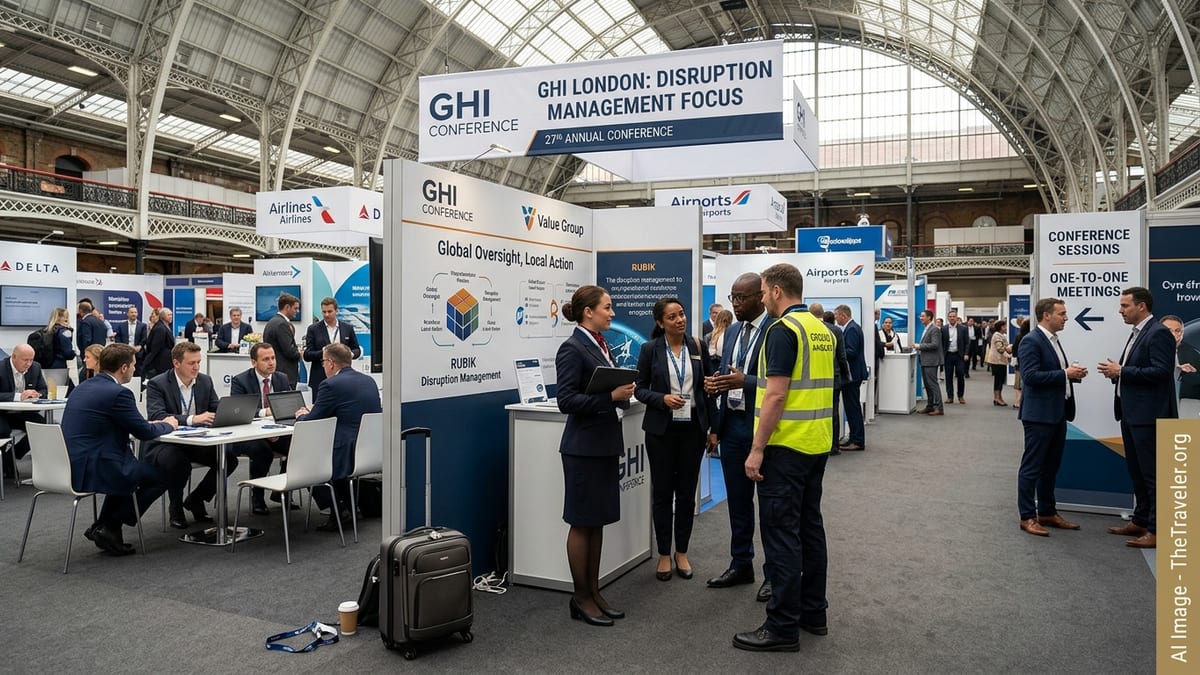
GHI London 2026: confirmed format and who is expected
The 27th Annual Ground Handling International (GHI) Conference is confirmed for 1 to 3 December 2026 at Olympia London in west London, with event listings and the official conference site describing it as the organiser’s flagship global ground-handling forum that combines a conference programme, supplier exhibition and structured one-to-one business meetings. Recent promotional material cites expectations of around 1,000 to 1,100 attendees, including more than 100 airlines and over 90 exhibiting suppliers, broadly in line with reported figures from the 2025 edition.
Programme outlines published in late 2026 point to an agenda focused on regulatory change, operational safety, workforce pressures and the digitalisation of ramp and passenger operations. Sessions are scheduled on forthcoming European Union rules specific to ground handling, a developing framework involving the European Union Aviation Safety Agency, and the first global ground-handling standards from the International Civil Aviation Organization that are due to apply from 26 November 2026, shortly before the London event. Other sessions are set to cover topics such as handler safety on the ramp, sustainability in ground support equipment and the challenges of recruiting and retaining ground-handling staff.
Registered delegates are offered a personal online page and conference app which together underpin the pre-booked meeting system, allowing participants to request and accept appointments that the organiser then schedules around conference sessions. The one-to-one format, combined with private meeting rooms on the Olympia show floor, is designed to support detailed discussions between airlines, airports, ground handlers and specialist vendors, including providers of disruption-management platforms such as Value Group.
How Value Group positions RUBIK within disruption care
Value Group, headquartered in Italy and active across Europe with growing coverage in other regions, focuses on services for irregular operations, widely known in the industry as IROPS. When flights face significant delays, cancellations or diversions and airlines are responsible for providing care, the company works alongside carriers and ground handlers to arrange hotel accommodation, meals and ground transport, and to support related passenger communications and reporting. Public material from the company and aviation trade press describes its model as a combination of a 24/7 operations control centre and a software and supplier ecosystem marketed under the RUBIK brand.
Information supplied to airline groups in recent years indicates that Value Group structures its services for both passenger disruption and crew care. For passengers, the emphasis is on securing hotel rooms and surface transport at or near airports during large-scale disruption, particularly where carriers have legal obligations under regulations such as European and UK passenger-rights frameworks. For crew, separate applications help airlines manage hotel stays and transfers for flight and cabin crews affected by irregular operations or routine rotations, using similar processes to secure rooms while respecting airline-specific standards.
RUBIK acts as the technology layer connecting these services with airline systems, station staff and a network of accommodation and ground-transport providers. Ahead of the London conference, Value Group has been presenting its approach under the phrase “Global Oversight, Local Action,” which describes how each airline defines its own disruption-care rules within the RUBIK environment while station staff or ground handlers carry out those rules on the ground. The stated objective is to reduce variations in how comparable disruption scenarios are handled across different airports and routes within a single airline’s network.
New RUBIK configurations and passenger-facing options on show
Product information distributed to trade partners ahead of GHI London 2026 describes RUBIK as a modular ecosystem that can be deployed in a variety of configurations, from deeply integrated solutions at major hubs to lighter options for outstations or newly launched routes. In the more integrated model, RUBIK connects to an airline’s reservation, ticketing and operations tools through application programming interfaces, allowing it to receive structured notifications when delays or cancellations reach thresholds that require care according to the airline’s own rules.
Once an irregular-operation event is confirmed in a connected environment, the airline can use RUBIK to retrieve passenger lists, apply the relevant entitlements and send targeted notifications, typically via SMS or email. Passengers receive a personalised link to a secure page that explains what care they are entitled to and offers a filtered selection of pre-approved hotels and, where applicable, ground-transport options. Filters can reflect maximum nightly rates, contracted hotel chains, distance from the airport, occupancy limits, and exceptions defined by the airline for particular cabins, loyalty tiers or markets.
For airports where this level of integration is not yet in place, Value Group promotes a lighter configuration based on QR codes and browser-based screens. In this model, airlines or their ground handlers display QR codes or short links at boarding gates, check-in counters and information points. Affected travellers confirm their disrupted flight details and identity before accessing a list of hotels that fall within the airline’s parameters for that specific disruption event. In parallel, a staff-facing interface allows ground handlers or airline agents to complete bookings on behalf of passengers who cannot or prefer not to use smartphones, such as customers requiring special assistance, families with young children or those facing connectivity or language barriers. Demonstrations in London are expected to focus on how these various configurations operate in practice rather than on a single fixed product setup.
24/7 control centre and supplier network expansion
Value Group’s 24/7 Operations Control Center is presented as the operational hub that links the RUBIK digital workflows with on-the-ground activity at airports. Publicly available descriptions state that the centre monitors factors such as airline schedules, weather forecasts, airspace constraints and airport capacity updates to identify locations where disruption risks are building. Where the company has an agreement in place with an airline, the control team can use these alerts to inform station staff and, within pre-defined limits, to signal likely demand to hotels and ground-transport providers in affected areas before disruption peaks.
This preventative approach is intended to reduce situations in which passengers face long journeys to available hotels or extended waits for buses and taxis during major events, particularly at hubs with restricted nearby accommodation. During active irregular operations, the same control centre acts as a support channel for station teams and ground handlers who may be seeking clarification on how rules apply to specific cases, on the availability of contracted hotels, or on potential exceptions for vulnerable passengers. Final decisions on individual travellers remain with each airline or its nominated handler, but the central team aims to support a more consistent interpretation of rules across stations, especially when a single weather system or air traffic control problem affects multiple airports.
The reach of any disruption-care platform depends heavily on its supplier network. Public trade announcements from late 2025 referred to Value Group services being available at more than 300 locations across Europe at that time, while more recent descriptions in 2026 mention coverage at over 400 locations worldwide. These figures are framed as indicative and subject to variation by season and by the scope of services contracted by individual airlines. The company continues to describe further expansion near high-traffic hubs and key leisure destinations as an ongoing strategic priority rather than a completed rollout, and it has not publicly disclosed a precise, up-to-date site count for late November 2026.
Regulatory backdrop and what airlines and handlers are likely to examine
Value Group’s planned RUBIK demonstrations in London come shortly after the first global ground-handling standards developed by ICAO are scheduled to take effect on 26 November 2026, alongside work on EU-wide requirements for ground handling and ongoing attention from national regulators such as the UK Civil Aviation Authority. The official GHI 2026 programme highlights sessions on these regulatory changes and their implications for safety, training and oversight, providing a backdrop for discussions about tools that document and structure disruption-care decisions.
For airline and ground-handling teams, this context means that digital disruption-care platforms are likely to be assessed not only on user experience and automation benefits, but also on their ability to support compliance and record-keeping. Practical questions expected to feature in London include how precisely airline-specific rules can be configured within RUBIK, what data are required to run automated entitlement checks, and how the system logs and time-stamps decisions taken at the airport during major disruption. Airlines are also likely to scrutinise how easily these records can be exported or audited to support internal reviews, regulator enquiries and passenger-complaint processes.
Ground handlers that manage disruption on behalf of multiple airlines from a single station are expected to pay particular attention to how multi-airline instances of RUBIK are presented to frontline staff. Key considerations include whether the platform can display different care policies side by side without mixing them, how logins and permissions are configured for employees working under several airline contracts, and what level of initial and recurrent training will be needed, given typical staff turnover in the sector. Some handlers and airlines will also be watching whether self-service tools reduce queues at customer-service points during disruption or whether they could trigger additional questions from passengers unfamiliar with digital options.
What travellers should expect and check ahead of future trips
For passengers, Value Group’s presence among exhibitors at GHI London 2026 is a signal that airlines and handlers are paying closer attention to how they organise care during disruption, but it does not in itself guarantee a particular experience on any given trip. Adoption of RUBIK or similar platforms depends on each airline’s commercial priorities, regulatory and data-protection assessments and internal IT capacity. Some carriers may decide to begin with their main hubs or selected routes before considering a broader rollout, and visible changes in airport processes or communications can take months to appear once a contract is signed.
Where an airline has fully integrated a disruption-management platform by late 2026 or into 2027, passengers who experience qualifying delays, cancellations or diversions may increasingly receive targeted notifications that include secure links to hotel and, where relevant, ground-transport booking options. At airports covered by lighter, QR-based configurations, travellers may see codes displayed at gates, check-in areas or airport information points, supported by staffed desks for those who require or prefer personal assistance. In all cases, the underlying entitlements to meals, accommodation and re-routing remain defined by applicable passenger-rights rules and the airline’s own conditions of carriage rather than by the technology used to deliver the offers.
Travellers planning journeys in late 2026 and 2027 who want to understand how disruption would be handled on their itinerary can start by reviewing the disruption and compensation sections on their chosen airline’s website and confirming that their booking includes up-to-date contact details for each traveller so that any automated notifications can reach them promptly. Passengers flying within or from regions that have specific passenger-rights legislation, such as the European Union or United Kingdom, may also wish to familiarise themselves with those rules to distinguish between legally mandated care and any additional support offered at the airline’s discretion. As airlines and handlers evaluate tools like RUBIK following the London demonstrations, travellers should expect to see gradual, airline-specific changes in how hotel offers and other care arrangements are communicated, rather than a uniform shift across the industry on a single date.