


More news on this day
A FedEx cargo jet overran a runway at Miami International Airport on Wednesday evening, November 25, 2026, briefly shutting down all but one runway and causing delays and diversions during one of the busiest travel periods of the year. No injuries were reported, but a ground stop and reduced runway capacity led to disruptions for passengers flying into and out of Miami.
Get the latest news straight to your inbox!
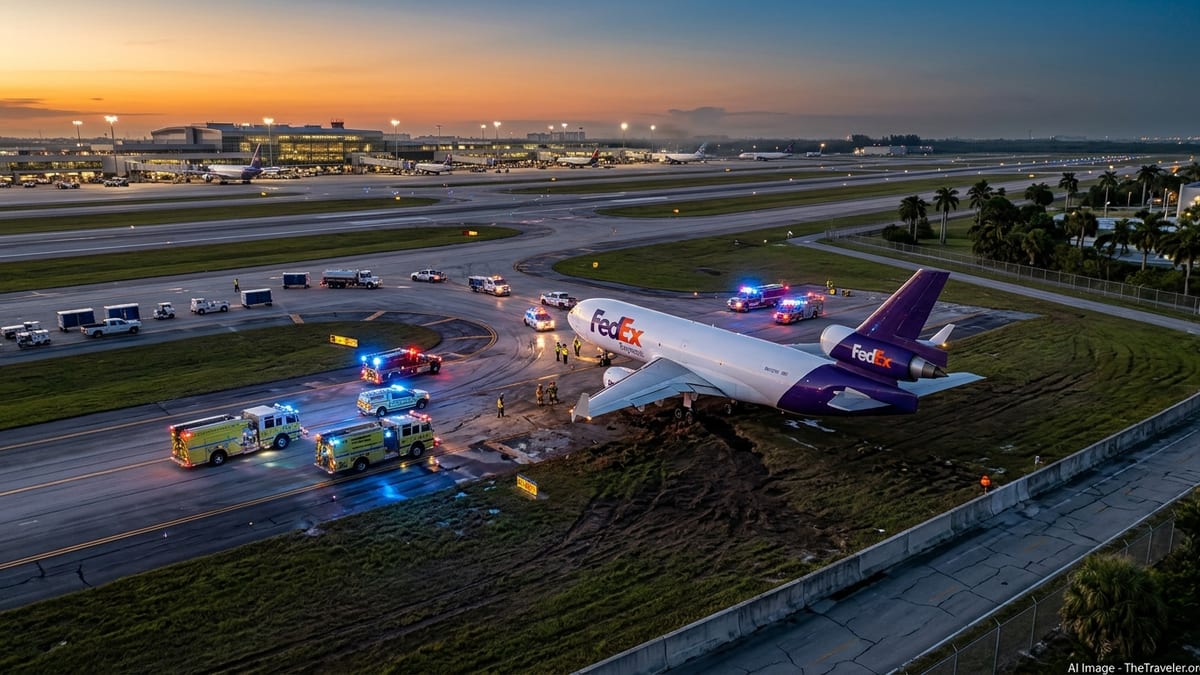
What happened at Miami International Airport
According to Miami International Airport, the incident occurred at approximately 8:40 p.m. local time on Wednesday, November 25, when a FedEx cargo aircraft overran Runway 26R after landing. Airport officials said the plane came to a stop beyond the paved portion of the runway, prompting an immediate emergency response and the closure of most of the airfield to arrivals and departures.
Local authorities reported that there were two people on board the FedEx jet and that no injuries were recorded. Miami-Dade Fire Rescue units responded to the scene, confirming there was no active fire. The aircraft remained on the ground at the overrun area while crews assessed the scene and began planning recovery operations.
FedEx stated that the aircraft "had an issue upon landing" at Miami and confirmed that it was working with airport authorities and federal investigators. The company emphasized that its crew members were safe and that there were no reported injuries to anyone on board or on the ground. As of the latest information, officials have not publicly identified the specific cause of the runway excursion, and a formal investigation has only just begun.
Impact on flights and passengers
The runway overrun triggered an immediate ground stop for flights bound for Miami International Airport on Wednesday night. The airport confirmed that all runways were initially closed except for the south runway, identified as Runway 9R, which remained available for limited operations. With only one runway usable at the height of the Thanksgiving travel period, airlines faced constraints on arrivals and departures.
Some inbound flights were placed in holding patterns while air traffic controllers and airlines assessed whether they could safely continue to Miami under the restricted configuration. Others were diverted to alternate airports in South Florida, including Fort Lauderdale, and potentially further afield when congestion built up. Travelers aboard those flights faced unscheduled detours, extra time in the air and, in some cases, onward surface journeys back to Miami.
For passengers departing from Miami, the incident translated into delays and, for some evening flights, cancellations. Airport officials urged travelers with Wednesday night and early Thursday morning departures to check directly with their airlines for the latest status before heading to the airport, warning that schedules were subject to rapid change while operations were being rebalanced. The combination of reduced runway capacity and aircraft out of position created knock-on effects that were expected to continue into Thanksgiving Day, even as the immediate emergency response wound down.
Runway layout, cargo operations and recent Miami incidents
Miami International Airport has multiple runways, with three converging at the western side of the airfield. Officials noted that the FedEx aircraft overran a different runway from the one involved in a previous Amazon-branded cargo overrun in early September, but that the geometry of the airfield means aircraft exiting those runways can end up in the same general area beyond the west end of the complex.
In the September incident, a Boeing 767 cargo flight operating on behalf of Amazon overran a runway at Miami after landing and collided with vehicles outside the airport boundary, resulting in fatalities and injuries. That event prompted a detailed investigation by U.S. authorities into runway safety, stopping performance and airfield protections at Miami. The November FedEx overrun occurred in the context of that earlier crash, though investigators have not suggested that the two events share a common cause, and the most recent incident did not result in injuries.
Miami has also experienced other airfield occurrences in recent months, including a minor collision between two commercial aircraft at a taxiway intersection. The cluster of events has focused additional attention on ground operations and runway safety at the airport. However, it is too early to know whether any systemic issues contributed to the FedEx runway excursion on November 25, and there is no confirmed link between this event and earlier incidents beyond the shared location.
What is known about the aircraft and investigation
The FedEx cargo jet involved in the incident was a McDonnell Douglas MD-11 freighter operating a domestic cargo route. Flight-tracking data and contemporary accounts indicate that the aircraft was operating as a FedEx Express service from Memphis to Miami, a key overnight cargo corridor linking FedEx’s main hub to South Florida. MD-11 freighters are a long-standing part of FedEx’s fleet and are typically used for medium- and long-haul cargo operations.
FedEx confirmed that it is cooperating with authorities and that safety remains its top priority. In keeping with standard practice for runway excursions at major U.S. airports, the Federal Aviation Administration and the National Transportation Safety Board are expected to review flight data, cockpit voice recordings, weather conditions, runway surface characteristics and crew actions. As of the latest reports, neither agency has released a detailed preliminary report, and officials have not publicly speculated on whether factors such as braking performance, landing distance calculation, tailwind components or runway condition played a role.
Until investigators gather and analyze data from the aircraft and the airport environment, many operational details will remain unconfirmed. Aviation authorities typically release an initial factual summary within days or weeks of a significant incident, followed by a more detailed analysis and any safety recommendations months later. Travelers and the general public are unlikely to receive definitive answers about the cause of the FedEx overrun in the immediate aftermath, even as recovery efforts and routine operations proceed at the airport.
What travelers should know in the days ahead
For passengers with flights to, from or through Miami International Airport in the next several days, the most immediate concern is residual disruption rather than ongoing safety issues. Runway capacity is expected to be restored once the aircraft is removed and inspections of the runway and overrun area are complete, but airlines may still be repositioning aircraft and crews affected by Wednesday night’s ground stop and diversions.
Travelers scheduled to depart from Miami should monitor their flight status frequently through airline apps, websites or customer service channels, particularly if they are booked on early morning or late-night departures when catch-up operations are most intense. Those flying into Miami may wish to pay close attention to any notifications from their airline regarding potential diversions to nearby airports, and allow extra time for ground transport in case their aircraft lands elsewhere and is then ferried back into position.
The incident comes during the peak U.S. Thanksgiving travel period, when flights are heavily booked and spare seats are limited. This means that passengers affected by cancellations or missed connections may have fewer immediate rebooking options than at quieter times of year. Travelers with tight onward itineraries, including international connections or cruise departures from South Florida ports, should verify the latest information directly with airlines, cruise lines or tour operators and be prepared for schedule adjustments while Miami’s operations fully normalize.