


More news on this day
A FedEx MD-11 cargo aircraft arriving from Memphis overran a runway at Miami International Airport on Wednesday night, prompting a brief ground stop for inbound flights, the closure of multiple runways and significant delays at one of the United States’ busiest Thanksgiving travel hubs, according to airport officials and federal regulators.
Get the latest news straight to your inbox!
What happened during the FedEx Flight 910 landing at MIA
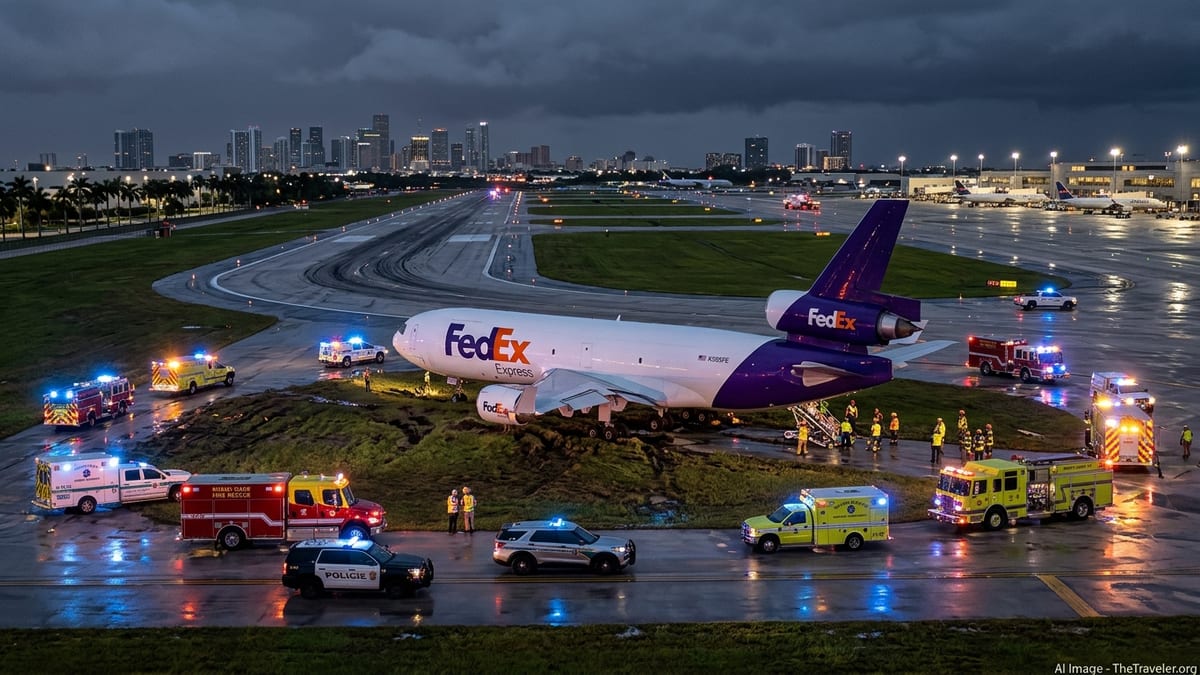
Miami International Airport officials said the incident occurred at approximately 8:40 p.m. Eastern on Wednesday, November 25, when a FedEx aircraft overran Runway 26R after landing. The widebody freighter, a McDonnell Douglas MD-11 operating as FedEx Flight 910 from Frederick W. Smith International Airport in Memphis, came to rest beyond the paved surface of the runway.
Photographs and video from the scene published by local and national outlets show the aircraft on soft ground off the end of the runway with emergency vehicles surrounding it and its landing gear visibly sunk into the grass. Authorities reported no fire and no fuel spill, and there were no injuries among the small cargo crew or on the ground.
The Federal Aviation Administration confirmed that the crew had landed normally before the aircraft exited the runway. The FAA described the event as a runway overrun and said it has opened an investigation, a standard step after this type of incident involving a large transport-category aircraft.
Runway closures, FAA ground stop and impact on holiday travel
The disabled freighter forced Miami International Airport to close all but one runway for a period on Wednesday night while emergency services secured the area and inspectors assessed both the aircraft and airfield surfaces. The FAA issued a ground stop for flights destined for Miami, meaning many departing flights from other airports were temporarily held at their origin rather than allowed to continue toward the congested airspace over South Florida.
FAA advisories and airport statements show that the ground stop began shortly after the incident and lasted until about 9:45 p.m., when limited arrivals began to resume using an alternate runway. While the formal ground stop was relatively brief, the loss of runway capacity at a major hub on the eve of Thanksgiving led to knock-on delays that extended into the late evening and into Thursday for some airlines.
By Thursday morning, November 26, data from the FAA and flight-tracking services indicated that departures and arrivals at Miami had largely resumed, although crews were still working around the closed section of Runway 26R where the FedEx jet remained. Some flights continued to show extended taxi times and minor delays as air traffic control adjusted to the reduced runway availability.
Official responses, safety investigations and weather context
FedEx confirmed the event in a brief statement, describing it as an issue upon landing involving Flight 910 from Memphis to Miami and emphasizing that its crew members were safe. The company said it was cooperating with authorities and would work to recover the aircraft once given clearance by investigators and airport officials. No further details on the aircraft’s condition or any potential repair plans had been released at the time of writing.
The FAA said its investigators would document the runway excursion, examine the aircraft and review air traffic control recordings, maintenance records and crew reports. In the United States, the National Transportation Safety Board typically takes the lead on major accidents that result in serious damage, injuries or fatalities; early indications from federal statements suggest that, for now, the incident is being treated as a serious runway overrun without casualties, and the exact scope of any NTSB involvement has not yet been publicly detailed.
The incident occurred during a period of rain and thunderstorms over parts of South Florida, which local meteorological reports linked to brief reduced visibility and wet runway conditions around the time of landing. Authorities have not attributed the overrun to weather, and no official cause has been identified. Investigators will consider meteorological data alongside aircraft performance information, braking action reports and cockpit crew statements as they work to determine the sequence of events.
Miami’s recent cargo runway overruns and implications for travelers
The FedEx overrun comes less than three months after a separate runway excursion at Miami International Airport involving an Amazon-contracted 21 Air Boeing 767 cargo aircraft. In that earlier September accident, the arriving freighter overran a different runway and struck vehicles outside the airport perimeter, causing fatalities on the ground and drawing intense scrutiny to runway operations at the busy cargo and passenger hub.
While the two incidents involved different aircraft types, operators and runways, they both highlight the operational complexity at Miami, which combines heavy passenger traffic with one of the busiest air cargo operations in the country. Safety authorities have not drawn any connection between the events, but the FedEx overrun is likely to prompt renewed attention to landing performance, braking conditions in wet weather and runway safety areas at the airport.
For passengers, the more immediate impact is operational rather than safety-related. The FedEx aircraft was operating a freight sector with no commercial passengers on board, and regulators quickly confirmed that there were no injuries. However, the resulting runway closure and ground stop affected passenger airlines using the same airfield, creating missed connections, late-night diversions for some inbound flights and extended waits at gates and on taxiways during one of the busiest travel periods of the year.
What travelers using Miami should know over the coming days
Miami International Airport has advised travelers to monitor their flight status closely with airlines over the Thanksgiving period while recovery work continues on Runway 26R. Even as most operations return to normal, the presence of a large disabled aircraft on the airfield can complicate taxi routing and require additional spacing between movements, particularly during peak hours.
Passengers with same-day or next-day connections through Miami should pay particular attention to minimum connection times, as even modest departure delays from other cities can translate into tight transfers when an airport is operating near capacity. Airlines are continuing to adjust schedules and aircraft assignments in response to Wednesday night’s disruption, and some carriers may use larger aircraft or combine services to help clear any residual backlog of passengers.
Travelers with flexible plans who experience significant delays or missed connections should consult their airline’s current rebooking and accommodation policies, which tend to vary by carrier and by whether the delay is considered within the airline’s control. Because the FedEx incident involved an external disruption on the airfield rather than a problem with a specific passenger airline’s own operations, compensation or hotel coverage is not guaranteed and will depend on the individual carrier’s rules and any applicable local regulations.
Authorities have not provided a firm timeline for removing the FedEx MD-11 from its position off the end of Runway 26R, a process that will require specialized recovery equipment and coordination between the airline, airport, insurers and investigators. Until that work is complete and the runway is inspected and declared fit for service, travelers using Miami International Airport should continue to build extra time into their journeys, especially during peak holiday periods and in the event of any additional adverse weather.