


More news on this day
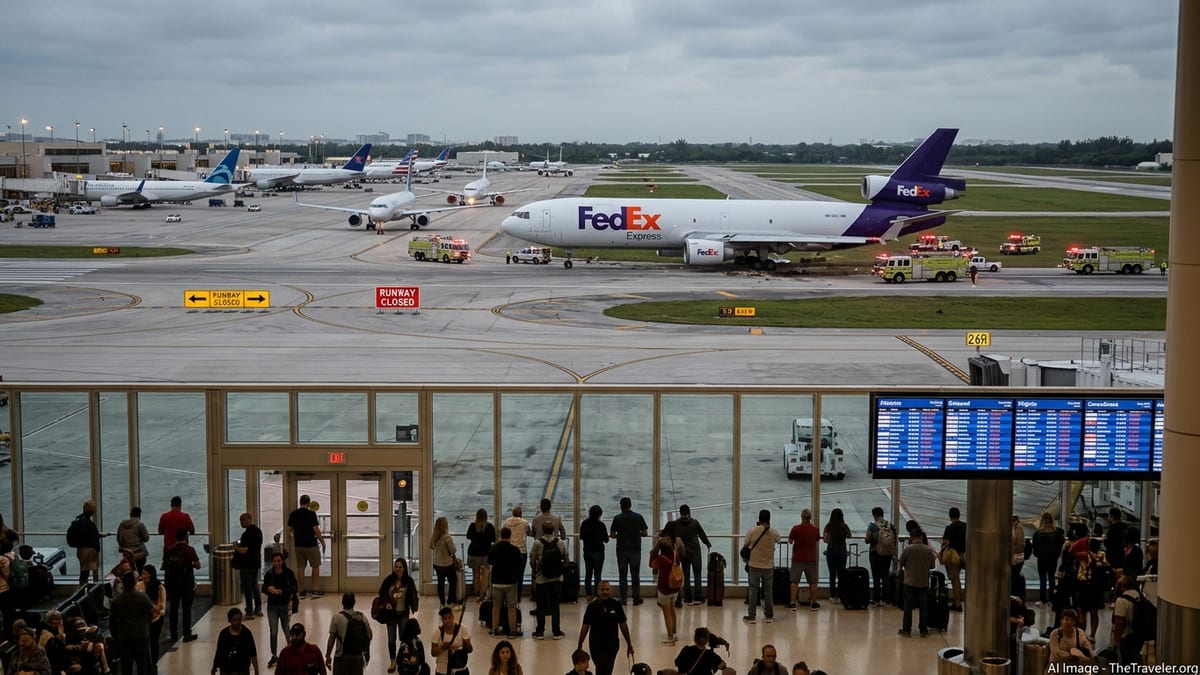
A FedEx Express MD-11 cargo jet arriving from Memphis overran a runway at Miami International Airport on the evening of November 25, 2026, temporarily closing all but one runway and triggering a ground stop for Miami-bound flights on the eve of the busy U.S. Thanksgiving holiday travel period, according to airport and federal aviation officials.
Get the latest news straight to your inbox!
What happened in Miami and the current status
According to Miami-Dade authorities and the Federal Aviation Administration (FAA), the FedEx aircraft, operating as a cargo flight from Memphis to Miami, landed at Miami International Airport on Wednesday night and went past the end of Runway 26R, coming to rest in a grassy area near the airport perimeter. Early reports from county officials and local law enforcement state that there were no injuries among the flight crew and no fires or hazardous cargo leaks were reported at the scene. Photographs and video from the airport perimeter show the MD-11 sitting off the paved surface with emergency vehicles surrounding the aircraft, but with the fuselage largely intact.
The runway excursion occurred at the height of evening operations, prompting Miami International to temporarily close all but one of its four runways while fire and rescue crews secured the site and inspectors assessed possible damage to airfield infrastructure. The FAA issued a ground stop for flights bound for Miami shortly after the incident, directing aircraft already in the air to hold or consider diversions until controllers could safely manage traffic on the remaining available runway. By the morning of November 26, the FAA reported that flights had resumed and Miami was again using more than one runway, although the runway where the FedEx aircraft came to rest remains closed for investigation and recovery work.
For travelers, this meant a period of halted arrivals into Miami and constrained departures on Wednesday night, followed by residual delays and schedule disruptions into Thanksgiving Day as airlines repositioned aircraft and crews. Data from airport trackers on Thursday showed a mix of delays and scattered cancellations across domestic and international airlines serving Miami, consistent with the knock-on effects of a multi-hour runway closure during peak evening operations.
Impact on Thanksgiving travel in South Florida
The incident came just as U.S. Thanksgiving travel was ramping up, with the FAA projecting one of the busiest holiday periods in more than a decade across the national airspace system. Miami is a major gateway for domestic flights from the Northeast and Midwest as well as international services to Latin America and the Caribbean, and the timing of the runway excursion amplified its impact on passengers. With a ground stop in place, inbound flights to Miami were held at their origin airports or rerouted to nearby hubs such as Fort Lauderdale, Orlando or Tampa, while some aircraft already en route entered holding patterns until air traffic control could sequence them for the single open runway.
Although the disabled FedEx aircraft is a freighter rather than a passenger jet, the resulting airfield restrictions had direct consequences for holiday travelers. Airlines operating from Miami reported delays to evening and late-night departures as departures were metered to match the reduced runway capacity and as crews waited for updated slot times from air traffic control. Early-morning departures on November 26 were also affected as aircraft and crew rotations did not line up with their planned schedules, a typical pattern after a major operational disruption at a hub airport.
For travelers with connections through Miami, the disruption was felt most acutely on itineraries with tight transfer times or on routes with limited daily frequencies, such as long-haul flights to South America and Europe. Some passengers reported being rebooked via other hubs in the southeastern United States as airlines worked overnight to reroute travelers around the constrained Miami operation. By late morning on Thanksgiving Day, however, airport and FAA updates indicated that operations were stabilizing, with the majority of scheduled flights operating, albeit with lingering delays and some aircraft substitutions.
Safety record, recent Miami overrun and ongoing investigation
The Wednesday night incident is Miami International Airport’s second cargo runway overrun in less than three months. On September 6, 2026, a Boeing 767 freighter operating for Amazon’s Prime Air overran a different runway at Miami, crossed a service road and struck vehicles outside the airfield perimeter, resulting in fatalities and prompting a detailed investigation by the National Transportation Safety Board (NTSB). That earlier accident involved passenger vehicles and significant damage to the aircraft and surrounding infrastructure, and the NTSB continues to review flight data, cockpit recordings and airport procedures in that case.
By contrast, early information from local authorities following the FedEx event indicates that the MD-11 remained on airport property and did not hit buildings or roadway traffic, and there were no serious injuries reported. Nevertheless, the FAA has confirmed that it opened an investigation, and the NTSB is expected to take the lead in determining the sequence of events that led to the runway excursion. Investigators typically review weather conditions at the time of landing, runway surface status, aircraft weight and configuration, braking action reports, and crew decision-making, as well as any potential mechanical issues that could have affected stopping performance.
While the causes of Wednesday’s overrun are not yet known, the similarity in location and runway direction to the September cargo overrun means regulators are likely to scrutinize whether there are any common contributing factors at Miami, such as runway length, approach procedures, or runway-end safety areas on specific runways used heavily by widebody freighters. However, it is too early to draw conclusions, and officials have not suggested a systemic problem at the airport. Both the FAA and the airport operator have emphasized that a full investigation will be required before any safety recommendations or changes to procedures are made.
Effects on cargo flows and FedEx operations
The aircraft involved belongs to FedEx Express, one of the largest cargo operators at Miami International, which is itself a major hub for freight traffic between North America and Latin America. While Thanksgiving Day is not a dominant peak day for cargo in the same way it is for passenger travel, the incident underscores the role freight operations play in overall airport capacity and the interconnectedness of cargo and passenger traffic at major hubs. A disabled freighter occupying the end of a runway can constrain movements for all types of flights until recovery operations are completed.
FedEx has not yet released detailed information on the condition of the aircraft beyond cooperating with local authorities and federal investigators. Images from the scene show the MD-11 resting upright on its landing gear in grass beyond the runway, suggesting that the airframe did not suffer the kind of catastrophic structural damage seen in some past runway overruns. Nonetheless, the airline will need to inspect the aircraft thoroughly to determine whether it can be repaired and returned to service or whether it will be written off, a decision that typically comes later in the investigative process.
In the short term, FedEx can reroute cargo through its other flights serving Miami or nearby airports, but shippers relying on time-sensitive overnight deliveries into South Florida may experience some delays or routing changes. Given the time of year, when parcel networks are already under strain from holiday shopping volumes, any disruption to a major cargo route can have noticeable effects on supply chains, although in this case the impact appears localized compared with widespread weather disruptions or labor issues. Customers tracking high-priority shipments into the Miami area in the next few days may wish to monitor carrier notifications for any updated delivery estimates linked to altered flight routings or ground handling schedules.
What travelers should know and how to plan around disruptions
With holiday travel already intense across the United States, passengers heading to or through Miami International in the days immediately following the FedEx runway excursion should be prepared for possible residual delays, gate changes and congested terminals as airlines work through repositioning aircraft and crews. Even with multiple runways now back in service, the closure of the affected runway for investigation and recovery means the airport is operating with slightly reduced flexibility, which can amplify the impact of any additional minor disruptions such as isolated thunderstorms or brief ground stops elsewhere in the system.
Travelers who are still to fly during the Thanksgiving period should check their flight status frequently on airline apps or websites, pay close attention to departure terminal and gate information, and allow extra time at the airport in case of longer security or check-in lines. Those with tight connections in Miami, especially on international routes to or from Latin America and Europe, may want to review options to move to earlier flights or build in longer connection buffers if their carrier offers complimentary rebooking because of the disruption. Given that the incident involved a cargo aircraft rather than a passenger jet, most airlines are continuing to operate their full Miami schedules, but recovery from a multi-hour runway closure can take a full operating day or more.
Looking ahead, the disabled FedEx aircraft will need to be moved from its current position off the end of Runway 26R before that runway can reopen, a process that can range from hours to several days depending on the complexity of the recovery effort and the need to preserve evidence for investigators. Airport officials have not yet given a firm timeline for reopening the runway, instead indicating that safety and the integrity of the investigation take priority. Travelers using Miami later in the holiday weekend and into early next week should continue to verify their flight status and remain alert to any advisories from airlines or the airport, particularly if additional weather or air traffic constraints coincide with the ongoing runway closure.