


More news on this day
Low-cost long-haul airline Norse Atlantic has suspended all flights on 26 November 2026 and warned it will file for bankruptcy if it cannot secure urgent new funding, leaving transatlantic travelers and charter partners scrambling for alternatives.
Get the latest news straight to your inbox!
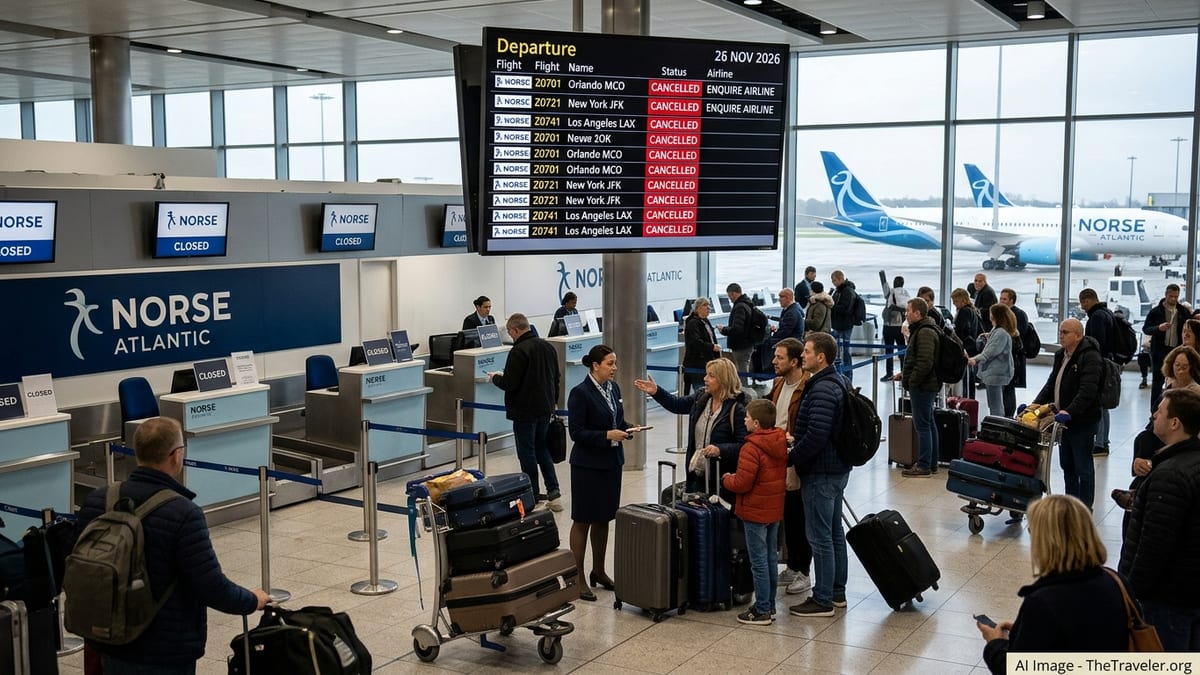
Flights halted worldwide as funding talks intensify
Norse Atlantic announced the suspension of all services scheduled for Thursday 26 November 2026 while it seeks what it calls a “viable financing solution” to keep operating. The move follows a stock exchange filing in Oslo on 25 November in which the airline said its financial position had become critical and that continued operations depended on securing short term liquidity.
The airline has stopped ticket sales and grounded its fleet of Boeing 787-9 aircraft after a wave of cancellations overnight into Thursday. Several flights between London Gatwick and Orlando, Oslo and New York, and other core transatlantic routes were marked as cancelled or “enquire airline” on airport departure boards as the situation unfolded. Norse said flights would remain suspended until it was clear whether fresh capital could be raised, but it has not provided a timetable for a decision.
As of the morning of 26 November, the carrier has not formally filed for bankruptcy or insolvency protection in Norway or other jurisdictions, but board statements and investor briefings indicate that a filing is the likely next step if funding talks fail. The company has been running a strategic review since July 2026, including a potential sale or merger, but no definitive agreement has been announced.
Impact on passengers, partners and key routes
The sudden suspension is disrupting travel plans on both sides of the Atlantic at the start of the busy U.S. Thanksgiving and early European Christmas travel period. Passengers booked on Norse flights departing on 26 November are being informed that their services are cancelled, in many cases with little notice at the airport, and are being advised to seek alternative arrangements with other airlines or via their travel agents.
Because Norse is a Norwegian carrier operating many flights from the European Union and United Kingdom, most itineraries fall under EU261 and UK261 passenger rights rules. In normal circumstances these require airlines to offer rebooking on comparable transport or a refund when a flight is cancelled. However, if the company enters formal insolvency and ceases trading, passengers with upcoming bookings are likely to become unsecured creditors and may have to rely on credit card chargebacks, travel insurance or package travel protections rather than immediate rerouting by Norse itself.
The suspension also affects Norse’s growing charter and wet-lease business. Pakistan International Airlines (PIA), which recently began using Norse Boeing 787-9s on routes from London Heathrow and Manchester to Pakistan, has reported that it was forced to cancel at least two departures on 25 November after receiving short-notice notification that Norse would not operate the flights. PIA has since said it will revert to using its own aircraft on UK routes while monitoring Norse’s situation.
How Norse grew and why its finances deteriorated
Norse Atlantic was established in 2021 and launched its first commercial flight in June 2022, stepping into much of the long-haul low-cost market previously served by Norwegian Air Shuttle before that airline retreated from intercontinental routes during the pandemic. Norse focused initially on budget transatlantic flights from Oslo, London Gatwick, Berlin and Paris to destinations such as New York, Fort Lauderdale, Orlando and Los Angeles, using a fleet of used Boeing 787-9 aircraft acquired on relatively low lease rates.
The model attracted price-sensitive leisure travelers and some visiting-friends-and-relatives traffic, but yields remained thin and the airline struggled to consistently fill aircraft outside the peak summer season. In its published 2024 annual report, Norse disclosed that it remained loss-making, with fuel and lease costs comprising a large share of expenses. The company also confirmed that it did not use fuel hedging, leaving it directly exposed to swings in global jet fuel prices.
Rising fuel costs in 2025 and 2026, driven in part by geopolitical tensions and disruptions to oil supply, put further pressure on the business. While many larger European network carriers and some low-cost rivals hedge a portion of their fuel needs months in advance to smooth out price spikes, Norse continued to buy fuel on the spot market. Company filings show that management regarded fuel price risk primarily as an operational rather than financial risk and chose not to enter into complex hedging contracts. As jet fuel prices climbed sharply in mid 2026, Norse’s unit costs rose faster than its ability to raise fares.
Cost-cutting, leadership changes and search for a buyer
Signs of strain became clearer through 2026. In July, Norse publicly launched a strategic review that included the possibility of a full or partial sale, merger or new equity injection. At the same time it introduced an internal cost-reduction program known as Project Falcon, targeting around 50 million dollars in annual savings. Measures included route rationalisation, reductions in administrative headcount and renegotiation of supplier contracts.
As part of these efforts, Norse relocated its corporate headquarters from Norway to Latvia to lower overheads and reduce staffing costs. The airline also announced that its founder and original chief executive, Bjørn Tore Larsen, would step aside, with a new leadership team taking over day-to-day management while he remained a significant shareholder. Despite these moves, the company continued to report losses and to warn in financial statements that there was material uncertainty about its ability to continue as a going concern without fresh capital.
The airline increasingly leaned on charter and wet-lease activity to utilise its Dreamliner fleet outside the core leisure season. In early 2025 it agreed to lease several 787-9s to IndiGo to support that airline’s expansion into longer-haul routes to Europe, and in 2026 it secured an aircraft, crew, maintenance and insurance (ACMI) deal with PIA. These contracts provided additional revenue and helped offset seasonal swings in transatlantic demand, but they did not fully resolve the underlying balance sheet pressures.
What Norse’s troubles mean for the low-cost long-haul model
Norse’s suspension is the latest blow to the low-cost long-haul segment, a niche that has repeatedly attracted new entrants but has proven difficult to sustain. Airlines such as Zoom Airlines, Primera Air and Wow Air all attempted variations of the budget transatlantic model over the past two decades before collapsing, often citing a combination of fuel volatility, intense fare competition and limited ability to stimulate sufficient year-round demand.
Like its predecessors, Norse pursued a strategy of offering basic point-to-point fares significantly below those of full-service carriers, charging extra for checked bags, seat selection and onboard services. While this attracted strong summer traffic between northern Europe and tourist destinations in the United States, the airline had to contend with powerful incumbents such as British Airways, Virgin Atlantic, Lufthansa Group and the major U.S. airlines, which could redeploy capacity and discount selectively on competitive routes while relying on higher-yield connecting traffic and corporate contracts elsewhere in their networks.
Industry analysts have long argued that long-haul low-cost carriers are particularly vulnerable when fuel prices spike or when macroeconomic conditions weaken, because their margins are thin and they lack the financial buffers of larger groups. Norse’s own statements emphasise that it entered 2026 with limited cash, a high proportion of fixed-dollar costs and no fuel or currency hedging. When jet fuel prices approximately doubled at points in 2026 compared with pre-crisis levels, the airline’s cost base rose sharply while it remained constrained by forward bookings and consumer price sensitivity.
What affected travelers should do now
For passengers with Norse tickets on 26 November or in the coming weeks, the immediate priority is to verify the status of their itinerary directly with the airline, their booking agent or online travel agency. Norse has indicated that all flights scheduled for 26 November are cancelled, and there is currently no published schedule beyond that date. Customers who were due to fly in the next few days should assume disruption is likely and should not travel to the airport without alternative confirmation.
Until a formal insolvency filing occurs, Norse remains bound by EU261 and UK261 rules on compensation and rerouting for cancelled services originating in the European Union or United Kingdom. In practice, however, passengers are reporting difficulty reaching the airline and uncertainty over whether it will be able to provide rebookings on other carriers. Travelers who booked through tour operators or package travel companies may have stronger protection, as those firms are generally responsible for providing alternative transport or refunds if a contracted airline cannot operate.
Customers who bought tickets directly with Norse using a credit card should keep records of booking confirmations, cancellation notices and any communication from the airline. If Norse enters bankruptcy and ceases operations, cardholders may be able to seek a chargeback or similar remedy under their card issuer’s policies, while travellers with comprehensive travel insurance should check whether their policy includes airline insolvency coverage. For now, would-be Norse passengers planning trips later in 2026 or early 2027 are being advised to monitor official announcements closely and to make backup plans on other airlines in case the suspension turns into a permanent shutdown.