


For most Alaska cruise passengers, Vancouver begins not on the waterfront but under the white sails of the airport terminal at Vancouver International Airport. From there, the challenge is simple but important: get yourself and your luggage smoothly to Canada Place, the city’s downtown cruise terminal. With the Canada Line rapid transit, regulated taxis, rideshares, and private transfers all in the mix, the best route depends on your budget, mobility, and how much luggage you are wrangling. This guide walks you through every realistic option and the embarkation details that matter on cruise day.
Get the latest updates straight to your inbox!
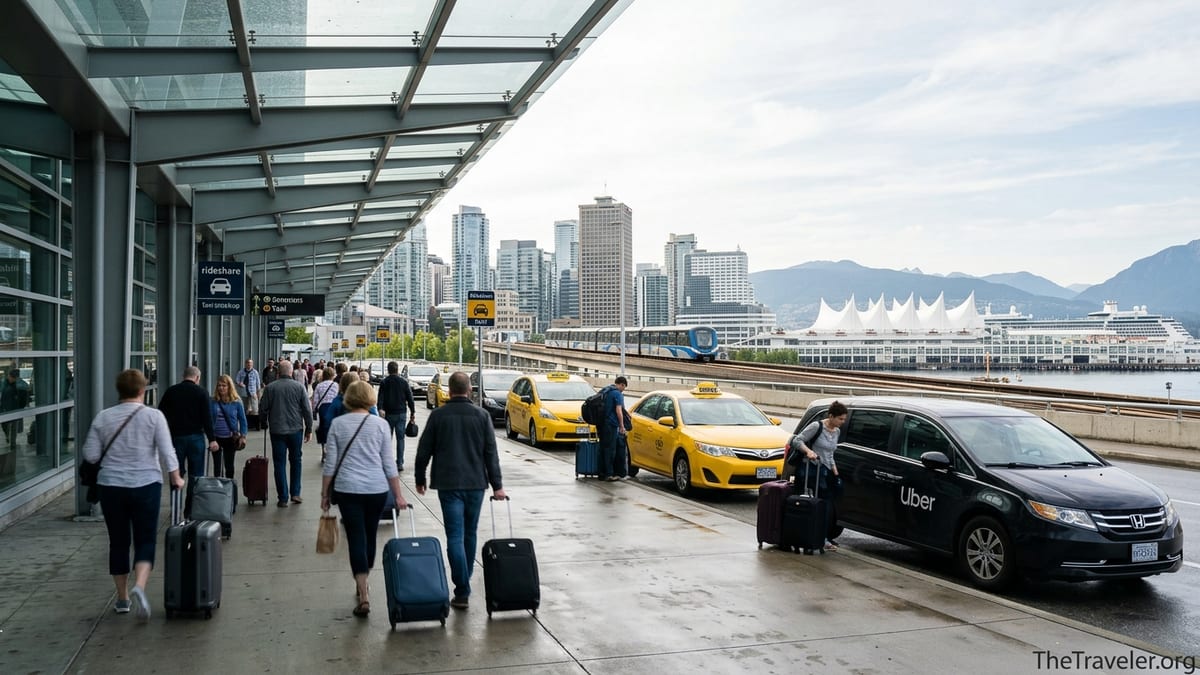
Key Overview: YVR to Canada Place in Real Life
Vancouver International Airport (YVR) sits on Sea Island, roughly 12 miles from Canada Place in downtown Vancouver. In normal traffic, a taxi or Uber/Lyft ride takes about 25 to 35 minutes. On weekday rush hours and peak summer cruise Saturdays, that can stretch closer to 45 minutes, especially approaching downtown. Public transit via the Canada Line SkyTrain typically takes around 30 minutes from YVR to Waterfront Station, plus a 5 to 10 minute walk to the cruise terminal.
Most Alaska cruises from Vancouver depart from the Canada Place Cruise Terminal between late April and early October. On busy days, there may be two or three large ships in port, which means thousands of passengers arriving from mid-morning through early afternoon. The good news is that the infrastructure between YVR and downtown is built to handle this flow, and you can reliably choose between rapid transit, taxi, rideshare, and private transfer depending on your comfort level and budget.
In practice, independent travelers commonly choose the Canada Line if they have wheeled suitcases and can handle a short walk at the end, while families with multiple checked bags or travelers with mobility issues often find a taxi or rideshare is worth the extra cost. Cruise line motorcoach transfers exist but are usually more expensive on a per-person basis unless bundled into an air–sea package.
To make the right choice, you need to understand exactly how each option works on the ground: where to go inside YVR, where you will be dropped in relation to the Canada Place check in area, and how timing, luggage and crowds interact on a real embarkation morning.
Canada Line SkyTrain: Fastest and Most Budget Friendly
The Canada Line is Vancouver’s driverless rapid transit line that connects YVR with downtown Vancouver via Richmond and the south side of the city. From YVR Airport Station to Waterfront Station, trains typically take about 25 to 26 minutes, running every few minutes for most of the day. Trains operate from early morning into late night, which comfortably covers most cruise embarkation and disembarkation schedules.
Inside YVR, follow the clearly marked “Canada Line” signs from either the Domestic or International Arrivals areas. The station is located between the two main terminals and is fully accessible with elevators, escalators, and level boarding. You can tap in at the fare gates with a contactless credit or debit card, mobile wallet, or a local Compass Card. An additional airport surcharge applies when you are leaving Sea Island toward downtown, so expect the adult fare from YVR to Waterfront to be in the rough range of around 10 dollars, depending on the exact mix of base fare and add-on at the time you travel.
Board any train marked “Waterfront.” Luggage space is limited to open floor areas near the doors, so compact wheeled suitcases, backpacks, and duffel bags are ideal. Travelers with large cruise cases often stand near the jointed sections between cars, where there is more floor space. You will pass through stations such as Bridgeport and Vancouver City Centre before reaching Waterfront, the last stop. Announcements and overhead displays clearly identify each station.
At Waterfront Station, you exit the fare gates into a historic terminal building. From there, it is roughly a 5 to 10 minute walk to Canada Place depending on your pace and how many bags you are handling. Most passengers follow the flow: exit toward the main hall, follow signs toward “Canada Place” or “Cruise Ship Terminal,” then cross Cordova Street and walk north toward the white sails on the waterfront. The route is mostly flat, with some mild slopes and curb ramps. Many travelers handle two wheeled suitcases plus a carry-on without difficulty, but if you have mobility issues, consider a taxi for the last leg.
Taxi from YVR to Canada Place: Simple, Door to Door
For many cruise passengers, especially those traveling in pairs or small groups with multiple bags, a traditional taxi from YVR to Canada Place hits the sweet spot between convenience and cost. Vancouver uses a regulated fare system for airport taxis going to downtown and to the cruise terminal. Recent provincial rate tables list a flat fare in the low-40-dollar range from Canada Place back to YVR on cruise days, and the reverse journey from the airport to downtown hotels or the terminal typically falls in a similar band once current flat-rate zones and fuel surcharges are applied.
On arrival, clear immigration and customs, collect your luggage, and follow the “Taxis” signs out to the designated taxi ranks outside each terminal. Airport staff usually marshal passengers into orderly lines and direct you to the next available cab. You do not need to pre-book, although very early morning arrivals or overnight flights will see fewer cars; in peak Alaska cruise season from late morning through early afternoon, there is usually a constant flow of taxis.
With a typical two-person party carrying two large checked bags and two carry-ons, the cost difference between taxi and Canada Line quickly narrows. For example, two adults and one teenager might pay the equivalent of around 30 dollars total to ride the Canada Line from YVR to Waterfront when you factor in the airport surcharge for each person, compared with perhaps 45 to 55 dollars total for a taxi that drops you directly in the cruise-ship drop-off lane underneath Canada Place. If you are four adults or a family group, the per-person cost of a taxi can undercut transit while saving you from managing luggage on and off trains.
One practical tip: on busy Saturdays with multiple ships in port, ask the driver specifically to take you to the “Canada Place cruise ship terminal drop-off ramp,” not just “Canada Place.” That ensures they use the correct vehicular ramp that curves under the building toward the terminal-level baggage drop, rather than stopping at the street-level hotel entrance. From the taxi drop-off area, porters and cruise line staff are on hand to take your large checked bags, after which you proceed inside for check in and U.S. preclearance.
Uber and Lyft: App Based Flexibility from the Airport
Rideshare services such as Uber and Lyft are fully authorized to operate at Vancouver International Airport. Pickups are restricted to marked ride app zones, so you will need to follow the “Ride App” or “Rideshare” signage from Arrivals. These zones are separate from regular taxi stands and are designed to keep traffic flowing; the Uber or Lyft app will update your pickup location automatically to match one of these approved areas.
Pricing for UberX, Lyft and comparable entry level services is dynamic and depends on demand, time of day, and traffic. At quiet times, solo travelers sometimes report rides as low as the mid-30-dollar range to downtown, but in peak summer cruise and convention weeks, prices can easily exceed taxi flat fares, particularly if surge pricing kicks in. Premium options such as Uber Comfort or larger vehicles suitable for four to five passengers with luggage will cost more, but can still be attractive when shared among a group.
One distinct advantage of rideshare is app based transparency. You will see an estimated fare before you confirm, helpful on days when traffic around downtown is heavy. The app also stores your destination; simply type “Canada Place Cruise Terminal” as the drop-off, and most drivers, who regularly handle cruise traffic between April and October, will know exactly where to go. If you are concerned about heavy luggage, message the driver through the app to confirm space in the trunk and whether roof boxes or folded third-row seats are available.
For early morning airport arrivals that land well before your check in time at Canada Place, rideshare can also be used to go first to a downtown hotel, luggage storage facility, or café near Waterfront Station, then walk or take a short taxi hop to the terminal later. Because rideshare is on demand, this approach can be more flexible than a pre-booked shuttle if your flight is delayed or you need to wait for checked bags.
Private Transfers and Cruise Line Shuttles
Travelers who prefer a completely arranged, low stress transfer can pre-book private vehicles, shared shuttles, or cruise line motorcoaches from Vancouver International Airport to Canada Place. Several local operators run sedan, SUV, and van transfers that include meet-and-greet service inside the terminal. These services typically cost significantly more than a standard taxi, but they can make sense for larger family groups, passengers with limited mobility, or guests carrying oversized luggage such as medical equipment or sporting gear.
Cruise lines themselves often sell airport-to-pier transfers as an add-on, especially when you book air travel through the cruise line. Pricing is usually per person and can be higher than a taxi for couples, but sometimes competitive for solo travelers who like the reassurance of being on a ship-organized transfer. Another advantage is that if your cruise-line-booked flight is delayed, the line is generally responsible for getting you to the ship, which may include holding the vessel within reason or transporting you to the next port if necessary.
Shared shuttle services between YVR and downtown typically run on fixed schedules and may stop at several downtown hotels before reaching Canada Place. On embarkation day, this can add 20 to 30 minutes of travel time compared with a point-to-point taxi. That said, if you are staying downtown for one or two nights before sailing, a hotel-focused shuttle that drops at your front door can be convenient, especially if mobility or unfamiliarity with Vancouver makes public transit feel daunting.
When vetting private transfers, confirm in advance where exactly you will be dropped at Canada Place, whether the quoted price includes all taxes, airport access fees and gratuities, and how they handle flight delays. For very early cruise departures or for travelers catching the first morning flights home after disembarking, a pre-arranged private car at a guaranteed time can remove a layer of stress compared with relying on taxi or rideshare availability.
Walking from Waterfront Station to Canada Place
Most Canada Line users will finish their journey with a short walk from Waterfront Station to Canada Place. This last segment is straightforward but matters if you have mobility considerations or very heavy luggage. Waterfront Station’s Canada Line platforms sit beneath the main hall; you take escalators or elevators up to the concourse and exit the fare gates. From there, look for signs to “Cordova Street” or “Waterfront / Cruise Ship Terminal.”
Once outside, the simplest route is to exit toward Cordova Street, turn right (heading east), and walk about two short city blocks. You will soon see the distinctive white sails of Canada Place extending into Burrard Inlet. Cross at the pedestrian crossings, then follow the wide sidewalk along the water side of the building. The walk is mostly level and takes about 5 to 10 minutes for the average traveler with wheeled suitcases.
If you prefer to minimize outdoor exposure in wet weather, you can cut through parts of the adjacent office and retail complexes, but routes vary by construction and building hours. In dry weather, staying at street level provides clearer sightlines and fewer stairs. Many travelers with a single rolling suitcase and a backpack report that this walk is quite manageable, even after a long international flight.
Note that the walk brings you to the upper, street-level portion of Canada Place. For embarkation, you will typically need to follow signs down a ramp or inside the building to reach the cruise check in and luggage drop zones. Staff and signage on cruise days are plentiful; if in doubt, ask any uniformed port staff where to go for your specific ship. The exact location of luggage drop can shift between the lower vehicle level and convention center level depending on which ships are in port that day.
Luggage, Storage, and Accessibility Considerations
Luggage is often the deciding factor in which route from YVR to Canada Place makes sense. A solo traveler with a carry-on and backpack will usually find the Canada Line simplest and cheapest. A family of four with four large checked suitcases plus carry-ons may prefer a taxi or UberXL to avoid juggling bags on and off trains and escalators. Remember that on embarkation day you generally drop your big suitcases with porters just outside the Canada Place terminal; only your small hand luggage stays with you through check in and security.
Short term luggage storage is available at Canada Place on cruise days, usually operated in partnership with ground transport companies. This is useful if you disembark in the morning, want to explore downtown, and do not fly out until the evening. There are also independent luggage storage networks downtown that partner with hotels and shops to hold bags for a fee, plus hotel bell desks at properties like the Pan Pacific, Fairmont Waterfront and Fairmont Pacific Rim that can store bags for guests and, in some cases, even deliver luggage to or from the ship as part of concierge services.
From an accessibility standpoint, both the Canada Line and Canada Place are equipped with elevators, ramps, and curb cuts. YVR Airport Station and Waterfront Station both feature step-free access from platform to concourse. Taxis and rideshares can drop you closer to the actual cruise check in level, which may reduce the distance you need to walk or roll, though you should still expect some queuing inside the terminal. If a member of your party uses a wheelchair, mobility scooter, or requires assistance, you can request special assistance through your cruise line, which often includes priority or escorted boarding routes at the terminal.
For those concerned about managing bags in crowds, a practical approach on embarkation day is to travel light from the airport to your hotel using the Canada Line or a standard taxi, then repack and check unneeded items in hotel storage if you are returning post-cruise. This is common among travelers who pair their Alaska cruise with a separate Rockies rail trip or a visit to Vancouver Island and need different clothing and gear at different trip stages.
Timing Strategies for Alaska Cruise Embarkation
Alaska cruises from Vancouver usually set sail in the late afternoon or early evening. Check in windows assigned by cruise lines are often staggered from late morning to mid-afternoon, but real world experience shows that lines can build up in waves as large coachloads from tour operators and cruise-air packages arrive simultaneously. To protect against flight delays and border formalities at YVR, many seasoned travelers choose to arrive in Vancouver at least one calendar day before embarkation.
If you must fly in on the same day your ship departs, look for flights that are scheduled to land no later than mid-morning. For instance, many cruise lines and travel advisors recommend arrivals by about 10:00 a.m. for a ship with a nominal departure time around 4:30 p.m. or 5:00 p.m. This allows roughly two to three hours for immigration, baggage claim, ground transfer, and potential queues at Canada Place before final boarding cut off, which is typically 60 to 90 minutes before sailing time.
When planning your transfer choice, factor in seasonal traffic. On a Monday in May with a single mid-size ship in port, the Canada Line may be the fastest and most predictable option, immune to surface traffic jams. On a Saturday in July with three megaships and a major downtown event, a taxi or Uber may take longer in traffic, but still spares you from navigating a crowded train with luggage. Some travelers split the difference by taking the Canada Line to a downtown hotel early in the morning, relaxing for a few hours, then taking a short cab ride to Canada Place closer to their assigned check in time.
On disembarkation day, ships typically begin clearing passengers in stages from around 7:00 or 8:00 a.m. Many people with early flights grab a taxi or Uber directly from the curb outside the terminal back to YVR; others ride the short distance to Waterfront Station and use the Canada Line instead. A realistic door to door time from ship to airport check in, including customs and transport, can range from 60 to 90 minutes for well organized travelers without mobility constraints, so booking mid-morning or lunchtime flights home is often safer than aiming for the earliest departures.
What to Expect Inside Canada Place on Cruise Day
Canada Place functions as both a convention center and a cruise terminal, so the exact flow on embarkation day can vary slightly from one sailing to another. However, the general sequence is fairly consistent: curbside luggage drop with porters, security screening, cruise line check in, U.S. Customs and Border Protection preclearance for Alaska-bound itineraries, and then boarding via gangway.
After your taxi, rideshare, or shuttle drops you in the signed “Cruise Ship Terminal” area, porters will be ready with large baggage carts. Attach the luggage tags provided by your cruise line before arriving; porters load your checked bags, which will later appear outside your cabin. Tipping porters a few Canadian dollars per bag is customary but technically at your discretion. Once you are free of large suitcases, keep passports, medications, valuables, and any required documents in a small day bag you keep with you.
Next, you enter the terminal and follow signage for your specific cruise line and ship. During peak hours, you may see long but steadily moving lines snaking through convention halls or roped areas. Staff direct passengers to the correct queues for check in, security, and customs. Because most Alaska cruises from Vancouver involve a U.S. destination as the first foreign port of call, you complete U.S. customs and immigration formalities at Canada Place before boarding. This is similar to airport preclearance and means you arrive at your first U.S. port as a domestic arrival.
Once all formalities are complete, you will proceed along escalators, ramps, and passageways toward the actual gangway, which can involve some walking. For guests with mobility issues, wheelchairs and assistance can usually be requested through the cruise line in advance. After tapping your keycard or wearable credential at the gangway, you are officially on board, and your Vancouver transfer worries are behind you.
The Takeaway
Getting from Vancouver International Airport to the Canada Place cruise terminal is not complicated, but the best solution varies with your priorities. The Canada Line SkyTrain offers a fast and economical connection directly from YVR to Waterfront Station, especially attractive for solo travelers and couples with light luggage. Traditional taxis and rideshares like Uber and Lyft cost more but provide door to door ease, which becomes increasingly worthwhile as your party size and suitcase count grows, or if mobility is a concern.
Private transfers and cruise line shuttles add a further layer of convenience and predictability, though at a premium price. Many travelers choose them when flights are tightly timed, when traveling with extended family, or when they simply prefer not to think about logistics after a long international flight. Regardless of mode, build generous buffers into your schedule, particularly for same day arrivals on peak season weekends.
Inside Canada Place, expect a well practiced but sometimes crowded embarkation process involving porters, security, cruise line check in, and U.S. preclearance. With realistic expectations about timing, a bit of homework on transit options, and a flexible attitude, your transfer from airport runway to cruise gangway can be a smooth prologue to the glaciers, fjords, and frontier ports that await on your Alaska voyage.
FAQ
Q1. How long does it take to get from Vancouver Airport to Canada Place on embarkation day?
In typical conditions, plan around 30 minutes on the Canada Line from YVR to Waterfront Station plus a 5 to 10 minute walk, or 25 to 45 minutes by taxi, Uber or Lyft depending on traffic.
Q2. Is the Canada Line safe and practical with cruise luggage?
Yes, the Canada Line is widely used by cruise passengers. Trains are modern and clean, with level boarding and space for wheeled suitcases, though there are no dedicated luggage racks. It is best suited to travelers with one or two manageable bags each.
Q3. Roughly how much does a taxi from YVR to Canada Place cost?
Fares are regulated and typically fall in the broad range of the low to mid 40 dollars for the trip between the airport and Canada Place or downtown on cruise days, though exact amounts depend on current flat rate zones, fuel surcharges, and taxes.
Q4. Where do Uber and Lyft pick up at Vancouver International Airport?
Rideshares pick up at designated ride app zones outside the terminals. After you order a ride in the app, follow airport signs for “Ride App” or “Rideshare” to reach the correct curb area for your pickup.
Q5. Can I walk from Waterfront Station to the cruise terminal at Canada Place?
Yes. It is an easy 5 to 10 minute walk on mostly level sidewalks from Waterfront Station to Canada Place. Many travelers roll their suitcases along this route without difficulty.
Q6. Is it better to arrive in Vancouver the day before my Alaska cruise?
Whenever possible, yes. Arriving at least one day before reduces stress from flight delays, long border queues, or unexpected congestion between the airport and the cruise terminal.
Q7. What time should my flight land if I fly in on the same day my cruise departs?
As a conservative guideline, aim to land by around 10:00 a.m. for an afternoon sailing, allowing time for immigration, baggage claim, and transit to Canada Place plus embarkation lines.
Q8. Is there luggage storage at or near Canada Place?
Yes. Short term luggage storage is usually available at Canada Place on cruise days, and several independent luggage storage services and downtown hotels also offer paid bag storage for a few hours or a day.
Q9. Are taxis and rideshares easy to find when disembarking after the cruise?
Yes. On cruise mornings, taxis and rideshares queue near the Canada Place exit. You can usually get a cab or order an Uber or Lyft within minutes, though there may be short waits at peak times.
Q10. Do I clear U.S. immigration in Vancouver for an Alaska cruise?
For most Alaska itineraries from Vancouver, you complete U.S. customs and immigration formalities at Canada Place before boarding. This functions similarly to airport preclearance, so you arrive at your first U.S. port as a domestic passenger.