


Landing at Venice Marco Polo Airport before a cruise can feel confusing, especially if you are rolling two suitcases and a carry-on through a city with almost no cars. The good news is that Venice is well set up for cruise passengers, with several reliable routes from the airport to the Marittima and Tronchetto cruise areas. The key is choosing the option that matches your budget, mobility and luggage load.
Get the latest updates straight to your inbox!
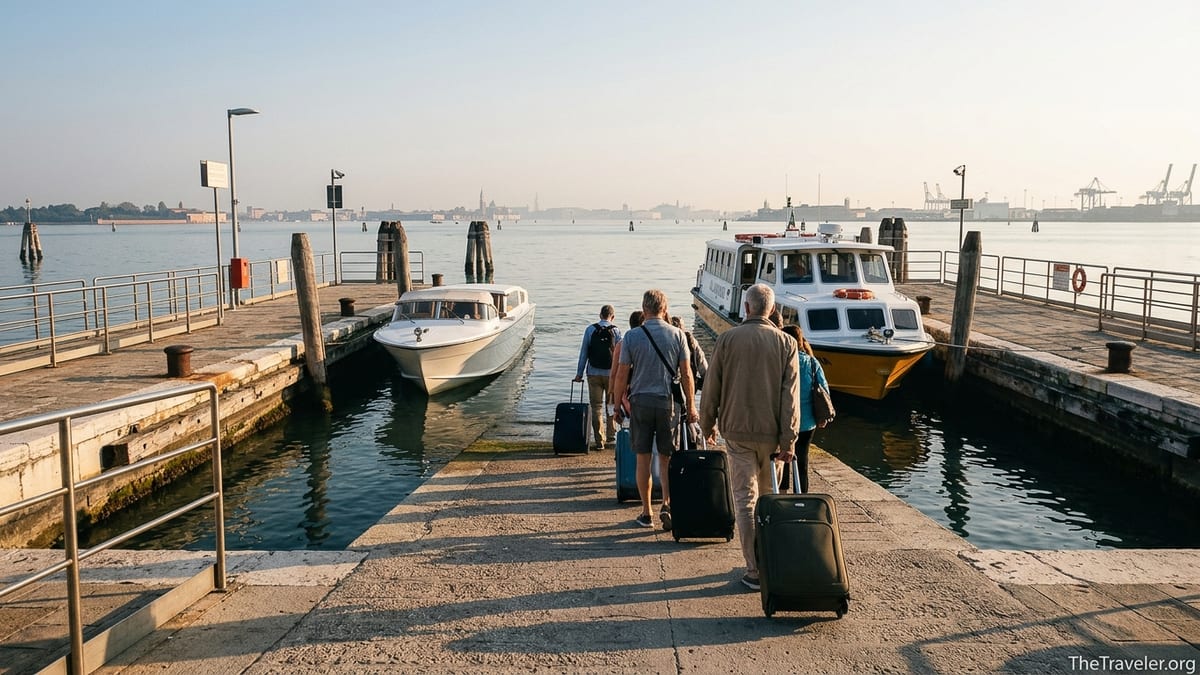
Understanding Venice’s Cruise Terminals and Transport Hubs
Before worrying about buses or boats, it helps to understand where your ship actually docks. Historically, most big cruise ships used the Venice Marittima terminals, a group of piers just beyond the historic center. Smaller ships and river vessels may use San Basilio or Santa Marta, while some itineraries list Tronchetto, an artificial island with large parking facilities and direct links to the People Mover and water transport. Your cruise documents will usually name the exact terminal, such as Venezia Terminal Passeggeri Marittima or Terminal San Basilio.
For planning airport transfers, the two land-accessible hubs that matter most are Piazzale Roma and Tronchetto. Piazzale Roma is the main road and bus gateway into Venice, right at the edge of the historic center. This is where airport buses and road taxis terminate, and where you can connect to vaporetti water buses or a short land taxi ride to Tronchetto. Tronchetto, on the other hand, is primarily a parking and coach area, but it also functions as a useful interchange point for some private shuttles, water taxis and the People Mover shuttle train.
From both Piazzale Roma and Tronchetto you can reach the cruise terminals in a few minutes. A short ride on the People Mover links Piazzale Roma, Marittima and Tronchetto in about three minutes, running on an elevated track. This means that even if your bus or taxi does not go directly inside the port, you are usually only one quick transfer away from your ship. Understanding these nodes helps you choose the right combination of land and water transport for a smooth journey with luggage.
Finally, remember that Venice operates as two worlds: the mainland around the airport and Mestre, where vehicles circulate normally, and the historic lagoon city where travel is almost entirely by boat or on foot. Your routing from Marco Polo Airport to the cruise port will always involve moving from the car-friendly mainland to one of these edge hubs, then making a short connection by shuttle, foot, or water transport into the port area itself.
Fastest Land Options: Airport Buses and Taxis to Piazzale Roma
For many cruise passengers, especially with checked suitcases, the simplest first step is to travel by road from Marco Polo Airport to Piazzale Roma. The airport is about 13 kilometers from central Venice by road, and you have a choice between airport buses and regular taxis. Dedicated airport coaches operated by regional and city companies run frequently throughout the day, taking roughly 20 to 25 minutes depending on traffic. Tickets are typically in the low to mid teens in euros per person, and luggage is included, so a couple might pay a modest total for a comfortable, air-conditioned ride directly to Piazzale Roma.
Standard land taxis are readily available at the official taxi rank outside the arrivals area. Local regulations provide an approximate fixed fare between Marco Polo Airport and Piazzale Roma, around 40 euros for the vehicle, which makes taxis cost effective for small groups or families. A party of four with two large suitcases and a few carry-ons can often fit into one sedan, and the price compares well to buying four separate bus tickets. It is wise to confirm the fare with the driver before departure, and always use the official taxi line rather than accepting unsolicited offers inside the terminal.
Once you arrive at Piazzale Roma, you are already at the threshold of the historic city and only a short hop from the cruise port. If your ship is at Marittima, you can take the People Mover train from the station on the edge of Piazzale Roma directly to the Marittima stop in about three minutes, avoiding any long walks with luggage. If your cruise documents specify Tronchetto, you can either ride the same People Mover in the opposite direction to Tronchetto or take a short taxi or shuttle if your cruise line provides one. This two-step combination of airport bus or taxi followed by the People Mover is one of the most practical and economical solutions for most passengers with standard luggage.
Travelers arriving late at night or very early in the morning should check the operating hours of both airport buses and the People Mover, but in practice these services cover most flight schedules. If your flight lands during a peak season weekend, allow extra time for queues at ticket machines and bus bays, and consider pre-purchasing bus tickets online or from automated kiosks in the arrivals hall to save time.
People Mover and Tronchetto: Crucial Links With the Cruise Terminals
The Venice People Mover is a short but extremely useful piece of infrastructure for cruise passengers. It is an automated shuttle train running on an elevated track that links three points: Tronchetto, the Marittima cruise area and Piazzale Roma. The full journey covers less than one kilometer and takes around three minutes, with trains typically running every few minutes during operating hours. For anyone wheeling suitcases, this is a far easier option than walking along busy roads or trying to navigate pedestrian bridges with heavy bags.
Tickets for the People Mover are inexpensive, roughly the price of a short city bus ride per person. You tap or validate your ticket before entering the platform, much like a metro system. Because travel times are so short, even families or groups with multiple bags can move efficiently between a bus that drops them at Piazzale Roma and their ship berthed at Marittima. Some visitors with light luggage do choose to walk from Piazzale Roma to the cruise port in 15 to 20 minutes, but this route involves crossings and cobbled stretches and is not ideal if you have large wheeled suitcases or mobility issues.
Tronchetto itself is worth understanding, because some cruise lines and private transfer firms use it as a meeting point. The island holds a large multi-story car park, coach parking and berths for water buses and water taxis. If a private driver collects you at the airport and brings you to Tronchetto, you can then board a pre-booked water taxi or a cruise line shuttle to your terminal. The People Mover station at Tronchetto makes it easy to continue to Marittima or Piazzale Roma if needed. This flexibility is particularly valuable when heavy traffic or changes in port allocation mean your ship is not where you expected.
For example, a couple flying into Marco Polo might book a transfer by road to Tronchetto, then meet friends and all board a single water taxi across to San Basilio or a nearby pier just inside the port area. This approach avoids dragging luggage through central Venice, uses the car-friendly side of the city as long as possible, and still lets the group enjoy a scenic arrival by boat. The People Mover remains available as a backup link, should any part of that plan need adjusting on the day.
Water Buses and Water Taxis: Arriving by Boat With Luggage
For many first-time visitors, the idea of sailing from the airport directly into Venice is part of the appeal. Public water buses, run under the Alilaguna brand, operate routes that connect Marco Polo Airport’s dock with various stops around the lagoon, including the cruise terminal area on certain lines in some seasons. One commonly used line is the Blue route, which links the airport to key stops such as Murano, Fondamente Nove, Lido and the San Marco area, then continues along the Giudecca canal toward the railway station and occasionally the port zone. Journey times from the airport to central stops like San Zaccaria near St Mark’s Square are typically around 45 minutes, and to the far end of the route nearer the cruise area can be longer.
Alilaguna boats are designed with tourists in mind, and luggage is generally allowed, though space can feel tight in peak months. Tickets from the airport to central Venice usually cost in the mid-teens range per person, with modest supplements for extra bags. Compared to a private water taxi, this is far more economical for solo travelers or couples. For a family of four with multiple suitcases, however, the cost narrows the gap with a private boat, especially if comfort and speed matter. Timetables and route maps posted at the airport pier help you choose the best line for your destination, and tickets can be bought at desks in the arrivals hall or directly at the quay.
Private water taxis are the most glamorous way to travel from Marco Polo Airport to the cruise port, but also the most expensive. These small motor launches pick you up at the airport dock and deliver you as close as regulations allow to your ship or a nearby pier in the Marittima or San Basilio area. Prices vary by operator, season and time of day, but it is common for a one-way airport to central Venice ride for up to eight passengers to cost well into the three-figure euro range. To put it in context, a recent example listed a dedicated sedan plus water taxi handoff from the airport to Marittima at around 170 US dollars for a small group.
For passengers with significant luggage or limited mobility, the value of a private water taxi is that there are no intermediate transfers. You walk from arrivals to the boat dock, step into your taxi, stow your cases and stay on board until you are essentially at the port. This can be especially attractive after a long overnight flight, or when traveling with older relatives who would find stairs and crowded buses difficult. Just be sure to confirm in advance how many large bags are included in the quoted price, as some operators may charge extra for very bulky luggage or additional suitcases beyond a standard allowance.
Private Car & Mixed Transfers: Door-to-Port Convenience
Some travelers prefer the predictability of a pre-booked private transfer that includes both land and water segments, coordinated by one company. These services typically meet you in the arrivals hall with a sign, drive you in a private car or minivan to Piazzale Roma or Tronchetto, and either connect you directly to a waiting private water taxi or include a short shuttle to the cruise terminal. Prices depend on the group size and level of service, but for a family or a group of friends sharing the cost, the per-person rate can become quite reasonable compared with multiple bus tickets and separate boat fares.
An example common in the market is a combined transfer where a driver meets a group of four at Marco Polo, loads two large suitcases and two carry-ons into a minivan, and drives them to Tronchetto in about 20 minutes. There, a reserved water taxi is waiting to complete the journey along the Giudecca canal to San Basilio, within walking distance of certain smaller cruise ships. By bundling the land and water parts into one booking, the group avoids lining up for separate tickets, worrying about whether the next bus has space for their luggage, or trying to communicate with boat operators during the busy embarkation hours.
Private transfers can also be tailored to special requirements. For instance, if one member of your party uses a folding wheelchair or has difficulty with steep steps, some companies can provide vehicles with extra space and request water taxis with easier boarding arrangements. These services should be discussed and confirmed in writing before you travel, including how many steps or changes in level are involved at each boarding point. While Venice is not the easiest city for those with mobility challenges, a coordinated land and water transfer can significantly reduce strain on the day you embark.
The trade-off is cost and the need for advance planning. During high season Saturdays in late spring and summer, private transfer slots around mid-morning can book up quickly, as dozens of flights arrive within similar time windows for multiple cruise departures. Booking at least a few weeks ahead is prudent, especially if your cruise line does not offer its own shuttle and you are relying entirely on independent arrangements. If your flight arrives very early or late, mention this so the company can adjust departure times to align with the opening hours of the cruise terminal and any luggage drop procedures.
Managing Luggage From Plane to Ship
Venice’s beauty hides a hard truth for cruisers: moving heavy luggage across bridges, cobbles and crowded walkways can be exhausting. Planning your route from Marco Polo Airport with your actual bags in mind is essential. A couple each with a large checked suitcase and a carry-on might find the airport bus plus People Mover combination perfectly manageable, because every segment is on smooth pavement with no stairs. However, that same couple adding a third oversized bag or traveling with a stroller might already be better off with a taxi to Piazzale Roma rather than a packed bus, simply to have more room and less jostling.
Think about the number of times you will have to lift or drag your bags. The most luggage-friendly routings minimize transfers. A private water taxi from the airport to near the port offers one single lift on and off the boat. A combined private car plus boat transfer usually involves two or three moves: into the car, out at Tronchetto or Piazzale Roma, and onto the boat or shuttle. By contrast, a budget route with a public bus, People Mover and perhaps a short walk to your terminal could mean five or six separate lifts and changes of direction. On a cool spring day this might feel achievable, but in July heat or with jet lag it can be far more tiring than expected.
Practical packing can make a big difference. Opt for suitcases with robust, larger wheels that handle uneven surfaces, and avoid very heavy hard-shell cases that are difficult to lift over small steps onto buses and boats. Where possible, shift weight from a single huge bag into two more manageable ones. A foldable luggage trolley can be useful, especially for older travelers, but remember that you must be able to carry it up a couple of steps if boarding a boat or bus. If your cruise line offers porters at the terminal, they usually assist only from the port entrance onwards, not from Piazzale Roma or the airport, so you still need to manage bags for the earlier part of your journey.
Finally, keep key items like passports, cruise documents, medications and valuables in a small backpack or crossbody bag that stays with you at all times, separate from rolling luggage. On a crowded airport coach or Alilaguna boat, your large suitcase might sit in a designated luggage area away from your seat. Having your essentials on your person means you do not need to open big bags mid-journey or worry if staff move them to optimize space.
Typical Routes for Different Types of Cruise Travelers
Because no single option suits everyone, it helps to consider a few concrete route examples tailored to typical cruise passengers. A budget-conscious couple arriving midday with two medium suitcases might choose the airport bus to Piazzale Roma, followed by the People Mover to Marittima. They would buy two bus tickets at the airport, wheel their bags onto the coach for a 20-minute ride, then purchase inexpensive People Mover tickets at Piazzale Roma. Within around 35 to 45 minutes from leaving the terminal, they could be stepping off the People Mover at the cruise area, having avoided expensive taxis and boats.
A multigenerational family group might opt for a pre-booked van and water taxi combo. Imagine six people, including grandparents, with four large suitcases and several smaller bags. Instead of squeezing onto a public bus, they prearrange a minibus to meet them at arrivals and drive directly to Tronchetto, where a private water taxi is waiting. The driver and boat captain help with loading bags, and the group enjoys a scenic but direct 15 to 20 minute ride along the canal to a pier near their ship. The cost is higher than public transport but divided by six, the per-person price can feel acceptable for the comfort and reduced stress.
Solo travelers or couples who want a scenic introduction to Venice without a private taxi might prefer a mixed route using Alilaguna and the People Mover. From Marco Polo Airport, they walk to the dock and board the relevant Alilaguna line, enjoying a 45 minute or longer cruise past Murano and the lagoon islands toward stops like San Zaccaria or the Giudecca area. From there, depending on the precise route and season, they may continue on the same boat closer to the cruise zone or change to a vaporetto line that stops near the port. Once within reach of Piazzale Roma or Tronchetto, they can use the People Mover to complete the last leg to Marittima with minimal walking.
Passengers arriving late at night or with tight same-day flight and cruise connections often place a premium on reliability over scenery. In that case, the simplest robust plan is usually an official airport taxi or fast coach to Piazzale Roma, then the People Mover to the cruise terminal. Road transport from the airport is less dependent on water conditions, and services tend to be well synchronized with typical arrival patterns. If there are significant delays, cruise lines sometimes arrange additional shuttles from Piazzale Roma or Tronchetto to the port, making these hubs a safe default destination when your time margin is small.
The Takeaway
Reaching Venice’s cruise port from Marco Polo Airport is less complicated than it first appears, as long as you think in terms of stages. The first stage is the move by road or water from the airport to a major hub such as Piazzale Roma, Tronchetto or a central lagoon stop. The second stage is a short link, usually via the People Mover, a shuttle, or a brief water taxi ride, into the specific cruise terminal where your ship is berthed. Once you understand these building blocks, you can assemble a route that matches your budget, comfort level and luggage situation.
Travelers with moderate luggage who value cost savings and simplicity often gravitate toward the combination of airport bus or taxi to Piazzale Roma and the People Mover to Marittima. Those seeking a more exclusive or low-effort experience, especially in larger groups or with mobility concerns, may find that a pre-booked private transfer or water taxi offers good value when the cost is shared. And for those who want their Venice experience to start the moment they leave the airport, Alilaguna’s public boats provide a scenic alternative that still ultimately connects to the cruise area via other services.
Whatever you choose, allow extra time in peak season, keep your luggage manageable and carry vital documents on your person. Venice rewards the traveler who plans ahead, and a smooth transfer from the runway to the gangway sets the tone for a relaxed and memorable cruise. With a clear understanding of Marittima, Tronchetto, Piazzale Roma, the People Mover and the city’s mix of buses and boats, you can step onto your ship confident that you picked the right route for you.
FAQ
Q1. What is the easiest route from Venice Marco Polo Airport to the cruise port with two large suitcases?
The most straightforward option for most travelers with standard luggage is to take an airport bus or taxi from Marco Polo to Piazzale Roma, then ride the People Mover to the Marittima cruise stop. This minimizes walking and involves only one simple change of transport.
Q2. How long does it take to get from the airport to the cruise terminals?
Typical travel times are around 20 to 25 minutes by bus or taxi from the airport to Piazzale Roma, plus about 3 minutes on the People Mover to Marittima. Including waiting and ticket buying, most passengers should allow 45 to 60 minutes door to door in normal conditions.
Q3. Is a private water taxi from the airport to the cruise port worth the cost?
For small groups, travelers with mobility issues or those arriving after long flights, a private water taxi can be worth the higher price because it removes transfers and provides direct, comfortable travel. For solo travelers on a budget, public buses and the People Mover usually offer better value.
Q4. Can I walk from Piazzale Roma to the cruise port instead of taking the People Mover?
It is possible to walk from Piazzale Roma to parts of the cruise area in roughly 15 to 20 minutes, but the route involves roads and some uneven surfaces. With large luggage or in hot weather, the inexpensive and fast People Mover is generally a more comfortable choice.
Q5. What is the difference between Marittima and Tronchetto for cruise passengers?
Marittima is the main cruise terminal zone where many ships dock, while Tronchetto is an island used for parking, coaches and some cruise-related shuttles. The People Mover links both areas, along with Piazzale Roma, so you can move between them easily if needed.
Q6. Are there luggage restrictions on airport buses and the People Mover?
Airport buses are designed for travelers and normally accept standard suitcases, though space can be limited at peak times. The People Mover has no special luggage holds, but most roll-aboard cases and larger suitcases can be taken on board as long as you can handle them yourself.
Q7. Should I pre-book a taxi or private transfer from Marco Polo Airport?
Pre-booking is recommended if you arrive during a busy cruise weekend, travel with a large group, or need extra assistance with mobility. For solo travelers or couples arriving at off-peak times, using the regular taxi rank or airport buses is usually sufficient.
Q8. Do cruise lines offer their own transfers from Marco Polo Airport?
Many large cruise lines sell transfer packages that take passengers from Marco Polo Airport directly to the port by coach or a combination of coach and shuttle. These are often more expensive than public options but can be convenient, especially if you prefer to have everything arranged through the cruise company.
Q9. What should I do if my flight is delayed and I arrive close to ship departure?
If you are running late, the quickest reliable option is usually an official taxi from the airport to Piazzale Roma, then the People Mover or a cruise line shuttle to the port. Keep your cruise line informed so they know you are on your way, and have local emergency contact numbers handy.
Q10. Is it safe to handle large suitcases on boats and busy piers in Venice?
Yes, as long as you move carefully, follow crew instructions and avoid rushing. Use suitcases with strong wheels and handles, keep one hand free for balance where possible, and consider private transfers if you are concerned about lifting heavy bags onto public boats during crowded periods.