


For many travelers, especially those on a budget or planning wider trips across northern Italy, staying in Mestre instead of on Venice island can be a smart move. Mestre offers lower hotel prices, fast rail links and easy access to both Venice Marco Polo Airport and the historic lagoon city. This guide walks you through the practical ways to get from the airport to Mestre, explains which options work best for different types of trips and highlights when choosing Mestre is the savvier choice.
Get the latest updates straight to your inbox!
Why Stay in Mestre Instead of Venice Island
Mestre sits on the mainland just across the bridge from Venice island, and it has become a major base for visitors who want Venice access without Venice prices. Typical mid-range chain hotels near Venezia Mestre railway station often cost noticeably less than similar quality options in Cannaregio or San Marco, especially in high season. You will also find larger rooms, more parking options and modern conveniences like big supermarkets and late-opening pharmacies that are harder to come by in the historic center.
For onward travel across Italy, Mestre is even more compelling. Venezia Mestre railway station is a major junction where high-speed Frecciarossa and Italo services stop on their way to cities such as Milan, Florence, Bologna and Rome. Many regional trains to Verona, Padua, Trieste and the Dolomites also begin or pass through here, which makes Mestre a useful base if Venice is just one stop on a broader itinerary.
Daily logistics are also simpler from Mestre for some travelers. If you are catching an early flight from Marco Polo, staying near the station or in central Mestre puts you closer to the airport by road than staying deep inside Venice. Regular ACTV and ATVO buses run between Mestre and the airport throughout the day and into the late evening, while night-time taxi rides are shorter and cheaper from Mestre than from the island.
Mestre does come with trade-offs. You will not have a canal view from your hotel window and you will need to factor in a short bus, tram or train ride over the causeway to reach Venice’s Piazzale Roma or Santa Lucia station each day. For many visitors, though, the cost savings plus the ease of transit to both the airport and the rest of Italy make those compromises worthwhile.
Understanding the Main Transport Options from Marco Polo to Mestre
Venice Marco Polo Airport is on the mainland north of the lagoon, and road connections to Mestre are straightforward. The airport is linked to Mestre mainly by two bus networks, ACTV and ATVO, plus taxis, private shuttles and rides with hotel-arranged transfers. Unlike Venice island, there are no waterbuses involved in getting to Mestre, which simplifies things if you are managing luggage, strollers or mobility issues.
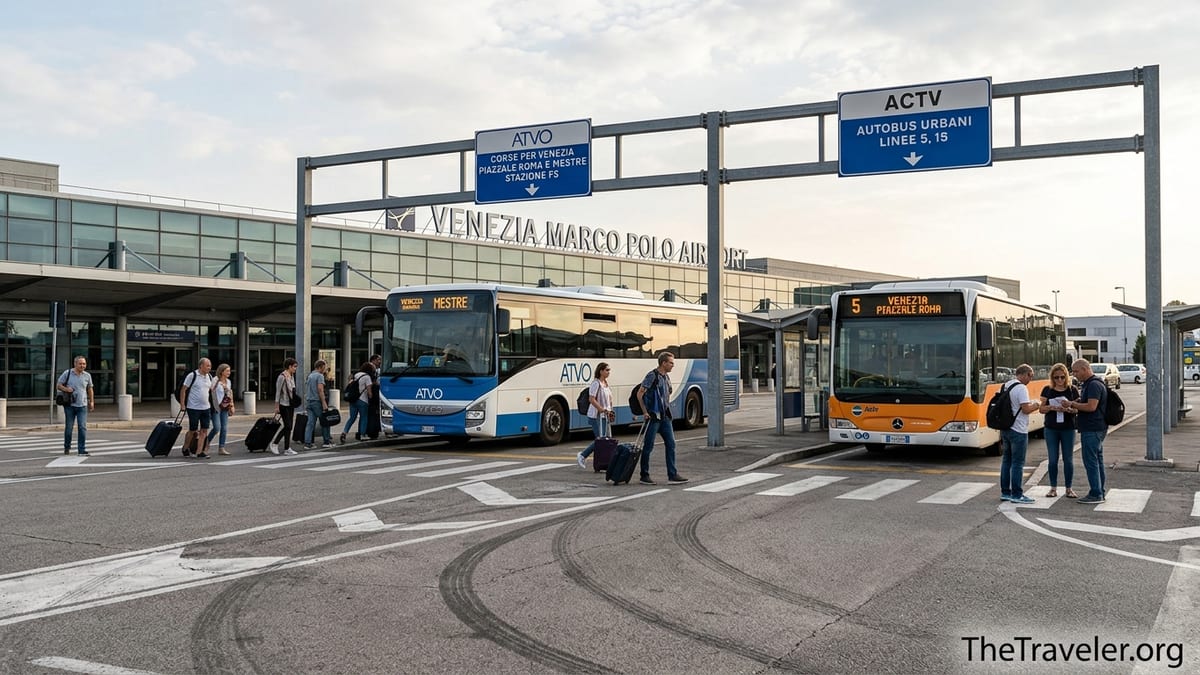
The ACTV services are the local public buses used by residents as well as visitors. They connect the airport with Mestre railway station and the wider mainland area, and tickets can be combined with passes that also cover trams and vaporetti. ATVO, by contrast, runs dedicated airport coaches that operate non-stop or limited-stop between the terminal and key hubs such as Mestre station and Venice Piazzale Roma. Both use normal road coaches, not city minibuses, so there is overhead space for hand luggage and underfloor compartments for larger bags.
Taxis are available directly outside the arrivals area and provide a door-to-door option to hotels in Mestre, which can be attractive after a long-haul flight or when arriving late at night. For small groups, the cost per person can be closer to the bus price than many travelers expect, especially compared with the higher fares to get all the way into central Venice. Some hotels in Mestre, particularly larger business hotels and airport-focused properties, may also offer their own shuttles at set times.
There is no direct train service from the terminal at Marco Polo, so even if your final hotel is near Venezia Mestre station you will usually take a bus or taxi for this short first leg. From the station, though, trains become central to how you move around the region, including quick hops into Venice Santa Lucia or longer journeys south and west.
ACTV and ATVO Buses: How They Work and Which One to Choose
The simplest way to travel from Marco Polo to Mestre for most visitors is by bus. Two main options operate from stops just outside the terminal: ACTV local buses and ATVO Venice Airport Bus Express. Both run roughly every 20 to 30 minutes through much of the day, with variations by season and time, and both connect you directly to Mestre station without needing to change in Venice.
ACTV’s key route between Marco Polo and Mestre station is line 15, a city bus that passes through several mainland districts before terminating at Venezia Mestre FS. Current timetables show frequent departures in both directions, starting early in the morning and continuing late into the evening, with some trips operating after midnight in peak periods. Tickets for the airport segment are sold at a specific airport fare, distinct from standard Mestre urban tickets. You can buy them at ACTV/AVM ticket counters, vending machines or many airport newsstands, and you validate the ticket when boarding.
ATVO’s Venice Airport Bus Express is designed specifically for air travelers. Coaches run non-stop or with minimal intermediate stops between the airport and Mestre station, and there is also a separate route to Venice Piazzale Roma. According to the latest schedules, the journey between Marco Polo and Mestre station typically takes around 17 to 20 minutes in normal traffic. Tickets are available from ATVO counters in the arrivals area, from ticket machines in the baggage hall and at the stop outside the terminal. One practical detail: at the airport, ATVO coaches to Mestre usually depart from a clearly marked lane signed for “Mestre Railway Station,” while coaches to Venice depart from a neighboring lane.
For many travelers, the choice between ACTV and ATVO comes down to two factors: whether you need integrated public transport passes and whether you value a more dedicated airport coach. If you plan to buy a multi-day ACTV ticket to cover buses, trams and vaporetti in Venice and Mestre, it can be convenient to add the airport supplement so you can simply use ACTV line 15 from the terminal. If you are focused purely on getting to your hotel in Mestre with minimal fuss, the ATVO coach’s direct route and luggage-friendly layout make it particularly attractive.
Taxi, Private Transfers and Late-Night Arrivals
The official taxi rank at Venice Marco Polo Airport is just outside the arrivals hall, clearly signposted next to the road access. Taxis are managed by a licensed cooperative, and vehicles are standard metered cars rather than water taxis, since you will be traveling by road to Mestre. There is usually a steady line of taxis waiting during the day and evening, with queues forming mainly after large flight arrivals.
Fares to Mestre depend on traffic and the exact location of your hotel, but the road distance is short compared with trips into central Venice. While the airport and city do not publish a single fixed official tariff for every Mestre destination, travelers commonly report that journeys to hotels near Venezia Mestre station or in central Mestre cost noticeably less than trips to Piazzale Roma. For a couple or small family arriving late, when buses are less frequent, this can be a worthwhile trade-off for door-to-door comfort.
Private transfers are also widely available and often used by cruise passengers or groups with heavy baggage. Many companies offer pre-booked rides in sedans or minivans from the arrivals area to specific Mestre addresses, priced per vehicle rather than per passenger. For instance, a group of four staying at a hotel such as NH Venezia Laguna Palace or Hotel Plaza Mestre might find that splitting a private transfer costs only slightly more per person than individual bus tickets, while providing direct delivery to the lobby.
For late-night and very early-morning arrivals, a taxi or pre-booked transfer is often the easiest option. Although ACTV and ATVO maintain relatively long operating hours, frequencies naturally drop late at night. If you land just before midnight and still need to check in at a hotel several blocks from Mestre station, the directness of a taxi can make the extra expense feel well justified.
Venezia Mestre Station: Your Mainland Hub
Venezia Mestre railway station is the primary transport hub for Mestre and a key gateway to the whole of northern Italy. Most high-speed trains heading to or from Venice stop here before continuing across the lagoon causeway to Santa Lucia station, and several regional lines terminate or intersect at Mestre. If your hotel is near the station, getting from the airport to your room and then onward by train becomes especially straightforward.
From Marco Polo, both ACTV line 15 and the ATVO airport coaches terminate directly in front of the station, typically in a bus area just outside the main entrance. That means you can collect your luggage from the airport carousel, board a bus, and step off within a short walk of hotels such as Hotel Plaza, Best Western Tritone, Leonardo Royal Hotel Mestre or Staycity Aparthotels. This is particularly useful if you have an early train the next morning to cities like Florence or Milan.
Inside Venezia Mestre station, you will find standard facilities for a major Italian junction: ticket counters, self-service machines, cafes, small food outlets and newsstands. There are multiple platforms connected by underpasses and elevators, which helps if you are handling rolling suitcases. Regional tickets are often available at short notice, so if you are planning a day trip to Padua or Vicenza, you can pick up tickets after checking into your hotel and survey the departure boards to plan your timings.
To reach historic Venice from Mestre station, frequent trains shuttle over the causeway to Venezia Santa Lucia in around 10 to 12 minutes. Alternatively, trams and buses run from Mestre center to Piazzale Roma, giving you flexibility depending on where your hotel sits. For instance, a traveler staying near Mestre’s Piazza Ferretto might prefer the T1 tram directly into Piazzale Roma, while someone staying opposite the station may choose the short train ride into Santa Lucia.
Where to Stay in Mestre for Easy Airport and Venice Access
Mestre’s accommodation scene has expanded significantly in recent years, and several clusters make sense if you want to balance airport convenience with fast access to Venice. The most popular area is around Venezia Mestre station itself. Hotels here cater to both business travelers and tourists, and you will find well-known brands such as Best Western, Leonardo, Hilton Garden Inn properties nearby and several independent Italian hotels. From this area, airport buses and long-distance trains are literally on your doorstep.
Another attractive area is central Mestre around Piazza Ferretto and the adjoining pedestrian streets. This neighborhood offers a more local feel, with cafes, restaurants and shops used by residents as well as visitors. From here you can catch buses or trams to both the station and Venice’s Piazzale Roma. The airport connection is one step less direct than the station area, since you will likely take a local bus or short taxi ride to reach the airport buses or a taxi straight from your hotel, but many travelers appreciate the atmosphere and dining options.
Travelers arriving by car sometimes choose accommodations in Mestre’s business districts or near major road junctions, such as hotels around the Via Orlanda or Marghera areas. These can be practical if you intend to drive on to destinations like the Dolomites or the Adriatic coast, but make sure to check their exact connections to both the airport and Venice before booking. Some properties on Via Orlanda, for example, lie close enough to the road between Mestre and the airport that local buses can drop you within walking distance, effectively splitting your journey between the terminal and Venice itself.
When evaluating hotels, consider not only the nightly rate but also how transport costs will add up. A hotel that is slightly more expensive but sits directly opposite Venezia Mestre station might save you the cost of multiple local tram or bus tickets and make early departures far less stressful. Look carefully at the hotel’s description of its nearest bus or tram stops and compare them with your expected arrival and departure times.
When Choosing Mestre Is the Smarter Strategy
Staying in Mestre instead of on Venice island makes particular sense in a few recurring scenarios. Budget-conscious travelers who plan several days of sightseeing in Venice plus side trips to nearby cities are prime candidates. For example, a couple visiting in high summer might find that a comfortable hotel near Mestre station costs significantly less than a small room in Venice, leaving more of their budget for restaurant meals, museum tickets and a gondola ride.
Mestre also works well if Venice is part of a broader rail itinerary. Imagine you are traveling from Milan to Venice, then continuing to Florence and Rome. Booking a hotel directly opposite Venezia Mestre station means you can roll your suitcase off the train from Milan, check in, and then take frequent local trains or trams into Venice each day. When it is time to continue south, you walk right back across the street to catch your next high-speed train without factoring in extra transfer time from the island.
Families and small groups can benefit from Mestre’s larger hotel inventory and more spacious rooms. It is often easier to find triple or quad rooms, or even small apartments, at a reasonable price on the mainland than in the narrow historic buildings of Venice. Combine that with the relative ease of using airport buses that stop outside station-area hotels, and the logistics of arriving with children or lots of luggage become much simpler.
Finally, Mestre is a practical choice if your trip involves an early morning or late-night flight from Marco Polo. Spending your last night in a hotel near Mestre station, rather than navigating from the heart of Venice at dawn, can significantly reduce the risk of delays or missed connections. With frequent ACTV and ATVO buses starting early and running late, plus taxis as a backup, you will have multiple ways to reach the terminal on time.
Practical Ticket Tips, Passes and Real-World Scenarios
Before you land at Marco Polo, it helps to think through what combination of tickets you will need. If your plan is simple, such as flying in, going straight to a Mestre hotel and then catching a train onwards the next morning, a one-way ATVO or ACTV ticket from the airport to Mestre may be all you require. In this case, buying at the airport on arrival is straightforward and avoids paying for services you will not use.
If you intend to spend several days exploring both Venice and Mestre using public transport, consider ACTV’s time-based passes, which cover buses, trams and vaporetti, with a paid supplement for trips to or from Marco Polo. In practice, a traveler staying three nights in Mestre might purchase a 72-hour ACTV ticket plus the airport add-on, then use it for ACTV line 15 from the airport, trams between Mestre center and Piazzale Roma, and vaporetto rides along the Grand Canal and out to the islands.
When you arrive at the airport, follow signs to the bus area and allow a little time to find the correct machine or ticket counter. Many modern machines accept international credit and debit cards, and some services support contactless EMV payments directly on buses for certain fare types. However, not every airport fare or long-distance coach ticket can be purchased by tapping a card onboard, so it is still wise to buy a paper or digital ticket first, especially for ATVO coaches.
As a concrete example, imagine you land mid-morning on a weekday with a hotel booked near Hotel Plaza opposite Mestre station. You walk out of arrivals, buy an ATVO ticket to “Mestre Railway Station,” and head to the marked stop. The coach ride takes around 20 minutes in average traffic, and you step off at the bus area right in front of the station. From there, your hotel is a short walk, and later that afternoon you can catch a regional train or tram into Venice for sunset on the Grand Canal.
FAQ
Q1. How long does it take to get from Venice Marco Polo Airport to Mestre by bus?
The journey typically takes around 20 to 30 minutes in normal traffic, with ATVO coaches often slightly faster and ACTV city buses varying depending on intermediate stops and peak-hour congestion.
Q2. Which bus should I take from Marco Polo to Venezia Mestre railway station?
Most travelers choose either the ACTV line 15 city bus or the ATVO Venice Airport Bus Express service to “Mestre Railway Station,” both of which depart from clearly signposted stops outside the terminal.
Q3. Can I use a Venice public transport pass on the airport bus to Mestre?
ACTV time-based passes can be extended to cover airport routes by purchasing a specific supplement, whereas ATVO airport express tickets are separate and not included in standard city transport passes.
Q4. Is it cheaper to stay in Mestre than on Venice island?
In most seasons, hotels in Mestre, especially around the railway station and central districts, are significantly cheaper than comparable properties in the historic center, and rooms are often larger as well.
Q5. How early do buses start running from Mestre to Marco Polo Airport?
ACTV and ATVO publish early-morning departures from Mestre station to the airport, generally starting well before typical first flight check-in times, though timetables vary by season and day of the week.
Q6. Are taxis from the airport to Mestre metered or fixed-price?
Taxis at Marco Polo are metered, with the final price depending on traffic and your exact address in Mestre, but the overall cost is usually lower than a similar ride into central Venice.
Q7. Is there a train directly from Venice Marco Polo Airport to Mestre?
No, there is no rail station at Marco Polo; you must first take a bus or taxi to Venezia Mestre railway station, where you can then board trains to Venice Santa Lucia or other Italian cities.
Q8. Which area of Mestre is best for easy access to both the airport and Venice?
The streets around Venezia Mestre railway station are the most convenient, as both ACTV and ATVO airport buses stop here and frequent trains and trams link the area directly with Venice.
Q9. Is Mestre safe for tourists returning late from Venice?
Mestre is a working city with normal urban dynamics, but the main station area and central districts are busy and commonly used by tourists, with many visitors returning by late trains and trams without issues.
Q10. When is it smarter to book a hotel in Mestre rather than on the island?
Choosing Mestre is especially smart if you have an early or late flight, plan onward train travel, are traveling on a tighter budget, or prefer larger, more modern hotel options.