


Zadar’s Old Town is compact enough to cross in fifteen minutes, yet layered with 2,000 years of history. Roman paving, a 9th century rotunda, Venetian gates and busy café terraces all sit within a walled peninsula you can easily explore on foot in half a day. This walking guide leads you through the key sights of the Roman Forum, St. Donatus, the Cathedral of St. Anastasia, Kalelarga, People’s Square and the Land Gate, with practical tips on the most atmospheric route, where to pause for coffee, and how to make the most of a short stay in Zadar.
Get the latest updates straight to your inbox!
How to Use This Walking Guide
Zadar’s historic core sits on a small peninsula locals simply call “Poluotok.” It is roughly 1 kilometer long and 400 meters wide, which means every major sight in this guide is within a 10 to 15 minute walk of each other. You do not need public transport or taxis once you are on the peninsula. Plan on two to three hours of easy walking, plus extra time for coffee, church visits, and photo stops.
A practical way to start is at the Land Gate and finish at the seafront, especially if you arrive by car or intercity bus and park near the modern bridge or the Foša harbor. If you are staying in a hotel or apartment within the Old Town, simply join the route at the closest point. Comfortable flat shoes are essential. Zadar’s streets are paved with polished stone that can feel slippery after rain and during humid summer evenings.
Try to schedule your walk either early in the morning, when cruise groups are still assembling and cafés are just setting tables, or from late afternoon into sunset. Midday in July and August can regularly reach around 30 degrees Celsius, and shade around the Forum and Kalelarga is limited. Many visitors time this walk so they end at the waterfront in time to watch the famous Zadar sunset and listen to the Sea Organ, which is a pleasant extension of the route described here.
Most religious buildings along the route, including St. Donatus and the Cathedral of St. Anastasia, keep fairly set visiting hours and close around midday and again by early evening, especially outside peak season. Admission to climb the cathedral bell tower is usually a small cash fee, often just a few euros equivalent, so keep some kuna-free local currency or a card handy, and check current prices posted at the entrance.
Starting at the Land Gate and City Walls
The most impressive way to enter Zadar Old Town is through the Land Gate, the ornate stone portal that once served as the main entrance from the mainland. Built in 1543 by the Venetian architect Michele Sanmicheli, the gate is decorated with the winged lion of St. Mark, a symbol of the Republic of Venice. Standing here, with the small fishing harbor of Foša at your back and the thick bastion walls curving away on both sides, you get a first sense of Zadar as a former island fortress.
These fortifications are not just picturesque. In 2017, Zadar’s defensive walls were added to the UNESCO World Heritage List as part of a group of Venetian works of defense from the 16th and 17th centuries. Walking up the ramp beside the Land Gate brings you onto a raised promenade on top of the bastion. From here you can look back to the mainland and see why the location was so strategic. In the late afternoon, this terrace catches warm sunlight and is often almost empty compared to the waterfront promenade.
As you step through the Land Gate itself, notice how the passage is still used by both pedestrians and local traffic. Small delivery vans and scooters squeeze across the narrow bridge while visitors stop to photograph the sculpted coats of arms. To avoid congestion, move to one side directly after you pass through, then take a moment to look up at the carved lion. From here, follow the gentle slope upward into the Old Town along the short stretch of street that leads toward the inner squares.
If you prefer to see more of the walls before heading to the Roman core, you can detour left after the gate and follow the line of fortifications along the park that crowns the eastern side of the peninsula. This shaded green belt offers views down toward the harbor and is a good option on hot days, but most first-time visitors will want to head straight for the heart of ancient Zadar: the Roman Forum and St. Donatus.
The Roman Forum and St. Donatus
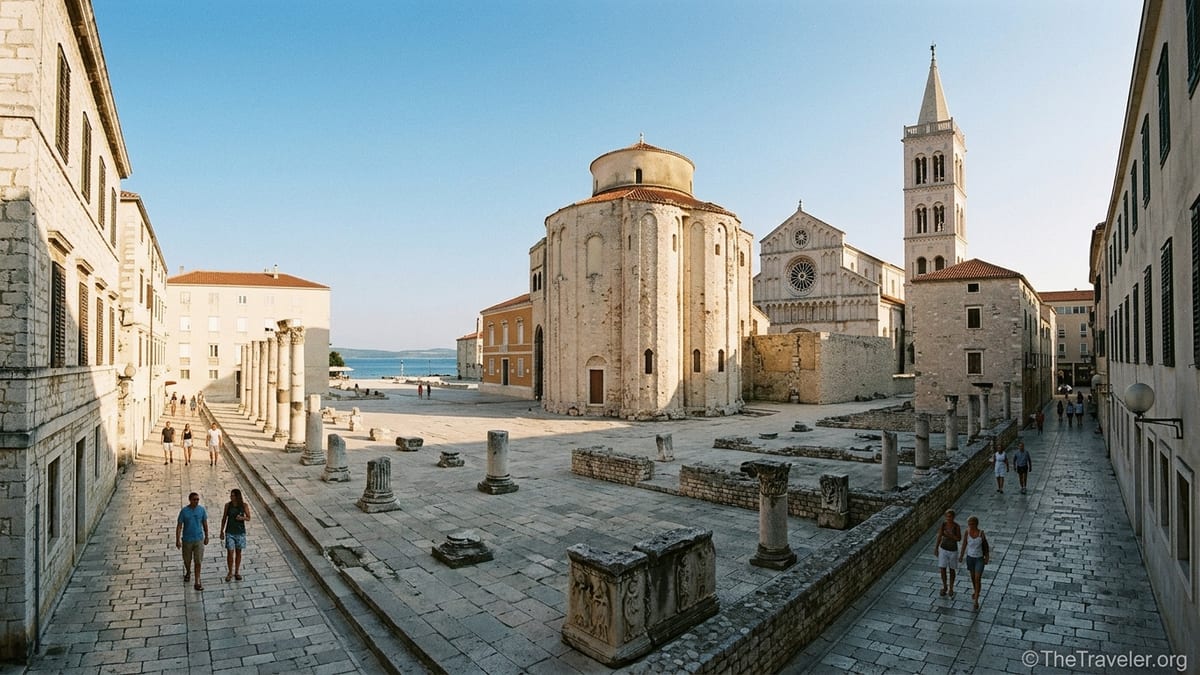
The Roman Forum is the natural focal point of any walk through Zadar’s Old Town. Laid out between the 1st century BC and the 3rd century AD under Emperor Augustus, it once formed the administrative and religious center of the Roman colony. Today it is an open stone plaza edged by fragments of columns, temple foundations and low marble blocks that locals casually sit on to chat or watch their children play. The square is free to access at all hours, and everyday life flows around the ruins in a way that makes the ancient setting feel unusually alive.
On the northern edge of the Forum stands the unmistakable round mass of the Church of St. Donatus, Zadar’s most iconic building and the largest pre Romanesque structure in Croatia. Built in the 9th century, its thick walls rest directly on the stones of the Forum and even incorporate reused Roman columns and carved blocks. From outside, walk all the way around the rotunda to appreciate how the church is layered onto the ancient remains. In the peak season, it often hosts classical concerts inside, benefiting from resonant acoustics and a stark interior stripped of decoration.
Costs and access here are straightforward. Strolling across the Forum is free, and you can wander anywhere outside the marked remains. Entry to St. Donatus itself usually requires a small ticket purchased at the nearby booth, often just a few euros in local currency. The area in front of the church is a popular spot for group photos, and you will likely see organized walking tours pausing here while guides explain the overlapping Roman, Byzantine and early Croatian history of the site. If you prefer a quieter experience, come either just after sunrise or around midday when groups thin out.
Before you leave the Forum, take note of your orientation. With your back to St. Donatus, the Cathedral of St. Anastasia rises slightly uphill to your right, while the sea lies just a short walk ahead. This makes the Forum a useful mental map anchor; as long as you can find your way back here, you are never far from the main pedestrian routes of the Old Town.
Cathedral of St. Anastasia and the Bell Tower
From the Roman Forum, walk a short distance uphill along the stone lane that leads to the Cathedral of St. Anastasia, the largest church in Dalmatia. The cathedral’s Romanesque façade is elegant but not overly ornate, marked by a large rose window and alternating bands of pale stone. Step inside when services are not in progress to see the simple nave, stone columns and side chapels. The building has been reshaped over centuries, but it still feels closely tied to the early medieval period when the relics of Saint Anastasia were brought here.
Next to the cathedral stands a tall separate bell tower that doubles as one of the best viewpoints in Zadar. For a modest fee paid at the small ticket window in its base, you can climb a series of relatively narrow staircases to an open viewing platform. The ascent is manageable for most visitors with average fitness, though those with mobility issues or a fear of heights may find the metal steps near the top challenging. Once above the rooftops, the reward is a 360 degree panorama of the red tiled Old Town, the blue Adriatic and, on clear days, the low mountains on the horizon.
Climbing the bell tower is particularly worthwhile in late afternoon, when the low sun flattens shadows and the white stone of the Forum and Kalelarga glows softly. Photographers will want a lens wide enough to capture the tight streets below, and a light jacket in shoulder seasons because the wind can be surprisingly strong at the top. Visits are usually time limited only by closing hours, so you can linger for as long as your legs are happy.
After descending, circle around the back of the cathedral to rejoin the open space of the Forum. From here you can choose to head west a short distance to see the waterfront promenade, or begin tracing the line of the main street that slices across the Old Town, known locally as Kalelarga. For the purposes of this walking guide, it makes sense to explore Kalelarga next, then loop back to the waterfront later.
Walking Kalelarga to People’s Square
Kalelarga, officially called Široka ulica, is the main east west street of Zadar Old Town and follows the route of the ancient Roman decumanus maximus. It runs slightly downhill from the vicinity of the Forum toward the central squares, lined with a mix of stone townhouses, modern shopfronts and occasional small churches. The polished limestone paving reflects light in the evenings, creating a gentle sheen that makes even an ordinary stroll feel festive.
In practical terms, Kalelarga is where you will find a cluster of everyday services. There are gelato counters charging a few euros equivalent for a generous scoop, bakeries selling slices of local-style pizza and burek pastries, and small boutiques and souvenir shops. In summer, many of these businesses stay open well into the night, and you will see families pushing strollers alongside couples dressed for dinner. The street is pedestrian only, which makes it one of the most relaxed ways to cross between the Forum and the central part of the peninsula.
As you walk, pause at one of the street side cafés that set out metal tables and wicker chairs directly on the stone. Ordering a macchiato or an espresso here is typically only marginally more expensive than on the mainland, and you gain a front row seat on the evening passagiata, the local tradition of strolling and socializing. Watching a summer storm roll in from the sea while you shelter under a café awning on Kalelarga can be as memorable as any formal sightseeing.
Continuing east along Kalelarga, you will soon arrive at People’s Square, or Narodni trg, one of Zadar’s liveliest meeting points. The transition is almost seamless; the street simply widens into an open space framed by the City Hall and older stone buildings. Street musicians often play here in the evenings, and café terraces spill out across the paving, making it an ideal place to rest before you complete the loop back toward the Land Gate or onward to the waterfront.
People’s Square, Cafés and Everyday Life
People’s Square has served as a civic center since at least the medieval period, and it still performs that function today. On one side stands the City Hall, while the older clock tower and surrounding façades remind you how Zadar’s role shifted through Venetian, Austrian and more recent histories. What might strike you most, however, is how relaxed the atmosphere feels; this is less a formal monument and more an outdoor living room for residents and visitors.
Cafés and bars ring the square, each with its own subtle character. Some cater more to locals, serving small cups of strong coffee at the bar or simple glasses of draft beer, while others lean toward visitors with longer cocktail menus and more prominent dessert displays. Prices here are typically a little higher than in less central parts of town but still reasonable by Western European standards. A cappuccino will often cost only a little more than on Kalelarga, and sitting here for an hour as the light fades is an easy splurge.
If you are traveling with children, this is a practical spot to let them run in sight of your table. The central paving is car free, and local kids weave between café chairs on scooters while grandparents chat nearby. In high summer, it is wise to reserve a table in early evening, especially on weekends, as seats facing the heart of the square fill quickly. In shoulder seasons like May, June, September and October, you can usually just wander in and choose any free chairs.
From People’s Square, several narrow side streets radiate outward. One leads back toward the Land Gate, another returns you to Kalelarga, and yet another threads north toward the cathedral and Forum. This makes the square a convenient crossroads. When you are finished with your drink or meal, it is easy to continue your circular walk by heading toward the Land Gate to see more of the city walls from ground level, or to dip back toward the Forum for a final daylight look before ending at the waterfront.
Linking the Route: Best Order for a Half-Day Walk
While Zadar Old Town is small, planning a logical route helps avoid backtracking and lets you experience how the districts connect. One efficient circuit begins at the Land Gate, where you enter through the UNESCO listed fortifications, then climbs gently up to People’s Square and Kalelarga. From there you continue west toward the Roman Forum, explore St. Donatus and the Cathedral of St. Anastasia, and finally finish at the seafront promenade. Walking this loop at a relaxed pace takes about two hours, not counting café stops or bell tower climbing.
In practice, you might start mid morning at the Land Gate, spending fifteen minutes exploring the gate itself and the adjacent walls. Then wander up to People’s Square for a late breakfast or second coffee, watching the square come to life. After half an hour there, join Kalelarga heading west. Ten or fifteen minutes of strolling, window shopping and photo taking will bring you back to the vicinity of the Forum. You can then devote a solid hour to the Forum, St. Donatus and the cathedral interior, plus extra time if you climb the tower.
After leaving the cathedral, it is a short walk down to the seafront promenade to continue to the Sea Organ and the modern installation that captures solar energy in colored glass panels on the pavement. Many organized walking tours recommended by the regional tourist board follow a similar order, connecting the Land Gate, People’s Square, Kalelarga, the Forum, St. Donatus, St. Anastasia and the waterfront. Following a comparable sequence on your own gives you the same overview, but at your own pace.
If you are staying longer in Zadar, you can also repeat this basic route at different times of day. Early in the morning, the streets and squares feel quiet and almost reserved. By late afternoon and into the evening, lights spill from cafés, and the Forum becomes a backdrop for casual gatherings and occasional cultural events. Experiencing both moods will give you a fuller sense of how Zadar Old Town functions not just as a set of monuments, but as a living neighborhood.
The Takeaway
A walk through Zadar Old Town is a compact lesson in Adriatic history. Within a few hundred meters, you step from a Roman Forum across pre Romanesque foundations into a Romanesque cathedral, then out under Venetian walls and into relaxed Croatian café culture. Because the peninsula is small and pedestrian friendly, you can experience this sequence in a single morning or evening without feeling rushed.
Using the Land Gate as your entry, the Roman Forum and St. Donatus as your historical anchor, the Cathedral of St. Anastasia for views, and Kalelarga and People’s Square for everyday life, you build a route that balances monuments with moments of simple enjoyment. Add in pauses at seafront terraces or shaded park benches along the walls and you have a walking circuit that fits easily into even a short city break.
Whether you are visiting Zadar as a cruise stop, a weekend escape, or a base for exploring nearby islands and national parks, setting aside time for this self guided walk will deepen your understanding of the city. You will leave not only with photographs from bell towers and Roman ruins, but also with vivid impressions of polished stone streets, the aroma of coffee along Kalelarga, and the echo of church bells drifting over the Forum at dusk.
FAQ
Q1. How long does it take to walk Zadar Old Town following this route?
Most visitors complete the loop from the Land Gate through People’s Square, Kalelarga, the Roman Forum, St. Donatus and the cathedral to the seafront in about two to three hours, allowing time for photos and a short café break.
Q2. Do I need a guided tour to see the Roman Forum and St. Donatus?
No, the area is easy to explore independently, with the Forum freely accessible at all times and clear signage. A guided tour can add deeper historical context, but is not essential for navigation.
Q3. Is there an admission fee for St. Donatus and the Cathedral of St. Anastasia?
Walking around the exterior and across the Forum is free. Entry to St. Donatus and climbing the cathedral bell tower typically require small separate tickets, usually only a few euros equivalent, purchased on site.
Q4. What is the best time of day to do this walking route?
Early morning and late afternoon are most comfortable, with softer light, fewer crowds and cooler temperatures. Many travelers start mid or late afternoon and time their finish at the waterfront for sunset.
Q5. Are the streets and squares suitable for people with limited mobility?
The route is mostly flat, but the highly polished stone paving can be slippery and some lanes have gentle slopes. Wheelchairs and strollers can navigate the main streets and squares, though climbing the bell tower is not accessible.
Q6. Can I easily find cafés and restrooms along the way?
Yes, Kalelarga and People’s Square are lined with cafés where you can order drinks and use facilities, and several restaurants and bars near the Forum and along the seafront also provide restroom access for customers.
Q7. Is Zadar Old Town safe to walk around at night?
Zadar’s Old Town is generally considered safe, and evenings see many families and couples strolling the streets. Standard city precautions apply, such as keeping valuables secure and staying aware of your surroundings.
Q8. Do I need to book anything in advance for this walk?
No bookings are needed for a self guided walk. You might book ahead only if you want a specific guided tour or a table at a popular restaurant during peak summer evenings.
Q9. What should I wear for walking through Zadar Old Town?
Comfortable flat shoes with good grip are recommended because of the smooth stone pavements, along with light clothing, a hat and sunscreen in summer, or a light jacket outside peak season.
Q10. Can I combine this walking route with visits to the Sea Organ and other waterfront sights?
Yes, it is easy to extend the route from the cathedral and Forum down to the seafront promenade, then continue a short distance to the Sea Organ and the nearby modern solar installation before looping back through the Old Town.