


Georgia has a reputation as an excellent-value destination, but what will seven days in 2027 in Tbilisi, the Caucasus mountains and Kakheti wine country really cost? Using verified late-2026 prices and the latest available 2027 accommodation and transport quotes, this guide builds three realistic one-week budgets at different comfort levels, showing exactly where your money goes and how much a solo traveler or couple should plan to spend.
Get the latest updates straight to your inbox!
Exchange rates, scope and price baseline for 2027
This guide prices all on-the-ground expenses in Georgian lari (GEL) and converts totals into US dollars and euros. For consistency, it uses the National Bank of Georgia’s official exchange rates valid on 13 November 2026: 1 USD = 2.5935 GEL and 1 EUR = 2.8793 GEL. That implies 1 GEL is roughly 0.39 USD and 0.35 EUR at that date. Actual card and cash rates in 2027 will vary slightly by bank and provider, but these figures offer a solid planning baseline.
All budgets cover seven full days in Georgia in 2027 and exclude international flights. They assume you arrive with travel insurance already arranged from home and price only the local component. Where insurance is itemised, it refers to short single-trip cover purchased online, not annual policies. Prices draw on official Tbilisi Transport Company tariffs, airport and bus station fares, and extensive menu and hotel checks carried out in 2026, updated with early 2027 hotel quotes where available. Where no official or current figure exists, this guide states that clearly rather than guessing.
Because Georgia has experienced noticeable inflation in restaurant and hotel prices, 2026 figures are treated as a floor, not a ceiling. For example, recent reporting on food costs in Georgia shows typical café lunches around 20–40 GEL per person, khinkali often 1.5–2.5 GEL per piece and restaurant khachapuri in central Tbilisi commonly 15–25 GEL, with restaurant and hotel prices rising by around 7 percent year on year in 2026. In practice, 2027 menus may be a few lari higher, so the budgets below add a modest buffer to the latest confirmed numbers.
Finally, Georgia is a largely cash-based economy outside big cities, especially for marshrutkas and smaller guesthouses. These itineraries assume a mix of card for metro, larger restaurants and hotels, and cash for intercity vans, small bakeries and tips, with an allowance built in for ATM and currency-exchange fees.
Transport costs: metro, Bolt, airport, marshrutkas and cars
Within Tbilisi, the cheapest way to move around remains the integrated metro, bus and city minibus system. The official tariff in late 2026 is a flat 1 GEL for 90 minutes of travel across metro, buses and yellow minibuses when you tap a Metromoney transport card or a contactless bank card. The Metromoney card itself costs 2 GEL to buy and can be loaded with credit. This means a day of three or four hops around the city might cost only 3–4 GEL, even if you swap between metro lines and buses.
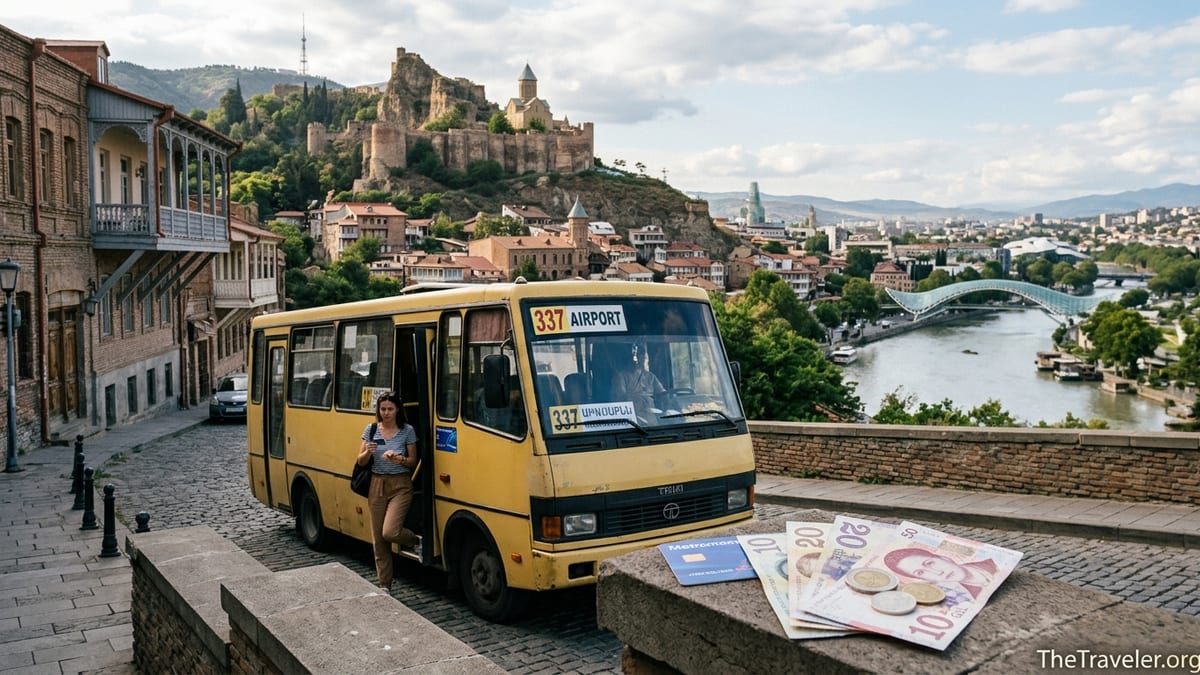
Ride-hailing through Bolt fills the gap late at night or for trips with luggage. Recent airport guides report typical Bolt fares between Tbilisi International Airport and the city centre in 2026 at roughly 25–40 GEL per car, depending on time of day, traffic and surge pricing. The airport’s own official taxi stand advertises fixed fares around 40–60 GEL into central districts. By contrast, municipal bus 337 linking the airport to central Tbilisi charges the standard 1 GEL public transport fare when paid with Metromoney or a contactless card, making it easily the cheapest airport transfer if your arrival fits the timetable.
For leaving the capital, Georgia relies heavily on marshrutkas, the shared minibuses departing from Didube, Samgori (also known as Navtlughi) and Ortachala bus stations. To reach Kazbegi (Stepantsminda), marshrutkas leave from Didube, connected directly to the metro. Current 2026 accounts and recent transport guides converge on a fare of about 15–20 GEL per person each way, with 20 GEL a realistic planning figure. The ride takes around three to three and a half hours and the fare is paid in cash to the driver or a small ticket booth. Some drivers charge an extra 5 GEL for oversized luggage.
Kakheti, including Telavi and Sighnaghi, is served mainly from Samgori / Navtlughi on Tbilisi Metro Line 1. In 2026, marshrutka fares from Tbilisi to Telavi are typically quoted around 12–15 GEL each way, while several municipal and tourism sources put the Samgori to Sighnaghi fare in the 8–15 GEL range per person, with local guides in 2026 updating their advice to 15 GEL for two to two and a half hours of travel. Again, these fares are cash only and schedules are approximate, so some waiting middle of the day is common.
Accommodation price patterns: Tbilisi, Kazbegi and Kakheti
Hotel and guesthouse prices vary by season. Spring and autumn, especially May, June, late September and October, are often considered “shoulder” periods with comfortable weather and moderate rates. July and August in Tbilisi tend to be cheaper in absolute terms because of the heat, but Kakheti wine hotels and mountain stays around Kazbegi stay comparatively busy and maintain firmer prices.
In central Tbilisi, late-2026 and early-2027 hotel searches show basic but well-reviewed hostels with dorm beds typically pricing from about 35–55 GEL per person per night in spring and autumn, rising slightly in high summer. Simple guesthouses or pensions with private rooms and shared bathroom in central areas like Avlabari or Marjanishvili often start around 120–150 GEL per double room, including breakfast, while international midrange hotels in the Old Town or Rustaveli area frequently quote 250–450 GEL per night for a standard double, depending on date and demand.
In Stepantsminda (Kazbegi), mountain guesthouses are still cheaper than city hotels, but there are now clear tiers. Family guesthouses a short walk from the centre commonly advertise doubles with breakfast from roughly 140–200 GEL in spring and autumn, with slightly higher rates over summer weekends. Meanwhile, view-focused properties just outside town and higher-end lodges command from 350–700 GEL per night for a double room. This gap becomes crucial once you factor in how you get there, because a cheap guesthouse accessed via private car can end up costing more overall than a pricier option reached on a shared marshrutka.
In Kakheti, especially around Telavi and Sighnaghi, standard guesthouses in town follow a similar pattern to Kazbegi, with doubles commonly from 130–180 GEL including breakfast. Dedicated wine hotels and vineyard properties with on-site tastings, farm-to-table dinners and pools now quote nearer 350–600 GEL per night for a couple, especially in late summer and during harvest. For this guide’s comfort-focused couple itinerary, vineyard hotel nights are budgeted at the lower end of that range.
Food, drink and daily incidentals
Recent 2026 menu checks across Tbilisi show that bakery breakfasts remain very affordable. A simple cheese or potato khachapuri from a corner bakery can still be found for about 3–6 GEL in the city, with a takeaway coffee adding 5–10 GEL depending on style and neighbourhood. That puts a quick on-the-go breakfast for one comfortably under 15 GEL, even in central districts.
In sit-down restaurants, prices jump but remain competitive compared with Western Europe or North America. Surveyed menus in 2026 show Adjarian khachapuri in Tbilisi restaurants commonly around 18–22 GEL, round Imeruli or Megruli khachapuri around 18–25 GEL, and khinkali by the piece in the 1.5–2.5 GEL range, with some central eateries already charging close to 3 GEL each. A generous dinner for two in a midrange Georgian restaurant with a salad or dips, a khachapuri to share, 15–20 pieces of khinkali and a carafe of house wine will usually land between 80 and 140 GEL before any tip, depending on the wine and meat dishes ordered.
Grocery shopping is cheaper again. A litre of local milk rarely exceeds 5 GEL, basic vegetables and fruit are inexpensive at markets, and a simple self-catered pasta or salad dinner can be assembled for under 15–20 GEL per person. This guide’s backpacker itinerary assumes a mix of bakery snacks, cheap lunches in canteens and a few restaurant dinners, while the midrange and comfort itineraries lean more on restaurant meals and wine bars. Wine tastings in Kakheti range widely, but many established cellars publish prices around 25–60 GEL per person for a basic tasting flight, with more for tours or food pairings.
Gratuities and service charges affect your final bill. Increasingly, Tbilisi restaurants add a 10 percent service line automatically, which functions similarly to a tip and goes partly to staff. In those venues an additional tip is optional. In simpler places with no service line, rounding up the bill or leaving around 10 percent in cash is appreciated but not obligatory. Marshrutka drivers are not tipped; you pay the posted fare. Hotel staff might be tipped modestly in cash for help with bags or exceptional service.
Itinerary 1: Solo backpacker, 7 nights in Tbilisi using marshrutkas
This first budget assumes a solo traveler based entirely in Tbilisi, with day trips using marshrutkas. The sample itinerary: Day 1, arrival and Old Town orientation; Day 2, Tbilisi museums and sulphur baths; Day 3, day trip to Mtskheta or Gori via marshrutka; Day 4, free neighbourhood exploration; Day 5, Kazbegi day trip using a Didube marshrutka there and back; Day 6, Kakheti day trip to Sighnaghi from Samgori; Day 7, last shopping and departure.
Accommodation for this profile is a central hostel dorm bed near a metro station, at 50 GEL per night in 2027 spring shoulder season. Over seven nights, that is roughly 350 GEL. If you upgrade to a basic private in a hostel or pension at 140 GEL per night, the weekly total rises to 980 GEL; both figures are shown when totals are converted.
Transport includes a Metromoney card loaded with around 30 GEL for a week of rides, two airport bus or metro trips for 1 GEL each, three city marshrutka or bus runs for day trips near Tbilisi, one return marshrutka to Kazbegi at about 40 GEL total and one return to Sighnaghi or Telavi at around 30 GEL. Together, a realistic week-long local and intercity transport spend for the backpacker is about 120 GEL, assuming one or two Bolt rides for late nights, budgeted at 15 GEL each, for an extra 30 GEL. Total transport: roughly 150 GEL.
Food is where choices matter most. A frugal backpacker mixing bakery breakfasts, cheap canteen lunches around 15–20 GEL and some self-catering can keep to approximately 70–90 GEL per day, especially if khinkali and khachapuri form a core part of the diet. This guide budgets 80 GEL per day for seven days, totalling 560 GEL, which allows for a couple of more substantial restaurant dinners at 70–100 GEL each without exceeding the weekly cap. Add 70 GEL for attraction tickets (museums, sulphur bath entry, a cable car ride) and 30 GEL for a local SIM and data, and 50 GEL for small contingencies and ATM fees.
Putting this together for the dorm-bed version, the solo backpacker’s seven-day total lands around 1,160 GEL. At the November 2026 rates that is roughly 450 USD or 400 EUR. If the same traveler takes a modest private room at 140 GEL a night, the weekly total climbs to about 1,790 GEL, or approximately 690 USD and 620 EUR, with all other assumptions unchanged.
Itinerary 2: Midrange couple visiting Tbilisi and Kazbegi
The second budget is for a couple sharing midrange accommodation, splitting transport costs and making one overnight trip to Kazbegi. The itinerary: Days 1–3 in central Tbilisi, Day 4 travel to Kazbegi, Day 5 in the mountains and return to Tbilisi, Days 6–7 city sightseeing and café time before departure.
Accommodation assumes five nights in a central Tbilisi boutique hotel at around 300 GEL per night for a double, and two nights in a Kazbegi guesthouse at about 180 GEL per night including breakfast. That produces a weekly accommodation total of roughly 1,740 GEL per couple. Prices checked for spring and autumn 2027 dates in established booking engines show many central Tbilisi properties clustering around this point in shoulder periods, with higher quotes in summer and during major events.
Transport starts with a shared Metromoney card or two separate cards, but the costs are light: budgeting 50 GEL for a week of metro and buses for both travelers is usually ample. The couple takes a Tbilisi airport Bolt into town and back, estimated at 70 GEL each way, so 140 GEL in total, or they may use the 1 GEL bus 337 one direction and Bolt the other, trimming that figure. A return marshrutka for two from Didube to Kazbegi is about 80 GEL, and local taxis in Kazbegi to reach trailheads or Gergeti Trinity Church add perhaps 60 GEL over two days. Factoring in a handful of city Bolts at 15–20 GEL each, a realistic combined transport figure for the week is around 350–380 GEL per couple.
For food, this couple enjoys hotel breakfasts, light café lunches and full restaurant dinners most nights. With breakfast included in room rates, lunch at 25–35 GEL per person and dinner plus drinks at about 60–90 GEL per person in most midrange places, a generous food budget works out to roughly 220 GEL per day for two, or 1,540 GEL over seven days. This allows for wine bar visits in Tbilisi and a couple of more expensive dinners with grilled meats and higher-end bottled wine.
Attractions and activities include museum entries, the Tbilisi sulphur baths, a basic wine tasting in one of the city’s wine bars or urban cellars, and perhaps a short guided walking tour. A pooled figure of 220 GEL covers both travelers for the week. A local SIM and data package for one phone, tethered to the other, might cost around 40 GEL, and contingency and small tips another 80 GEL.
Adding these together, the midrange couple spends approximately 3,930 GEL in seven days, excluding flights. That is close to 1,515 USD or 1,365 EUR at the benchmark exchange rates. Shared costs make a big difference here: where the solo traveler bore the full cost of airport taxis and private rooms, this couple shares them, bringing the per-person cost down to roughly 758 USD or about 680 EUR.
Itinerary 3: Comfort couple with private transfers and Kakheti wine
The final profile is a comfort-oriented couple adding Kakheti wine country and relying on private transfers instead of marshrutkas. A typical itinerary: Days 1–3 in Tbilisi in a higher-end central hotel, Days 4–5 in Kazbegi at a well-located guesthouse accessed with a private driver, and Days 6–7 in Kakheti, spending at least one night at a vineyard hotel near Telavi or Sighnaghi before returning by private car.
Accommodation in this bracket is budgeted at 450 GEL per night for five nights in an upscale Tbilisi property and 220 GEL per night for two nights in Kazbegi. In Kakheti, a vineyard hotel night can easily reach or exceed 450 GEL; the budget here uses 400–450 GEL as an estimate for one night, plus a simpler guesthouse at 180–200 GEL for the other. Spreading these choices across the week yields an approximate total of 3,350 GEL in accommodation, with the understanding that prime vineyard hotels during harvest may push this higher.
Transport is where a cheap mountain guesthouse can quickly become expensive. Instead of paying 20 GEL each for a marshrutka seat to Kazbegi, this couple books a private car-and-driver via a platform such as GoTrip or a Tbilisi agency. Late-2026 quotes for a Tbilisi–Kazbegi transfer with sightseeing stops start around 210–230 GEL per car each way, while some operators and larger vehicles list up to 400 GEL per car. Using a mid-range 230 GEL each direction, the couple spends 460 GEL just on the Kazbegi round trip, more than five times the marshrutka cost but buying door-to-door comfort and scenic stops.
For Kakheti, private drivers from Tbilisi with winery stops typically quote from around 190–250 GEL per day per car, depending on distance and how many hours of waiting are required. A one-way Tbilisi to Telavi or Sighnaghi transfer with vineyard visits might sit near 200–250 GEL. A return to Tbilisi at the end of the stay, possibly via a different route or with extra cellar stops, can cost a similar amount. A conservative budget therefore allocates about 450–500 GEL for Kakheti private transport. Adding airport transfers by Bolt (140 GEL total), in-city taxis and some metro rides (another 100 GEL for the week), the comfort couple can easily spend 1,000–1,100 GEL on local transport alone.
Food and wine are a core part of this itinerary. Two nights of multi-course vineyard dinners with wine flights may be priced as packages at 200–300 GEL per couple per evening, while tastings at smaller family cellars often range 60–120 GEL per couple for a more extensive lineup. City dining is similar to the midrange couple but with more frequent ordering of premium ingredients and bottled wines. A realistic daily food-and-drink budget is therefore around 300 GEL for the couple, totalling 2,100 GEL over seven days.
Activities in this tier include paid winery tours, perhaps a private guide for one or two days in Kakheti, entry fees, and a few extras such as a higher-end sulphur bath package in Tbilisi or a guided hike in the mountains. A pooled figure of 600 GEL for activities and extras covers these experiences. A SIM card and generous mobile data might cost around 60 GEL if higher data bundles are chosen, and a contingency pot of 150 GEL accounts for exchange rate slippage, bank fees and incidental tips.
Altogether, the comfort-focused couple’s week in Georgia comes to roughly 7,260 GEL excluding flights. Using the benchmark rates, that is about 2,800 USD or 2,520 EUR, or roughly 1,400 USD / 1,260 EUR per person. This is more than double the per-person cost of the midrange itinerary, illustrating how private cars and premium stays transform Georgia from a budget destination into a comfortably priced one.
Cash, cards, fees and seasonal road realities
Travelers to Georgia in 2027 should plan to operate with a mix of cash and cards. Supermarkets, international hotels and many Tbilisi restaurants accept Visa and Mastercard, and contactless payments work on metro turnstiles and municipal buses. However, marshrutkas, smaller guesthouses and rural restaurants are almost universally cash-only. ATMs are widespread in cities, but some charge a flat withdrawal fee or limit per-transaction amounts, which can raise effective costs. Building 2–3 percent into your total budget for card foreign-exchange spreads and ATM fees is prudent.
The official exchange rate is set daily by the National Bank of Georgia, but individual banks and exchange booths apply their own buy and sell spreads. Many travelers find that withdrawing cash at ATMs with a home-bank card gives a better effective rate than using exchange kiosks at the airport. Whatever method you choose, avoiding dynamic currency conversion, where a terminal charges you in your home currency at a marked-up rate, will save several percentage points on each bill.
Seasonal road conditions matter most for the Kazbegi leg. The Georgian Military Highway, linking Tbilisi to Stepantsminda, can experience snow, ice and occasional closures or delays in winter and early spring, which can lengthen journey times or force last-minute itinerary tweaks. Marshrutkas generally continue running when the road is open, but schedules become more weather-dependent, and more expensive private drivers may insist on safer, slower speeds. In such conditions, the comfort of a private transfer may be worth the extra outlay, especially for nervous drivers or those on tight schedules.
Kakheti roads are usually easier, but fog, rain and harvest traffic can slow travel. Marshrutkas seldom leave exactly on time, often waiting to fill enough seats. Private transfers are more predictable and can incorporate stops at specific vineyards that are hard to reach otherwise. In this region especially, the value of splitting a driver between two or four people is clear: a 220 GEL car split four ways costs only slightly more per person than two marshrutka fares plus onward taxis between dispersed wineries.
Comparing the three 7‑day budgets and saving strategies
Across these three itineraries, a pattern emerges. A solo backpacker based in Tbilisi using public transport and day-trip marshrutkas can enjoy a varied seven days for roughly 1,160 GEL (about 450 USD or 400 EUR) with a dorm bed, or about 1,790 GEL (around 690 USD or 620 EUR) with a basic private room. A midrange couple moving between Tbilisi and Kazbegi and sharing costs lands around 3,930 GEL (roughly 1,515 USD or 1,365 EUR), while a comfort couple who adds Kakheti and private drivers sees their bill rise to approximately 7,260 GEL (2,800 USD or 2,520 EUR).
Transport decisions explain much of the difference. In the mountains, a Didube–Kazbegi marshrutka at 20 GEL per person each way makes a family guesthouse stay genuinely budget-friendly. Once you add 230 GEL each way for a private driver, that same cheap guesthouse becomes part of a more expensive holiday, and it can even be better value to pay extra for a village hotel if it reduces the need for local taxis and saves an extra day of transfers. Likewise, in Kakheti, a vineyard hotel reached by a 15 GEL marshrutka to Sighnaghi and a short taxi is a very different proposition from one that requires a 200–250 GEL private car because it lies off the minibus routes.
To keep costs down while maintaining comfort, couples can: combine public transport and private cars selectively, using marshrutkas for the long, straightforward Tbilisi–Kazbegi leg and reserving private drivers for Kakheti’s dispersed vineyards; travel in shoulder seasons when hotel rates are lower but weather is still pleasant; book centrally located accommodations in Tbilisi so most sightseeing can be done on foot; and treat vineyard hotels as a one- or two-night splurge rather than a week-long base. Solo travelers can look for hostels with kitchen access and rely on bakeries and markets for some meals, reserving restaurant dinners for a few special evenings.
For all three traveler types, Georgia in 2027 still represents strong value compared with many European destinations, particularly once local lari prices are converted back into dollars or euros. Public transport in Tbilisi remains exceptionally cheap, marshrutkas keep intercity travel within reach of tight budgets, and even generous restaurant meals cost less than their equivalents in Western capitals. Rising prices in 2026 and 2027 mean old blog posts often understate real costs, but with realistic current numbers in hand, travelers can still craft rewarding, affordable weeks that match their preferred balance of comfort and adventure.