


More news on this day
Cambodia’s aviation market is entering a new growth phase as national carrier Air Cambodia accelerates fleet renewal and route expansion, positioning Phnom Penh and Siem Reap as rising hubs for regional travel across Asia.
Get the latest news straight to your inbox!
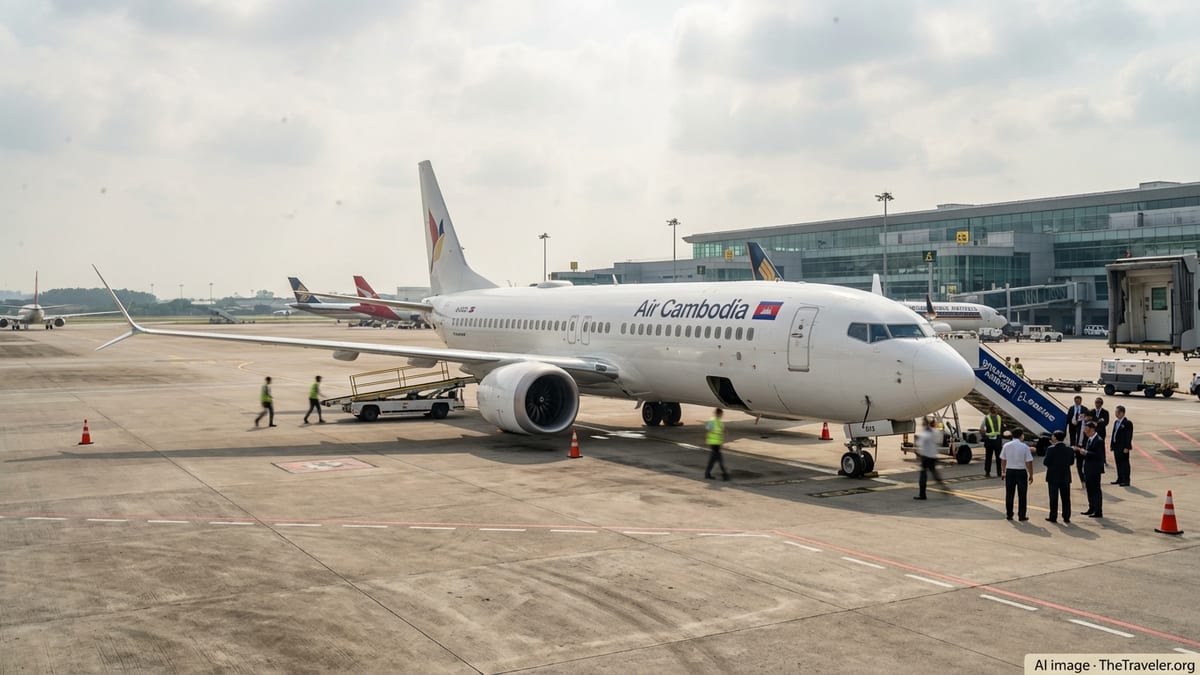
Rebranded Flag Carrier Anchors Cambodia’s Aviation Push
Publicly available information shows that Cambodia’s long‑standing national airline, Cambodia Angkor Air, has now been rebranded as Air Cambodia, with the refreshed identity tied directly to a more ambitious growth strategy. The carrier is focusing on both regional connectivity and tourism-driven routes, aligning its plans with government efforts to modernise airports and attract higher visitor numbers.
Reports from Phnom Penh indicate that the airline has already grown its network beyond traditional links to neighbouring Vietnam and Thailand, adding flights to India, China, Japan and Hong Kong. According to fleet data and company disclosures, Air Cambodia currently operates a mix of single‑aisle jets and regional aircraft on these services, reflecting a dual focus on trunk routes and thinner regional sectors that can be developed as demand rises.
This renewed push is taking place against a backdrop of steady traffic recovery. Cambodia’s international airports handled more than 6 million passengers in 2024, according to local media summaries of airport statistics, as tourism and business travel rebounded from the pandemic period. Analysts tracking the market note that rising demand is helping to justify new aircraft orders and more direct international links.
Regional Jets and New Orders Signal Long‑Term Growth
The centrepiece of Air Cambodia’s new phase is a wave of fleet investment. Boeing announced in February 2026 that the airline has placed its largest single‑aisle order to date, covering up to 20 737 MAX jets, underscoring long‑term plans to deepen regional and medium‑haul operations from Cambodia’s main gateways. The agreement highlights expectations for sustained traffic growth across Southeast Asia and connects the carrier’s strategy to broader regional fleet demand forecasts.
Alongside larger narrowbodies, Air Cambodia and its predecessor have committed to expanding their regional fleet. ATR disclosed in late 2024 that three additional ATR 72‑600 turboprops are being added under lease to the national carrier, with deliveries scheduled from 2025. The aircraft are intended to support domestic sectors and short‑haul routes across the Mekong sub‑region, where smaller, fuel‑efficient regional equipment can open new city pairs and increase frequencies.
Specialist aviation coverage suggests that the carrier also operates a small but growing group of regional jets on routes where demand and sector length exceed turboprop sweet spots but do not yet justify larger narrowbodies. This layered fleet approach allows Air Cambodia to match capacity more closely to developing markets, a key factor in improving load factors and profitability as new routes mature.
Industry observers see these moves as emblematic of a broader shift in Cambodia’s aviation profile, from a primarily inbound leisure destination served by foreign airlines to a market in which a home‑based carrier uses regional jets and turboprops to knit together secondary cities and drive outbound as well as inbound travel.
Network Expansion Taps Tourism and Business Corridors
Route planners are pairing the new aircraft with an increasingly diversified network. Schedule data compiled by aviation analytics providers show that services between Phnom Penh and major cities in Vietnam, Thailand, India and Greater China have been strengthened over the past two years, often with higher weekly frequencies and better connectivity for onward travel.
According to summaries of airline announcements, Air Cambodia has added or expanded flights linking Phnom Penh with Delhi and other Indian gateways, benefiting from the launch of a Cambodia‑India tourism year initiative designed to boost bilateral travel. Additional services to cities in mainland China, together with links to Tokyo and Hong Kong, have positioned the carrier to tap both leisure and corporate demand.
At the same time, turboprop capacity is being directed toward strengthening domestic and near‑neighbour travel. ATR’s latest delivery commitments are described as central to improving links between Phnom Penh, Siem Reap and coastal Sihanoukville, as well as short‑haul cross‑border routes into Laos and Vietnam. Travel industry reports note that better connectivity to Angkor Wat and the country’s beach destinations is a key priority for tour operators seeking to package Cambodia with other Mekong-region stops.
Traffic forecasts published by regional tourism bodies anticipate that flights touching Cambodia could grow by more than 14 percent year‑on‑year in the mid‑2020s as new aircraft arrive and recently opened airports scale up. Observers argue that Air Cambodia’s regional jet and turboprop deployments are central to capturing a significant share of this projected growth.
New Airports and Competitive Landscape Reshape the Market
Cambodia’s infrastructure expansion is giving the national carrier more room to grow. A new international airport serving Phnom Penh has been designed to handle significantly higher passenger volumes than the existing facility, complementing the Siem Reap‑Angkor International Airport that opened in 2023. Government briefings and independent analysis indicate that these projects aim to shift more regional connecting traffic through the country and reduce congestion over the long term.
The emergence of low‑cost and hybrid competitors is also reshaping the environment in which Air Cambodia is expanding. AirAsia Cambodia, which began operations in 2024 with Airbus A320 aircraft on domestic and regional routes, has increased competitive pressure on key city pairs such as Phnom Penh–Siem Reap and Phnom Penh–Sihanoukville. Other Cambodian carriers and foreign low‑cost operators are similarly targeting price‑sensitive leisure traffic.
Despite the more crowded field, regional aviation studies suggest that overall capacity to and from Cambodia still trails pre‑pandemic levels on some long‑haul markets, leaving space for incremental growth. In this context, Air Cambodia’s focus on right‑sized regional jets and turboprops, complemented by a pipeline of larger 737 MAX aircraft, is viewed as a way to strengthen its position before the next wave of international competitors scales up.
Sector analysts caution, however, that sustainable expansion will depend on disciplined capacity management, continued recovery in Chinese outbound tourism and stable regional geopolitics. Fuel prices, currency fluctuations and infrastructure ramp‑up at the new airports will also influence how quickly Air Cambodia can translate its growing fleet into lasting market share gains.
Regional Connectivity Puts Cambodia on the ASEAN Aviation Map
Beyond immediate commercial considerations, Air Cambodia’s growth is seen as part of a wider push to integrate the country more deeply into ASEAN’s aviation network. Data from regional tourism outlook reports show that cross‑border corridors involving Cambodia, such as Thailand–Cambodia and Vietnam–Cambodia, rank among the bloc’s most significant emerging travel flows.
By adding regional jets capable of linking Phnom Penh and Siem Reap to second‑tier cities across Southeast Asia and Northeast Asia, the carrier is positioned to capture itineraries that previously required multiple connections through Bangkok, Ho Chi Minh City or Singapore. This shift could help distribute tourist arrivals more evenly across Cambodia and support year‑round traffic rather than peak‑season spikes only.
Industry projections suggest that if planned aircraft deliveries and new routes proceed on schedule, the country could move closer to pre‑2020 air traffic levels within the next few years, with Air Cambodia accounting for a larger share of both inbound and outbound seats. As regional jets, turboprops and next‑generation narrowbodies join the fleet, the airline’s expansion is expected to play a central role in how Cambodia’s aviation rise unfolds.
Boeing: Air Cambodia 737 MAX order
ATR: Air Cambodia ATR 72-600 fleet expansion