


More news on this day
Air travel across Argentina faces disruption this week as workers at the National Civil Aviation Administration prepare a 48-hour protest on Thursday and Friday, a move that is expected to cause delays and schedule changes at dozens of airports nationwide.
Get the latest news straight to your inbox!
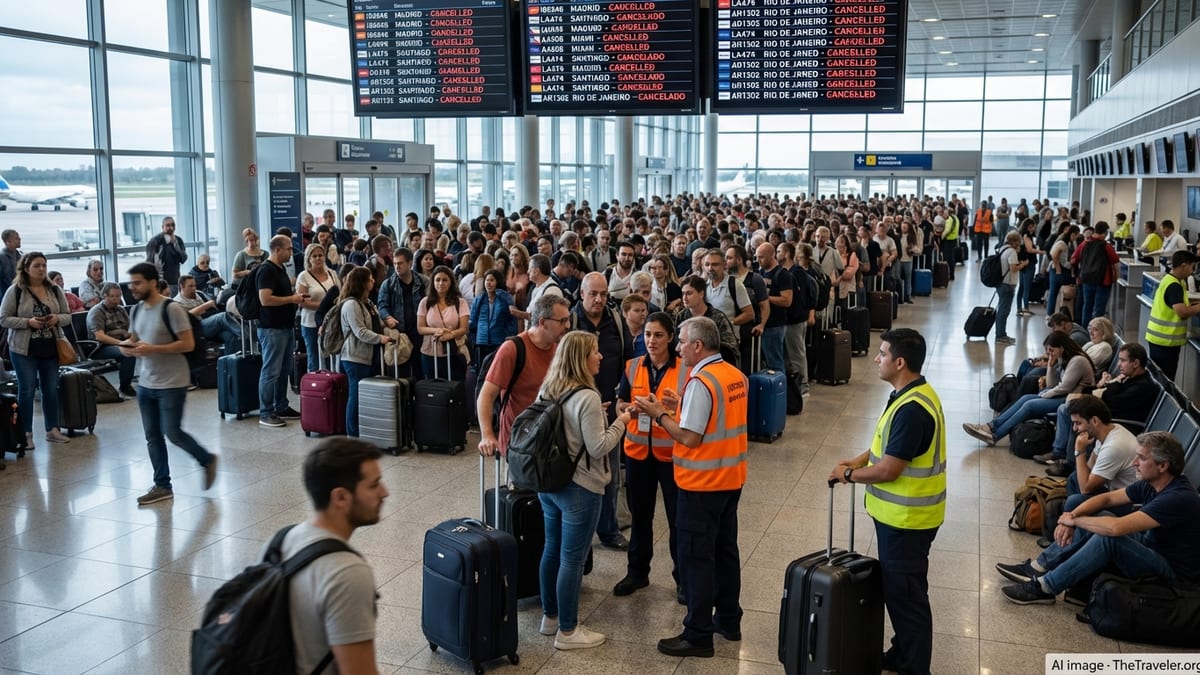
Two-day stoppage to hit peak travel periods
According to published coverage, the State Workers Association (ATE) has called a 48-hour action at the National Civil Aviation Administration (ANAC) for Thursday, September 3, and Friday, September 4, 2026. The protest will affect at least 27 of Argentina’s roughly 40 commercial airports, including the main international gateway, Ministro Pistarini International Airport in Ezeiza, and Aeroparque Jorge Newbery in Buenos Aires.
Reports indicate that work stoppages are scheduled in two daily blocks on both days: from 9 a.m. to 12 p.m. and from 6 p.m. to 9 p.m. Local media describe the plan as a combination of strikes, assemblies and on-site demonstrations that could slow airport processes and reduce available staffing during those windows.
Government information notes that aeronautical services are classified as essential, with regulations requiring that at least 75 percent of normal operations be maintained during labor conflicts. Authorities have formally notified the union of this requirement, meaning that a full shutdown of the air transport system is not anticipated, even at the height of the action.
Nonetheless, the timing of the stoppages overlaps with busy morning and evening travel periods, prompting airlines and travel advisors to warn of potential knock-on delays throughout each day as schedules are compressed into the remaining operating hours.
Who is striking and which airports are affected
The industrial action targets ANAC, the national body that oversees civil aviation operations in Argentina. Publicly available information shows that the walkout covers a broad range of state-employed airport personnel, including ground operations staff, firefighters, health workers, inspectors and administrative teams based at ANAC-managed facilities.
Because the measure is focused on ANAC staff, it does not formally include airline-employed pilots, cabin crew or privately contracted ground handlers. Industry-focused outlets note that this distinction reduces the likelihood of mass cancellations, but does not eliminate the risk of significant disruption to check-in, security, ground movements and emergency coverage at the affected airports.
Union announcements and local media reports list more than two dozen airports in line to be affected, spanning major hubs, regional capitals and smaller provincial terminals. Coverage highlights that both Buenos Aires airports are included, along with other key gateways that connect Argentina’s interior with the capital and international routes.
Travel intelligence summaries emphasize that the impact will vary by location, depending on how many ANAC staff are on duty and how airlines adjust their operations. Some airports may experience only minor slowdowns, while others could see longer queues, runway restrictions or temporary suspensions of departures during the protest windows.
Limited services guaranteed, but delays likely
Union communications cited in local reporting state that certain categories of flights will continue to receive support during the protests. These include medical and humanitarian services, organ transport operations and official government flights, which are expected to be prioritized even during the strike periods.
Government releases similarly stress that essential service rules require a baseline level of operations to be maintained. As a result, aircraft already in the air are expected to be handled on arrival, and certain critical departures may still go ahead, albeit with reduced staffing and slower turnaround times.
Aviation experts quoted in specialized coverage point out that the combination of rolling stoppages and minimum-service guarantees is likely to translate into schedule reshuffling rather than a complete halt. Airlines may bring forward or push back flights to operate outside the strike windows, concentrate services into mid-day and late-night slots, or consolidate some frequencies to manage available capacity.
However, passengers should be prepared for secondary effects such as missed connections, aircraft and crew out of position, and congestion at check-in and security in the hours immediately before and after each stoppage. Even flights scheduled outside the protest periods could experience delays if earlier disruptions ripple through the network.
What travelers with upcoming flights should do
Travel advisories recommend that anyone holding tickets to, from or within Argentina on September 3 or 4 monitor their flight status closely in the days leading up to departure. Airlines typically post real-time updates on their websites and mobile apps, and major Argentine airport operators maintain online arrival and departure boards that reflect operational changes.
Industry coverage suggests that carriers may offer rebooking options, waiving change fees for affected dates or allowing passengers to move their travel to adjacent days. International travelers with onward connections from hubs such as São Paulo, Santiago, Lima or Panama City should pay particular attention to minimum connection times and consider building in extra buffers if possible.
Travelers are also advised to arrive at the airport earlier than usual, especially for flights that fall near the start or end of the strike windows. Longer queues at security and check-in are likely if staffing levels are uneven or if additional checks are required to manage crowding around protest activities inside terminal buildings.
For those with time-sensitive journeys, such as business trips, events or medical appointments, contingency planning may include exploring alternative routes, such as connecting via nearby countries, or shifting to intercity bus or rail where practical. However, given the scale of Argentina’s geography and the concentration of long-haul flights in Buenos Aires, many international travelers may find that air remains the only realistic option, underscoring the importance of staying informed.
Uncertain outlook beyond Friday
Union representatives have signaled through public statements that the 48-hour protest is part of a broader dispute over wages, working conditions and funding for key safety services such as airport firefighting and oversight. They have also warned that, if negotiations do not progress, further measures could be considered in the coming weeks.
At the same time, official notices emphasize that the current call only covers Thursday and Friday, with no confirmed extensions as of Wednesday, September 2. Any escalation, additional strike dates or changes to the time bands would need to be formally announced and are not guaranteed.
Travel risk analysts note that Argentina has experienced periodic aviation-related labor actions in recent years involving different unions and agencies. As a result, many airlines already have contingency plans for schedule adjustments and passenger support in the event of renewed disruption.
For now, observers describe the immediate risk as concentrated on Thursday and Friday’s peak periods, with the possibility of residual delays into the weekend as airlines work to reposition aircraft and crews. Travelers planning trips later in September are encouraged to keep an eye on developments, but not to alter plans solely on the basis of the current 48-hour action unless further announcements are made.