


The dream of a polar adventure usually divides along one big question: Arctic Circle or Antarctica? Both promise ice-choked seas, surreal light and wildlife you will never forget. Yet the experiences on offer are surprisingly different in rhythm, cost, comfort and intensity. Choosing the right pole is less about which is “better” and more about which one matches how you like to travel.
Get the latest updates straight to your inbox!
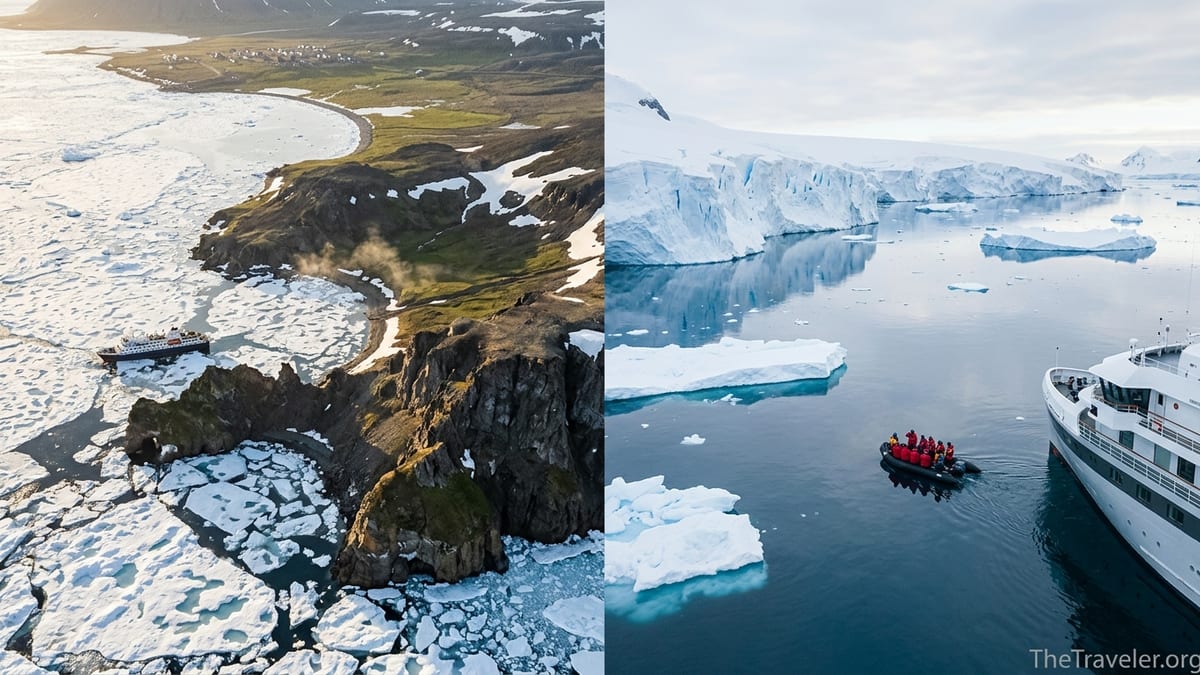
Two Poles, Two Very Different Worlds
On a map, the Arctic Circle and Antarctica look like mirror images at opposite ends of the globe. On the water, they feel nothing alike. The Arctic Circle is a region, not a single place. It spans northern Norway and Svalbard, Iceland, Greenland, Arctic Canada, Alaska and parts of Russia. Many Arctic voyages weave between small settlements, fjords and pack ice, blending wilderness with glimpses of human life and culture.
Antarctica, by contrast, is a vast, uninhabited continent. Expedition ships leaving from Ushuaia at the southern tip of Argentina typically spend two days crossing the Drake Passage before reaching the Antarctic Peninsula, an alpine coastline of glaciers and ice cliffs. Once you arrive, there are no villages, no shops, no local pubs. Landings are to research stations, penguin colonies and raw, empty bays that can feel like the edge of the world.
This difference shapes the feel of the whole journey. A July voyage around Svalbard might include a stroll through Longyearbyen’s colorful houses and a stop at an old whaling station, followed by Zodiac cruises under bird cliffs and slow navigation through pack ice in search of polar bears. An early December expedition to the Antarctic Peninsula, on the other hand, is about crossing a powerful ocean, then spending most waking hours in rubber boots, boarding Zodiacs to step onto ice and snow where almost nothing human exists.
If you imagine yourself enjoying a mix of wilderness and culture, plus more flexibility to adjust plans based on weather and ice, the Arctic Circle leans your way. If your dream is a once-in-a-lifetime feeling of complete remoteness, surrounded by towering glaciers and tens of thousands of penguins, Antarctica delivers that in a way no other place does.
Wildlife Encounters: Polar Bears or Penguins?
For many travelers, wildlife is the deciding factor. The classic Arctic Circle “headline” species is the polar bear. Summer expeditions around Svalbard with operators such as Lindblad Expeditions, Oceanwide or Hurtigruten spend days slowly working the sea ice, scanning for bears that might be hunting seals on floes. On a good trip, you may watch a bear padding across the ice from a safe distance, or observe walrus hauled out on low beaches and bearded seals resting on blue slabs of ice.
Antarctica’s icons are penguins and whales. On a typical 10 to 12 day Peninsula voyage, you might visit chinstrap and gentoo penguin colonies, and, in January or February, see fluffy penguin chicks chasing adults along snowy slopes. Humpback whales often lunge-feed around Zodiacs in peak season, and it is common to see Antarctic fur seals on rocky shorelines. Travelers who sailed with mid-sized expedition ships in the 2025 and 2026 seasons reported multiple whale sightings on almost every outing, sometimes with orcas transiting the channels alongside the ship.
The two poles also differ in how intimate the encounters feel. In the Arctic, regulations usually keep ships back from the pack ice and bears are seen from the deck or Zodiacs for everyone’s safety. The moments can still be electric, but you are always at a respectful distance. In Antarctica, landing guidelines strictly limit how close you can approach wildlife on foot, yet penguins often ignore the rules and wander right past your boots while you kneel quietly on the snow.
If your lifelong dream is to see a polar bear in its natural habitat and you are happy with a “binocular distance” encounter, the Arctic Circle is the logical choice. If you want to walk among nesting penguins, hear their calls and watch whales bubble-net feeding a few hundred meters away, Antarctica is more likely to match that mental picture.
Itineraries, Seasonality and Travel Logistics
Both regions have tight seasons, but they run at opposite times of the year. Arctic Circle voyages to Svalbard, Greenland and the Canadian High Arctic generally operate from about May to September, peaking in June, July and August when sea ice retreats and wildlife is active. That timing lets many North American and European travelers pair their trip with summer holidays. A common route is a 9 or 10 day circumnavigation of Spitsbergen from Longyearbyen, with a pre-night in Oslo and a domestic flight north.
Antarctica’s main cruise window runs from roughly late October to March, the austral summer. Early season voyages emphasize dramatic ice and pristine snow, while mid-season (December and January) sees longer days and more active wildlife. Late season in February and early March brings excellent whale viewing and more exposed rock as snow melts. Most Peninsula itineraries depart from Ushuaia, often with travelers connecting via Buenos Aires or Santiago. Door-to-door from the United States, it is common to spend two full travel days each way just reaching the ship.
Itinerary style is another key difference. Arctic Circle trips offer more variety: Svalbard-focused voyages, Greenland’s east coast and Scoresby Sund, Iceland plus Jan Mayen, or longer “Three Arctic Islands” routes combining Svalbard, Greenland and Iceland. Many ships also offer hiking, kayaking and photography-themed departures. Antarctica itineraries are more standardized: 10 to 12 days on the Peninsula, extended 18 to 21 day routes including South Georgia and the Falklands, or shorter “air-cruise” programs that skip the Drake Passage by flying from Punta Arenas to King George Island.
Those air-cruise programs are a practical example of how logistics shape experience. Operators such as Antarctica21 publish 8 day itineraries in the 2025–26 season where you fly to the South Shetlands and board a smaller expedition vessel directly, often with about 70 to 100 guests. This eliminates two days each way on the Drake, which can appeal if you are prone to seasickness or cannot spare more than about 10 days off work.
Budget, Value and Ship Comfort
Costs are substantial at both poles, but Antarctica usually requires a bigger financial commitment. Recent pricing guides from major expedition operators indicate that a genuine Antarctica cruise typically starts around 8,000 to 10,000 US dollars per person for an entry-level shared cabin on a smaller ship, with many classic Peninsula voyages priced in the 12,000 to 20,000 dollar range for 10 to 12 days. Premium suites on luxury vessels can climb above 30,000 dollars per person, particularly on long South Georgia itineraries or fly-cruise combinations.
Arctic Circle trips are still expensive but often slightly more accessible. A 9 or 10 day Svalbard expedition on an ice-strengthened ship can start in the ballpark of 6,000 to 8,000 US dollars per person for a basic cabin, rising toward 12,000 dollars or more for balcony suites or high-end small-ship product. Greenland and Canadian Arctic voyages typically cost more than Svalbard because of longer distances and charter flights, but they still tend to undercut comparable Antarctica itineraries of similar length.
Ship style has a big influence on both budget and onboard atmosphere. In the Arctic, you will find everything from older research-style vessels with fewer than 100 guests and simple cabins, through boutique expedition yachts, to new luxury ships with spas, fine dining and glass-walled lounges. Antarctica has seen a surge in next-generation expedition ships as well, with brands offering all-suite layouts, heated outdoor pools and butler service. Example brochures for the 2025–26 season show veranda suites on premium Antarctica ships priced above 20,000 dollars per person on peak holiday departures, while more modest twin cabins on older expedition vessels still exist at lower price points.
If you prioritize value and are flexible on exact ship features, the Arctic Circle often lets you get into serious polar scenery and wildlife for a bit less money, with shorter flights from Europe and, in some cases, North America. If you are prepared to invest more for a once-in-a-lifetime journey, and want cutting-edge expedition hardware with stabilizers, advanced ice class and plush interiors, Antarctica’s newer fleet offers many options.
Adventure Level, Seas and Everyday Experience
What does daily life feel like on board and ashore? In the Arctic Circle, much depends on your chosen region, but seas are often more forgiving than the Southern Ocean. Coastal voyages in Svalbard and Greenland can still be choppy, yet many days are spent in sheltered fjords. Mornings might involve Zodiac cruises among icebergs or landings to hike across tundra dotted with Arctic flowers. Afternoons could bring optional kayaking, a visit to a historic trapper’s cabin or simply quiet time watching ice floes from the observation lounge.
Antarctica adds a stronger sense of expedition. Nearly all ship-based trips to the Peninsula must cross the Drake Passage, a 600 mile stretch of open ocean that can be calm or notoriously rough. Many operators recommend bringing prescription-grade seasickness medication and planning to spend those two days reading in the lounge or attending lectures on wildlife and polar history. Once in the sheltered channels of the Peninsula, conditions often improve dramatically, but the memory of the Drake tends to define the story people tell when they return.
Both regions offer active options such as sea kayaking, in-depth photography workshops and, on some departures, camping on the ice. Prices for these add-ons vary widely but commonly range from a few hundred to around a thousand US dollars per person for a full voyage kayaking program. In the Arctic, these activities might have you paddling past blue-tinged glacier fronts in Svalbard or along Greenland’s red rock coastline. In Antarctica, you might slide through brash ice as penguins porpoise nearby and the ship looms like a white hotel beyond.
If your comfort zone includes some physical challenge but you prefer relatively gentle seas, the Arctic Circle is often kinder. If you actively want the drama and storytelling rights that come with crossing one of the world’s most infamous stretches of water, and do not mind a few days of feeling unsteady, Antarctica is a better match.
Cultural Immersion vs Pure Wilderness
One underestimated difference between the poles is culture. The Arctic Circle is home to about four million people, including Indigenous communities in Greenland, Canada and Alaska, and long-established settlements in places like Tromso and Reykjavik. Many itineraries build in time to explore these towns, visit museums and learn about Arctic traditions, from Inuit hunting practices to Norwegian polar exploration history. Some Greenland trips include visits to small communities where you might hear local choir performances in a church overlooking an iceberg-studded bay.
Antarctica has no permanent population and no Indigenous culture. Human presence is limited to scientists and support staff at research stations, plus the seasonal influx of tourists arriving by ship. When you land at a place such as Port Lockroy or a Chilean or Argentine base, the “culture” you encounter is that of international science and logistics: fuel tanks, weather instruments, and maybe a small gift shop or post office run by seasonal staff.
For travelers who want a blend of wilderness and human story, the Arctic Circle offers more layers to explore. An example would be a two week itinerary that starts in Reykjavik, sails to the remote fjords of East Greenland, stops in a small village for a cultural visit, then finishes in Svalbard with glacier walks and polar bear watching. Antarctica, by comparison, is purer wilderness. Your days revolve around ice, wildlife and weather, punctuated only by the occasional radio message about changing conditions or a visit to a research base.
If swapping stories with locals, browsing small-town bakeries in Tromso or learning about traditional Arctic hunting techniques appeals to you, the north is more satisfying. If you want to spend your entire trip immersed in a landscape where human history is a thin overlay on deep time, Antarctica is unmatched.
Choosing Based on Your Travel Style
When you strip away the romance, the choice between the Arctic Circle and Antarctica comes down to how you like to travel. If you are a first-time expedition cruiser who wants a manageable trip length, easier access from Europe or North America and a mix of activities without the full commitment of a Drake Passage crossing, an Arctic voyage is often the more practical “first pole.” A 9 day Svalbard loop with a well-known operator can fit into a standard two week vacation window, and you will still come home with images of sea ice, glaciers and possibly polar bears that feel quintessentially polar.
If you are already comfortable on small ships, or if this feels like a once-in-a-lifetime investment and you want the most dramatic possible contrast to everyday life, Antarctica might be the better fit. Many travelers describe stepping ashore on the Peninsula for the first time as almost disorienting: a silent amphitheater of ice walls, the smell and noise of a penguin colony and the awareness that the nearest city is thousands of kilometers away. The logistics are more demanding and the cost higher, but the payoff in terms of psychological distance from home can be enormous.
There is also a sequencing argument. Some seasoned travelers suggest visiting the Arctic first, then Antarctica later, because Antarctica’s theatrical landscapes can be so overwhelming that they reset your baseline for “wild.” Others argue the opposite: that the Arctic’s cultural depth, varied coastlines and changing light reward multiple return visits, while Antarctica is best saved for a single capstone journey. Ultimately, the “right” order is the one that aligns with your budget, timing and physical readiness.
If you find yourself unable to choose, consider letting availability, special offers or unique itineraries decide. For example, if you see a last-minute reduced fare on a shoulder-season Svalbard voyage in May, when sea ice is still substantial, that might be the nudge you need. Or if you come across an open cabin on a late February Antarctic Peninsula trip that emphasizes whale watching, and that matches your interests, that alignment could break the tie.
The Takeaway
Both the Arctic Circle and Antarctica deliver something increasingly rare in modern travel: the feeling that you have stepped far outside the usual map of tourism. They simply do it in different ways. The Arctic feels like a living, changing region where people, wildlife and ice coexist at the edge of what is habitable. Antarctica feels like another planet that you are allowed to visit briefly, as long as you leave almost no trace.
If your ideal polar adventure blends wilderness with culture, offers relatively flexible routing, slightly lower average costs and somewhat gentler seas, start by looking north. If your dream is to stand among penguins, cross the Drake Passage, and feel, even for a few days, like you have reached the last continent, then plan for the south and give yourself time and budget to do it properly.
Whichever pole you choose, treat it as an expedition rather than a cruise in the traditional sense. Book with a reputable operator that prioritizes safety and environmental responsibility, build in extra time at the start and end of your journey for flight disruptions, and prepare for conditions to change quickly. The ice will not always cooperate with your plans, but that unpredictability is part of what makes a polar adventure feel alive.
Most importantly, choose the adventure that excites you when you imagine yourself on deck in the cold air, watching the midnight sun hover over an Arctic horizon or the last pink light of an Antarctic evening fade behind a jagged line of glacier-covered peaks. That gut-level pull, more than any checklist, is the best guide to which polar world fits your travel style.
FAQ
Q1. Is the Arctic Circle or Antarctica generally cheaper to visit?
Antarctica usually costs more, with many classic Peninsula voyages starting around the low five figures per person, while comparable Arctic expeditions to places like Svalbard often begin a bit lower for similar trip lengths.
Q2. Which destination is better if I get seasick easily?
The Arctic Circle is often the safer choice, as many itineraries spend more time in sheltered fjords and avoid the notoriously rough Drake Passage that you must cross to reach the Antarctic Peninsula.
Q3. Can I see both polar bears and penguins on the same trip?
No single standard itinerary visits both regions. Polar bears are found in the Arctic, while penguins in large numbers are a feature of Antarctica and the subantarctic islands, so you would need separate journeys.
Q4. How long should I plan for a typical polar expedition?
Most first-time Arctic voyages run about 9 to 12 days including embarkation and disembarkation, while classic Antarctica Peninsula trips are often 10 to 12 days, with longer 18 to 21 day itineraries if you add South Georgia or the Falklands.
Q5. Do I need special fitness levels for Arctic or Antarctic trips?
You do not need to be an athlete, but you should be comfortable walking on uneven, sometimes snowy or icy ground, climbing short gangways into Zodiacs and managing stairs around the ship while wearing warm layers and boots.
Q6. When is the best time of year to visit the Arctic Circle?
Most expedition cruises operate between May and September, with June to August offering the greatest access to open water and active wildlife, plus the chance to experience the midnight sun in high-latitude areas such as Svalbard.
Q7. When is the best time of year to visit Antarctica?
Antarctic voyages typically run from late October to March. Early season highlights dramatic ice and fresh snow, mid-season brings long days and nesting penguins, while late season is excellent for whale sightings.
Q8. What kind of clothing and gear do I need for a polar cruise?
Operators usually provide waterproof boots and sometimes a parka, but you should bring a system of thermal base layers, insulating mid-layers, a windproof outer shell, warm hat and gloves, plus dry bags for camera gear during Zodiac rides.
Q9. Are polar cruises suitable for children or older travelers?
Many companies accept children above a certain age and regularly welcome active older travelers, but policies vary. It is important to check minimum ages, mobility requirements and cabin options when booking for families or multi-generational groups.
Q10. How far in advance should I book an Arctic or Antarctica expedition?
Booking 12 to 18 months ahead is common, especially for peak season dates, smaller ships and specific cabin types, although occasional last-minute deals may appear when departures are not yet full.