


Planning a trip to Argentina now involves navigating a mix of long-standing immigration rules, newer electronic systems and a surprising amount of outdated information still circulating online. This guide brings together the latest official guidance available as of November 13, 2026, and explains what tourists really need at the border today, with a special focus on the long-suspended reciprocity fees that still appear on older consular pages and agency checklists.
Get the latest updates straight to your inbox!
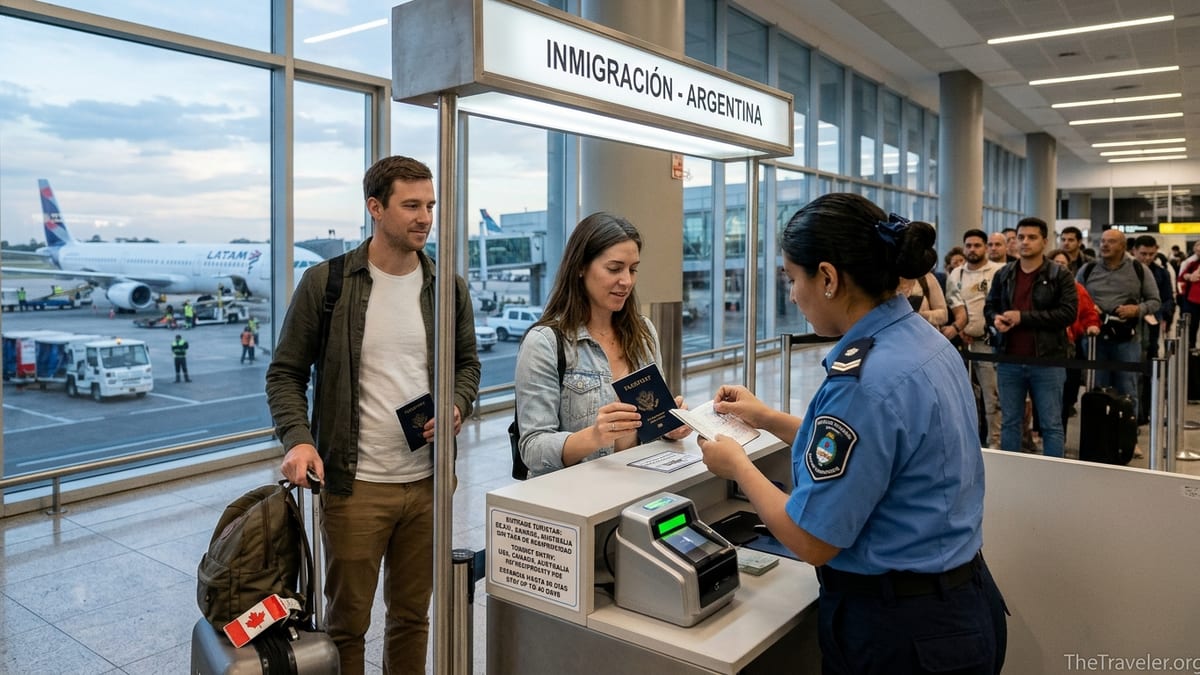
Reciprocity fees: suspended for years and still causing confusion
Argentina once charged a reciprocity fee to tourists from several countries, collected online before arrival and checked at major airports. The system applied to United States, Australian and Canadian citizens for many years and was widely documented on consular pages and visa agency websites. Travellers often still encounter these instructions when searching for “Argentina entry requirements” because many sites have not been updated or archived.
The official position changed in stages. Argentina suspended the reciprocity fee for United States citizens in 2016, for Australians in 2017 and for Canadians in 2018. A later decree exempted United States citizens from the fee for tourism and business from September 23, 2016 onward. Current consular guidance for US, Australian and Canadian passport holders, checked across multiple Argentine consulates and partner-country travel-advice pages in late 2026, no longer lists any reciprocity fee for tourist entries. Instead, they describe visa-free stays of up to 90 days and make no reference to online payment portals.
Because older instructions were often published as printable PDFs, it is common to see “official-looking” reciprocity fee notices hosted on consulate domains or on third-party visa agency sites that have not been updated for a decade or more. One example is a widely circulated form that still quotes fees of around 160 US dollars for American citizens and similar figures for Australians and Canadians. These documents are now historical. Travellers should treat any payment requirement that is not visible on the current website of Argentina’s National Directorate of Migration or a recently updated Argentine consulate as outdated and should never attempt to pay fees through third-party links that are not explicitly referenced by official immigration channels.
As of November 13, 2026, there is no reciprocity fee for United States, Australian or Canadian citizens entering Argentina as tourists or on short business trips. If an airline check-in agent, a travel agency or an old blog still refers to a reciprocity receipt, travellers should politely insist on current rules and, where necessary, ask the airline to verify directly with their station briefing or the IATA Timatic database rather than relying on printed fee charts from earlier years.
Who can visit visa-free and for how long
Most visitors from the Americas, Europe and several Asia-Pacific countries enter Argentina visa-free for short tourism stays. United States, Canadian, Australian, British and most European Union passport holders are all allowed to visit without a visa for up to 90 days, counted from the date of entry. This 90-day allowance is written into Argentina’s immigration regulations for visa-exempt nationalities and appears consistently on Argentine consular pages and on the travel advice of foreign ministries such as those of the United States and the United Kingdom.
Visa exemption covers tourism, family visits and many informal business activities such as attending meetings, conferences or trade fairs, provided the traveller remains on foreign payroll. For example, an American flying from New York to Buenos Aires for a two-week holiday in Palermo and Mendoza, staying in hotels and short-term rentals, can simply present a valid US passport and a return ticket. No visa or reciprocity fee is required, and the passport will be stamped with permission to stay up to 90 days, even if the actual trip is much shorter.
British and European Union nationals benefit from similar arrangements. A French or German tourist arriving from Paris or Madrid on a direct flight to Ezeiza is normally admitted for up to 90 days visa-free. Canadian and Australian citizens receive the same 90-day allowance. Some consulates describe the period as “up to 90 days per entry” while others refer to “90 days within a 180-day period,” but in practice border officers focus on the length of each stay and the traveller’s overall pattern of visits rather than a strict rolling calculation, particularly for classic holiday itineraries.
Travellers from countries that do require a visa must obtain permission in advance from an Argentine consulate unless they qualify for one of the special electronic or Green Card-based arrangements discussed later in this guide. Common visa-required nationalities include India, China, the Dominican Republic and many African and Asian states. For these travellers, the 90-day tourist stay usually still applies once they are admitted, but only after a visa or equivalent authorization has been granted.
Documents you must have and what officers may ask for
Argentina’s National Directorate of Migration sets general conditions for entry that apply to all foreign visitors. In all cases, travellers must arrive with a valid travel document; for most tourists this means a passport, while eligible South American citizens may enter using a national identity card. For visa-required travellers, some consulates specify that the passport must be valid for at least six months beyond the date of entry. For visa-exempt tourists like Americans and Europeans, there is no universally published six-month rule, but airlines and border officers usually expect the passport to be valid for the intended stay and, in practice, preferably several months longer to avoid problems with airline systems and onward destinations.
Return or onward tickets are an important practical requirement, though not always written in detail into legislation. Airline staff rely on carrier databases to ensure that passengers who do not hold a residence permit do not appear “one way with no exit.” At the border, Argentine immigration officers may ask to see proof of onward travel, especially if the visitor’s plans are open-ended. For example, a Canadian backpacker arriving into Buenos Aires by ferry from Colonia del Sacramento after a month in Uruguay may be asked to show a booked bus or flight out of Argentina within 90 days, or at least a flexible ticket that could cover onward movement.
Accommodation details and proof of funds also sit in a grey area between strict legal requirement and practical expectation. The law requires that tourists must be able to support themselves without working, and officers can ask how they will pay for their stay. In real terms, this often means showing a hotel reservation, Airbnb confirmation, invitation letter from a host, or at least an address where the traveller will stay, along with access to funds on a bank card. It is rare for short-stay visitors from visa-exempt countries to be asked for printed bank statements, but consulates do request them when issuing tourist visas and electronic authorizations, which indicates the standard officers may apply if they have concerns.
Since 2025, Argentina has also emphasised health coverage in its entry regulations. Updated visa guidance for US citizens, as well as regional news reports, state that tourists should have travel medical insurance covering their stay in Argentina. Some foreigners report being asked for proof of insurance at Ezeiza, especially during or after public-health alerts, while others have not been questioned. The safest approach is to carry a travel insurance certificate in print or on a device and be prepared to show it if asked, recognising that its presentation is now treated much closer to a core requirement than a suggestion.
Where you enter: airports, land borders and ferries
Most international tourists first encounter Argentine immigration at Buenos Aires’ two main airports. Ministro Pistarini International Airport (Ezeiza) handles the majority of long-haul flights from North America, Europe and Australia. Jorge Newbery Airport (Aeroparque) serves regional international routes, particularly to and from Brazil, Chile and Uruguay. Both airports follow the same national rules, but the mix of passengers can influence how closely officers inspect documents.
At Ezeiza, officers are accustomed to large numbers of visa-exempt tourists from the United States, Canada and Europe, and processing is usually straightforward when travellers have valid passports, onward tickets and accommodation details. A typical American tourist arriving on an overnight flight from Miami will present a passport, have fingerprints and a photo taken if requested, answer a few questions about the purpose and length of stay and then receive a 90-day stamp. More detailed questions tend to arise when onward plans are vague, visit patterns suggest repeated long stays, or documentation does not match the stated itinerary.
At Aeroparque and at land borders with Chile and Brazil, officers see a higher proportion of regional travellers using Mercosur or associate-country arrangements. For example, Chilean and Brazilian citizens often cross with only their national identity cards, without passports, for weekend trips to cities like Mendoza, Bariloche and Foz do Iguaçu. Long-distance buses between Santiago and Mendoza or Porto Alegre and Buenos Aires pause at frontier posts where passengers exit the bus, visit Chilean or Brazilian control and then Argentine control. Non-visa-exempt nationals who board these routes are normally checked for visas or electronic authorizations before departure, but they should still carry printouts of approvals to avoid delays at the border.
The Río de la Plata ferry route is another common entry point. High-speed ferries connect Buenos Aires with Colonia del Sacramento and Montevideo in Uruguay. Immigration for both countries is performed in the ferry terminals before boarding, often at shared control counters. For a British tourist doing a loop from Buenos Aires to Colonia and back, the experience is typically smooth: officers inspect the passport, confirm an exit ticket from South America or a longer itinerary, and stamp a new 90-day stay if the previous allowance has not been exhausted. Visa-required nationals using a ferry must carry the same visas or electronic permissions that apply at airports.
Mercosur travel with national identity documents
Argentina is a full member of Mercosur, the regional bloc that also includes Brazil, Paraguay and Uruguay, with Bolivia in the process of accession and several associate members. One visible benefit of these arrangements is simplified travel for citizens of member and some associate countries, who may enter surrounding states with their national identity cards instead of passports.
In practice, this means that a Uruguayan travelling by bus from Montevideo to Buenos Aires can show a valid Uruguayan identity card at the immigration booth rather than a passport, and still receive permission to visit for tourism or to reside under long-term Mercosur rules. Brazilian and Paraguayan citizens enjoy similar treatment. For many South American families, this turns cross-border trips into something closer to domestic travel in terms of documentation, especially when visiting border cities.
The identity-card option does not extend to nationals from outside the Mercosur and associate-country network, even if they live in the region. For example, a Colombian citizen who has obtained temporary residence in Argentina may be able to travel within Mercosur using a local identity document once fully registered, but an Indian citizen living in São Paulo cannot use a Brazilian ID card in place of an Indian passport when entering Argentina. Non-Mercosur nationals must still meet the ordinary rules for visa exemption or advance visas described elsewhere in this guide.
For tourists from North America, Europe and Asia, Mercosur is mainly relevant in two ways: first, as an explanation for why regional passengers may be presenting ID cards at the border; and second, because long-term residents who later apply for Mercosur-based residence often start as tourists and then change status with the National Directorate of Migration. However, these residence pathways require separate legal processes that sit beyond the scope of normal short-term tourism.
Tourist visas, AVE electronic authorization and the 2026 Green Card rules
Travellers from visa-required countries generally need to obtain a tourist visa in advance from an Argentine consulate. The exact procedure and fee vary by nationality and consular post, but recent guidance from Argentine consulates in North America indicates that applicants normally provide a completed form, valid passport, recent photographs, proof of employment or income, bank statements, round-trip tickets, hotel bookings or an invitation letter and, in some cases, a criminal-record certificate. Interview appointments are common, and processing times of several weeks are typical, though some consulates process straightforward tourist visas more quickly when documentation is complete.
Consular fees are published in US dollars or local currency and adjusted periodically. As an example, tourist visas for certain nationalities have recently been quoted in the range of several tens to a few hundred US dollars, depending on reciprocity agreements with the applicant’s home country. Applicants should always check the latest consulate fee schedule because older PDFs can linger online after prices change. Importantly, these visa fees are different from the historical reciprocity fees that applied to visa-exempt tourists; today’s fees apply only to those who genuinely need visas.
Argentina also operates an Electronic Travel Authorization system, known as AVE, which in some cases replaces a regular tourist visa. According to the National Directorate of Migration and multiple consular notices, AVE is available to specific nationalities that would otherwise need tourist visas but who hold certain forms of United States immigration status. Typically, eligible travellers must have a valid ordinary passport and either a valid US B1/B2 tourist or business visa, or another qualifying category such as J, O, P, E or H-1B, or they must come from a country that does not require a visa to enter the United States but has entered the country at least once in the preceding two years.
AVE is not universal. Only a defined list of nationalities can apply, set out in Argentine resolutions that are periodically updated. Many consulates highlight that travellers must first confirm that their nationality is on the AVE eligibility list before applying online, and that approval is not guaranteed. Where available, AVE allows short tourist stays of up to 90 days and requires printing an approval document to present at airline check-in and border control. Recent community reports suggest that AVE processing can be relatively quick where eligibility is clear, but the rules for some nationalities, particularly India and the Dominican Republic, have changed several times since 2024, underlining the need to check the current wording before relying on online anecdotes.
A separate development, effective from mid-January 2026 and confirmed by multiple Argentine consulates and professional briefings, introduced new entry arrangements for certain US permanent residents. Nationals of India, the Dominican Republic and the People’s Republic of China who hold a valid US Permanent Resident Card can now enter Argentina for business or tourism without an Argentine visa, for stays of up to approximately 30 days. These travellers present their passport from one of the three listed countries together with their original US Green Card at the border. Some consular notices further state that holders of specific US non-immigrant visas from these countries may also enter without a separate Argentine visa, although interpretations vary between consulates, so affected travellers should verify the exact categories that apply to them shortly before travel.
These 2026 Green Card and US visa-based arrangements are tightly limited. They do not extend to other visa-required nationalities, and they do not remove the need for ordinary tourist visas or AVE in all cases. For example, an Indian citizen living in the United States with a Green Card may be able to fly from Chicago to Buenos Aires for a short tourism stay relying solely on their Indian passport and Green Card, in line with the new rules, while an Indian citizen living in Europe without US status would still require either a consular visa or, if reintroduced for their nationality, an AVE. Because this is an evolving area, travellers from visa-required countries who hold US immigration status should always confirm the latest rules with an Argentine consulate before booking non-refundable tickets.
Extensions, overstays and how reentry works
Argentina classifies tourists as “transitory residents,” generally admitted for up to 90 days at a time. Official guidance from the National Directorate of Migration explains that tourists may apply once for an extension of their stay, typically for up to a further 90 days, by visiting Migration offices in Buenos Aires or regional delegations, paying a fee and presenting their passport and arrival stamp. The exact fee is set in local currency and adjusted periodically; travellers in recent years have reported amounts equivalent to several tens of US dollars. Applications must be made before the original period expires, and approval is not guaranteed if there are concerns about repeated long-term stays.
Overstaying without an approved extension attracts penalties. Historically, travellers who overstayed by a short period could pay a fixed fine at the airport or Migration office and still depart, though repeated or lengthy overstays could lead to bans or difficulties reentering. News reports and legal commentaries emphasise that Argentina has tightened its stance on serial overstayers, particularly digital nomads treating back-to-back 90-day entries as a substitute for residence. In such cases, officers may reduce the length of the next stay, refuse entry or advise the traveller to seek an appropriate long-stay visa.
Reentry after a trip to neighbouring countries remains common and usually straightforward for genuine tourists. An American who spends 85 days in Buenos Aires and then takes a ferry to Uruguay for a week will often receive a fresh 90-day stamp on returning if immigration is satisfied that the person is a visitor rather than a de facto resident. However, travellers who repeatedly exit for a few days only to return and stay near the maximum on each visit can expect more questions. Officers may ask about work, income sources and accommodation, and can lawfully refuse entry if they suspect that the tourist category is being misused.
For travellers on the new 30-day Green Card or specific US visa-based arrangements, the pattern appears stricter. Professional briefings note that these entries are designed for short visits and are not intended for cumulative long stays through repeated border runs. US permanent residents from India, China or the Dominican Republic who plan more than a brief holiday should discuss their plans with an Argentine consulate and secure an appropriate visa rather than relying on multiple short entries.
Real-world trip examples and practical checklists
Consider three concrete itineraries. First, an American tourist visiting Buenos Aires for two weeks from Los Angeles. This traveller books a round-trip flight to Ezeiza, reserves a hotel in the Microcentro and buys travel medical insurance that covers Argentina. At check-in, the airline verifies that the US passport remains valid for the duration of the trip and that the return flight is within 90 days. On arrival, the traveller answers basic questions about the purpose of the visit, shows the hotel address and returns ticket details if requested, and is admitted visa-free with a 90-day stamp and no reciprocity fee.
Second, a Canadian traveller combining Argentina and Chile over a five-week journey. They fly into Buenos Aires, spend ten days exploring the city and Iguazu Falls, then take a domestic flight to Mendoza and cross into Chile by bus through the Andes to Santiago and Valparaíso. Afterwards, they return to Argentina for another week in Bariloche before flying home from Ezeiza. The Canadian passport owner enjoys visa-free entry to both countries. However, they must pay close attention to their total time in Argentina, ensuring that the combined days before and after Chile remain within 90 days, and they should carry bus tickets and hotel bookings to show their route at the mountain border crossing, where officers may ask for concrete proof of the itinerary because of the multi-entry pattern.
Third, an Indian passport holder residing in the United States, planning a three-week visit to Buenos Aires and Patagonia in mid-2027. Depending on the precise rules in force at that time, and on their US status, several scenarios may apply. If the 2026 policy allowing Indian nationals with US Green Cards to enter Argentina visa-free for short tourism stays remains in effect, a permanent resident might only need their Indian passport and original Green Card to board a flight from New York to Buenos Aires for up to 30 days. On the other hand, if the traveller holds a US non-immigrant visa, such as H-1B or B1/B2, they may fall under the AVE electronic authorization system or a separate US-visa-based exemption, if applicable to Indians at that point. Because these programmes have changed more than once, the traveller should consult the nearest Argentine consulate several months in advance and obtain written confirmation of whether a consular visa, AVE or Green Card-based entry will apply to their specific case.
Across these examples, a practical on-the-ground checklist emerges. Before departure, every traveller should confirm that their passport or identity card is valid well beyond the trip dates, secure return or onward travel, keep accommodation confirmations easily accessible, and buy travel medical insurance that names Argentina among covered destinations. Visa-required nationals must also verify whether a traditional visa, electronic authorization or a special US immigration-based exemption applies to their passport well before booking. On arrival at Ezeiza, Aeroparque, a land border with Chile or Brazil, or a ferry terminal with Uruguay, they should expect basic questions about their plans and be ready to present supporting evidence, but they should not expect to pay any reciprocity fee if travelling on US, Canadian or Australian passports.
A final point concerns fraud and misinformation. The persistence of outdated reciprocity-fee instructions and cash-like payment schemes makes it easy for unscrupulous intermediaries to claim that a fee is still required and to solicit card details or bank transfers. Any website that demands payment of an “Argentina reciprocity fee” for United States, Canadian or Australian citizens for travel after 2018 is using obsolete information. Tourists should rely on the current pages of Argentina’s National Directorate of Migration and its consulates, along with recent travel-advice notices from their own governments, and should refuse to enter payment details on third-party sites that are not expressly referenced by these official channels.
Current versus outdated fee information and last-checked date
To put the evolution of Argentina’s entry charges into perspective, it is helpful to contrast current practice with historical information that still appears in search results. Before the mid-2010s, many Americans, Australians and Canadians were rightly instructed to pre-pay a reciprocity fee of roughly 100 to 160 US dollars via a designated web portal before boarding flights to Buenos Aires. Airlines would check printed receipts at check-in, and immigration officers would verify them on arrival, sometimes turning away passengers who had failed to pay in advance.
By contrast, as of November 13, 2026, multiple official sources and consular advisories confirm that no reciprocity fee is charged to United States, Australian or Canadian tourists or short-stay business visitors. Any fees now collected relate to traditional consular visas for travellers from visa-required countries, optional services such as expedited processing, or administrative penalties such as overstay fines collected by Migration offices. Put simply, a US, Canadian or Australian tourist arriving at Ezeiza, Aeroparque, a land border or a ferry terminal today should not be asked to pay any reciprocity fee, either online beforehand or at the border.
When interpreting fee tables, travellers should keep in mind that the appearance of an Argentine government logo or consular seal does not guarantee that a document is current. Many consulates have shifted to dynamic online schedules while leaving older PDF circulars available for archival purposes. The safest practice is to look for the most recent modification date on a page, confirm that it refers explicitly to the current year or recent months and, if in doubt, contact the consulate directly by email or phone to ask whether any tourist reciprocity fee applies to your nationality. Clear confirmation from official staff is the best defence against unnecessary payments and trip-disrupting surprises at the check-in desk.
This guide reflects information available from Argentina’s National Directorate of Migration, official consular communications and up-to-date foreign travel advisories as of November 13, 2026. Because immigration policy and electronic authorization schemes can change with little notice, particularly for visa-required nationalities and for travellers relying on US permanent residence or specific US visas, readers should always carry out a final check with official sources shortly before travel.