


Banff is one of those places people insist you already know. You have seen it on calendars and desktop wallpapers, in drone videos sweeping over emerald lakes and jagged peaks dusted with snow. By the time my flight landed in Calgary and the shuttle bus rolled toward the Rockies, I thought I was inoculated against surprise. Then the mountains rose around the Bow Valley like a closing hand, and I realized every picture I had seen had lied by omission. Banff looks like a postcard, yes, but the raw scale of the mountains still shocked me when I was standing at their feet.
Get the latest updates straight to your inbox!
First Impressions on the Bow Valley Parkway
The first real glimpse of Banff’s drama happens before you even reach town. The highway from Calgary follows the Bow River into the Rockies, and somewhere past Canmore the valley narrows, the walls steepen, and Cascade Mountain appears in the windshield like a fortress. On paper, it is just another 2,998 meter summit in Banff National Park, a number you might glance at in a guidebook and forget. In person, it feels impossibly vertical, slabs of grey limestone stacked to the sky, with avalanche chutes carved like scars down its flanks.
Many visitors arrive on an airport shuttle or rental car and pull into the first viewpoint at the Hoodoos or Surprise Corner on the edge of town. These are the spots that show up endlessly on social media: the Bow River bending in a turquoise arc beneath Mount Rundle, the Fairmont Banff Springs sitting like a castle at the forest’s edge. Even here, still jet-lagged and fiddling with camera settings, there is a sense that the scale is out of proportion. Cars in the parking lot shrink to toys. Hikers on the far shore are invisible. A telephoto lens compresses everything into a tidy frame, but when you drop the camera, the mountains occupy your entire field of vision.
Banff itself is compact and walkable, a town of a few blocks pressed into the valley floor. The official tourism board likes to point out that you can cross the townsite in about 15 minutes on foot, and that feels about right. At street level, it resembles other alpine resort towns: gear shops selling down jackets, cafés pulling espresso, buses on Roam Transit gliding past with photos of elk printed along their sides. Look up for even a second, though, and the illusion of normalcy shatters. Buildings are only one or two stories; above them rise rock faces so tall it is hard to believe they fit in the same world as the souvenir shops.
Riding the Banff Gondola Into the Sky
If you want proof that postcards cannot capture scale, ride the Banff Gondola up Sulphur Mountain. The gondola is hardly a secret: it is one of the most popular attractions in the national park and in 2026 a standard adult ticket typically ranges from about 90 to 95 Canadian dollars at peak summer times, with dynamic pricing that can drop a little lower on early mornings or shoulder season days. Buying online in advance is almost essential in July and August, when cars back up on Mountain Avenue and same-day time slots fill quickly.
The eight-minute ride climbs nearly 700 meters above the townsite, and it is here that the dimensions of the Bow Valley finally hit home. As the cabin glides over the forest, the town shrinks into a neat grid beside the river. You can pick out the football field, the Banff Centre buildings on the hillside, and the long curve of Banff Avenue. By the time you reach the upper station at around 2,281 meters, the view is a full 360 degrees: ranges stacking to the horizon, peaks like Cascade, Rundle, and Bourgeau now eye-level instead of looming overhead.
At the summit complex, many visitors head straight for the rooftop deck and the Sky Bistro restaurant, where a burger or Alberta steak costs more than it would in town but comes with a panorama that makes the surcharge feel almost rational. Others follow the wooden boardwalk to Sanson Peak, a short stroll that feels longer only because you keep stopping to stare. Even on a clear summer evening, there is wind on the ridge and a chill in the air, a reminder that you are standing in the high mountains without having taken a single step on a trail.
The shock of scale is not just visual. Standing on the observation deck during a busy afternoon, it is striking how small human noise becomes. You hear snippets of conversation in half a dozen languages, the soft hum of the cable machinery, the clatter of plates inside the café. But beyond the railings there is silence. Cliffs and glaciers swallow sound. The realization settles in: the postcard view is real, but you are the speck in the picture, not the subject.
Lake Louise and Moraine Lake: Famous, Crowded, Vast
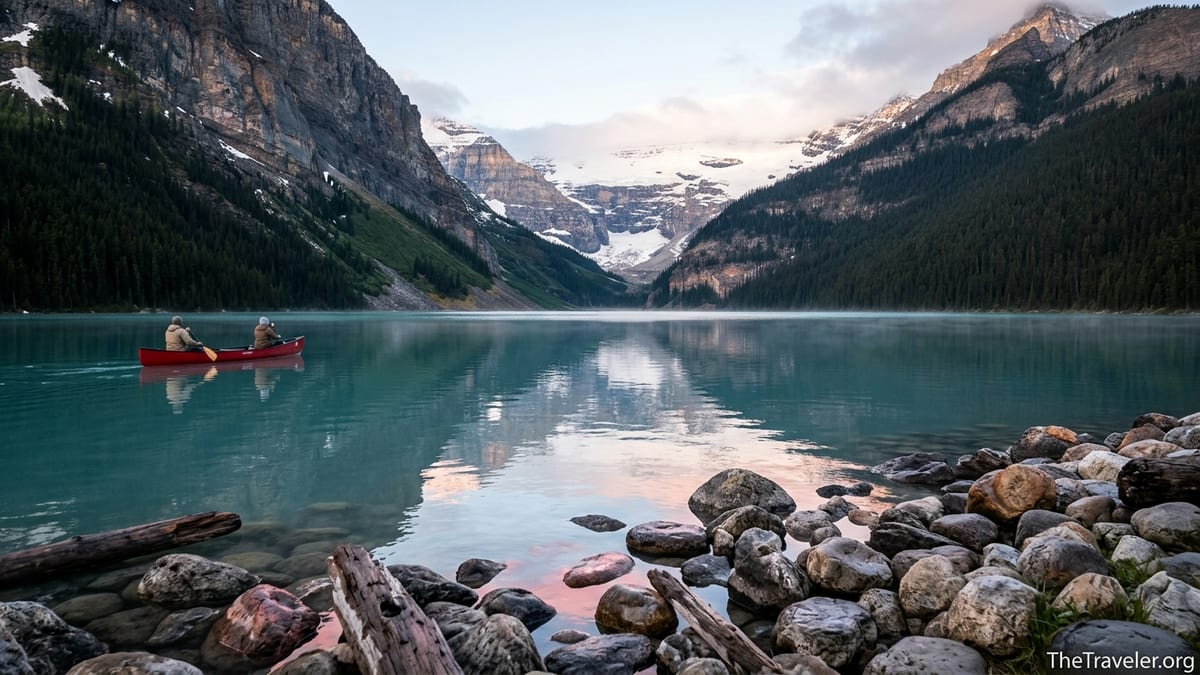
Lake Louise and Moraine Lake might be the most photographed lakes in Canada. Every angle has been posted and reposted on travel accounts, from the classic canoe-on-emerald-water shot to long-exposure images of alpenglow on the Ten Peaks. Yet the first time you step off the Parks Canada shuttle at either shoreline, the sheer size of the amphitheater around you is dizzying. The turquoise water is real, but what the lens flattens is the height of the surrounding walls, cliffs lifting more than a kilometer straight up from the lake.
Reaching these lakes now requires more planning than it did a decade ago. Private vehicles are no longer allowed at Moraine Lake, and at Lake Louise, paid parking during the shuttle season can cost more than 30 dollars a day, with rates updated by Parks Canada as traffic management evolves. Most travelers opt for the shuttle system from the Lake Louise Park and Ride, where a reserved round-trip ticket has recently been around 8 dollars per adult and 4 for seniors, while youths ride for free. These figures are based on 2025 pricing, and final 2026 rates may change slightly, but the principle is clear: buses, not private cars, move the crowds now.
On a peak summer morning, the shorelines are busy by 8 a.m. Photographers set up tripods near the water, day hikers tighten boot laces for the Plain of Six Glaciers or Larch Valley trails, and families cluster near the canoe docks, where an hour on the water can easily cost over 150 dollars for a small group. It is a reminder that Banff is not a budget destination, especially in July and August. Yet even with the crowds, there are moments when the human presence recedes. Paddle 10 minutes away from the dock at Lake Louise, and voices blur into a soft murmur against the clunk of your paddle on the gunwale and the distant hiss of meltwater spilling from the Victoria Glacier.
For many people, the first serious encounter with Banff’s vertical scale happens on the Lake Agnes or Plain of Six Glaciers trails. These are not technical routes, just moderately steep hikes that most reasonably fit travelers can manage in a few hours. The payoff is an elevated vantage point above the lake, where canoes become colored dots and the hotel reduces to a pale rectangle at the far end of the valley. Standing at the Plain of Six Glaciers teahouse, cradling a mug of hot chocolate that cost more than it would in town because every ingredient is helicoptered or hauled in, you can hear distant cracks from seracs shifting on the glacier across the valley. Nature here is not just scenery, it is moving machinery on a titanic scale.
Walking Banff’s Streets Under Towering Walls
One of the strangest experiences in Banff is how quickly you can move between ordinary errands and otherworldly vistas. You can walk out of a grocery store on Banff Avenue with a bag of bagels and a carton of milk, and in the time it takes for the automatic doors to slide closed, your eyes are pulled up toward Mount Rundle, whose east face runs like a stone blade along the valley. The mountain is so close that in certain spots, like the Bow River bridge beside Central Park, it feels as if it is leaning over the town.
The town’s compact layout accentuates this feeling. Most visitors stay in small hotels and lodges clustered along Banff Avenue, Spray Avenue, or Tunnel Mountain Road. A typical summer room rate can easily land in the 350 to 500 dollar range per night at midrange properties, and significantly higher at luxury hotels such as the Fairmont Banff Springs. Step outside one of these properties at sunrise, when many day trippers are still on the highway from Calgary, and Banff briefly feels like a village again. Delivery trucks rattle down the back lanes; a few locals bike to work; elk sometimes graze on the town’s edge like they own the place.
From town, even short walks reveal the valley’s proportions. The paved path along the Bow River below the Banff Springs leads to Bow Falls, where the river spills down wide rocky ledges. Upstream, a short climb to Surprise Corner offers one of the best perspectives on how the town fits into the landscape. The hotel, which looks enormous in brochure photos, suddenly seems modest: a blocky stone shape perched on a forested shoulder, framed by the broad pyramid of Sulphur Mountain and the slabs of Tunnel Mountain opposite.
Because Banff is small and parking is increasingly restricted in peak times, local officials encourage walking, cycling, and the use of Roam Transit buses. A day pass costs only a handful of dollars and can connect you to nearby sites like the Cave and Basin National Historic Site, the gondola base, and the trailheads at Tunnel Mountain. For visitors used to driving everywhere, leaving the car parked and moving under your own power is part of absorbing the scale of the place. Distances that look modest on a map can feel vastly different when measured under the gaze of 3,000 meter peaks.
On the Trail: Where Scale Turns Personal
It is surprisingly easy in Banff to experience the mountains without ever really entering them. You can ride gondolas, stand at viewpoints, and wander lakeshores in sandals. But the real shock of scale arrives when you commit to a trail that gains serious elevation. Even a relatively accessible hike like Sulphur Mountain, which climbs around 655 meters over 5.5 kilometers, changes your relationship with the landscape. What looked like a clean grey tower from town becomes a series of forested switchbacks, open slopes, and rock outcrops, each corner revealing wider slices of the valley below.
On early season hikes in late May or June, there may still be snow and icy patches in shaded sections, while higher passes can hold snow well into July. Travelers often underestimate how quickly conditions change with elevation. In Banff town it might be 20 degrees Celsius and sunny, while a couple of hundred meters higher a cold wind demands gloves and a jacket. Roam Transit buses and Parks Canada shuttles make reaching trailheads easier, but they do not flatten the mountain. The vertical meters are real, whether on the switchbacks of the Cory Pass trail or the high traverse over Sentinel Pass above Moraine Lake.
Wildlife encounters also drive home the park’s scale. Bears, elk, and bighorn sheep are not mythical postcards mascots; they are residents of a huge protected landscape that happens to tolerate human passage. Parks Canada signage reminds hikers to carry bear spray, make noise on the trail, and keep at least 100 meters from bears if spotted. In crowded areas near Lake Louise or Johnston Canyon, staff sometimes implement temporary area closures or require hikers to travel in groups of four in sensitive wildlife corridors. These rules can surprise first-time visitors but are a direct response to the reality that Banff is more than a scenic backdrop. It is a functioning ecosystem measured in square kilometers, not selfies.
For those willing to spend a night or two in the backcountry, the sense of scale deepens. Permits for designated campsites must be reserved months in advance, and sites are limited, but the payoff is waking to alpenglow on unnamed peaks with no one else in sight. The distances involved are not extreme by expedition standards, often 10 to 15 kilometers a day, yet watching a storm roll across a ridge or hearing rockfall echo down a remote valley makes it clear you are a visitor in a landscape that would barely notice if the roads and hotels vanished.
Practical Realities Behind the Postcard
The romantic vision of Banff as a pristine alpine hideaway bumps quickly into practical concerns, especially in an era of record visitor numbers. Parks Canada estimates more than four million people now visit Banff National Park annually, which puts immense pressure on roads, parking lots, and popular viewpoints. As a result, visiting in 2026 requires more deliberate planning than older guidebooks might suggest. A valid Parks Canada park pass is required for almost every day you spend in the park outside simple through-travel on the Trans-Canada Highway, and tickets are checked at entry gates and sometimes at parking areas.
Costs add up quickly. A single adult day pass in early 2026 has been listed around the low teens in Canadian dollars, with slightly discounted rates for seniors and free entry for youths. Multi-day or annual Discovery Passes can be cost effective if you will spend a week or more in multiple national parks. Then there are transportation costs: shuttles to Lake Louise and Moraine Lake, Roam Transit day passes, occasional taxis for late-night returns when buses stop running. A couple staying five nights in Banff, riding the gondola once, visiting both marquee lakes by shuttle, and eating mostly in casual restaurants should not be surprised by a total trip budget in the low thousands of dollars, excluding flights.
Crowding is a reality in high season, but it is not uniform. Banff Avenue on a Saturday evening in August can feel like a small city, with lineups out the door at popular pizza spots and a 30 minute wait for a table on a patio. Yet 15 minutes away on a side trail near Two Jack Lake or along the Fenland loop, you might pass only a handful of people. The difference lies in how far you are willing to step off the main tourism conveyor belt. Early starts help. Arriving at the Lake Louise shuttle parking by 6 a.m. or catching the first gondola slot of the day can mean quieter experiences and softer light that makes the mountains feel even more outsized.
Season matters too. In shoulder seasons such as late May, early June, September, and October, hotel rates can dip noticeably compared to peak summer, and attractions like the Banff Gondola sometimes offer slightly lower prices and shorter lines. In October, golden larch trees blaze on high slopes, and there is often fresh snow dusting the peaks while the valley floor remains mostly clear. Winter, meanwhile, turns Banff into a different kind of postcard, one dominated by ski hills like Mount Norquay, Sunshine Village, and Lake Louise Ski Resort. Lift tickets, gear rentals, and hotel prices follow their own seasonal logic, and the mountains feel even more massive when half-buried in snow.
The Takeaway
Travelers arrive in Banff already familiar with its most iconic views, yet the experience of being there remains bracingly new. The photographs do not lie, exactly; they just leave out what it feels like to tilt your head back until your neck protests and still not see the tops of the cliffs, or to ride a gondola that makes a thousand vertical meters vanish in minutes. They do not capture the low roar of a crowded shuttle parking lot giving way to silence only a few hundred meters up a trail, or the way your own plans start to feel small compared with the scale of the valleys.
Banff’s postcard perfection is real and easily accessed: you can step off a plane in Calgary in the morning, be on the Banff Avenue bridge by lunchtime, and ride a gondola to an alpine ridge before dinner. What takes longer to absorb is the three-dimensional depth of the place. It extends far beyond the edges of every frame you have seen online. The mountains here are not simply scenic walls, they are the architecture of an entire ecosystem and the backdrop to a community figuring out how to welcome millions of visitors without losing what makes the valley special.
For anyone planning a first visit, the most useful mindset is a blend of preparation and humility. Book the shuttles, tickets, and hotel rooms early. Budget realistically. Leave the car parked when you can. But also leave space in your itinerary for the unplanned moments, the times when you round a bend in the Bow River trail or crest a hill above Moraine Lake and your sense of scale has to be rewritten in an instant. Banff still looks like a postcard from afar, but when you stand beneath its mountains, you finally understand that the picture was never big enough.
FAQ
Q1. Do I really need a park pass to visit Banff in 2026?
Yes. With very limited exceptions for vehicles simply passing through on the Trans-Canada Highway, every visitor stopping in Banff National Park needs a valid Parks Canada park pass for each day in the park. Passes can be purchased at park gates, visitor centers, and online in advance.
Q2. How much should I budget for the Banff Gondola?
In peak 2026 summer dates, adult round-trip tickets often run in the 90 to 95 Canadian dollar range, with youth tickets cheaper and children under a certain age typically free. Prices are dynamic and can be lower during off-peak times or seasons, so it is wise to check current rates and book ahead.
Q3. Is it possible to see Lake Louise and Moraine Lake without a car?
Yes. Parks Canada shuttles run from the Lake Louise Park and Ride to both lakes during the main season, and Roam Transit routes connect Banff town to Lake Louise village. Many visitors now use these services exclusively, since Moraine Lake is closed to private vehicles and Lake Louise lakeshore parking is expensive and often full early.
Q4. When is the best time of year to avoid crowds in Banff?
Late May, early June, September, and early October usually see fewer visitors than July and August, while still offering mostly accessible trails and services. Winter is quieter again away from ski resorts, though some roads and high hikes close or become avalanche terrain.
Q5. Are the iconic turquoise lakes really that color in person?
Yes. On clear days in late spring through early fall, lakes like Louise, Moraine, and Peyto glow an intense turquoise due to fine glacial sediment suspended in the water. Overcast skies or late-season snow can mute the color somewhat, but the effect is still striking.
Q6. How expensive is food in Banff?
Expect higher prices than in many Canadian cities. A casual sit-down meal can easily cost 25 to 35 dollars per person before drinks, and even takeaway items like sandwiches or burgers often exceed 15 dollars. Dining at popular hotel restaurants or at the top of the gondola will be more.
Q7. Do I need a car to explore Banff properly?
Not necessarily. Many visitors now combine airport shuttles from Calgary with Roam Transit, Parks Canada shuttles, and walking or cycling in town. A car remains useful if you plan to explore further afield or outside peak shuttle seasons, but it is increasingly optional, especially in summer.
Q8. What kind of clothing should I pack for a summer trip?
Layers are essential. Even in July and August, mornings can be chilly, afternoons warm, and higher elevations windy and cool. Pack a light insulated jacket, rain shell, moisture-wicking base layers, sturdy footwear, hat, and gloves if you plan higher hikes.
Q9. Is Banff safe for wildlife encounters?
Banff is generally safe if you follow Parks Canada guidelines: keep your distance from all animals, store food properly, carry bear spray when hiking, and never feed wildlife. Most encounters are brief and uneventful, but this remains a wild landscape where animals have priority.
Q10. How many days do I need to experience the main highlights?
Three full days is enough to see the Banff townsite, ride the gondola, and visit one of the major lakes. Five to seven days allows a more relaxed pace, with time for both Lake Louise and Moraine Lake, a couple of substantial hikes, and perhaps side trips to places like Yoho National Park or the Icefields Parkway.