


Bengaluru’s Kempegowda International Airport sits more than 35 kilometers from the city’s core, and how you get there can easily add or subtract an hour from your journey. With the long-awaited Namma Metro Blue Line to the airport under construction and premium Vayu Vajra buses still doing most of the heavy lifting, it is worth understanding what actually works on the ground in 2026, and how things are likely to change once the metro opens.
Get the latest updates straight to your inbox!
The Airport Metro Project: What Is Being Built
The long-discussed Bengaluru airport metro is officially the Blue Line of Namma Metro, a 58 kilometer corridor that will eventually run from Central Silk Board in the south, along the Outer Ring Road tech belt, through KR Puram and Hebbal, and all the way to Kempegowda International Airport. The airport stretch is part of Phase 2A and 2B, designed specifically to take pressure off the choked Hebbal and Ballari Road corridors.
On the ground in mid 2026, construction is visible at multiple elevated stations such as HBR Layout, Ibbaluru and Doddajala, as well as along the highway median leading to the airport. Official communication in recent months has continued to reference a broad target of late 2026 to late 2027 for different parts of the Blue Line to open, with the Outer Ring Road section expected before the full airport branch. However, frequent local reporting and commuter commentary suggests that some viaduct and station works, especially on the northern airport leg, may extend beyond those optimistic timelines.
For travelers, the practical translation is simple: there is no operational metro to the airport yet, and none is expected in the next few months. Even when test runs begin, full commercial service with convenient airport check-in style features may take additional time. Anyone planning a trip to Bengaluru in 2026 should still expect to rely on buses, taxis, and private cars to reach the terminals.
Once complete, the Blue Line is expected to offer a one-seat ride from dense employment hubs like Bellandur, Marathahalli and Manyata Tech Park to airport-adjacent stations in under an hour, turning what is currently a 90 to 150 minute peak-hour taxi crawl into a predictable commute. But for now, the Blue Line remains a future solution that is shaping planning decisions today even though travelers cannot yet board it.
How Airport Access Works Today
Today, every passenger arriving at or departing from Kempegowda International Airport has three realistic options: taxi or ride-hail, the BMTC Vayu Vajra airport bus network, or a private pickup or drop by car. There is no direct suburban rail or metro platform connected to the terminal buildings, and auto rickshaws are not allowed inside the inner airport pickup zone.
Most first-time visitors default to app-based cabs ordered from Ola, Uber or local rivals. A typical daytime fare from central areas like MG Road, Indiranagar or Koramangala to the airport ranges from roughly ₹900 to ₹1,400 in a regular sedan, depending on traffic and surge pricing. In rush hour or during rain, locals commonly report door-to-door journey times of 1.5 to 2.5 hours from the city’s tech corridors, especially if they have to cross bottlenecks at KR Puram, Tin Factory or Hebbal.
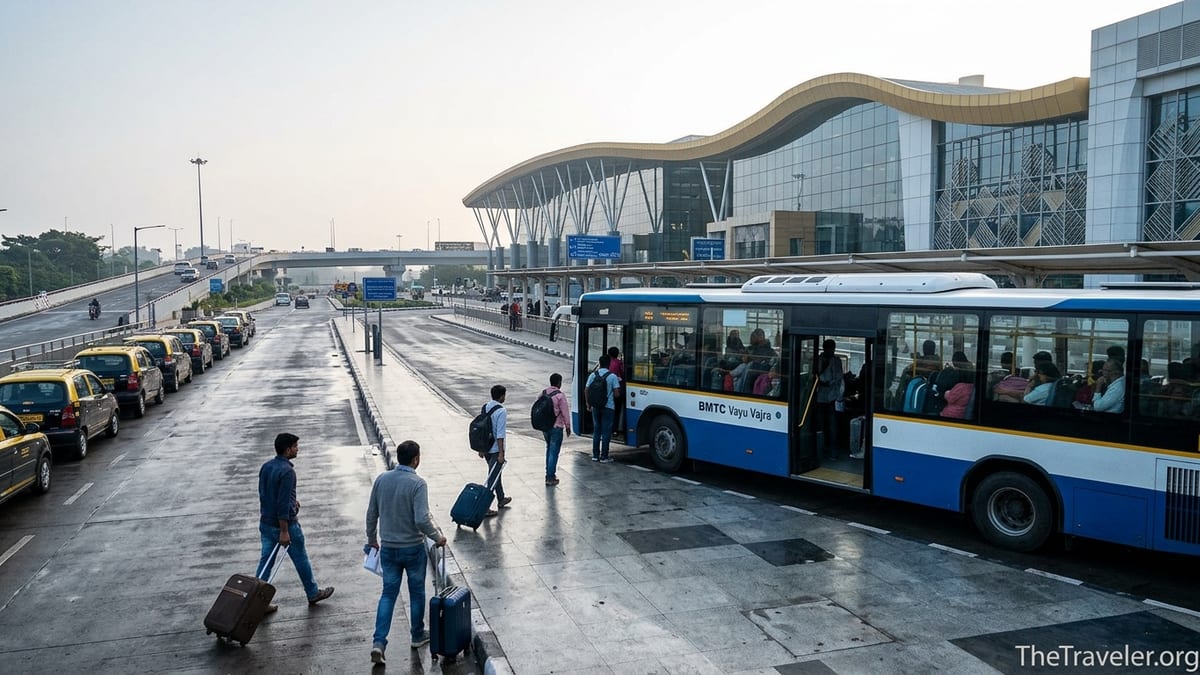
Those looking to save money or avoid surge pricing increasingly turn to the dedicated BMTC airport bus services branded as Vayu Vajra. These air-conditioned buses use larger luggage holds, run 24/7 across multiple corridors, and offer a fixed, transparent fare by origin point. For a solo traveler commuting from Bannerghatta Road or Whitefield, the savings can be meaningful compared with a solo cab, particularly at night when Vayu Vajra frequencies remain reasonably robust on the busiest routes.
Many Bengaluru residents also arrange airport runs by private car, often timing their departure very conservatively. A family in Yelahanka may leave home only 60 minutes before departure for a domestic flight, while a couple in Electronics City might comfortably budget three hours or more from home to security. This large spread in planning reflects how unpredictable road congestion can be on certain stretches like the Outer Ring Road and the Hebbal flyover.
Understanding the Blue Line’s Future Airport Connectivity
When complete, the Blue Line airport metro will change not just how people reach the airport but how they choose where to live, stay and work in the city. From a traveler’s perspective, the most important future detail is that this line is planned to run directly to the airport area rather than stopping several kilometers short. Station names like Doddajala highlight how the metro will follow the highway alignment north from Hebbal toward the airport campus.
Early route plans show the Blue Line weaving together several of Bengaluru’s densest employment corridors: Central Silk Board in the south, the Outer Ring Road stretch past HSR Layout, Bellandur, Marathahalli and Mahadevapura, onward to KR Puram and then further north via Nagawara and Hebbal. This means that a guest staying in a business hotel near Bellandur or Doddanekundi could, in theory, walk or take a short auto to a Blue Line station and then ride all the way to the airport without changing lines.
Travel time estimates vary because final operating speeds and stop patterns have not been announced. However, extrapolating from current Namma Metro averages, local transit observers expect a Silk Board to airport run to take under 60 minutes, and a KR Puram or Hebbal to airport run in the range of 25 to 40 minutes once express frequency ramps up. That would make the metro competitive not just with buses but also with taxis for any trip made during waking hours when the roads are busy.
One subtle but important change will be how early-morning and late-night flights connect. Today, many international departures between midnight and 4 a.m. rely on taxis because even though Vayu Vajra services run 24 hours, waiting 40 to 60 minutes for a bus at 2 a.m. can feel uncertain. With a future metro, if operating hours extend from early morning until close to midnight, travelers landing in the late evening could comfortably ride the metro into the city, connecting to last-mile cabs or autos from major stations like KR Puram or Silk Board.
Vayu Vajra Airport Buses: The Workhorse of 2026
Until trains start rolling, BMTC’s Vayu Vajra airport buses remain the most important public transport link to Kempegowda International Airport. Operated with air-conditioned Volvo or similar premium coaches, these buses are identified by route numbers beginning with “KIA,” such as KIA-5, KIA-7A, KIA-9H, KIA-14 and KIA-17. They run from early morning through the night, with key routes offering 24/7 coverage.
Fares on Vayu Vajra are higher than ordinary city buses but still markedly lower than most taxi rides. In 2026, a typical one-way adult fare from inner south Bengaluru areas like Bannerghatta Road to the airport on a direct KIA-14 bus is reported around ₹330. From closer intercept points such as Hebbal Bridge on the northern side, a KIA-9H ticket may cost roughly ₹150 to ₹220, reflecting the shorter distance. Ticket prices generally bundle in tolls and allow standard airline-size luggage in the underfloor hold at no extra cost.
For example, a traveler staying in a hotel near MG Road can take a short auto to the BMTC stop where KIA-5 or a similar route passes every 30 to 60 minutes. From there, the ride to the airport may take 60 to 90 minutes depending on traffic, but the fare typically remains in the ₹300 range, compared with a ₹1,000-plus app cab. Students and solo backpackers often emphasize that even with two pieces of checked luggage, the buses remain comfortable, with reclining seats and onboard air conditioning.
On the digital side, planning a Vayu Vajra journey is easier than it used to be. The official “Namma BMTC” mobile app and several independent tools help riders find the nearest KIA bus stop and check recent schedules. At the airport itself, signboards in the arrivals area direct travelers from the baggage claim toward the Vayu Vajra parking bays, where a small BMTC kiosk typically displays updated route charts and departure boards. It is still wise to arrive 15 to 20 minutes before your preferred departure, especially at night, in case the previous bus is full or running late.
Other Current Options: Taxis, Private Cars and Emerging Hacks
Despite the bus network, taxis continue to carry a large share of airport traffic, especially among groups or travelers with heavy luggage. App-based fleets line up at clearly marked pickup zones outside both terminals, and passengers book rides via their smartphones after reclaiming baggage. The exact fare depends on the time of day and platform, but it is common to see two friends splitting a ₹1,200 ride from Indiranagar or Koramangala instead of each paying for a bus ticket plus last-mile autos.
One common local “hack” to keep taxi costs down is to combine a short cab ride with a Vayu Vajra hop. A traveler from Electronic City, for instance, might book an intra-city cab or auto to the Silk Board or BTM Layout intercept point, then board a KIA bus from there. This reduces the total bill compared with a direct taxi from the far south, while still avoiding complex multi-bus transfers on regular city routes. A similar pattern is visible around Whitefield, where riders use local transport to reach KR Puram or Hebbal and then transfer to an airport bus.
Private vehicles remain a mainstay for airport access, especially for families and business travelers who have a driver. Parking at the airport is priced to encourage shorter stays, so many residents prefer to be dropped off rather than leaving a car overnight. Parents dropping a student for an early-morning international flight often leave home in south Bengaluru around midnight, using the relatively open roads to reach the airport in under 90 minutes and then driving back empty once the passenger has checked in.
Ride choices also shift with the time of day. In the middle of the afternoon, when Outer Ring Road congestion can spike unpredictably near Marathahalli, it is not unusual for Bengaluru-based frequent fliers to state that they would rather take a slightly slower but predictable Vayu Vajra from Hebbal or KR Puram than sit in a meter-running cab that might crawl for half an hour past a single bottleneck.
How Access May Change Once the Metro Opens
The opening of the Blue Line will alter the logic of airport access in several ways, even if Vayu Vajra buses and taxis remain important. First, the balance between time and cost will shift for many segments of the city. A software engineer living near Bellandur today might accept a 90 minute, ₹1,000 taxi to the airport as a necessary inconvenience. In a metro-enabled future, that same person could walk to the nearest Blue Line station, tap in with a travel card, and reach the airport in perhaps 45 to 55 minutes for a much lower fare.
Second, hotel and office location decisions will increasingly factor in metro proximity rather than pure road access. Airport-bound business visitors may choose to stay near Outer Ring Road stations where they can reliably reach morning meetings and evening flights without worrying about flyover closures or holiday traffic. For example, a consulting team with back-to-back client visits in Mahadevapura and a late-night departure might book rooms near a Blue Line station instead of in the traditional CBD around MG Road.
Third, the role of Vayu Vajra itself is likely to evolve. Rather than completely disappearing, the airport buses may reorient as feeder services linking neighborhoods that sit beyond walking distance of Blue Line stations. A future traveler from HSR Layout’s inner sectors, for instance, could take a short BMTC or auto ride to a metro station, ride the train to the airport, and use buses only for short local connections instead of trunk-line coverage all the way to the terminal.
Finally, airport planning and passenger experience inside Kempegowda will adapt to a metro-connected reality. While exact details are still emerging, airports elsewhere in India that gained metro access, such as in Delhi and Hyderabad, eventually developed clear wayfinding from the train platforms to check-in counters, dedicated security lanes for metro-arriving passengers in some cases, and integrated signage encouraging public transport. Travelers can expect Bengaluru to follow a similar model, gradually making the metro the intuitive first choice for anyone without excessive baggage or mobility constraints.
Practical Planning Tips for 2026 Travelers
For trips in 2026, the most reliable strategy is to build your airport plan around current infrastructure while quietly tracking Blue Line milestones if your travel dates are far in the future. As of July 2026, anyone flying in or out of Kempegowda should assume that buses, taxis and cars will handle the entire journey and that metro will only assist indirectly, for example by getting you to a Vayu Vajra boarding point at KR Puram or Hebbal.
If you are budget-conscious and traveling light, aim to use a Vayu Vajra route that passes reasonably close to your origin. A solo traveler staying near IIM-Bangalore on Bannerghatta Road, for instance, can walk or auto to a KIA-14 stop, pay around ₹330, and ride directly to the terminal in comfort. From central areas like MG Road or Cubbon Park, routes such as KIA-5 or KIA-7A remain convenient options, with frequencies that can be checked through the BMTC channels or local journey-planning tools.
On the other hand, if you are a family of four with multiple check-in bags and a late-night international departure, the convenience of a door-to-door taxi may be worth the extra cost, especially from neighborhoods that are not on a direct Vayu Vajra line. In such cases, booking ahead and padding your departure by at least 30 to 45 minutes beyond what the app predicts for travel time can help absorb unexpected congestion around bottlenecks like Hebbal or the airport trumpet interchange.
Whichever mode you choose, it is important to factor in airport processing times. Domestic passengers are typically advised to arrive at least two hours before departure, and international passengers at least three hours. That means a 7 a.m. domestic flight from Bengaluru often requires leaving central areas like Indiranagar around 3:30 to 4 a.m. by taxi, or catching one of the first Vayu Vajra services of the morning from your corridor. Until the Blue Line starts offering a fast, rail-based alternative, most travelers will continue to build generous buffers into their plans.
The Takeaway
Bengaluru’s airport access story in 2026 is one of transition. The city is building an ambitious metro corridor that promises to connect its IT belt and residential neighborhoods directly to Kempegowda International Airport, but for now that system lives largely on construction sites, engineering drawings and projected timelines.
In the present tense, the real work is being done by Vayu Vajra buses fighting through the same traffic as everyone else, and by thousands of taxis shuttling passengers up and down Ballari Road at all hours. Travelers choosing between these options are constantly trading time, money and predictability, with each corridor and time of day tilting the balance differently.
When the Blue Line finally opens to the airport, it will almost certainly reshape that equation, putting a reliable, high-capacity rail spine at the center of how Bengaluru moves to and from its gateway. Until then, the smartest approach is to know your current options, watch the slow but steady progress of the metro with cautious optimism, and build enough slack into your plans so that Bengaluru’s famously unpredictable traffic does not make you miss your flight.
FAQ
Q1. Is there a metro to Bengaluru airport right now?
As of July 2026 there is no operational metro service directly to Kempegowda International Airport. The Blue Line airport metro is under construction and travelers must currently rely on buses, taxis and private cars.
Q2. When is the Bengaluru airport metro expected to open?
Official and media statements have mentioned targets between late 2026 and late 2027 for different parts of the Blue Line, but construction status suggests that full airport service may slip beyond the earliest of those dates. If you are traveling in 2026 you should not plan around the metro being available.
Q3. What is the cheapest way to reach Bengaluru airport in 2026?
For most solo travelers the BMTC Vayu Vajra airport buses are the most economical comfortable option. Typical fares range from roughly ₹150 to ₹220 from nearby points like Hebbal and around ₹300 to ₹350 from farther areas such as Bannerghatta Road or central Bengaluru, usually cheaper than a taxi.
Q4. How long does the Vayu Vajra bus take to reach the airport?
Travel time depends heavily on your boarding point and traffic. From central areas like MG Road or Indiranagar, passengers often report 60 to 90 minutes. From Outer Ring Road or Hebbal, rides can take 45 to 75 minutes in normal conditions, but it is wise to allow extra time during peak hours or heavy rain.
Q5. Where can I catch the airport bus at Kempegowda International Airport?
After exiting arrivals, follow the signs marked for BMTC or Vayu Vajra buses. These lead to a dedicated bus parking area where different KIA routes line up. A small BMTC counter or information board usually lists current routes, approximate timings and fares.
Q6. Are the airport buses comfortable for travelers with luggage?
Yes. Vayu Vajra buses are air conditioned and use large coach-style vehicles with dedicated underfloor luggage holds for suitcases. Standard airline-sized checked and cabin baggage is normally included in the ticket price, making them suitable even for long international trips.
Q7. Is it safe to take the airport bus late at night?
The Vayu Vajra network operates 24/7 on key routes and is widely used by airport staff and passengers on very early or late flights. Buses are generally considered safe, but as in any large city travelers should keep valuables close, avoid isolated stops where possible, and check that their chosen route has night departures that match their schedule.
Q8. How do taxis compare with buses for airport trips?
Taxis and app-based cabs offer door-to-door convenience and are especially useful for families, groups or those with heavy luggage. They are, however, significantly more expensive than Vayu Vajra buses and can be slower in peak traffic. Many travelers choose buses when traveling light and taxis when prioritizing comfort or traveling at odd hours.
Q9. Will Vayu Vajra buses stop running once the metro opens?
It is unlikely that all airport buses will disappear immediately when the Blue Line opens. More realistically, some routes may be adjusted to act as feeders to major metro stations, and frequencies on overlapping corridors could be reduced over time as more passengers switch to rail.
Q10. How can I plan my airport journey around future metro openings?
If your travel dates are more than a year away, it is worth following local news and Namma Metro updates to see when specific Blue Line sections are likely to open. However, given the possibility of delays, you should always have a backup plan based on existing Vayu Vajra routes and taxi options, and only rely on the metro once commercial services and operating hours have been clearly announced.