


Birmingham, Alabama, sits in the foothills of the southern Appalachians, roughly midway between Atlanta and Jackson, and just south of the Tennessee River Valley. Founded in 1871 as an industrial boomtown of steel, railroads and coal, it later became one of the central stages of the Civil Rights Movement. Today Birmingham is a city where the legacies of segregation, activism, labor and faith sit directly beside parks, galleries, breweries and award winning Southern cooking. For many travelers it works well as a focused two or three day visit, either as a stand alone weekend or a key stop on a wider Deep South road trip.
Get the latest updates straight to your inbox!
Why Birmingham Matters and How Long to Stay
Geographically, Birmingham anchors north central Alabama. Interstates connect it to Atlanta about two and a half hours east by car, Nashville roughly three hours to the north and Montgomery just over an hour to the south. The city spreads across a valley hemmed in by Red Mountain and Ruffner Mountain, a landscape shaped by iron ore seams that once fed blast furnaces and now provide green space and views. For visitors, that setting means a compact downtown core framed by residential neighborhoods on the slopes, with trailheads and overlooks never far from the urban streets.
Birmingham’s importance in American history far outweighs its size. In 1963 it became a national flashpoint when local Black leaders, including Rev. Fred Shuttlesworth, invited Martin Luther King Jr. and the Southern Christian Leadership Conference to challenge segregation through the Birmingham Campaign. Boycotts, sit ins and marches confronted a segregationist city government and police force that responded with mass arrests, police dogs and high pressure fire hoses. Images from Kelly Ingram Park and surrounding streets helped shift public opinion and built momentum toward the Civil Rights Act of 1964. The bombing of 16th Street Baptist Church in September 1963, which killed four girls preparing for Sunday service, exposed the deadly violence used to resist change.
These events are not distant abstractions. The blocks where children marched are still lined with churches, barber shops and office buildings. The motel rooms where King and other leaders strategized at the A. G. Gaston Motel, now part of the Birmingham Civil Rights National Monument, face the same streets. Visiting today invites travelers to engage with living neighborhoods and institutions that continue to grapple with the legacies of segregation, white supremacy and economic inequality. A respectful trip means allowing time to listen, read and reflect instead of racing through a checklist of landmarks.
For first time visitors, two full days in Birmingham is the minimum to balance civil rights history, food, industrial heritage and a sense of the city’s modern culture. If you are especially interested in museums and hiking, stretching to three nights gives you a more comfortable pace and space for side trips to Red Mountain Park or Ruffner Mountain. Travelers driving a broader circuit that includes Montgomery, Selma or Atlanta can treat Birmingham as a focused weekend anchor or a dense 24 to 36 hour stop, but compressing key sites into a single day will feel rushed.
Understanding Birmingham’s Civil Rights Landscape
The core of Birmingham’s civil rights story sits within a small downtown district centered on 16th Street North and 6th Avenue North. Here you find the Birmingham Civil Rights Institute, Kelly Ingram Park, 16th Street Baptist Church and the newly developed visitor center for the Birmingham Civil Rights National Monument. Each institution offers a different lens on the same era, so planning enough time for all four gives a fuller picture than any one site alone.
The Birmingham Civil Rights Institute, a Smithsonian affiliate, is a museum and research center that traces local history from Reconstruction through the Civil Rights Movement and into contemporary struggles for equity. As of late 2026 public information indicates that the Institute is generally open Tuesday through Saturday and closed Sunday and Monday, with timed entry tickets and last admission in late afternoon. Travelers should check current hours and consider reserving tickets in advance, especially for spring weekends and school break periods when field trips and group tours are common. Inside, the main exhibition moves chronologically and thematically, combining period objects, oral histories, recreated segregated spaces and extensive interpretive text. Most visitors take at least two hours to move through the galleries in a thoughtful way.
Across the street, Kelly Ingram Park holds sculptural installations that depict scenes from 1963, including police dogs lunging at demonstrators and children facing water cannons. The park served as a staging ground for marches during the Birmingham Campaign and the Children’s Crusade, when young people left from 16th Street Baptist Church to confront segregation downtown. Walking the park with context from the Institute deepens its impact. Although there is no entry fee and the park is open to the public, visitors should remember that this is both a memorial landscape and a neighborhood park. Speaking quietly, supervising children and avoiding climbing on the sculptures are basic forms of respect.
Within the same district, the Birmingham Civil Rights National Monument, managed by the National Park Service, links multiple historic sites, including the A. G. Gaston Motel, portions of the 4th Avenue Business District, Kelly Ingram Park and partner institutions such as 16th Street Baptist Church and St. Paul United Methodist Church. By mid 2026 the National Park Service had opened a dedicated visitor center with exhibits and ranger programs focused on the 1963 campaign and its broader significance. Entry to the monument and visitor center itself does not require a ticket, but some partner sites do charge admission or request donations. Rangers may offer scheduled talks or walking tours that are especially valuable for visitors who want detailed historical framing without relying only on their own reading.
Key Civil Rights Sites and How to Visit Them Thoughtfully
16th Street Baptist Church is both an active congregation and a National Historic Landmark. It served as a critical organizing base during the Birmingham Campaign, hosting mass meetings and training sessions before young demonstrators left from its steps toward downtown. On September 15, 1963, Ku Klux Klan members planted dynamite beneath the church. The blast killed four girls, injured more than 20 others and shocked the nation. Trials and convictions for the bombing unfolded over decades, illustrating both the persistence of local activists and the reluctance of state authorities to confront racial terror. Visiting the church today means entering a living place of worship that continues to serve its community while welcoming visitors who seek to learn.
Tours of 16th Street Baptist Church typically operate on weekdays, with the local convention and visitors bureau noting guided heritage tours from Tuesday through Friday between late morning and mid afternoon. The church also offers its own tour booking process and encourages visitors to schedule in advance, especially for groups. Modest admission fees are usually charged, and donations support ongoing preservation, educational work and a new visitor and education center that opened to mark a recent bombing anniversary. Independent travelers should plan at least an hour for the tour, which commonly includes the sanctuary, memorials to the four girls and exhibits in the lower level. Visitors are expected to dress and behave as they would in any active church service, including silencing phones, avoiding loud conversations and refraining from photography during times the church designates as inappropriate.
The Birmingham Civil Rights Institute requires timed entry and bag screening. Security policies draw on Smithsonian standards, including restrictions on large bags and certain items in galleries. Tickets for adults are usually in the low to mid teens in US dollars, with reduced pricing for children, students, seniors and local residents. Some evenings and special dates may offer free or reduced admission, including community days. The Institute emphasizes that children and school groups must be accompanied by adults at all times, both for safety and to ensure that young visitors can process difficult material with support. Travelers should expect graphic imagery and narratives related to racial violence, including the church bombing, police brutality and prison conditions, and consider this when planning visits with younger children.
Kelly Ingram Park and the broader Civil Rights District are walkable from most downtown hotels during daylight hours. For visitors with mobility concerns, curbside drop off zones and accessible paths exist near the museum and church entrances, though construction and event closures can temporarily reroute routes. The National Park Service’s presence in the monument area often includes ranger led Junior Ranger activities, interpretive talks and seasonal events. These programs can help visitors understand the role of local Black churches, youth activists and business owners in sustaining the campaign, and they often highlight less widely known sites like the Masonic Temple building or the former 4th Avenue Black business corridor.
A Two Day Itinerary Balancing History, Food and Neighborhoods
For a first weekend, many travelers find it helpful to dedicate most of the first full day to civil rights history and the second to industrial heritage, parks and neighborhood exploration. Arriving on Friday afternoon gives time to settle into a hotel downtown or in Five Points South and get oriented on foot before immersing yourself in heavy historical material.
On Day One, begin in the Civil Rights District when the Birmingham Civil Rights Institute opens in the morning. Spend at least two hours with the core exhibits, allowing time to watch video testimonies and read interpretive text. Emerging around midday, walk across to Kelly Ingram Park and follow the sculptural trail, taking breaks on benches to absorb the setting. Nearby cafes and casual restaurants downtown provide lunch options, including barbecue plates, meat and three specials and lighter salads. After lunch, join an afternoon tour at 16th Street Baptist Church, ideally one that includes time for questions with a guide or church member. End your day with a quiet walk back through the park or a short detour past the exterior of the A. G. Gaston Motel, which is undergoing preservation work as part of the National Monument.
In the evening, shift to a lighter tone with dinner in Five Points South, one of Birmingham’s best known dining districts. Here you find long running spots that helped define modern Alabama cuisine alongside newer bistros and casual pizza and burger joints. Many visitors pair dinner with a short stroll around the neighborhood’s historic streets, where early twentieth century apartment buildings and churches share blocks with music venues and bars. Ride hailing services operate widely between downtown and Five Points, and hotel front desks can call licensed taxis for travelers who prefer not to walk back after dark.
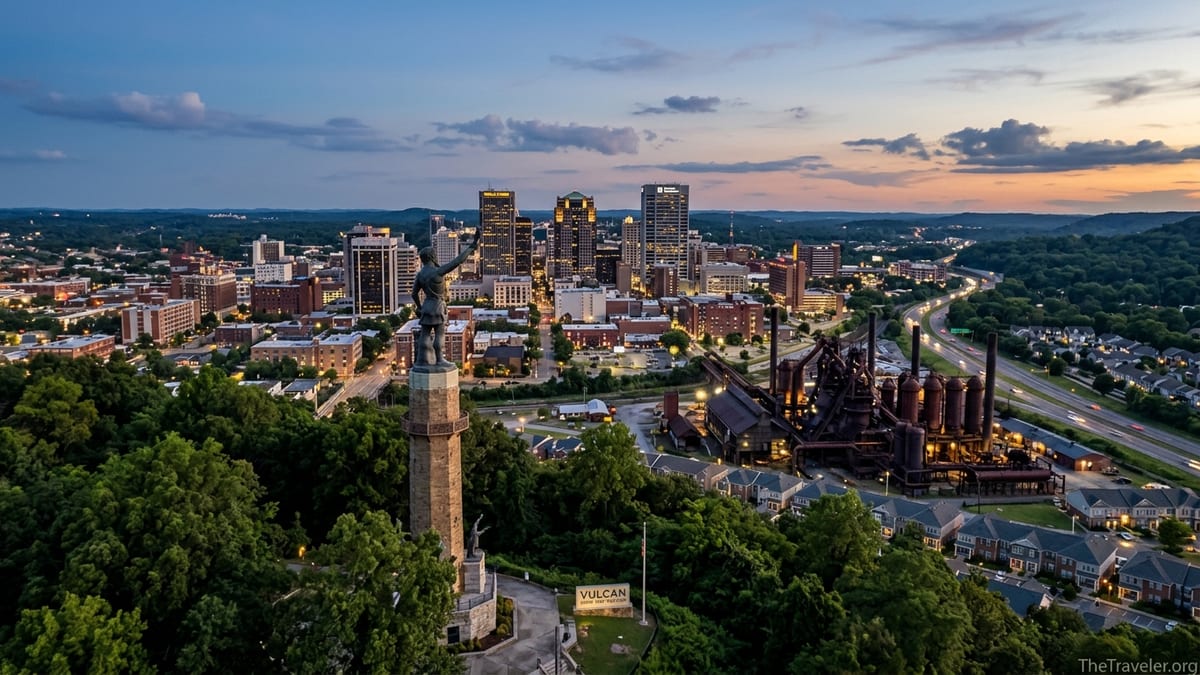
Day Two can focus on the city’s industrial and cultural layers. Start at Vulcan Park and Museum on Red Mountain, which is generally open daily from late morning to early evening and charges a modest admission that includes access to the museum galleries and the observation tower. Exhibits explain how iron ore and coal shaped Birmingham’s growth, while the observation platform under the Vulcan statue offers one of the best panoramic views of the city. After exploring the museum, you can walk a segment of the Vulcan Trail, an urban hillside path, weather permitting. From there, drive or ride share down to Railroad Park, a modern green space built along downtown rail lines, where families picnic and children play on lawns with freight trains rolling nearby.
In the afternoon, head to Sloss Furnaces National Historic Landmark, a preserved iron making complex just east of downtown. The site is free to enter during opening hours, though guided tours, special events and workshops sometimes carry fees. Walking through the towering stacks, casting sheds and rail trestles, visitors can imagine the heat, noise and danger that defined industrial labor here. Exhibits and ranger or staff interpretation highlight how Black and immigrant workers bore the brunt of harsh conditions and how convict leasing systems fed cheap labor into the furnaces after the Civil War. Those connections link back to Birmingham’s civil rights story, illustrating how economic exploitation and racial hierarchy intertwined.
Food, Neighborhoods and a Separate Culture Focused Itinerary
Birmingham’s culinary reputation is grounded in Alabama barbecue, meat and three cafeterias and Southern comfort food, but the city has evolved into one of the Southeast’s more interesting mid sized dining scenes. In practical terms, that means you can order a plate of slow smoked pork shoulder with vinegar based or tomato rich sauces at an old line barbecue joint for an affordable lunch, then reserve a table at a chef driven restaurant for refined takes on Gulf seafood, seasonal vegetables and heirloom grains in the evening. Many establishments emphasize local farms and producers, a trend visible in restaurant menus across Five Points South, Avondale and downtown.
For travelers more interested in food and contemporary culture than long museum visits, an alternate two day plan still weaves in historical context. Spend a shorter morning at the Birmingham Civil Rights Institute and a self guided walk through Kelly Ingram Park, then devote the afternoon to tasting the city. That might mean a late lunch at a meat and three cafeteria in the 4th Avenue area, where you choose one meat and several vegetables or sides from a steam table, followed by coffee at an independent cafe in the loft district downtown. In the evening, explore Avondale, a neighborhood east of the core where breweries, beer gardens and casual restaurants have opened in renovated warehouses and storefronts.
The following day, focus on Railroad Park, the adjacent Rotary Trail and the surrounding Parkside district. Brunch at a nearby cafe or bakery overlooking the park lets you watch joggers and families while sampling biscuits, shrimp and grits or lighter options. Afterwards, walk to the Birmingham Museum of Art, which has free general admission and a collection that ranges from Asian ceramics to American paintings and contemporary works by Southern artists. In the late afternoon, music fans can visit the Alabama Jazz Hall of Fame, which celebrates local legends like Erskine Hawkins and Sun Ra and is housed in the historic Carver Theatre, a venue that also hosts performances and film screenings.
At night, Five Points South and Lakeview host much of the city’s nightlife, from cocktail bars and live music venues to quiet wine bars and dessert cafes. Ride hailing makes it relatively easy to move between neighborhoods without a car in the evening, though surge pricing during peak times or big events can increase costs. Travelers who prefer quieter streets might choose to stay in Homewood, a separate municipality just over Red Mountain with its own small downtown of shops and restaurants, then commute into the city center for specific meals or shows.
Arriving, Getting Around and Where to Stay
Birmingham Shuttlesworth International Airport sits northeast of downtown and handles a mix of major US carriers with frequent flights from hubs like Atlanta, Dallas and Charlotte. Driving time from the terminal to central hotels is often 10 to 15 minutes in light traffic. On site rental car counters and garages offer national brands, and many travelers choose to rent a car for flexibility, especially if they plan to visit Red Mountain Park, Ruffner Mountain or outlying suburbs. Limited public bus service connects the airport with downtown, but schedules and frequencies are not always convenient for visitors with luggage or late flights.
By car, Birmingham lies along Interstate 20 and Interstate 59, with Atlanta around 150 miles to the east, Memphis several hours to the northwest and Montgomery about 90 miles south via Interstate 65. The drive from Atlanta usually takes two and a half to three hours, depending on traffic, while Nashville is reachable in around three hours by heading north on I 65. Parking downtown is a mix of garages, surface lots and metered street spaces. Daytime parking near the Civil Rights District, Railroad Park and business core ranges from modest hourly rates to daily maximums that remain lower than in larger cities like Atlanta. At attractions such as Vulcan Park and Sloss Furnaces, on site or adjacent visitor parking is available, though special events can fill lots quickly.
Public transit within Birmingham is limited compared with larger metropolitan areas. Local buses cover main corridors but service can be infrequent, especially at night and on weekends. For most short term visitors, a combination of walking, ride hailing and occasional taxis will be the most practical approach if they do not rent a car. Sidewalk conditions vary by neighborhood, but the Civil Rights District, much of downtown and Five Points South are walkable during the day. At night, many travelers prefer driving or using ride services for trips between districts.
When choosing where to stay, downtown offers the greatest convenience for civil rights sites, business travelers and those arriving by intercity bus or train. Hotels in historic buildings sit alongside newer high rises, with easy daytime walks to the institute, park and museum. Five Points South has a different feel, with mid rise hotels, older apartment buildings and an established dining and nightlife scene clustered around a traffic circle. Homewood, on the other side of Red Mountain, provides a quieter, more residential atmosphere with mid range chain hotels and a walkable central strip of restaurants and boutiques. Avondale and the Parkside area near Railroad Park are growing visitor districts, though accommodation options there are still more limited than downtown or Five Points.
Outdoor Space, Family Friendly Options and Weather Planning
Families visiting Birmingham can balance museum time with outdoor play and hands on experiences. Railroad Park is one of the best central options, with open lawns, a small lake, playground areas and food kiosks or nearby cafes. Children can watch freight and passenger trains pass by, tying into older kids’ understanding of the city’s industrial history. The Birmingham Museum of Art offers family programs and activity guides that help younger visitors engage with the collection, and staff can advise on quieter galleries or shorter routes suitable for those with limited attention spans.
For more expansive outdoor time, Red Mountain Park on the western extension of Red Mountain offers miles of trails, treehouse overlooks and remnants of former iron ore mining infrastructure. Some activities, such as ziplines and aerial adventure courses, carry separate fees and advance booking requirements, while general trail access is usually free or supported by suggested donations. On the opposite side of town, Ruffner Mountain provides a nature preserve with hiking trails, city views and educational programs that highlight local geology and ecology. Both parks sit within short driving distances of central Birmingham and make good half day trips in cooler months.
Weather is a central consideration in planning. Summers in Birmingham are hot and humid, with daytime highs often in the 90s Fahrenheit and frequent afternoon thunderstorms from June through August. Civil rights sites and museums are air conditioned, but walking between them or exploring outdoor parks can be draining in mid afternoon heat. Spring and autumn, especially March to May and late September through early November, offer more comfortable temperatures and are popular times for festivals and outdoor events. The wider region is vulnerable to severe thunderstorms and occasional tornado outbreaks, most often in spring and late autumn, so visitors should monitor local forecasts and heed guidance from hotels or venues if warnings are issued.
Rainy day alternatives include spending more time at the Birmingham Civil Rights Institute, the National Monument visitor center and the Birmingham Museum of Art, all of which can absorb several hours indoors. The Alabama Jazz Hall of Fame and Carver Theatre provide additional indoor options when open, particularly for music fans. Shopping districts in Homewood and the Summit, a larger commercial center southeast of downtown, offer covered or indoor spaces for those seeking a break from weather dependent activities.
Budget, Safety and How Birmingham Compares
Costs in Birmingham are generally lower than in larger Southern cities like Atlanta or Nashville, though recent years have brought some price increases. A mid range downtown or Five Points hotel often falls in the low to mid hundreds of dollars per night for a standard room, with lower rates available in outlying suburbs or on weekends that do not coincide with major events. Budget conscious travelers might find simple motels or limited service hotels under that range, especially if booking in advance or staying farther from the core. Parking charges vary widely: some hotels bundle self parking into resort style fees, while others charge separate nightly rates or offer complimentary lots, particularly in Homewood and suburban areas.
Meals can be as economical or indulgent as you wish. A counter service barbecue lunch with a sandwich, side and drink might cost a bit over ten dollars, while a dinner at a well known contemporary Southern restaurant with appetizers, mains and drinks will be considerably higher per person. Independent coffee shops and breakfast cafes provide affordable starts to the day, and grocery stores or markets allow for picnic supplies to enjoy in parks. Museum admissions add up but remain moderate compared with many major metropolitan institutions, and visits to outdoor sites like Railroad Park and Ruffner Mountain are free or low cost.
Visitor safety in Birmingham, as in many US cities, varies by neighborhood and time of day. The city has areas with higher crime rates, but tourist districts and main attraction corridors are regularly patrolled and see significant daily activity. Practical precautions include being aware of your surroundings, avoiding walking alone on unfamiliar, poorly lit streets late at night, and using ride hailing or taxis after evening events, especially if you are carrying cameras or bags. Keep valuables secured, do not leave bags visible in parked cars and follow any guidance from hotel staff about routes they recommend or suggest avoiding after dark. Within major museums and the airport, security screening and staff presence provide additional layers of oversight.
For travelers tracing civil rights history across the South, Birmingham stands in dialogue with cities like Montgomery, Selma, Memphis and Atlanta. Montgomery offers the state capitol, the Legacy Museum and National Memorial for Peace and Justice and sites associated with the Montgomery Bus Boycott. Selma centers the story of voting rights and the Selma to Montgomery marches. Memphis holds the National Civil Rights Museum at the Lorraine Motel and deep connections to music history. Atlanta presents King’s birthplace, the King Center and the headquarters of several national civil rights organizations. Birmingham’s particular importance lies in the intensity of the 1963 campaign, the role of children and youth in protests and the visibility of both violent resistance and courageous local leadership within a relatively compact urban district.
Stand Alone Weekend or Part of a Longer Southern Journey
Whether Birmingham works best as a stand alone destination or one stop on a larger itinerary depends on your interests and available time. Travelers who feel a strong pull to understand the Civil Rights Movement in depth will find that two or three days in Birmingham, combined with visits to Montgomery, Selma or Atlanta, provide a powerful arc through some of the era’s most consequential places. In that context, Birmingham is an essential stop, with the Civil Rights Institute, 16th Street Baptist Church, Kelly Ingram Park and the National Monument forming a core that cannot easily be replicated elsewhere.
At the same time, Birmingham can hold its own as a focused weekend, particularly for visitors from nearby states or those flying in for a short break. The combination of serious historical learning, engaging museums, good food and accessible outdoor space allows for a satisfying trip without long drives. You can arrive on a Friday evening, immerse yourself in the civil rights story and industrial heritage on Saturday and Sunday, and leave feeling both informed and well fed. For repeat visitors, layering in neighborhood exploration, live music and additional trails keeps the city fresh.
For many, the most meaningful approach is to weave Birmingham into a broader Southern road trip that acknowledges both the pain and creativity that have shaped the region. Driving between cities like Atlanta, Birmingham, Montgomery and New Orleans reveals continuities in landscape and culture as well as the specific histories of each place. Along that route, Birmingham offers a concentrated lesson in how ordinary streets, downtown parks, churches and factories can become global symbols of both injustice and the ongoing struggle for a more equal society.
However you structure your journey, approaching Birmingham with time, humility and curiosity will reward you. Listen closely in museum galleries, in church sanctuaries and at kitchen tables in local restaurants. The stories here belong first to the communities who lived them; as visitors, our task is to learn with care and carry that understanding forward when we leave.