


Since 10 April 2026, most non European visitors arriving in the Schengen area are processed through Europe’s new Entry/Exit System instead of receiving ink passport stamps. The change is significant but, for most travelers, manageable once you understand who is affected, what information is collected and how the first registration actually works at airports, seaports and land borders.
Get the latest updates straight to your inbox!
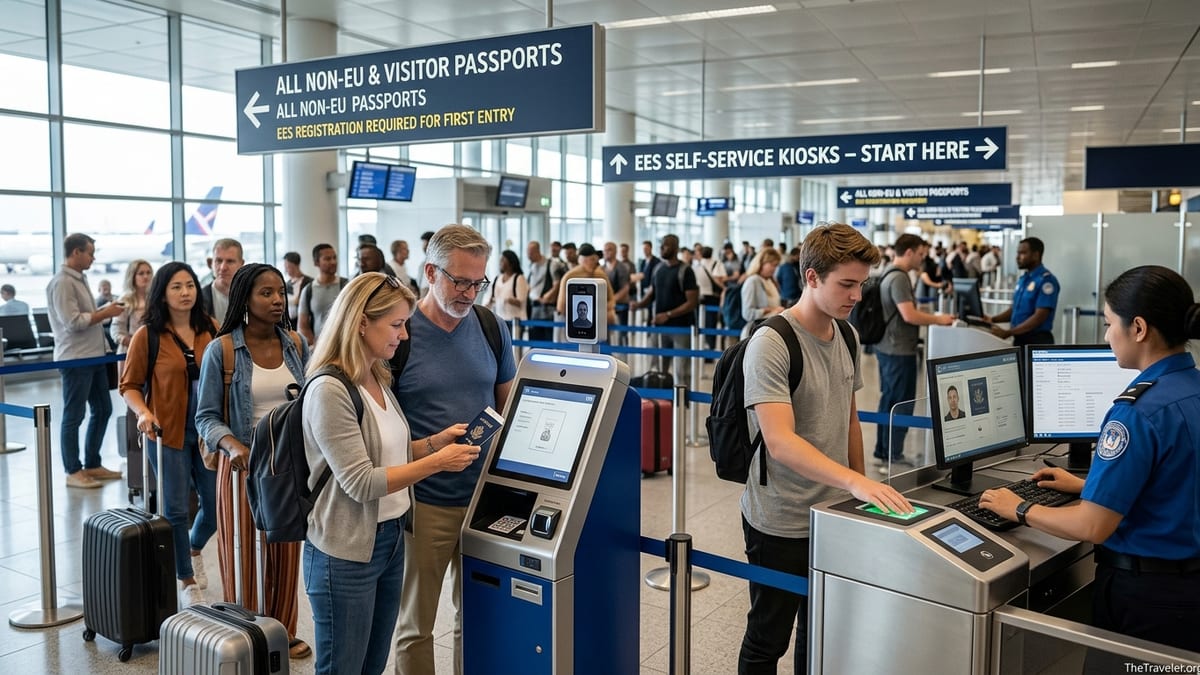
Key dates, where EES applies and who it actually covers
The Entry/Exit System, usually called EES, began a phased rollout on 12 October 2025 and became fully operational at all participating external border crossings on 10 April 2026. From that date, manual Schengen passport stamps were phased out at air, sea and most land borders in favor of a shared digital record. The system is used at the external borders of all Schengen countries, including non EU members such as Norway, Iceland, Switzerland and Liechtenstein, along with EU members that apply Schengen rules like France, Italy, Spain and the Netherlands.
EES covers “third country nationals” who come for short stays. In plain language, this means people who are not citizens of an EU country, not citizens of the wider European Economic Area and not Swiss. It applies whether you normally need a visa for Schengen or not. For example, a US, Canadian, Japanese, British or Australian tourist entering France for two weeks, a Brazilian visa holder arriving in Italy on a Schengen C visa and a South African business traveler visiting Germany on a short stay visa all fall inside the system.
The system is designed around short stays that are limited to 90 days in any rolling 180 day period. It is not used for those whose main purpose is to live, work or study long term in a Schengen state under a national visa or residence permit. That distinction between short stay visitors and longer term residents is crucial, because it determines whether your passport is entered into EES or checked under different rules.
For travelers coming from nearby non Schengen countries, such as people driving from the United Kingdom through the Channel Tunnel or crossing from Albania into Greece, EES applies as soon as they cross into the Schengen border area and head for passport control. However, some specific border points, including UK to EU ferry ports and the Eurostar, went live with partial functionality slightly later than large airports, so experiences can still differ between locations even after April 2026.
Who is exempt and who is not: understanding status and nationality
A common misunderstanding is that EES is “for tourists only”. In reality, it is based on your legal status, not why you say you are visiting. Citizens of EU countries, the wider EEA and Switzerland are entirely exempt from EES because they already enjoy free movement inside the Schengen area. A French, German, Italian or Spanish citizen continues to use the EU or EEA lanes and either automated eGates or staffed booths without any EES fingerprint registration.
Similarly, non European nationals who hold a valid residence permit or a long stay visa for a Schengen state are generally exempt from EES, even if their passport is from a country normally covered. For example, a US citizen with a French residence card, a Moroccan national with a long stay Italian D visa or an Indian software engineer with a German residence permit are treated as residents for the purpose of border checks and do not have their details stored in EES. Their permitted stay is governed by their residence documents instead of the 90 days in 180 days visitor rule.
Family members of EU, EEA or Swiss citizens benefit from related protections. Where they hold residence status under EU free movement rules or the Withdrawal Agreement arrangements in countries such as Spain, Portugal or the Netherlands, they too are normally processed outside EES and rely on their residence cards at the border. By contrast, a Canadian spouse of a German national who has not yet obtained residence status and is entering for a short holiday in Italy is still treated as a visa exempt short stay visitor and will be registered in EES.
There are also age and capability based exemptions from some biometric requirements. While children who are non EU nationals and travel as short stay visitors are covered by EES, their fingerprints are not always collected. Current EU practice is that fingerprints for EES are usually taken from ages 12 and up, while younger children may have only their face image captured. People for whom fingerprinting is physically impossible, such as some disabled travelers, and certain holders of residence documents are exempt from fingerprint capture even though a record of their crossing may still exist in immigration systems.
What data EES stores about you and how long it stays there
At its core, EES replaces the ink stamps once placed in passports with a shared electronic record. Border authorities scan the machine readable zone of your passport, capturing identity information such as your full name, date of birth, nationality, document number and validity dates. The system then records the date and place of entry or exit and whether you were permitted to enter or refused. That digital trail is what officials use to confirm how many days you have spent inside Schengen in the last 180 days.
EES adds biometric identifiers to this record. On a first registration, border officers capture a live facial image and a set of fingerprints. In many airports this happens at a self service kiosk that takes your photo before you see an officer, while the fingerprint scan occurs either at the kiosk or at the staffed booth. The combination of passport data and biometrics creates a unique file for each traveler, which is later matched when you exit or re enter, rather than relying on the variable quality of manual ink stamps.
Data retention is a common concern. Current EU practice is that EES records are kept for several years after your last recorded movement, with a longer retention period if you overstay the legal limit. During that time, border officials and certain law enforcement agencies can access the system under strict rules to confirm travel histories, investigate document fraud or compare biometrics. The information is held in a central EU operated database at secure technical sites, subject to the Union’s data protection laws.
Children and vulnerable travelers trigger slightly different data handling. Where fingerprints are not taken because of age or medical reasons, the system relies on passport data and facial images, sometimes supported by the fingerprints of a parent or guardian for identity verification. That means the precise combination of data points varies, but for most adult visitors the quartet of passport, entry date, facial image and fingerprints forms the standard EES record.
Step by step: your first EES experience at a major airport
The first encounter most travelers have with EES is at a large international airport. Take the example of a US tourist landing at Paris Charles de Gaulle from New York after 10 April 2026. After disembarking and walking toward arrivals, they reach a fork between EU or EEA citizens and “All passports” or “Non EU passports”. As a US citizen visiting France for 12 days, they follow the non EU signs and may see additional signage mentioning EES registration.
In terminals where self service kiosks are available, such as many zones at Paris Charles de Gaulle, Amsterdam Schiphol, Rome Fiumicino and Madrid Barajas, staff direct first time EES travelers to these machines. The passenger places their passport photo page on the reader, confirms answers on a touch screen and has their face photographed. The kiosk prints or sends an electronic token that summarizes the captured data. At this stage no passport stamp is applied and, at some French locations, children may stand beside a parent while only the adult completes the kiosk process.
The passenger then joins a staffed border control queue where an officer calls them forward. Here, for a first ever EES registration, the officer scans all ten fingerprints or a subset depending on national practice, compares the live face with the stored image and verifies itinerary details such as accommodation address and length of stay. This is the point where questions like “How long are you staying in the Schengen area?” or “Where will you be staying in Paris?” are still asked and where evidence of onward travel can be requested.
Once fingerprints and facial data are accepted, the EES file is created or updated and the officer authorizes entry. For that US tourist in Paris, the entire process from reaching the EES kiosk queue to walking past the officer can typically range from a few minutes in quiet periods to significantly longer at peak times if many first time visitors arrive at once or fingerprint capture proves difficult. Importantly, no extra fee is charged at the airport and there is no separate EES application form to pay for online beforehand.
How later trips feel different and why queues may still be slow
On a second or later visit, the experience changes subtly but not always dramatically. Imagine the same US traveler arriving in Amsterdam several months later. When they pass through passport control, the officer or automated system can now retrieve their existing EES record using the passport chip, facial recognition and sometimes a quick fingerprint scan. Because the biometric link already exists, the process may involve fewer questions and a shorter time at the desk.
Airports that have rolled out full biometric lanes for repeat travelers can in some cases route visitors whose fingerprints and photo are already in EES through faster channels. At certain terminals in Rome Fiumicino and Madrid Barajas, repeat non EU visitors are directed either to mixed eGates supervised by border police or to shorter manual lanes clearly marked as EES. The precise setup changes by terminal, and airlines at check in sometimes display notices telling passengers which cues to expect.
What does not change is the fact that everyone on a given flight must still clear border control. Even where the inspection of each passport is faster because biometrics are pre enrolled, the total wait time depends on how many officers are on duty and how many flights land simultaneously. Reports from early summer 2026 at busy hubs like Paris and Madrid describe periods when first time EES registrations created bottlenecks of an hour or more. Later in the year, anecdotal accounts show that once most regular visitors were enrolled, queues shortened again, though spikes remain at peak holiday weekends.
It is therefore realistic to say that subsequent EES entries can be less burdensome at the booth itself, but it is not safe to assume that overall queues will always be shorter. Travelers making tight connections, especially those changing from a non Schengen to a Schengen flight in hubs like Amsterdam or Frankfurt, should continue to allow generous minimum connection times and favor through tickets that offer rebooking protection if missed.
EES is not ETIAS: fees, pre registration and scam warnings
One of the most confusing aspects for travelers is the alphabet of new European systems. EES is a border crossing database that is automatically populated when you physically arrive at an external Schengen border. You do not apply for it, you do not pay for it and there is currently no official website where you can “submit” an EES registration ahead of travel. Airlines and ferry companies only check your passport and, where required, your visa or existing travel authorizations.
ETIAS, by contrast, is a separate electronic travel authorization that the EU plans to introduce for visa exempt travelers such as US, Canadian, UK, Australian and many Latin American nationals. When ETIAS begins, travelers will have to apply online before travel, pay a modest fee and receive a digital approval linked to their passport. Authorities have repeatedly stressed that ETIAS is not yet required for travel as of late 2026, even though information campaigns are already underway and some media coverage has blurred the timelines.
The distinction matters because a cottage industry of commercial websites has sprung up selling “EES registration services” or “mandatory EES forms” for substantial fees. These sites piggyback on legitimate concern about border changes but, at present, there is no separate EES form issued by European authorities that a traveler can or must pay for in advance. Any website that suggests you must buy an EES application as a condition of boarding a flight or cruise should be treated with deep skepticism.
Some countries have introduced optional pre registration tools that let visitors enter part of their data into national systems or apps before arrival, particularly at busy ports handling car traffic or coaches. For instance, French guidance has discussed remote data collection devices at certain Channel ports and the possibility of mobile pre recording apps. These tools can sometimes reduce the time spent at kiosks but they do not change your legal obligations and are free to use where offered. They should not be confused with fee based visa intermediaries or private authorization services.
Real world airport and port examples across Europe
At Paris Charles de Gaulle and Orly, travelers arriving from non Schengen destinations such as New York, London or Dubai now see EES signage in the “All other passports” area. First time EES visitors are often pulled to a line of blue self service kiosks before proceeding to the regular booths. In busy periods that can add an extra stage, but by the time they reach the officer their photo is already in the system and only fingerprints need to be captured. Departing passengers back to non Schengen destinations also pass border control, where their exit is recorded in EES, typically with only a passport scan and perhaps a brief face check.
In Rome Fiumicino, separate areas have been arranged for travelers who need full first time EES registration and those who have already been enrolled. For example, an Argentinian tourist entering Italy for the first time in 2026 is directed to an EES registration area where staff assist with kiosk use and fingerprint scans, sometimes leading to longer waits on busy Saturday mornings. Months later, if the same traveler enters Italy again from a non Schengen flight, they may be able to use mixed nationality eGates supervised by the Polizia di Frontiera, where a face scan matches their previous record and only occasional fingerprint verification is required.
Madrid Barajas has combined its EES rollout with existing automated border control lines. Non EU visitors from countries such as Chile, South Korea or the United States already accustomed to using eGates in Spain find that, on their first post EES trip, they may be diverted to a staffed desk for full fingerprint collection even if they have just used a gate to scan their passport and face. On exit, the process is generally faster: travelers scan their passport at an eGate or hand it to an officer and the system records their departure, closing that particular stay in the 90 day cycle.
Amsterdam Schiphol, which has long used biometric eGates for EU and some non EU visitors, routes many first time EES travelers straight to staffed lines from intercontinental arrivals. A Canadian business traveler arriving from Toronto in May 2026, for example, may encounter an initial bottleneck where dozens of non EU passengers queue for kiosks and fingerprint scanning. On later trips, Schiphol often directs EES enrolled visitors to mixed lines where the officer simply scans the passport, verifies the photograph and, when necessary, asks for a quick finger scan, reducing the time each person spends at the counter even if the overall queue looks similar to before.
Land borders, cruises, Eurostar and connection times
At land borders, especially those handling cars and coaches, the physical experience of EES can be different but the underlying principles are the same. Drivers approaching external Schengen crossings, whether at Norway’s outer borders or at the French side of the Channel ports, stop at booths where officers scan passports and, when needed, take biometrics. In some French and Belgian ports serving UK traffic, dedicated lanes for cars with non EU passengers now include small shelters with biometric devices so that first time EES visitors can step out briefly for fingerprint capture.
Cruise passengers encounter EES either at the initial embarkation port within Schengen or at the first Schengen port of call if they join from outside the area. A passenger boarding a cruise in Southampton that heads first to Vigo or Le Havre, for example, clears Schengen immigration at that first continental stop. Local authorities set up temporary inspection zones on the quay where officers process hundreds or thousands of passengers in a short window. In early operations, some ships reported extended stays in port while first time EES enrollments were completed, leading lines to advise guests to carry water, medications and patience when heading ashore at those initial stops.
Rail travel via the Eurostar and Eurotunnel has required more complex infrastructure changes because French border officers carry out Schengen checks on UK soil. New equipment for fingerprint capture and face imaging has been installed at London St Pancras, Paris Gare du Nord and the Channel Tunnel vehicle terminal. During the early months of EES, official reports and parliamentary briefings noted that technical integration between UK and French systems took longer than expected, so full EES processing for foot passengers lagged behind airports slightly. As of autumn 2026, travelers still report busy weekend periods where queues at St Pancras and Gare du Nord stretch far beyond their pre EES length.
For flight connections, the main impact is on minimum recommended transfer times when changing from a non Schengen to a Schengen flight. The first entry point into Schengen on a given journey is where EES checks happen, regardless of your final destination. A traveler flying New York to Amsterdam to Florence, for instance, completes all EES formalities in Amsterdam. Airlines and airports have been conservative in their advice, suggesting that non EU travelers allow at least 90 minutes, and ideally longer, when connecting for the first time after 10 April 2026. Cruise passengers joining ship excursions that require re entering Schengen, as when a cruise briefly calls in a non Schengen port in the Balkans, must also account for extra border time when re boarding.
Stays, overstays, errors and what to do if something goes wrong
EES is designed to end the old confusion caused by unreadable passport stamps. Every time an eligible traveler enters or exits, the system updates their record and automatically recalculates how many days of short stay allowance remain within the rolling 180 day window. This calculation applies across the entire Schengen area, not by country. So if a Canadian tourist spends 60 days between Portugal and Spain and then exits via France, they will have only 30 days left for a later stay anywhere in Schengen during the same 180 day period.
Because EES is automated, it flags likely overstays far more reliably than human officers leafing through old stamps. When someone shows up at a border after overstaying, the system can mark the infringement and, depending on national rules, lead to a fine, entry refusal or a future entry ban. Data published by European institutions in 2026 has already highlighted thousands of entries denied because previous stays exceeded the limit. For most visitors this is a positive development, since it also protects bona fide travelers whose properly timed stays are now clearly documented.
Errors do still occur. Travelers have reported cases where their exit was not automatically recorded, either because of a technical glitch or because officers reverted to manual entry without creating a visible EES trace. When they later used an online calculator to check remaining days, the system incorrectly showed that they had never left and were therefore out of time. In such situations, the current advice is to keep evidence of flights, boarding passes and hotel bills and to contact the border authority of the country you plan to visit, either through national consulates or dedicated online “write to us” channels, so that officials can investigate and correct records where appropriate.
If your fingerprints cannot be captured at the border because of worn ridges, skin conditions or equipment failures, officers have some discretion. Many reports suggest they will attempt several scans, sometimes with lotion, alternate fingers or different devices. If capture still fails, they can authorize entry using a combination of facial recognition, document checks and questions, logging the issue in their systems. It is important in such cases not to leave the control point until you are clearly told that entry has been granted and your crossing has been registered in some form.
Families, children, assisted travelers and privacy concerns
Families with young children should expect to go through EES together. At airports with kiosks, parents are often asked to complete the kiosk steps first while a staff member oversees the children nearby. Younger children may then be brought to the counter with the parent for a quick facial photo, sometimes using a handheld camera or a moveable screen. Border authorities generally avoid scanning the fingerprints of children below a certain age, usually around 12, but still create a digital record of their entry and exit linked to the passport details.
Disabled travelers and those requiring wheelchair assistance can and should request help for the EES process when they arrange airport assistance. At many major hubs, assistance staff now receive specific training on guiding passengers through the kiosks, handling biometrics and communicating with border officers. In practice, this often means being escorted through dedicated lanes to avoid long standing in crowded queues and having equipment adjusted to match the passenger’s seated height. Where fingerprints truly cannot be taken, officers rely more heavily on document checks, support person confirmation and visual identification.
Elderly passengers may find the kiosks confusing, especially if instructions are only partly translated into their language. A practical approach is for multigenerational groups to stick together in the same line and for younger adults to assist older relatives with reading screens and placing passports on scanners, while officers retain the final decision making power. Many airports have deployed floating staff within the EES area whose role is to spot anyone struggling and step in to help before frustration builds.
On privacy, EES has sparked debate because it involves centralized storage of biometric data for millions of travelers. EU institutions emphasize that the system operates under strict data protection rules. Access is limited to border and designated law enforcement authorities for specified purposes such as verifying identity, combatting document fraud and managing migration flows. Data is not used for commercial marketing and is periodically deleted after the legal retention period expires, typically several years after the last recorded movement unless an overstay or other alert extends it. Travelers worried about misuse can raise concerns with national data protection authorities or the dedicated oversight bodies in the country where the issue arises.
Country by country eligibility checklist and planning timeline
EES currently applies when you cross the external borders of all Schengen states and a handful of closely associated countries. These include long established members such as France, Germany, Italy, Spain, the Netherlands, Belgium, Portugal, Greece, Austria, Finland, Sweden and Denmark, as well as more recent Schengen participants such as Croatia, Romania and Bulgaria at their external borders. Non EU Schengen countries Iceland, Norway, Switzerland and Liechtenstein are fully involved, so flights from North America or Asia that land there will also trigger EES records for eligible travelers.
If your nationality normally benefits from visa free short stays in Schengen, such as citizens of the United States, Canada, the United Kingdom, Japan, South Korea, Australia, New Zealand and many Latin American and Gulf countries, you can assume that EES will register your arrival and departure on every trip after 10 April 2026. If you normally require a Schengen visa, holding that visa does not exempt you from EES. Instead, your visa details are cross checked against EES entries so that airlines and border guards can see whether the allowed number of entries or days has been used.
Those who hold residence permits or national long stay visas for a Schengen country should always travel with both their passport and their residence document. Airline staff at check in may not be fully familiar with EES exemptions and could ask about your status if your passport nationality alone appears to fall inside the system. Presenting residence cards for France, Germany, Spain, Italy or other Schengen states at check in and at the border helps ensure you are channeled correctly and not mistakenly enrolled as a short stay visitor.
For a first EES arrival by air, most travelers should allow additional time in their overall travel day. For example, a family of four from Chicago arriving in Madrid for the first time in June 2026 and planning an onward connecting flight to a smaller Spanish city should avoid tight connections of less than 90 minutes. At seaports, especially on summer Saturdays when ferries and cruise ships converge, queues for first time biometric capture can be longer than experienced frequent travelers expect. Over the next years, as more visitors are enrolled and procedures bed in, those peaks may moderate, but for now caution is advisable.
Last checked date and how to stay updated
European rules on digital borders are still evolving as authorities refine procedures based on real world experience. The information in this guide is based on official European and national sources and is current as of 11 November 2026. Travelers should be aware that some implementation details, such as which specific terminals use kiosks or the exact age from which fingerprints are collected, may change with limited notice as airports adjust their layouts and equipment.
Before traveling, it remains wise to double check three points. First, confirm whether your nationality is visa free or requires a Schengen visa for short stays, using official consular or government resources. Second, if you hold a residence permit or long stay visa, ensure that it will still be valid on the date you re enter and carry the physical card with you. Third, be cautious of any site or company that demands a separate EES registration fee, since at present EES enrollment happens only at the border and is included as part of the normal immigration process.
For now, the key message for first time EES visitors is simple. Arrive with extra time, keep travel documents and itineraries handy, expect a one off biometric enrollment that may add a few minutes to border crossing, and then treat later trips much as you did in the era of passport stamps. The technology behind the scenes has changed significantly, but the essentials of polite, prepared international travel still apply.