


More news on this day
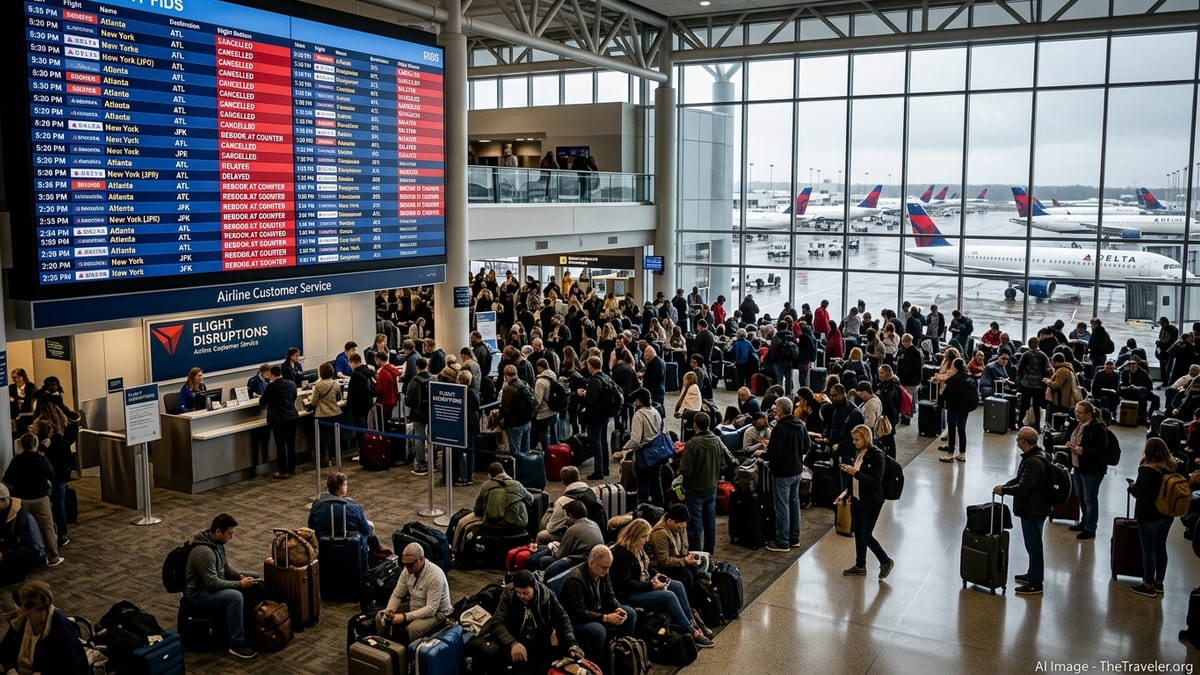
A nationwide Federal Aviation Administration ground stop on November 13, followed by a separate Delta Air Lines technology outage on November 22, has left millions of Americans facing one of the most challenging Thanksgiving travel weeks in years, with cascading flight delays, packed airports and renewed questions about the resilience of the U.S. air travel system.
Get the latest news straight to your inbox!
What Happened On November 13 And Why It Still Matters This Week
The immediate backdrop to this year’s Thanksgiving disruptions is the Federal Aviation Administration’s nationwide ground stop on Friday, November 13, 2026. In the early afternoon, the agency ordered all aircraft grounded across the United States after a telecommunications failure affected communications and radar systems used by air traffic control. The halt lasted roughly four hours and 45 minutes before the FAA gradually lifted restrictions and allowed departures to resume.
Federal officials later explained that the problem involved the network supporting the FAA’s communications, not the core collision-avoidance equipment on aircraft themselves. As a precaution, the agency froze departures nationwide while engineers verified that controllers could safely manage traffic. That decision, taken in the middle of one of the busiest autumn travel periods, produced immediate ripple effects as aircraft, flight crews and passengers were left out of position around the country.
Data released in the days after the outage shows how severe the disruption became. According to the FAA and subsequent government briefings, airlines canceled about 12,500 flights on November 13 alone, including more than 9,000 cancellations by major U.S. carriers. Thousands more flights operated with significant delays as airports tried to clear the backlog once the airspace reopened. Although the ground stop formally ended that evening, schedule recovery took several days, with carriers still adjusting timetables and repositioning aircraft into the following week.
Delta’s Separate Tech Glitch Deepens Holiday Week Disruption
Just as operations were stabilizing after the November 13 ground stop, a separate failure hit Delta Air Lines on Sunday, November 22, at the very start of the Thanksgiving rush. The Atlanta-based carrier reported an outage in its weight-and-balance automation system, which is used to calculate safe loading and performance numbers for each flight. Without that system available, many departures had to be held while crews worked through alternative procedures.
Delta requested that the FAA temporarily stop flights bound for its main hub at Hartsfield–Jackson Atlanta International Airport while it addressed the glitch. The agency issued a limited ground stop for some Atlanta-bound flights for roughly an hour on Sunday morning before replacing it with a program spacing out departures at staggered intervals. By then, the impact on Delta’s network was significant, with more than 1,000 flights delayed and over 100 canceled on Sunday, and the carrier acknowledging that about 70 percent of its disruptions that day were linked to the earlier FAA system failure on November 13.
By Monday morning, Delta said its Atlanta operation was stable again, and the FAA emphasized that the Delta outage did not involve air traffic control systems and was not a cyberattack. Even so, the timing has proved difficult for travelers. Many customers who had already rebooked once after the nationwide ground stop found themselves facing new delays at the start of their holiday journeys, particularly on routes that depend on connections through Atlanta or other Delta hubs.
A Busy Thanksgiving 2026 Travel Season Meets A Strained System
These technical failures are colliding with one of the busiest Thanksgiving travel seasons on record. AAA’s latest forecast indicates that nearly 82 million Americans are expected to travel at least 50 miles from home between Tuesday, November 24, and the Monday after Thanksgiving, a figure only slightly below last year’s and still well above pre-pandemic levels. Roughly 6 million of those travelers are projected to fly, accounting for just over 7 percent of holiday journeys and adding pressure to airport security lines, gate areas and baggage systems.
The Transportation Security Administration has been preparing to screen record numbers of passengers at major hubs across the week, with Sunday, November 29, projected as the busiest single day for many airports. Some local forecasts point to more than 80,000 or even 90,000 passengers moving through individual terminals on peak days, concentrating the risk that even minor schedule changes can cascade into missed connections and lost seats on already full flights.
Complicating matters further is seasonal weather. Forecasts ahead of Thanksgiving indicate the potential for strong winds, heavy rain and coastal storms along parts of the East Coast and in several inland hubs. Local authorities in Charlotte, for example, canceled the city’s Thanksgiving Eve parade on November 25 because of expected high winds and rain, warning that conditions would be too dangerous for large balloons and heavy equipment. Such outlooks do not guarantee aviation disruptions, but they increase the likelihood of flow-control measures, de-icing delays and longer taxi times precisely when airlines are operating near capacity.
The 100th Macy’s Thanksgiving Day Parade And The Pressure To Get Home
This year’s Thanksgiving holds particular symbolic weight because of milestone celebrations in several cities, including the 100th Macy’s Thanksgiving Day Parade in New York. Official permits from the City of New York confirm that the parade is scheduled to step off at 8:30 a.m. on Thursday, November 26, 2026, running until midday along its traditional route from Central Park West and Central Park South through Midtown Manhattan to Herald Square. Macy’s has framed the event as a centennial celebration of culture and creativity, complete with new balloons, returning favorites such as the Blue Hippopotamus and a full lineup of marching bands and performers.
New York is not the only city marking a centenary-style holiday event. Detroit’s America’s Thanksgiving Parade is also celebrating its 100th edition this year, with more than 30 floats, character balloons and performance groups scheduled to proceed down Woodward Avenue on Thursday morning. Chicago’s Thanksgiving Parade, while younger, remains a regional draw, bringing thousands of spectators to the Loop to watch bands, horses and inflatable characters kick off the holiday season.
The visibility of these high-profile parades underscores why Thanksgiving travel disruptions resonate so personally. For many travelers, the goal is not just a meal but a shared moment, whether that is watching the balloons from a Manhattan sidewalk, crowding around a television in the living room or attending a local turkey trot or tree lighting. When a flight is canceled or a connection is misaligned, it is often these singular experiences that are lost, rather than simply a seat on an aircraft. The current strain on the system amplifies the emotional stakes for families who may have planned for months to reunite around one day.
How Travelers Can Navigate The Remainder Of Thanksgiving Week
With the FAA’s November 13 ground stop long since lifted and Delta reporting that its weight-and-balance system has been restored, the underlying technical issues that triggered this month’s worst disruptions are no longer active. However, their effects continue to ripple through network schedules, and the volume of passengers traveling between now and the end of the holiday period means that further localized delays remain likely. Travelers still planning to fly this week can reduce their exposure to disruption by focusing on preparation, information and flexibility.
First, officials and consumer advocates are stressing the importance of checking flight status frequently, starting at least a day before departure and continuing until boarding. Airline mobile apps and websites remain the primary sources of real-time gate and schedule changes, but the FAA’s own status tools can help identify whether delays are caused by airport-specific traffic management programs or broader airspace constraints. Because crew and aircraft imbalances from earlier this month are still being resolved, a flight that appears on time in the morning can slide later in the day if inbound aircraft arrive behind schedule.
Second, contingency planning is more valuable than usual this year. For passengers with critical arrival times, such as those trying to reach an evening Thanksgiving dinner or a morning parade, leaving a day earlier or choosing a morning departure instead of a peak late-afternoon or evening flight can provide a useful buffer. Where geography allows, some travelers are combining modes, such as driving to a larger hub with more frequent departures, or arranging backup ground transport in case a short final leg is canceled. Any such plan should be discussed in advance with family or friends on the receiving end, so that last-minute decisions at the gate do not have to be made in isolation.
Finally, the combination of crowded terminals and recent high-profile outages has renewed calls from regulators and lawmakers to accelerate modernization of the national airspace system. For this week’s travelers, those debates will not change the experience at the gate. In the near term, what matters most is building in time, monitoring conditions at both origin and destination, and understanding that recovery from large-scale disruptions does not end when a ground stop is officially lifted. As the Thanksgiving 2026 travel period continues, passengers who stay informed, allow extra margin in their plans and remain flexible will have the best chance of reaching the people and places they are traveling to see.