


More news on this day
More than 900 flights within, into or out of the United States were delayed and around 50 were canceled on Tuesday morning, as gusty winds at major Northeast hubs, low clouds in San Francisco and Seattle, and the lingering effects of recent airline technology outages combined to unsettle one of the busiest travel weeks of the year.
Get the latest news straight to your inbox!
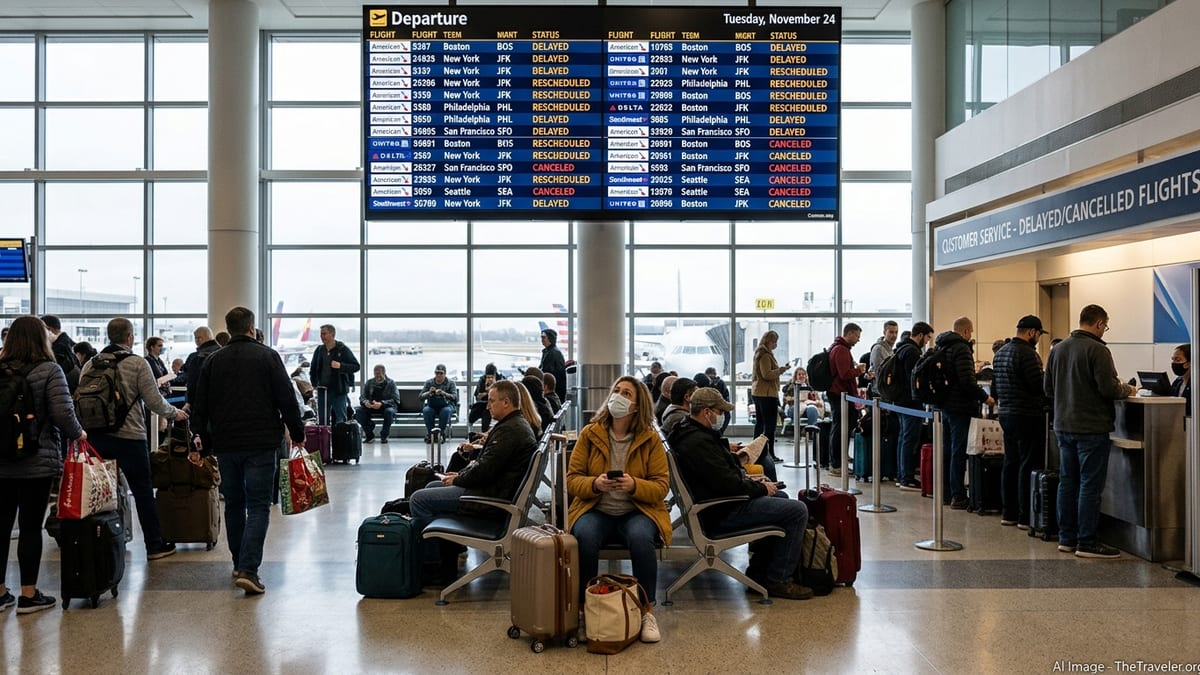
Delays and cancellations mount as holiday traffic builds
By mid-morning on Tuesday, November 24, live data from flight tracking services showed that U.S. airlines had already logged more than 900 delayed departures and arrivals for the day, with roughly several dozen flights canceled outright. Global disruption was far wider, with thousands of flights around the world operating behind schedule or scrubbed as carriers and air traffic control centers handled a heavy pre‑Thanksgiving load. While the precise numbers continued to change throughout the day as more services departed, the early totals confirmed a difficult start for many travelers heading out ahead of the long weekend.
Although the U.S. delay count fluctuated in real time, the broad pattern aligned with forecasts that Tuesday would be one of the busiest air travel days of the year, with federal aviation planners expecting more than 50,000 flights nationwide. That dense schedule left limited slack in the system, so localized weather or airport constraints quickly translated into longer queues for departures, airborne holding and missed connections across the network.
The latest disruptions arrived on the heels of two high‑profile technology outages at major U.S. carriers earlier in the month, as well as a nationwide ground stop linked to the air traffic system itself. While those specific issues had been resolved, the resulting congestion underscored how vulnerable peak‑season operations can be when routine weather challenges coincide with infrastructure strain.
FAA flags wind and low clouds at key coastal hubs
The Federal Aviation Administration’s daily air traffic report for Tuesday highlighted weather‑related constraints in both the Northeast and along the Pacific coast. Gusty winds were identified as a particular concern at Boston Logan, New York’s LaGuardia and Newark Liberty, and Philadelphia International, all of which serve as critical connecting points for domestic and transatlantic traffic. Strong or shifting winds can force controllers to change runway configurations, increase spacing between aircraft on approach and departure and impose ground delay programs that ripple through airline schedules.
On the West Coast, the FAA pointed to low clouds around San Francisco International and Seattle‑Tacoma International as another source of potential slowdown. When ceilings drop, arrivals may need to be spaced further apart to maintain safe separation, and some visual approaches may have to be replaced with instrument procedures that allow fewer movements per hour. San Francisco, in particular, is susceptible to low‑cloud and fog‑related bottlenecks because of its closely spaced parallel runways and its role as a major connecting hub.
In a separate operations advisory, federal planners warned that persistent low ceilings, wind and rain in Northern California could prompt formal ground delay or ground stop programs at San Francisco later in the day if conditions did not improve. These programs meter the flow of inbound flights by assigning expect‑departure or arrival slots, which can quickly extend delays for travelers starting their journeys at outstations hundreds or thousands of miles away.
Recent tech outages expose fragile margins in peak season
This latest wave of delays also followed a series of technology and systems disruptions earlier in November that revealed how little room for error exists during peak travel periods. Within the last week, one major U.S. airline experienced an automation problem affecting its weight‑and‑balance calculations, forcing it to temporarily halt some departures while engineers restored the system. The carrier later reported that a majority of its delays and cancellations on the affected day were directly tied to that outage, with the remainder driven by adverse weather.
Another large airline reported its own computer systems issue days later, again triggering widespread delays before normal operations gradually resumed. Those airline‑specific problems came shortly after a historic ground stop tied to the national air traffic control network, which shut down departures for several hours across the country and left schedules heavily disrupted through the following weekend. Although all three issues were eventually resolved, the knock‑on effects underscored that even brief interruptions can leave crews and aircraft out of position for days, particularly when demand is elevated.
While Tuesday’s delays were primarily rooted in forecast weather and routine traffic constraints, the recent pattern has prompted renewed scrutiny of both airline technology resilience and the modernization of the federal air traffic system. Officials have signaled that task forces are reviewing redundancy and backup procedures, but any large‑scale infrastructure upgrades will take years. In the meantime, travelers remain exposed to the compounding effect of ordinary weather on already tight schedules and occasionally brittle software systems.
How today’s disruptions affect U.S. travelers on the move
For individual passengers, Tuesday’s statistics translated into a familiar range of challenges at airports around the United States. Travelers at affected Northeast hubs reported longer waits at departure gates as aircraft queued for takeoff in strong crosswinds, while some arrivals were held in airborne stacks before being cleared to land. At West Coast airports dealing with low clouds, inbound flights faced extended vectors and occasional diversions to alternates with better visibility, which in turn disrupted onward connections.
These operational constraints are especially significant during the Thanksgiving period, when the Transportation Security Administration expects to screen tens of millions of passengers over a nine‑day window. With seat capacity largely sold out on many routes, especially during peak departure waves, options for same‑day reaccommodation can be limited once a flight is delayed beyond the point where connections can be protected. Even delays of 30 to 60 minutes at a constrained hub can cascade into misconnected bags and overnight stays for travelers on complex itineraries.
Data from previous holiday seasons suggest that nearly one in four U.S. flights in November and December arrives at least 15 minutes behind schedule, and analysts caution that this year’s numbers may be further distorted by the earlier nationwide ground stop and subsequent tech outages. Past performance does not guarantee that a particular flight will be delayed, but the combination of dense schedules, unsettled weather on both coasts and residual operational strain means that travelers on Tuesday and through the rest of the week face elevated risk of disruption compared with typical off‑peak periods.
What stranded passengers can do to protect their trip
Consumer advocates and airline representatives agree on several practical steps for travelers caught up in Tuesday’s disruptions or worried about the rest of the week. The first is to monitor flight status directly through the airline’s website or mobile app, rather than relying solely on third‑party booking sites or airport departure boards. Airline apps typically receive schedule changes and rebooking options first, sometimes minutes before gate agents are able to offer the same alternatives in person.
Booking directly with the airline can also make a significant difference when large numbers of flights are affected. When a ticket is held in the airline’s own system, agents generally have more flexibility to move a passenger to another flight or reroute them entirely without involving an intermediary. Travelers who have elite status or certain co‑branded credit cards may find themselves higher in the queue for available seats, although front‑line staff are still constrained by what inventory exists on remaining services.
In the event of a cancellation, passengers are usually entitled to a refund if they choose not to travel, but the precise rules and any additional compensation or amenities vary by carrier and by the cause of the disruption. If the problem is within the airline’s control, such as a technical issue, some carriers may provide hotel rooms or meal vouchers when overnight stays are required, while weather‑related delays typically come with fewer guaranteed benefits. Travelers are advised to review the specific customer service commitments of their airline and to ask agents about any residual value left in partially used tickets, which can sometimes be applied to future travel even after a rebooking.
Outlook for the rest of the holiday week
Looking beyond Tuesday, forecasters expect unsettled conditions to persist on both coasts through the Thanksgiving period, with a Pacific storm impacting Northern California and the Pacific Northwest and a separate system developing over the Southeast and moving toward the Mid‑Atlantic and Northeast. For air travelers, that pattern raises the possibility of further wind and low‑cloud disruptions at major hubs, particularly in San Francisco, Seattle, Boston, New York and Philadelphia, along with periodic thunderstorms in parts of Florida and the Gulf Coast.
Federal aviation planners have urged travelers to check the national airspace status and individual airport advisories on the day of travel for the latest information about ground stops, arrival and departure delay programs and runway configuration changes. Airlines may also issue weather waivers for specific dates and routes, allowing passengers to change flights in advance without the usual penalties when storms are forecast to affect operations. Taking advantage of those options early can help travelers move to flights with a lower risk profile or greater buffer time for connections.
As the week progresses, the busiest periods are expected to remain the Tuesday and Wednesday before Thanksgiving and the Sunday that follows, when return traffic peaks. Travelers who have not yet departed are encouraged to build extra time into their itineraries, travel with essential items in their carry‑on in case of extended delays and confirm all bookings directly with their airlines before heading to the airport. With limited spare capacity and a mix of weather challenges and residual system strain, flexibility and preparation will be critical for anyone flying in or out of U.S. airports over the coming days.