


More news on this day
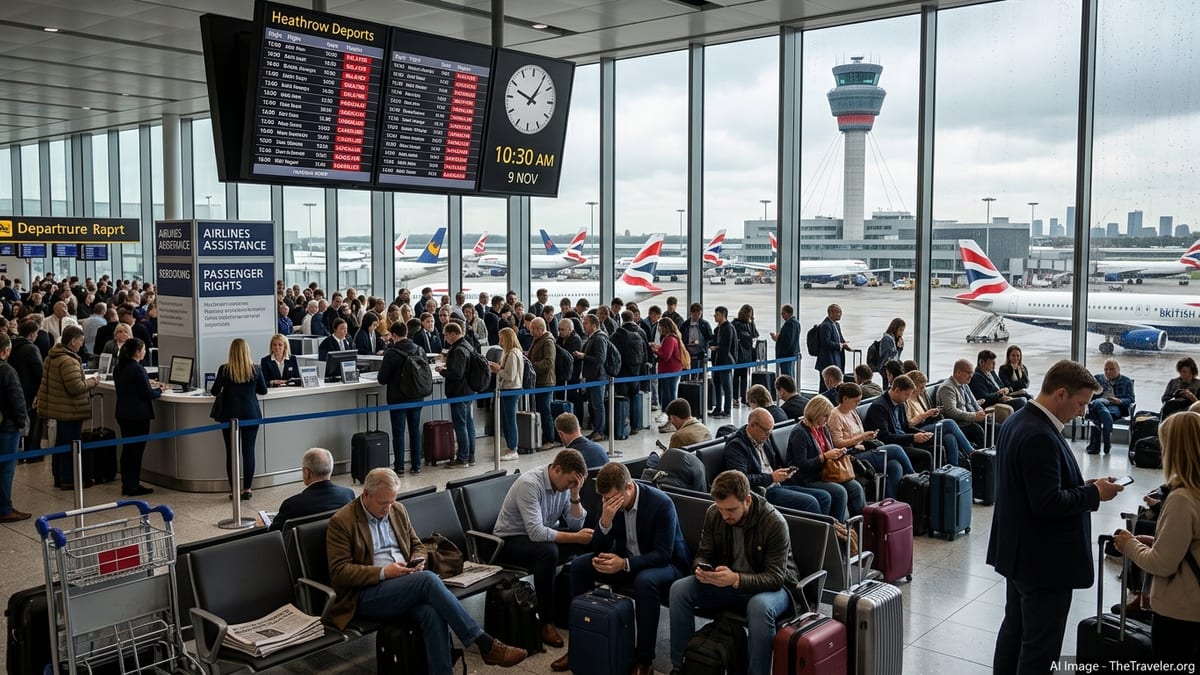
UK MPs have opened a fresh line of scrutiny into National Air Traffic Services (NATS) and airlines after a 9 November technical failure in the air traffic control network led to widespread delays and cancellations across UK airspace, sharpening questions about how passengers were treated on the day and whether lessons from earlier outages have been fully applied.
Get the latest news straight to your inbox!
What is known so far about the 9 November disruption
While a full official chronology of the 9 November event has yet to be published, parliamentary questions and early statements from aviation bodies describe a technical fault within NATS’ flight data systems that restricted capacity in parts of UK airspace. As in previous incidents, controllers reportedly shifted operations into a reduced mode while engineers validated data and worked to restore normal functions, which limited the number of aircraft that could be handled at any one time.
The immediate safety of flights was not reported to have been compromised, in line with the approach taken during earlier air traffic control failures, where traffic levels are cut back until system integrity is assured. However, even a relatively short period of restrictions can create significant knock-on effects in a tightly scheduled European network, and MPs have highlighted evidence from airports and airlines that delays and cancellations continued after the core fault was addressed as aircraft and crews fell out of position.
Members of the House of Commons Transport Committee have asked NATS to provide detailed data on the number of flights affected on 9 November, broken down by airport and time of day, together with the duration and geographic scope of any restrictions. Those figures will be needed to place the disruption in context with earlier failures, including the 28 August 2023 outage and a major technical incident on 8 September 2026, which NATS’ own preliminary report says led to disruption affecting more than 2,000 flights across the day.
How 9 November fits into a run of NATS system failures
The 9 November issue is now being examined against a backdrop of recent high profile NATS incidents. A Civil Aviation Authority independent review of the 28 August 2023 outage set out detailed recommendations on software robustness, testing and contingency planning. In September 2026, another technical failure in the flight data processing system forced nationwide flow restrictions while the London Area Control centre systems were restarted and flight data reloaded, an event NATS has since described in a preliminary investigation report and which the CAA is now subjecting to its own independent review.
Crucially for current parliamentary scrutiny, NATS and the government have both stressed that these failures did not share a single root cause. The 2023 outage and the 8 September 2026 incident were traced to different software defects and unexpected interactions within complex safety critical systems rather than to cyber attacks or deliberate interference. Early indications suggest that the 9 November fault is again technically distinct, although MPs have signalled they will test that claim once detailed evidence is available and will look closely at any common themes in testing, change-control and fall-back arrangements.
Written answers and previous Transport Committee evidence sessions on air traffic control disruption also confirm that, although individual failures have been short-lived, their impact has been magnified when they occur at peak times at major hubs or on particularly busy travel days. That has prompted the Committee Chair to question whether commitments made after the 2023 and September 2026 events, including promises to remove single points of failure and enhance redundancy, have been delivered at the pace required by a growing and highly interconnected flight network.
Passenger rights, airline duties and where compensation applies
For travellers, the most immediate questions arising from 9 November concern what airlines were obliged to provide on the day. Under the UK’s retained version of EU Regulation 261/2004 and associated domestic rules, carriers must offer rebooking or refunds when flights are cancelled and provide meals and, where necessary, overnight accommodation when passengers face long delays, regardless of whether the cause lies within the airline’s control.
The Civil Aviation Authority has previously treated major NATS technical failures, including the 8 September 2026 disruption, as likely to qualify as an “extraordinary circumstance” for the purposes of compensation rules. In practice that has usually meant that cash compensation for delay is not payable where the root cause is firmly outside an airline’s own operations, even if the disruption is substantial. However, the CAA has also reminded airlines that their duty of care to stranded passengers still applies in full, and that they may be required to reimburse reasonable expenses for food, accommodation and alternative transport when their own arrangements fall short.
Consumer groups have repeatedly told MPs that many passengers struggle to secure that assistance in real time during large incidents, either because information is unclear or because airport desks and call centres are overwhelmed. Complaints following the September 2026 outage, which prompted a specific CAA statement on compensation and an appeal for passengers to share evidence of their experiences, are informing how regulators and lawmakers assess airlines’ responses to the 9 November disruption. The Committee has indicated it will use those earlier cases as a benchmark when it looks at how quickly carriers offered rebooking options, hotel rooms and practical support this time.
Committee scrutiny of NATS resilience and the new Civil Aviation Bill
Alongside examining what happened operationally on 9 November, MPs are folding the incident into wider work on aviation resilience and consumer protection. The Civil Aviation (Consumer Protection and Regulatory Reform) Bill now before Parliament would give ministers clearer powers to amend and replace air passenger rights legislation, including the framework currently derived from Regulation 261, and strengthen the Civil Aviation Authority’s enforcement toolkit.
The government’s impact assessment for the Bill highlights an intention to make it easier to update detailed rules on issues such as disruption handling, accessibility and transparency around pricing, as well as to improve the regulator’s ability to act where airlines and other aviation businesses fail to meet their obligations. The Transport Committee has previously pressed ministers on how these new powers will be used in practice, especially in large scale disruption events caused by infrastructure providers such as NATS where responsibilities are spread across multiple organisations.
On the technical side, both the Department for Transport and the CAA have required NATS to report formally on past failures, including by providing preliminary accounts within days and fuller analyses within weeks. The preliminary report on the 8 September 2026 incident, published in mid September, set out immediate mitigations inside the flight data processing system and flagged longer term investment plans in systems and technology, including a proposed further multibillion pound programme through to 2033. MPs are expected to ask whether those mitigation and investment plans adequately address failure modes revealed by the 9 November event or whether additional changes are needed.
Practical implications for travellers using UK airspace
Although large scale air traffic control failures remain infrequent given the volume of flights handled in UK airspace, the sequence of events in 2023 and 2026, and now the 9 November disruption, underlines several practical points for travellers planning itineraries. First, any serious doubt about the integrity of flight data systems is likely to trigger capacity restrictions or, in extreme cases, temporary suspensions of departures, even when weather conditions appear benign and airport terminals are operating normally. For passengers, this means that a flight can be significantly delayed by airspace management constraints that are not immediately obvious on the ground.
Second, recovery from such incidents can extend beyond the period when the technical fault itself is present. NATS’ own data on the 8 September 2026 failure shows that while the core issue affected higher level traffic managed through the London Area Control centre, flow restrictions had to be spread more widely while systems were restarted and flight data reloaded. Aircraft and crews ended up in the wrong places for later rotations, and that pattern is likely to have been repeated to some extent on 9 November given similar capacity limitations, even if the exact technical trigger was different.
Third, passengers with time critical onward connections, such as cruise departures, long distance rail services or major events, may wish to factor in additional buffer time when planning same day connections through busy UK hubs. Government answers on the September 2026 disruption acknowledged that knock-on effects could persist into the following day while schedules and crew rosters were rebalanced. While there is no indication that such failures will become more frequent, recent experience suggests that when they do occur their effects can be felt beyond the initial incident window.
What travellers should watch for next
In the coming weeks, the key developments to watch will be publication of any preliminary findings specific to the 9 November failure and how those findings are picked up by Parliament, the Civil Aviation Authority and the Department for Transport. If previous practice is followed, NATS will be expected to submit an initial account of the incident to ministers and the regulator within a relatively short period, outlining the technical cause, the operational response and the immediate mitigations put in place to reduce the risk of recurrence.
Travellers are unlikely to see direct changes to day to day flying as an immediate result, but the handling of 9 November is feeding into active discussions on the Civil Aviation Bill and on the CAA’s independent review of the 8 September 2026 disruption. Together, those processes will shape future enforcement of passenger rights and the framework within which NATS funds and prioritises its technology upgrades. Any proposals to refine guidance on when disruption is classed as an extraordinary circumstance, or to change how compensation and care rules are communicated to passengers during an incident, are likely to emerge through these channels rather than via standalone announcements.
For now, the most practical step for passengers remains to keep contact details up to date in airline bookings, monitor airline apps and airport departure boards closely on the day of travel, and retain receipts for reasonable expenses if disruption occurs. If a future airspace or air traffic control issue arises, information from airlines and official channels is typically updated more quickly than third party travel sites, and knowing the distinction between compensation and care rights should help travellers make informed decisions while MPs, regulators and NATS work through the longer term questions raised by the 9 November failure.