


More news on this day
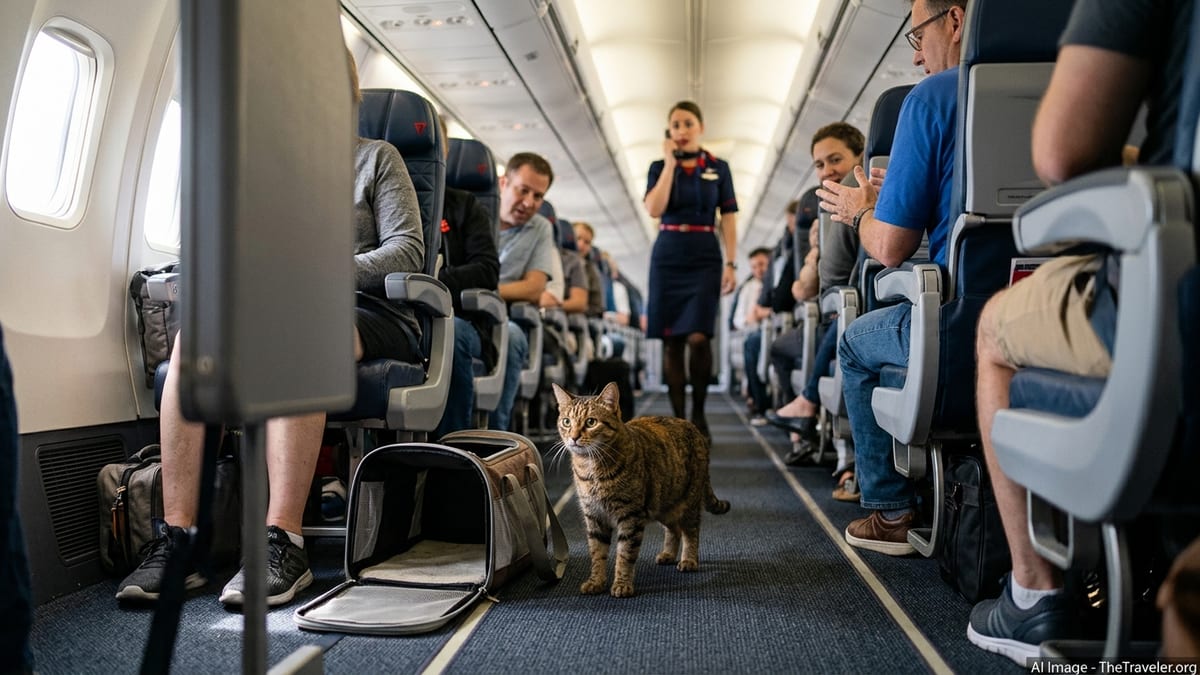
A Delta Air Lines flight from Boston to Tampa was briefly delayed on November 20, 2026, when a passenger’s pet cat slipped out of its carrier during taxi, prompting the crew to halt the aircraft on the Logan International Airport taxiway while the animal was secured.
Get the latest news straight to your inbox!
What happened on Delta flight 2706 from Boston to Tampa
According to multiple local reports and air traffic control recordings, the incident occurred on Delta flight 2706, a Boeing 737-900 scheduled from Boston Logan International Airport to Tampa International Airport on the morning of Friday, November 20, 2026. As the aircraft taxied toward the runway, the captain radioed Boston ground controllers to request a stop because of “a situation in the cabin.” After controllers instructed the jet to hold its position, the pilot later explained that the crew had “a cat loose in the cabin.”
Recordings of the exchange, shared by aviation monitoring sites, captured a lighthearted response from the controller, who closed the conversation by telling the pilots, “Have a good day. Meow.” Despite the unusual interruption, Delta and local outlets reported that the time on the taxiway was brief and that the flight departed soon after the cat was recaptured, arriving in Tampa more or less on schedule.
Delta later confirmed that a pet traveling in the cabin had escaped its carrier while the aircraft was moving toward the runway. The airline did not report any injuries to passengers, crew or the animal. There is no indication that the incident led to a diversion, emergency declaration or significant operational disruption beyond the short pause during taxi.
Why a loose animal requires a stop during taxi and takeoff
Aviation safety specialists note that even seemingly minor cabin disturbances, such as a pet slipping out of a carrier, can trigger a requirement to halt taxi or takeoff. U.S. regulations and airline operating manuals require passengers to be seated with seat belts fastened and all carry-on items properly stowed during taxi, takeoff and landing. A loose animal on the floor or in the aisle can interfere with those conditions and complicate an evacuation if one suddenly becomes necessary.
In practice, that means flight attendants must quickly assess whether the situation is under control and, if not, notify the pilots, who then coordinate with air traffic control. Stopping the aircraft on a taxiway is a standard response when cabin crew need time to secure something that could move freely around the cabin, whether that is a passenger who is out of their seat, an unsecured bag or an escaped pet. Safety professionals emphasize that bringing the aircraft to a stop is a precaution, not an emergency, and typically results in only a short delay as long as the situation can be resolved promptly.
The Boston incident reflects how strictly these rules are applied even for small animals. A cat roaming the aisle may seem harmless, but in a confined space it can cause tripping hazards, startle passengers, trigger allergic reactions or, in rare cases, scratch or bite if frightened. The safest option from the crew’s perspective is to keep the aircraft stationary until the cabin is secure and all passengers are seated again.
Delta’s in‑cabin pet policy and what went wrong
Delta permits small dogs and cats to travel in the passenger cabin on many domestic routes when they are booked in advance and meet specific size and health requirements. The airline’s current pet travel rules state that animals must be transported in a soft- or hard-sided, ventilated kennel that fits under the seat in front of the traveler. The pet is required to remain fully inside the closed carrier, with the door secured, in the boarding area, during boarding and deplaning, inside lounges and throughout the flight.
The airline also limits the number of pets allowed in each cabin on a given flight, and passengers typically pay an in‑cabin pet fee at check‑in. Delta’s guidance notes that travelers who do not follow the rules, including failing to keep pets secured in their carriers, may be refused transport with the animal or lose the ability to bring pets on future flights. The requirements are intended to protect the pet, the owner and other passengers, particularly those with allergies or phobias.
In the case of flight 2706, the cat appears to have slipped out of its kennel while the aircraft was already moving, which indicates that the carrier either was not fully secured or had an opening the animal could exploit. Cats are known for squeezing through small gaps or unzipping soft-sided bags from the inside, and online discussions following the Boston incident quickly filled with similar anecdotes from travelers whose pets had managed to open carriers mid‑journey. From the airline’s standpoint, however, the core expectation remains that the animal stays confined whenever the aircraft is in motion.
Reactions from travelers and what this means for passengers with pets
The brief delay in Boston quickly drew attention far beyond the passengers on board once audio of the exchange with air traffic control began circulating on aviation websites and social media. Many users focused on the controller’s dry “meow” sign‑off, treating the incident as a moment of levity after a tense period for U.S. air travel marked by high-profile disruptions and infrastructure issues. For some, the idea of a cat exploring the cabin mid‑taxi sounded more charming than concerning.
Others, including people with pet allergies or phobias, reacted quite differently. Online commenters pointed out that a loose animal on a full flight can pose a real problem for travelers who react strongly to dander or who are uncomfortable around animals. Loose pets can also approach passengers who did not choose to sit near them, something airline pet policies are designed to prevent by requiring carriers to remain under seats and closed. The Boston incident therefore highlighted ongoing tension between growing demand for pet-inclusive travel and the need to safeguard passengers who do not wish to share a small cabin space with free‑roaming animals.
The incident also renewed debate over how consistently rules are enforced. Some travelers recounted flights where cabin crew strictly insisted that carriers stay zipped and under the seat, while others described flights where pets were allowed to sit in laps once the seat belt sign was off. For passengers planning to travel with animals, the Boston case is a reminder that enforcement often becomes stricter whenever an issue arises, particularly during safety-critical phases such as taxi and takeoff. Pet owners who have become accustomed to more relaxed enforcement on quiet flights should not assume that will always be the case.
Practical guidance for flying with pets after the Boston incident
For travelers planning to bring pets in the cabin, the events on Delta flight 2706 underline several practical considerations. First, it is important to confirm up-to-date pet policies directly with the airline ahead of travel, including whether your specific route allows in‑cabin pets, what types of animals are accepted, any applicable fees and the maximum carrier dimensions for the aircraft type. Policies can change and may vary by route or partner airline, so relying on older information or third-party summaries can lead to problems at check‑in.
Second, pet owners should pay close attention to the security of the carrier itself. Soft-sided bags with zippers, mesh panels or expanding sections can be comfortable for animals but may also present escape opportunities if not fully closed or if a stressed pet learns how to work the closures. Many experienced travelers with cats and small dogs recommend practicing with the carrier at home so the animal is comfortable inside, checking for weak spots or gaps, and considering secondary fasteners such as clips on zipper pulls if the design allows. Investing in a sturdy, airline-compliant carrier that your pet cannot open is often less costly than dealing with a last-minute escape on the tarmac.
Finally, all passengers, with or without pets, may want to recognize that such delays, while inconvenient, typically reflect the crew’s obligation to follow safety procedures rather than discretionary caution. When a loose animal or other cabin disruption is reported, pilots must coordinate with ground control, bring the aircraft to a controlled stop if necessary and wait for confirmation from cabin crew that the situation is resolved. For travelers who are sensitive to animals, the Boston incident is a prompt to review airline policies on seating, pet-free sections if available, and any medical documentation that may be helpful when requesting accommodations.
Delta has not announced any specific policy changes in response to the November 20 event, and in‑cabin travel for small pets continues under existing rules. However, as the viral “meow” exchange fades from the headlines, the practical impact for future passengers is likely to be subtle but real: greater awareness among pet owners of their responsibilities, and a renewed focus among crews on checking that carriers are properly secured before the aircraft begins to move.