


More news on this day
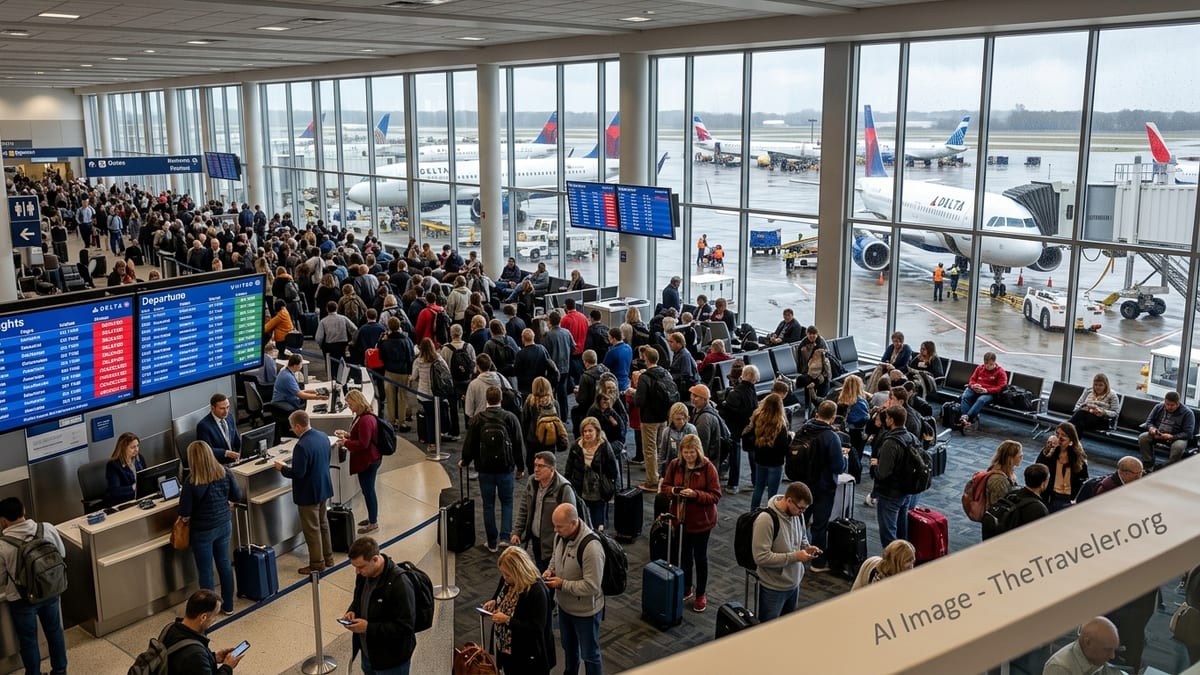
With U.S. air traffic over Thanksgiving 2026 forecast to reach its highest level in 16 years and recent tech outages triggering delays at major hubs, travelers are being urged to check real-time airport and flight disruption information before setting out for the airport.
Get the latest news straight to your inbox!
Thanksgiving 2026: Why Disruption Risk Is Elevated
The U.S. Federal Aviation Administration expects the 2026 Thanksgiving travel period to be the busiest in more than a decade, with roughly 417,000 flights scheduled nationwide between November 23 and December 1 and more than 52,000 flights planned on Wednesday, November 24 alone, the peak day in the agency’s holiday forecast. At the same time, Transportation Security Administration data show that Thanksgiving 2025 was the busiest week of air travel on record, and checkpoint volumes so far in 2026 have tracked only slightly below last year, suggesting crowded airports and high demand across many routes.
The run-up to Thanksgiving has already seen several high profile disruptions. Earlier in November 2026, an FAA systems problem triggered the longest nationwide ground stop in around 25 years, temporarily halting departures across the United States. In the week before Thanksgiving, United Airlines and Delta Air Lines each experienced separate technology outages that led to hundreds of flight delays. On Sunday, November 22, more than 1,000 Delta flights were delayed after an automated system used to calculate aircraft weight and balance malfunctioned, prompting the FAA to impose a short ground stop for flights bound for Atlanta, one of the world’s busiest hubs.
Weather is adding another layer of uncertainty. The National Weather Service has warned of a rainy pattern affecting both East and West Coast regions around the holiday period, while king tide flooding and saturated soils are a concern in parts of coastal California. Meteorologists are not forecasting severe nationwide storms for every day of the travel window, but they have advised passengers to monitor local forecasts closely and to check with their departure and arrival airports on the day of travel, because even localized thunderstorms, low clouds or heavy rain can slow operations and cause knock-on delays elsewhere in the network.
Using FAA Tools to Check Airport-Wide Delays
For an overview of how Thanksgiving congestion and weather are affecting airports, the most authoritative public source is the FAA’s Air Traffic Control System Command Center. Its National Airspace System status pages, including the text-only National Airport Status feed, show current conditions at major U.S. airports, including whether they are operating normally or subject to arrival or departure delays, ground delay programs or ground stops. When a ground delay program is in effect, flights are metered into an airport at controlled intervals, which can significantly lengthen gate departure times even in good weather.
These FAA dashboards report airport-level constraints in near real time, such as low-visibility operations, runway construction impacts or volume-related flow restrictions. They do not replace airline flight status pages, because they do not display information for individual flights or smaller airports. However, they give Thanksgiving travelers an early warning that a particular hub is experiencing systemic issues. For example, if an advisory notes a ground stop or prolonged departure delays at an airport where a traveler is due to connect, that is a signal to check onward connections carefully and consider reaching out to the airline about rebooking options.
The FAA’s terminology around delay programs is precise, and understanding it can help passengers interpret holiday disruption reports. A ground stop generally means flights bound for a specific airport are held at their point of departure for safety or capacity reasons, with no clear departure time until the stop is lifted. A ground delay program manages traffic into an overloaded airport by assigning each flight an expected departure window, often leading to moderate but predictable waits. Terminal facilities report delays of 15 minutes or more into central systems, which then feed the National Airspace System status displays. Over Thanksgiving, the Command Center may issue advisories throughout the day as conditions change, so checking shortly before leaving for the airport tends to be more useful than relying on early-morning snapshots.
Checking Your Specific Flight: Airlines, Apps and Data Services
While FAA tools show the big picture, only the airline operating a flight can provide binding, flight-specific information. U.S. carriers maintain their own status pages and mobile apps that generally draw from internal operational systems and offer the earliest confirmations of changes such as equipment swaps, crew reassignments or rolling delays. In travel advisories issued after recent outages and the nationwide ground stop, multiple airlines have explicitly urged customers to verify flight status in their app or on the airline’s website before heading to the airport, noting that schedules can continue to shift as operations recover.
Most major airlines also provide same-day operational alerts by email, text message and app push notification for passengers who enter their contact details at booking or later retrieve their reservation using a confirmation code. These alerts can flag gate changes, new estimated departure times or cancellations, sometimes before airport departure boards are updated. During busy periods such as Thanksgiving, when delays can cascade and turn-times between inbound and outbound flights grow tighter, monitoring these official notifications throughout the day can give travelers a clearer sense of whether a connection is realistically achievable or whether to call and request protection on a later flight.
Third-party flight-tracking services, including those that draw from FAA or airline feeds, can add context but have limitations. Many publish aggregate statistics on on-time performance by route or airport based on Department of Transportation data from the previous year. For example, recent analyses of November and December 2025 show that roughly one in four flights arrived at least 15 minutes late, with performance varying widely by route and time of day. Such historical data can help set expectations about busy morning versus evening banks or the relative reliability of certain hubs during the holiday season. However, Thanksgiving 2026 flights themselves are subject to the day’s actual weather, staffing and technical conditions, which can diverge significantly from averages.
Interpreting Delay Risk by Day, Airport and Time
Beyond checking whether a particular flight is running on time, travelers planning or adjusting Thanksgiving trips may want to understand patterns in how disruption risks differ by day and time. TSA checkpoint archives show that the Sunday after Thanksgiving was the single busiest air travel day in 2025 and that the entire week set a record for passenger volumes. Forecasts for 2026 suggest only a small decline from those peaks, meaning security lines and boarding areas are likely to be crowded again on the main getaway and return days, particularly the Wednesday before Thanksgiving and the Sunday and Monday that follow.
Historical on-time performance data suggest that early morning departures tend to experience fewer and shorter delays than afternoon and evening flights, because they are less exposed to knock-on effects from earlier disruptions. Analyses of previous Thanksgiving periods indicate that flights departing before mid-morning had a significantly lower rate of late arrivals than those scheduled in the late afternoon and evening. That pattern is not a guarantee for any specific day in 2026, especially if morning fog or low clouds affect a particular airport, but it is a useful benchmark when choosing between remaining options or considering voluntary changes offered by airlines during peak travel windows.
Airport-specific conditions are another factor. Major coastal hubs and upper Midwest airports are more exposed to weather-related constraints such as winter storms, low ceilings or strong crosswinds during late November, while interior hubs often feel the knock-on impact of volume-related flow controls as they absorb diverted or delayed traffic. The recent ground stop at Chicago O’Hare during the holiday week, for example, was imposed for staffing reasons and temporarily halted some departures even as the wider region’s weather remained manageable. Travelers connecting through such hubs during Thanksgiving should treat any Command Center advisory, even if short-lived, as a signal to watch subsequent flights closely.
Steps Travelers Can Take Before and During Thanksgiving Trips
For those who have not yet departed, there are several practical checks that can reduce uncertainty on Thanksgiving week journeys. Starting 24 hours before a flight, passengers can monitor both their airline’s app and the FAA’s airport status pages for their departure and arrival airports, watching for the appearance of ground delay programs or volume-related advisories. At the same time, local National Weather Service forecasts for each city on the itinerary can clarify whether any expected rain, snow or low cloud ceilings are likely to coincide with the scheduled departure window, increasing the chance of spacing restrictions or de-icing delays.
On the day of travel, verifying that the inbound aircraft actually operating the flight has departed its previous station and appears to be tracking toward the gate makes it easier to distinguish between a minor schedule adjustment and a more serious disruption. If the inbound aircraft or crew is running significantly late into a tightly banked hub during one of the busiest hours, travelers with tight connections may want to contact the airline proactively from home or the departure gate to discuss backup options. Airlines generally have more choices earlier in the disruption timeline, before later flights sell out or weather creates additional constraints.
Once at the airport, passengers should continue to rely on airline status tools and announcements rather than assuming that departure boards fully reflect recent developments. Because the Thanksgiving peak often coincides with high load factors, same-day reaccommodation can be challenging, and travelers whose flights are canceled or severely delayed may need to consider rerouting through alternate hubs or even departing from or arriving at secondary airports, when those options are offered. In these cases, the combination of FAA airport-wide status pages, which can identify which hubs are least constrained, and airline inventory displays, which show where spare seats remain, can guide decisions that minimize total disruption.
Looking beyond 2026, federal regulators and airlines are continuing to work on technology upgrades and staffing measures intended to make the system more resilient to periods of intense holiday demand. Recent announcements from the Department of Transportation have highlighted initiatives such as new congestion-prediction tools at the FAA’s Command Center and internal “tiger teams” tasked with stress-testing schedules ahead of peak travel days. Those efforts will not eliminate Thanksgiving delays altogether, since weather and technical issues will continue to arise, but they underline why real-time checks of official delay and status sources are likely to remain a key part of holiday travel planning for U.S. passengers in the coming years.