


More news on this day
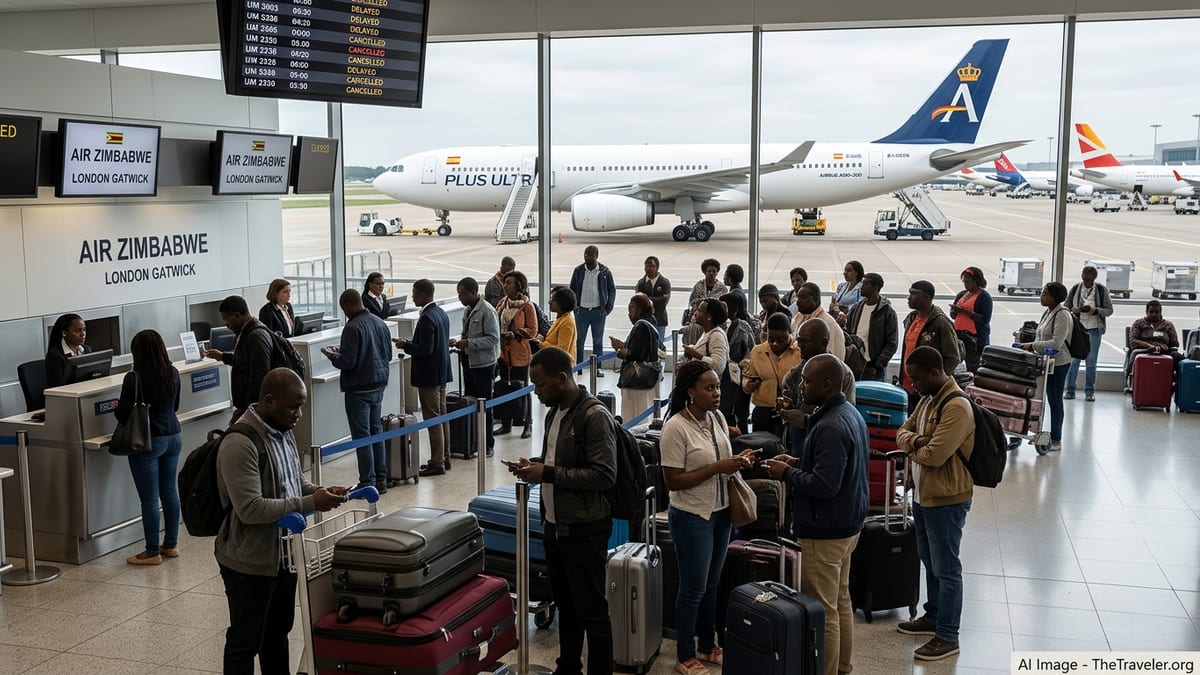
Air Zimbabwe’s recently restored direct London–Harare flights have been disrupted after Spanish wet-lease partner Plus Ultra Líneas Aéreas halted operations and reclaimed the Airbus A330 normally used on the route, prompting at least one cancellation and a short-term schedule reset just months after the service relaunched.
Get the latest news straight to your inbox!
What has happened to Air Zimbabwe’s London flights?
Air Zimbabwe relaunched non-stop flights between Harare and London Gatwick on 22 July 2026 using a 302-seat Airbus A330-300 supplied under a wet-lease agreement with Madrid-based Plus Ultra Líneas Aéreas. Under this structure, Plus Ultra provided the aircraft, crew, maintenance and insurance, while Air Zimbabwe controlled ticket sales and commercial aspects of the route.
On 23 November 2026, the A330 scheduled to operate flight UM725 from London Gatwick to Harare did not depart as planned. Industry tracking data and local media reports indicate that the aircraft instead repositioned to Madrid, where it has been parked, leaving passengers booked on the London–Harare service stranded or in need of rebooking.
Air Zimbabwe subsequently confirmed in a statement on 24 November that the 23 November London–Harare flight had been “rescheduled due to operational reasons” and that it was working to accommodate affected passengers. The airline did not publicly name Plus Ultra in that statement or give a detailed operational explanation, but the disruption coincided with, and appears linked to, Plus Ultra’s decision to halt its own flying.
Plus Ultra suspends operations amid financial restructuring
The disruption to Air Zimbabwe’s London route comes as Plus Ultra moves into a deeper restructuring phase. On 23 November 2026, the Spanish carrier announced the suspension of its Madrid–Caracas service, its last remaining scheduled passenger route, citing surging fuel costs and ongoing financial pressures while it negotiates with creditors over government-backed loans.
By 24 November, multiple Spanish and international aviation outlets reported that Plus Ultra had extended that move into a suspension of all flight operations “until further notice.” The airline has filed for preliminary creditor protection and is in talks over approximately 53 million euros in state-backed financing granted in 2021 during the Covid-19 pandemic. It has also signalled planned workforce reductions as part of its restructuring proposals.
For Air Zimbabwe, Plus Ultra’s escalation from trimming its South American network to halting operations altogether has immediate consequences, as the wet-lease arrangement depends on Plus Ultra continuing to operate and maintain the A330. Once Plus Ultra grounded its own flights and parked the aircraft in Madrid, the Harare–London operation lost the only widebody currently approved to serve that route under Air Zimbabwe’s existing permissions.
How the wet lease made Air Zimbabwe’s London return possible
Air Zimbabwe’s July relaunch of London flights followed a lengthy absence from the UK. The carrier last operated its own aircraft to London more than 14 years ago before suspending the route amid financial difficulties and safety oversight concerns. It remains on the European Union Air Safety List, a registry of airlines that do not meet certain international safety standards and are therefore banned from operating their own aircraft into EU and, by extension, UK airspace.
Being listed does not prevent a banned airline from selling tickets on flights into Europe, provided those flights are actually operated by a different carrier that meets European safety requirements. To use this exception, Air Zimbabwe secured a foreign operator permit from the UK Civil Aviation Authority for Plus Ultra and concluded a wet-lease deal under which all technical and operational responsibility for the London flights sat with the Spanish airline.
Air Zimbabwe promoted the return to London as a key part of its turnaround strategy, highlighting both passenger demand and the aircraft’s role in cargo. The A330-300 used on the route is configured with 302 seats and a reported belly-hold capacity of around 30 tonnes of freight, enabling exports of horticultural produce and other goods from Zimbabwe to reach the UK on a non-stop service once again.
Impact on passengers, bookings and festive season plans
The timing of the disruption has heightened its impact. On 20 November 2026, just three days before the A330 repositioned to Madrid, Air Zimbabwe announced plans to increase the Harare–London service from three to four weekly flights from December, citing what it described as rising customer demand in the run up to the festive travel peak. At that stage, the airline continued to sell seats on the route through its website and distribution channels.
Passengers booked on the 23 November London–Harare flight were the first visibly affected, as the aircraft was no longer available to operate the scheduled service. Local media reports and social media posts from stranded travellers described last-minute cancellations and uncertainty as to when they would be able to depart. In its 24 November statement, Air Zimbabwe said it was re-accommodating affected customers, but did not specify whether this would be on alternative routings with other airlines, on later dates once a replacement aircraft is in place, or through refunds where requested.
Zimbabwe’s state broadcaster has reported that Air Zimbabwe intends to maintain the Harare–London route despite Plus Ultra’s suspension of operations, and that passengers with existing bookings will “not be affected” in the longer term. As of the afternoon of 24 November, Air Zimbabwe’s booking engine continued to display London flights beyond 26 November, although the airline has not yet publicly released a revised timetable or clarified the exact aircraft and operator that will be used for upcoming rotations.
Regulatory constraints and options for keeping the route alive
Air Zimbabwe’s ability to continue London services in the short term is constrained by its ongoing presence on European and UK safety lists. The airline cannot simply substitute one of its own aircraft on the Gatwick route, because its fleet is not currently cleared to operate into European airspace under EU or UK regulations. Any immediate solution therefore has to involve another compliant carrier supplying aircraft and crew.
One avenue would be for Air Zimbabwe to secure a new wet-lease partner at short notice. To do that, the prospective lessor would require approval from the UK Civil Aviation Authority and, where relevant, European authorities for the specific arrangement and aircraft type. The process typically includes demonstrating equivalent safety and maintenance standards and can take time, particularly when a previously banned carrier such as Air Zimbabwe is involved in the commercial agreement.
A second possibility is that Air Zimbabwe temporarily suspends the London route while it negotiates a new leasing arrangement, focusing instead on its regional and domestic network. The airline’s latest available annual report highlights a broader restructuring plan that includes fleet renewal and route optimisation, but it does not anticipate near-term removal from the EU Air Safety List. Given that structural limitation, any long-term Harare–London offering is likely to depend on continued access to a third-party widebody operator.
What travellers should do now
The immediate question for travellers is whether their upcoming flights between Harare and London will operate as originally scheduled. As of 24 November 2026, Air Zimbabwe has confirmed that the disrupted 23 November flight is being rescheduled and has indicated that services will resume on Thursday 26 November. However, the airline has not yet issued a detailed public timetable adjustment or confirmed the identity of any new operating partner that might replace Plus Ultra.
Passengers with bookings in the coming days and weeks should therefore treat all schedules as provisional until Air Zimbabwe publishes a definitive update. Travellers are advised to check their booking status directly with the airline or their travel agent, monitor for schedule-change notifications, and verify departure times with London Gatwick and Harare airports on the day of travel. Those with time-sensitive journeys, such as onward connections or fixed event dates, may wish to explore alternative routings via other carriers until Air Zimbabwe releases clearer operational information.
For new bookings, the uncertainty around the operating carrier and aircraft means that prospective passengers should pay close attention to fare conditions, particularly change and refund rules, before committing to travel on the route. Until Air Zimbabwe confirms a stable replacement for Plus Ultra and publishes an updated schedule, the Harare–London service remains in a transitional phase rather than a fully secure offering.