


More news on this day
Commercial air traffic to and from Belgium was largely halted on Monday 23 November 2026 after air traffic control provider Skeyes closed Belgian airspace for 14 hours during a nationwide union strike, prompting Brussels Airport to cancel almost all scheduled passenger flights and disrupting travel plans for an estimated tens of thousands of passengers across Europe.
Get the latest news straight to your inbox!
How the 23 November shutdown unfolded
Belgian air navigation service provider Skeyes confirmed that it suspended regular air traffic control services between 07:00 and 21:00 local time on Monday 23 November 2026 as part of a national day of industrial action against federal government austerity and labour policies. During this period, Belgian airspace was closed to most commercial flights, with exemptions limited to categories such as medical, state and certain diversion or emergency operations.
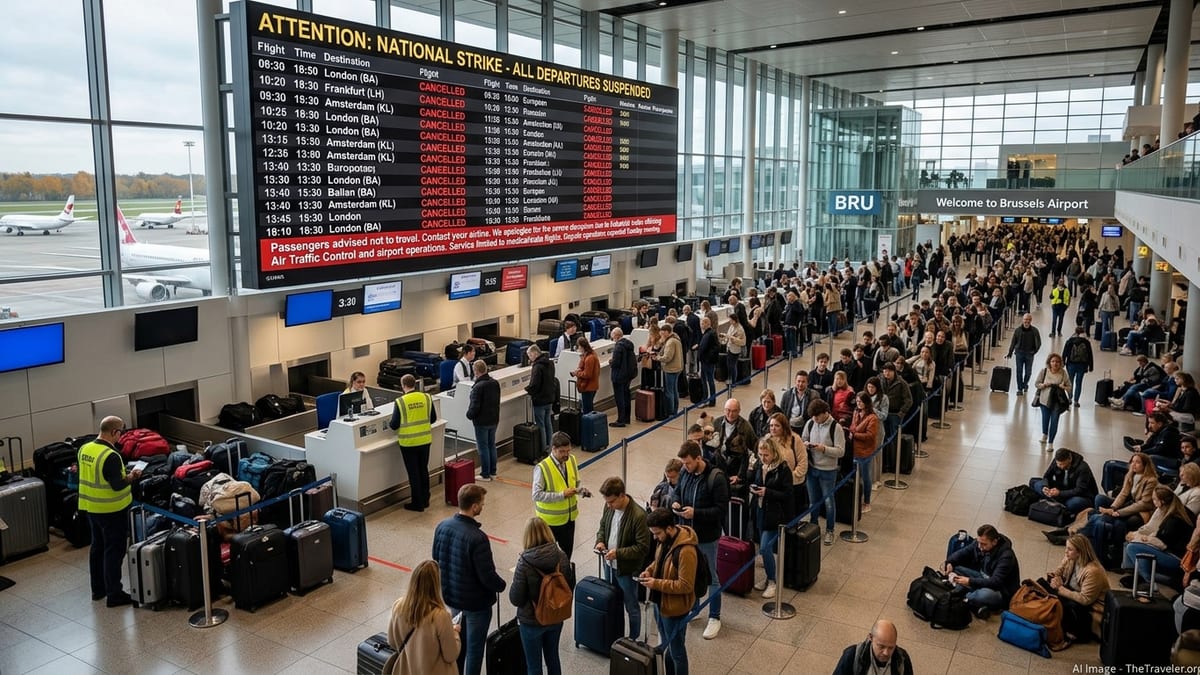
Brussels Airport in Zaventem, the country’s main international hub, announced in advance that it expected “significant disruptions” on 23 November and warned that most passenger flights during the 14 hour window would be cancelled. On the day, the airport’s live departures and arrivals boards showed a near blank schedule between early morning and late evening, with only a small number of exempt or repositioning flights operating. The airport advised passengers not to travel to the terminal unless they had explicit confirmation from their airline that their flight would operate outside the shutdown window.
Monitoring services that track strike impacts across Europe reported that civil flights at Brussels Airport and Brussels South Charleroi Airport “came to a halt” during the closure, with Belgian airspace unavailable for routine commercial operations. Data compiled after the event by aviation specialist outlets and local media show that regular air traffic through Belgian airspace resumed after 21:00 on Monday, although with some residual disruption as aircraft and crews were repositioned.
Scale of cancellations and effect on airlines
Initial tallies compiled from airport timetables and flight tracking data indicate that Brussels Airport cancelled 404 passenger flights on 23 November in connection with the airspace shutdown, affecting more than 50,000 booked travellers across its network. These figures cover both departures and arrivals that were either cancelled outright or re-timed to operate outside the 07:00 to 21:00 period. Industry reports suggest that Charleroi, Belgium’s main secondary passenger airport, also saw its commercial flight programme largely wiped out during the same hours, although with a smaller absolute number of flights than Brussels.
The cancellations touched almost every airline operating at Brussels. Home carrier Brussels Airlines curtailed much of its schedule in advance, including European feeder services that connect to its Africa and North Atlantic network. Leisure operator TUI fly Belgium, low cost carriers such as Ryanair and Wizz Air on affected routes, and a wide range of European and intercontinental airlines adjusted their operations. Some long haul services were re-routed to nearby hubs such as Amsterdam Schiphol, Paris Charles de Gaulle and Frankfurt, with passengers rebooked to continue their journeys from those airports instead of Brussels.
For many passengers whose flights were originally scheduled inside the closure window, airlines opted to bring services forward to early morning departures before 07:00 or delay them to later in the evening after 21:00, in cases where aircraft and crew availability allowed. Others were shifted to flights on later days, while some itineraries involving tight connections via Brussels were broken and reissued to route travellers via different hubs altogether. Cargo operations using Belgian airports also faced disruption, with operators reporting delays and diversions on 23 November as a result of the loss of air traffic control capacity.
Why Belgian airspace and ground transport were affected
The 23 November shutdown formed part of a wider national day of action called by Belgium’s main trade union federations against what they describe as federal government austerity measures, labour reforms and cost of living pressures. The unions had issued strike notices to cover employees in multiple sectors, including public transport, education and various public services, as well as air traffic control staff at Skeyes who elected to take part.
In its communications ahead of the strike, Skeyes said that it had received notice that a group of its air traffic controllers intended to participate in the national action and that, as a result, it would not be able to guarantee normal levels of air traffic services between 07:00 and 21:00 on 23 November. The provider stated that it was obliged to prioritise safety and therefore chose to restrict Belgian airspace capacity for routine civil flights during those hours. This prompted Brussels Airport and other Belgian airports to drastically reduce their planned schedules and issue early cancellation warnings.
The strike’s impact extended beyond the airspace itself. In Brussels, local public transport operator STIB confirmed heavy disruption to metro, tram and bus services on 23 November, with only limited core lines operating and a formal “attestation of disruption” issued for passengers. Regional operator De Lijn reported reduced bus operations in Flanders, while national rail company SNCB indicated that most of its intercity and regional train timetable would run but warned of possible knock on delays. The combination of reduced flights and patchy local transport made it more difficult for affected air passengers to switch to land based alternatives at short notice.
How passengers were impacted and what rights apply
The sudden loss of capacity in Belgian airspace left many travellers facing late notice cancellations or major changes to their itineraries. Reports from passengers and local media describe crowded airline service desks at Brussels Airport during the morning and early afternoon of 23 November, as travellers arriving on early long haul flights or already in transit sought new connections after finding their onward services scrubbed from departure boards.
Under European Union Regulation 261/2004, passengers whose flights were cancelled or heavily delayed retain certain rights when travelling from an EU airport or on an EU based carrier. In cases like the 23 November strike, where cancellations were caused by air traffic control staffing decisions and nationwide industrial action, the event is generally treated as an extraordinary circumstance outside the airline’s direct control. This usually means that while carriers must still offer a choice between a refund of the unused portion of the ticket and re-routing at the earliest opportunity under comparable conditions, they are not normally required to pay fixed cash compensation for short notice flight cancellations triggered by such external strikes.
Airlines remain responsible for providing care and assistance while passengers wait for rebooking. Depending on flight distance and the length of the delay, this can include vouchers or reimbursement for meals and refreshments, as well as hotel accommodation and local transport between the airport and accommodation when an overnight stay becomes necessary. In practice, the level of support offered on 23 November varied between airlines and depended on how easily travellers could be moved to flights outside the Belgian airspace closure window or rerouted via other hubs. Some travellers reported being placed on trains from Brussels to Amsterdam or Paris in order to continue their journeys from those airports, while others accepted rebooking on flights several days later.
Operational recovery and what travellers should watch next
By the morning of Tuesday 24 November, Brussels Airport and flight tracking services were showing a near normal flight programme, with airspace restrictions lifted and both inbound and outbound services operating across most airlines. Nonetheless, a residual layer of disruption persisted into Tuesday, including some delayed departures and further cancellations linked to aircraft and crew being out of position after the previous day’s shutdown and to remaining backlogs of stranded passengers being accommodated on subsequent flights.
Travel advisory platforms and airport information feeds on 24 November continued to flag Brussels and Charleroi as locations with ongoing “knock on” effects, recommending that passengers due to travel in the following days monitor their bookings for any schedule adjustments. Even where flights were operating, some airlines altered departure or arrival times in the short term to restore aircraft rotations and comply with crew duty time regulations following the 14 hour suspension of commercial air traffic. Travellers who had already accepted rebooking to dates later in the week were advised to reconfirm their new itineraries and adjust any associated hotel or ground transport reservations as needed.
Looking ahead, there is potential for further uncertainty. Union representatives at Skeyes have filed a new strike notice covering a period from early December 2026 into January 2027, creating the legal possibility of additional industrial action affecting air traffic control during that window, although no specific strike dates have been publicly confirmed at the time of writing. Separately, Belgium’s unions have previously organised other national demonstration days in 2026 that disrupted transport without fully closing airspace. For travellers planning new trips involving Brussels or other Belgian airports in the coming weeks, it is therefore advisable to check fare conditions carefully, consider tickets that allow date or routing changes at low cost, and review travel insurance coverage related to strike disruption.
For those with imminent bookings, the most reliable information sources remain airline notifications, Brussels Airport’s operational updates and official communications from Skeyes and Belgian transport operators. Passengers should verify the status of their flights in the days and hours before departure, pay attention to any changes in departure times or routing, and allow extra time to reach the airport if local public transport is affected by wider industrial action. Where flexible options exist, such as rebooking to flights outside any announced strike windows or routing via unaffected hubs, early use of those options generally improves the chances of completing the journey with a manageable level of disruption.