


More news on this day
Vanuatu’s tourism recovery in 2025 was led numerically by cruise passengers rather than longer-stay air tourists, according to newly published visitor-arrival data that also underline how differently Pacific nations count “sea arrivals.”
Get the latest news straight to your inbox!
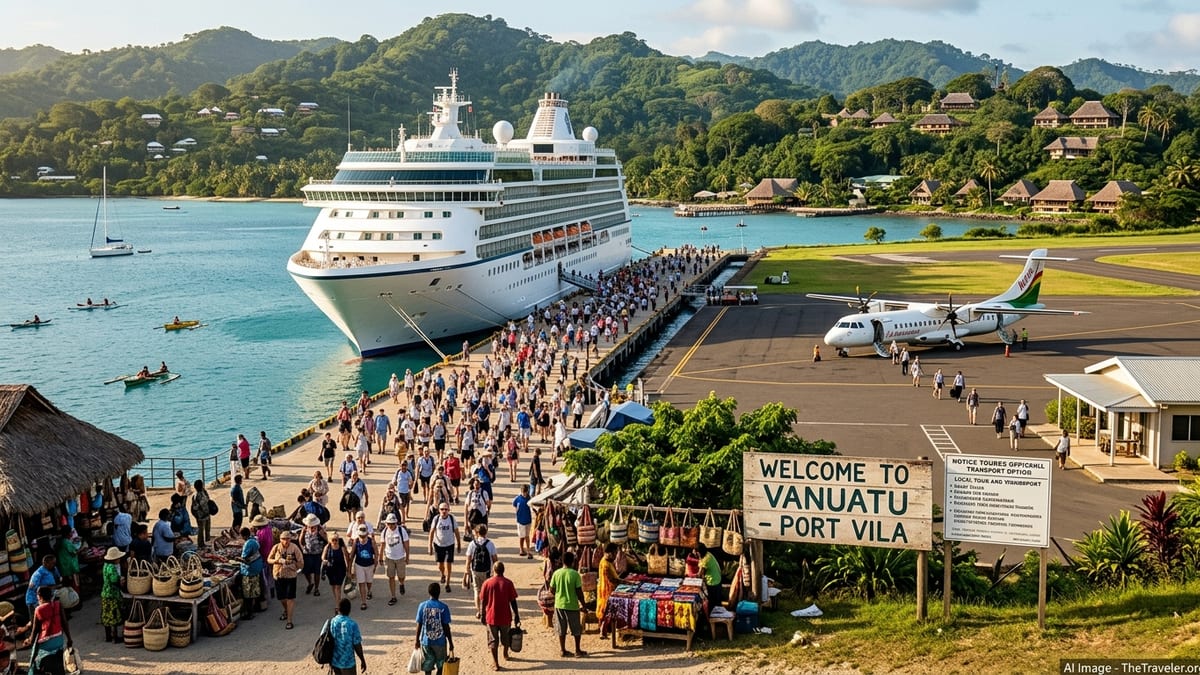
Cruise Arrivals Outpace Air Visitors in 2025
Final international arrivals tables published by the Vanuatu Bureau of Statistics confirm that in 2025 the country recorded 178,929 cruise passenger arrivals, compared with 96,983 international visitors arriving by air and 1,114 visitors by yacht. Cruise passengers therefore accounted for roughly two-thirds of all counted visitors, outnumbering air visitors by 81,946 over the year.
The same statistical release shows that air visitors in 2025 stayed an average of 8.8 nights, underscoring the difference between short-stop cruise passengers and stayover tourists who book accommodation on the islands. While detailed per-capita spending figures for 2025 have not yet been fully published, both the statistics office and regional tourism reports caution that headcount alone does not translate into equivalent economic impact.
For travelers interpreting headline numbers, this means that a destination can show strong “visitor arrivals” growth even if the number of people staying overnight in hotels, guesthouses and holiday rentals is recovering more slowly.
Recovery Shaped by Air Vanuatu’s Troubles and Cruise Disruption
Vanuatu’s latest annual totals come after a volatile two years for the tourism sector. Air Vanuatu entered liquidation on 9 May 2024, leading to grounded flights and a visible fall in air arrivals before replacement and charter services were gradually introduced later that year and into 2025.
Regional assessments drawing on Vanuatu Bureau of Statistics data report that total visitor arrivals in 2024 reached about 255,870, with cruise passengers making up around 78 percent of visitors and cruise volumes standing roughly 52 percent above 2019 levels. In contrast, 2024 air arrivals remained about half their 2019 total, reflecting limited seat capacity during and after the airline’s collapse.
The December 2024 earthquake that affected Port Vila’s cruise infrastructure further complicated the recovery path. Central-bank and tourism-agency commentary indicates that cruise calls dropped immediately after the damage, while air arrivals began to partially recover in early 2025. Cruise operations later resumed using temporary disembarkation arrangements in Port Vila, helping lift cruise headcounts again by the end of 2025.
Why “Visitor Arrivals” Mean Different Things in Vanuatu and Fiji
The prominence of cruise visitors in Vanuatu’s 2025 figures reflects how the country defines “visitor arrivals.” Official metadata explains that Vanuatu counts cruise passengers as visitors alongside air tourists, disaggregating totals by mode of transport, purpose of visit and country of residence. In practice, this means thousands of day-trippers stepping off cruise ships for a few hours each port call are included in the same core visitor totals as tourists who fly in for a week or more.
Fiji’s latest release illustrates a contrasting approach to sea arrivals. Provisional October 2026 statistics from the Fiji Bureau of Statistics record 94,317 total visitor arrivals for the month, of which 91,065 were by air and 3,252 by sea. However, the sea component is dominated by 3,065 crew members on fishing vessels, with only 187 yacht passengers. In other words, Fiji’s sea-arrival category is largely non-leisure traffic and represents a very small share of tourism-focused visitors.
These underlying differences mean that raw “sea arrivals” figures are not directly comparable across the region. A headline number for Vanuatu that is heavily influenced by cruise passengers reflects large volumes of short-stay leisure visitors, while Fiji’s equivalent number primarily captures working crew and a much smaller yachting segment.
What the Numbers Mean for Travelers and Planners
For prospective visitors, Vanuatu’s 2025 statistics suggest two distinct experiences. The typical cruise passenger spends a single day in port, often limited to shore excursions, markets and short tours, contributing to local spending but generating minimal demand for overnight accommodation. By contrast, the average air visitor spends around 8.8 nights in the country, supporting hotels, transport providers and multi-day tours across several islands.
For planners and investors, this distinction affects how capacity and infrastructure are evaluated. Cruise-heavy totals can indicate pressure on port facilities, excursion sites and waterfront areas during peak days, without necessarily signaling a parallel need for more hotel rooms. Air arrivals are a closer indicator of sustained demand for beds, inter-island flights and longer itineraries.
Cross-country comparisons also require care. Fiji’s October 2026 data show high overall visitor arrivals with a sea component that is mostly crew, so benchmarking Fiji’s “sea arrivals” directly against Vanuatu’s cruise counts would obscure the very different mix of travelers involved.
What To Watch Next
As of late 2026, monthly arrivals dashboards from Vanuatu continue to track air and cruise visitors separately, providing a clearer picture of how the recovery is balancing between stayover tourism and cruise calls. Travelers planning trips should monitor the latest flight schedules, particularly any updates from Air Vanuatu’s restructured operations and other airlines serving Port Vila and Santo, as these determine the availability and reliability of air access.
Anyone using statistics to plan investments or forecast demand should check the most recent Vanuatu Bureau of Statistics releases for 2026, noting whether cruise and air segments are reported distinctly, and should avoid aggregating them uncritically when estimating nights or spending. Similarly, those comparing Vanuatu with other Pacific destinations such as Fiji should look closely at how each country defines and categorizes “visitor” and “sea” arrivals before drawing conclusions about relative tourism performance.