


More news on this day
Germany’s Foreign Office has updated its travel advice for Belgium to highlight a nationwide protest and strike on 23 November 2026 that is severely disrupting flights and public transport, while also strengthening strike-related warnings in its guidance for Germany and other nearby countries.
Get the latest news straight to your inbox!
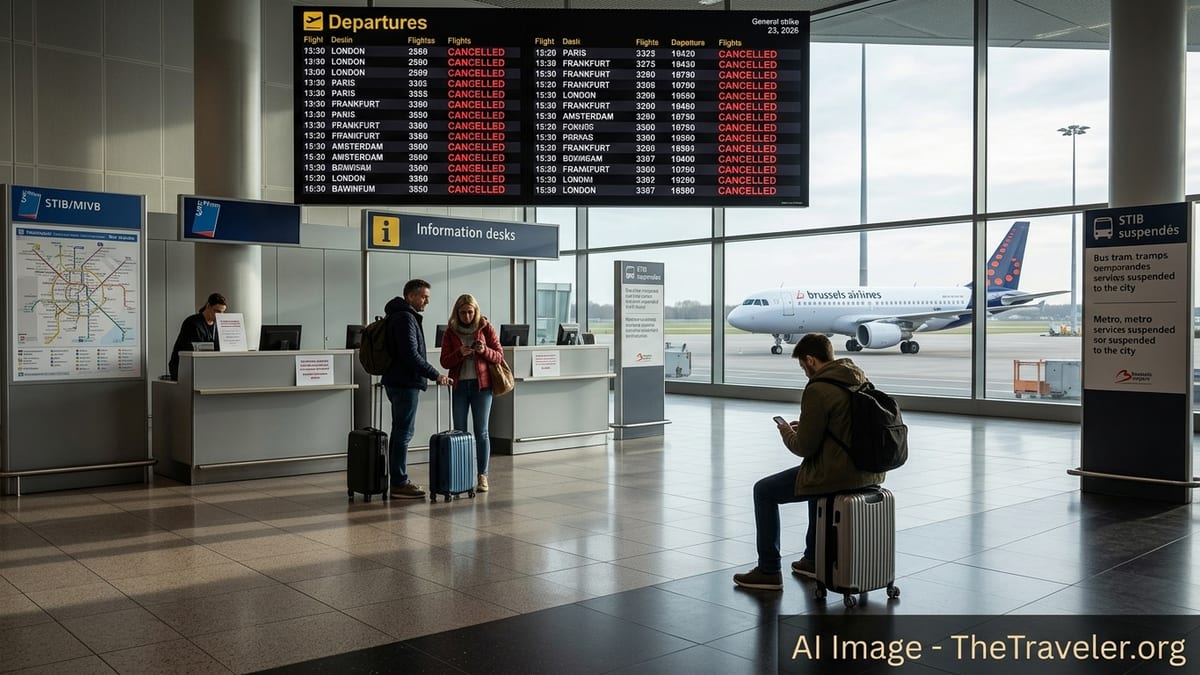
Belgium’s 23 November general strike halts flights and transport
In its Belgium travel and safety advice, updated on 23 November 2026 and unchanged since 22 November, Germany’s Foreign Office warns that Belgian trade unions have called a national day of protest in Brussels on Monday 23 November, with major restrictions expected on public transport and anticipated flight cancellations. The advisory urges travellers to monitor the websites of Belgian Rail operator SNCB, Brussels public transport company STIB and the capital’s airports for real-time information.
On the ground, the impact has gone beyond “possible” disruption. Belgium’s air navigation service Skeyes has confirmed that a strike by air traffic controllers means it cannot maintain normal operations between 07:00 and 21:00, leading to large-scale flight cancellations at Brussels and Charleroi airports. Several foreign ministries and motoring organisations in neighbouring countries have echoed that travellers should expect flights to and from Belgium to be largely suspended in this time window, with only emergency and safety-critical services operating.
The strike is also affecting buses, trams and metro services in Brussels and other cities. The Austrian embassy in Brussels, for example, has issued a security notice advising that substantial disruptions are expected across the Brussels public transport network on 23 November. Travellers moving between airports, railway stations and city centres are therefore being advised to allow extra time, check live timetables and consider alternative options such as taxis where available.
How Germany’s advisory frames the risk without a formal “Reisewarnung”
Despite the severity of the disruption on 23 November, Germany’s Belgium notice remains a standard travel and safety advisory rather than a formal “Reisewarnung”. The Foreign Office reiterates that, across Belgium and especially in Brussels, large-scale strikes are currently being announced more frequently, particularly in local and long-distance public transport. It notes that some previous protests in cities such as Brussels and Liège have occasionally seen clashes between demonstrators and security forces, and recommends that visitors behave cautiously and avoid demonstrations.
This distinction is important for travellers. A travel and safety notice signals heightened operational or security risks, such as transport disruption or potential unrest, but does not advise against all non-essential travel. A formal “Reisewarnung” is reserved for situations such as armed conflict or extreme security threats and can have implications for package tour contracts and insurance cover. In the case of Belgium on 23 November, German authorities are instead focusing on practical steps: checking transport operator channels, allowing for cancellations and delays, and staying away from protest hotspots.
For independent travellers and those on dynamically packaged trips, the advisory language underscores the need to read fare conditions and insurance policies carefully. While widespread cancellations can trigger refund or rebooking rights, especially under EU air passenger regulations when flights are significantly disrupted, compensation rules may differ when strikes involve air traffic control or airport services rather than the airline’s own staff.
Strikes at home: German advice for travel within Germany
Alongside the Belgium update, Germany’s Foreign Office has, in recent months, repeatedly highlighted strike-related disruption within Germany itself in its general travel information. Domestic and foreign visitors are reminded that industrial action involving rail staff, airport ground workers or security personnel can lead to short-notice cancellations of long-distance and regional train services and significant queues or closures at airport security checkpoints.
The wording in Germany-focused guidance typically stresses that strike calls are sometimes announced only a few days ahead and that replacement services, where they exist, may be limited. Travellers are advised to check the websites and apps of Deutsche Bahn, regional transport associations and German airports shortly before departure, and to plan connections with generous transfer times. As with Belgium, this is not framed as a reason to avoid travel altogether, but as a practical warning that journeys may take longer and require flexibility.
For visitors using Germany as a hub to reach Belgium or other neighbouring countries, this combination of domestic and cross-border strike risks means that itineraries with tight same-day connections at German airports or major rail interchanges can be particularly vulnerable to disruption. Where possible, travellers may wish to schedule important meetings or events at least a day after their planned arrival to leave room for rebooking if strikes escalate.
France as a second focus of strike-related disruption
France currently stands out as another nearby country where strike and protest activity has fed into German travel advice. The Foreign Office’s France guidance, updated repeatedly through 2026, notes that while there is no formal travel warning, there have been ongoing demonstrations and, at times, significant strikes affecting public transport in cities such as Paris as well as intercity rail and, on some days, domestic flights.
French union federations have periodically announced national days of action, including recent calls for coordinated protests and strikes that have closed parts of the Paris metro, disrupted commuter rail lines and affected some regional and long-distance services. German and other European advisories for France reflect this pattern by urging travellers to follow local media, avoid demonstrations, and anticipate delays in urban mobility on key protest days rather than assuming that normal timetables will operate.
For travellers combining Belgium and France on the same trip, the overlap of a Belgian general strike on 23 November with a broader backdrop of intermittent French protest and strike activity reinforces the value of flexible tickets. Rail journeys on international routes such as Brussels–Paris or Brussels–Cologne–Paris may be particularly exposed both to Belgian domestic disruption and to potential knock-on effects at French hubs.
What travellers should do next
For journeys scheduled on 23 November 2026 involving Belgium, the immediate priority is to verify whether flights, trains or local transport are operating at all. Passengers should check airline apps, booking portals and airport websites for cancellation notices and rebooking options, paying attention to the 07:00 to 21:00 window in which Belgian air traffic control capacity is most restricted. Those with non-refundable accommodation or event bookings may wish to contact providers promptly to discuss flexibility if arrival becomes impossible due to cancellations.
Looking beyond 23 November, neither the German Foreign Office nor Belgian and French operators list confirmed dates for further nationwide strikes, although unions and transport companies in all three countries have signalled that industrial action remains possible. Because calls for strikes can be issued on relatively short notice or modified shortly before they begin, travellers planning winter trips should keep checking official advisories and operator channels in the days leading up to departure rather than relying on information obtained at the time of booking.
In practice, the strengthened focus on strikes in Germany’s travel advice means that European trips now require closer monitoring of operational risks even when no formal “Reisewarnung” exists. Building in longer connection times, favouring direct services where available, and having a clear plan for what to do if a key flight or train is cancelled can substantially reduce the stress if strike-related disruption materialises during a journey.