


For most visitors, the first real glimpse of Munich is from the window of an S-Bahn train rumbling in from the airport. Choosing between the S1 and S8, buying the right ticket, and knowing exactly where to get off can save you money, stress, and a surprising amount of time. This guide walks you through the two Munich Airport S-Bahn lines in plain language, so you can step off your flight and head into the city with confidence.
Get the latest updates straight to your inbox!
How the Munich Airport S-Bahn Works
Munich Airport (Flughafen München, MUC) is connected to the city by two S-Bahn commuter lines: S1 and S8. Both run directly from the station beneath the airport terminals into Munich, and both go to the main train station, München Hauptbahnhof. Trains alternate, so in practice you see either an S1 or an S8 roughly every 10 minutes at busy times, with a typical ride into the center taking around 40 to 45 minutes.
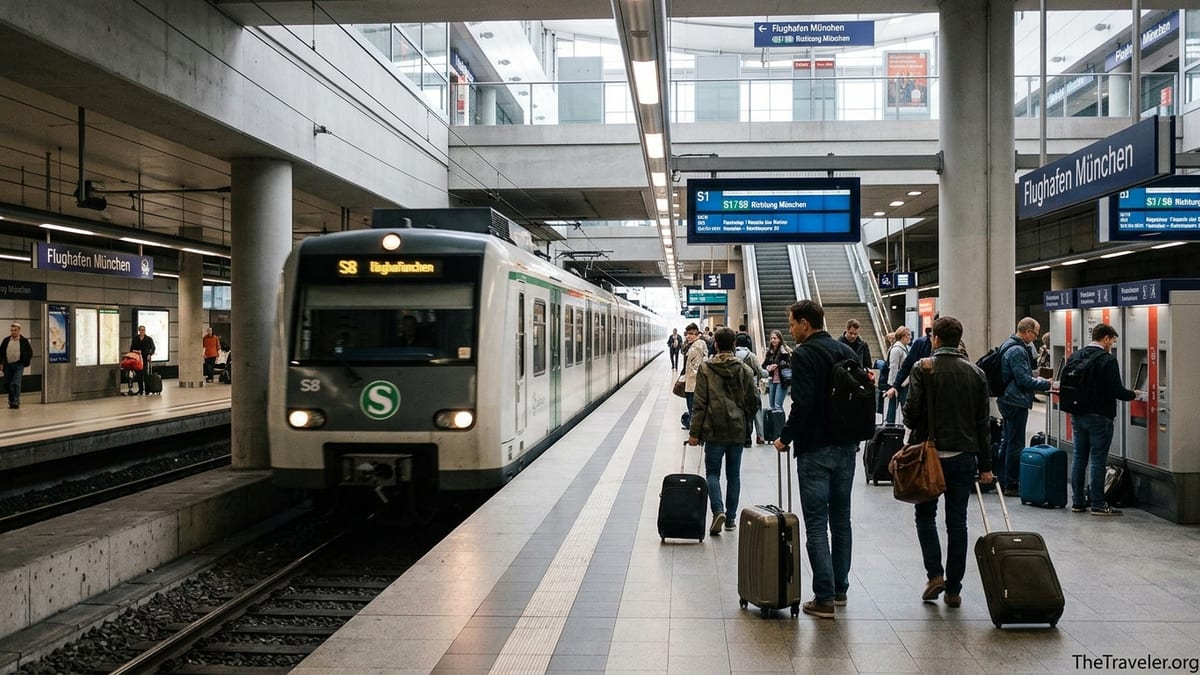
The airport S-Bahn station sits between Terminal 1 and Terminal 2, signed as “S-Bahn” and often “S1 / S8 Richtung München.” From the arrivals area you follow the green S-Bahn symbol downstairs to the platforms. Ticket machines and validation devices are positioned before the escalators and at platform level, so you can buy and validate your ticket before boarding.
Both S1 and S8 are part of the Munich public transport network MVV. That means regular MVV tickets, day tickets and passes all work on these trains, and if you already hold a pass that covers the whole city and outer zones, you simply walk onto the S-Bahn without buying anything extra. Many business travellers, for example, use the monthly MVV pass that their company provides, tap straight into the S-Bahn, and never interact with a ticket machine at the airport at all.
For occasional visitors, the key is understanding that S1 and S8 are not special airport shuttles but regular commuter trains used by locals as well as tourists. At rush hour, you will be sharing the carriage with office workers heading to meetings near Marienplatz, students bound for universities in the city, and families on day trips. This is good news: the system is integrated, well signposted, and designed for everyday use rather than a niche tourist product.
S1 vs S8: Which Line Should You Take?
The main difference between S1 and S8 is the route they take through Munich. Think of S1 as the western loop and S8 as the eastern loop. Both lines start at the airport and end in the western suburbs, but they snake through the city in slightly different ways, which makes one or the other better depending on where you are staying.
The S8 is the most straightforward option for many first-time visitors whose hotels are around Marienplatz, Viktualienmarkt, or near the Isar River. After stopping at München Ostbahnhof (the eastern railway hub), the S8 continues via Rosenheimer Platz and Isartor directly to Marienplatz, then on to Karlsplatz (Stachus), München Hauptbahnhof, and Hackerbrücke. For example, if you have booked a room at a hotel just off Marienplatz, taking the S8 and getting off at Marienplatz allows you to walk to your hotel in 5 to 10 minutes without having to change lines.
The S1, by contrast, approaches the city from the northwest. After leaving the airport it runs via smaller suburban stations before entering the city through Moosach and then heading to München Hirschgarten, Laim, and finally into the central corridor through München Hauptbahnhof, Karlsplatz (Stachus), and Marienplatz. This makes S1 attractive if you are staying in the western districts or near the long-distance bus station at Hackerbrücke but are boarding in that direction, or if your final destination is out towards Dachau or Freising and you are continuing on by S-Bahn or regional train.
In practical terms, if you are new to Munich and your hotel is in the historic center, in Schwabing, or near major city U-Bahn hubs, it is usually simpler to take whichever train, S1 or S8, is leaving next and then change once if needed. However, if you see an S8 and you are bound for Marienplatz or Ostbahnhof, that is usually the most efficient, no-change option. Conversely, if your accommodation is near Pasing, Laim, or Hirschgarten, you will often prefer S1 or an S8 that you change off at the right point.
Key City-Centre Stops and How They Connect
Both S1 and S8 share a central east–west tunnel through downtown Munich. Along this shared stretch are the stations that matter most to visitors: München Ostbahnhof, Rosenheimer Platz, Isartor, Marienplatz, Karlsplatz (Stachus), München Hauptbahnhof, Hackerbrücke, and then outwards to Laim and Pasing in the west. Understanding what each stop offers can save you time dragging luggage across town.
Marienplatz is the symbolic heart of Munich and a major interchange between S-Bahn and U-Bahn. Almost every visitor eventually passes through here. From Marienplatz you can transfer to U3 or U6, useful for getting to the Olympic Park, the Allianz Arena, or the university area. Many central hotels around the Altstadt are within a short walk of Marienplatz station, so arriving here via S8 or via S1 and then changing in the tunnel can be very convenient.
München Hauptbahnhof is the main railway station and a common target for travelers continuing by long-distance train to cities like Nuremberg, Salzburg, or Zurich. Both S1 and S8 stop at Hauptbahnhof underground; from there you ride escalators up to the main concourse for InterCity or EuroCity trains. If your hotel advertises “directly at the Hauptbahnhof,” it is this station they mean, and you will likely exit via Bayerstrasse or Arnulfstrasse to reach properties such as the large chain hotels lining the south side of the station.
München Ostbahnhof, in the east, is important if you are connecting to regional trains down to Rosenheim, the Chiemsee area, or into Austria. It is also handy if you are staying in the trendy neighborhoods of Haidhausen and around the Kultfabrik / Werksviertel area, which lie just a short walk from the station. Here the S8 sweeps through directly from the airport, while the S1 reaches Ostbahnhof via the central tunnel in the opposite direction, so travelers heading east with luggage often favor the S8.
Travel Time, Frequency, and What to Expect Onboard
In normal conditions, the journey from the airport to München Hauptbahnhof takes around 40 to 45 minutes on either S1 or S8. The ride to Marienplatz is often a few minutes shorter, roughly 38 to 42 minutes on S8, depending on the exact stopping pattern. During the day, trains on both lines typically run every 20 minutes, and because they alternate, you see an S1 or S8 approximately every 10 minutes on average at the airport platforms.
During early mornings, late evenings, and on Sundays, frequency can be slightly reduced, but you will rarely wait more than 20 minutes for a train. Electronic departure boards at the airport show exactly when the next S1 and S8 are due, where they are heading, and which key stops they serve. For example, you will see lines such as “S8 Richtung Herrsching via Ostbahnhof – Marienplatz – Hauptbahnhof,” which confirms that this train will pass through both the eastern and central hubs.
Onboard, S-Bahn trains are similar to commuter rail elsewhere in Europe: long multiple-unit trains with a mix of open seating and small bays of four seats. Luggage racks near the doors and in the middle sections allow you to stow suitcases. At busy times, especially weekday mornings between 7:30 and 9:00 or late afternoon, the trains can be crowded with commuters. In these cases, many travelers with large suitcases stand near the doors rather than navigating the aisle with bags. If you are arriving on a late-night flight, you will often find the carriages quiet, with plenty of room to sit and spread out.
Each carriage is equipped with route diagrams and digital displays that show the next stop. Stations are announced in German and usually also visible on the overhead screens. Even if you do not speak German, watching for your station name a few stops ahead and preparing your luggage can make disembarking much smoother, especially in tight stations like Marienplatz where doors may open on both sides depending on the platform.
Tickets and Prices: Getting the Best Value
Munich’s public transport system uses a zone-based ticketing scheme. The airport lies in the outer zone, while central Munich is zone M. To travel between Munich Airport and the city center you need a ticket that covers zones M to 5. If you buy a standard single journey ticket from the airport to Hauptbahnhof or Marienplatz, the price is roughly in the low to mid-teens in euros for one adult at current 2026 tariffs, and the same ticket is valid on S1 or S8 with unlimited transfers along the way within the covered zones.
For many visitors, an MVV Airport-City-Day-Ticket offers better value. This day ticket is priced a bit higher than a simple one-way fare but covers unlimited travel in zones M through 5 for the rest of the calendar day. In practice, that means you can ride from the airport into the city, take the U-Bahn to your hotel, hop trams to explore Schwabing in the afternoon, and then ride back out to the airport in the evening if you are on a same-day turnaround, all on one ticket. Families and small groups can buy the group version of this ticket, which becomes very economical once you have three or more people traveling together.
Another increasingly popular option is the Deutschlandticket, a nationwide monthly pass that covers most local and regional public transport across Germany, including the MVV network and the airport route. If you have a valid Deutschlandticket for the current month, you do not need any additional ticket to ride S1 or S8 between the airport and the city. Many repeat travelers and long-stay visitors who will use public transport frequently in multiple cities find that this pass pays for itself after just a handful of long journeys and daily commutes.
Tickets can be bought in several ways: from the blue or white MVV ticket machines at the airport S-Bahn station, from staffed counters in the Munich Airport Center, or via official transport apps. Machines generally accept coins and banknotes, and most now take major credit cards. When buying at the machine, you can choose English, select “Airport to Munich City” or zones M–5, and the machine will calculate the correct fare. Always check the time and date printed on your ticket and, if necessary, validate it in the small blue or yellow stamping machines next to the escalators before boarding.
Choosing the Right Line for Your Hotel or Connection
To decide whether to take S1 or S8, start by looking up the nearest S-Bahn or U-Bahn station to your hotel or onward connection. Many booking sites list this under “location” or “transport.” For example, if you are staying at a hotel near Sendlinger Tor, you might choose the S8 to Marienplatz and then transfer one stop south by U1, U2, U3, or U6. If your accommodation is around Ostbahnhof or in Haidhausen, an S8 that goes directly to München Ostbahnhof is usually the most logical option.
Travelers heading towards the west or northwest of the city might lean toward the S1. For instance, if you need to reach Moosach, Dachau, or the large residential areas around Feldmoching, the S1 connects directly or offers easy onward transfers. A common real-world scenario is a business traveler who has a meeting in an office park near Moosach. Taking the S1 from the airport to Moosach and then walking or transferring one stop on the U3 can be quicker than riding the S8 into the city center and back out again.
If your final destination is simply “near Hauptbahnhof,” both lines work perfectly well because each stops at the central station. In these cases, it often makes sense just to catch whichever S-Bahn departs first. One typical example: landing at Munich Airport around 09:00, clearing immigration by 09:30, and walking into the S-Bahn station to see that the next S1 departs in 3 minutes while the next S8 is in 12 minutes. If your hotel is directly opposite the Hauptbahnhof, it is sensible to board the S1 and arrive approximately 40 minutes later rather than waiting on the platform for the S8.
For early-morning flights, some travelers prefer to stay near stations like Ostbahnhof or Laim that give them flexibility to catch either S1 or S8 on their way to the airport. If there is a disruption on one line, being near a shared central corridor stop means you can often switch to the other line or take an alternative route using regional trains and buses, keeping the risk of missing a flight lower than if you rely on a single suburban branch line.
Common Mistakes to Avoid on S1 and S8
One of the most frequent mistakes is buying the wrong ticket zones. Visitors sometimes buy a cheaper zone M ticket because that is what they used during their city stay, then try to use it from the airport. Because the airport lies outside zone M, this ticket is not valid for the full journey, and ticket inspectors can issue on-the-spot penalty fares that are significantly higher than the original ticket price. Always check that your ticket explicitly covers zones M–5 or carries wording that includes “Airport” or “Flughafen.”
Another common issue is forgetting to validate paper tickets. While many tickets printed from modern machines are pre-stamped with date and time, others require you to insert them into a small stamping machine before your first journey. Travelers who board in a hurry and skip validation can be treated as traveling without a valid ticket during inspections. A good rule is: if your ticket has no start time or today’s date already printed, look for the small rectangular validation slot near the escalators and stamp the ticket before going down to the platform.
Confusion between S1 and S8 can also cause problems, especially at late hours. For example, some visitors intending to go to a hotel near Ostbahnhof mistakenly take a late S1 that does not call at the station in the direction they expect or runs with a shortened route during evening works. They then find themselves needing to change trains unexpectedly in the city. Always check the line number and final destination on the front of the train and on the platform screens. If in doubt, ask a local or train staff before boarding rather than after the doors close.
Finally, travelers sometimes get off at the wrong “Hauptbahnhof” level. The S-Bahn station is underground, and if you follow the first “exit” signs you might emerge on a side street far from your intended hotel entrance. Take a moment on the platform to look at the overhead maps which show exits toward Bayerstrasse, Arnulfstrasse, or the central hall. For example, if you are booked into a chain hotel on Bayerstrasse, following the exit signs specifically labeled Bayerstrasse saves you from dragging suitcases through crowded side corridors and across multiple roads.
The Takeaway
Munich’s S1 and S8 S-Bahn lines offer a reliable, cost-effective connection between Munich Airport and the city centre, with clear signage and integrated ticketing that make them easy to use even for first-time visitors. Both lines reach the key downtown stations, including Marienplatz and München Hauptbahnhof, within roughly three quarters of an hour, and trains run often enough that you rarely need to study the timetable in detail.
To make your journey smooth, decide in advance which station is closest to your hotel or onward connection, buy a ticket that correctly covers zones M–5 or consider a day ticket or Deutschlandticket if you plan to ride several times, and pay attention to validation rules. Choosing S8 for stays around Marienplatz or Ostbahnhof, or S1 for destinations in the northwest, will usually minimize changes, but in many cases the best option is simply the next train leaving the airport.
With a little preparation and an eye on the station names displayed onboard, the ride from the runway to the city becomes an easy, almost scenic start to your Munich visit rather than a stressful logistical puzzle.
FAQ
Q1. How long does the S-Bahn take from Munich Airport to the city centre?
The journey from Munich Airport to central stations like Marienplatz or Hauptbahnhof usually takes around 40 to 45 minutes on either S1 or S8.
Q2. Which is better from the airport, S1 or S8?
Neither is universally better; choose based on your destination. S8 is usually best for Marienplatz and Ostbahnhof, while S1 can be better for the northwest suburbs.
Q3. Do S1 and S8 both go to München Hauptbahnhof?
Yes. Both lines pass through the underground S-Bahn platforms at München Hauptbahnhof, so either train works if you are heading to the main station.
Q4. How often do S1 and S8 trains run from the airport?
During the day, each line generally runs every 20 minutes, so you typically see an S1 or S8 about every 10 minutes in total at the airport.
Q5. What ticket do I need from Munich Airport to the city centre?
You need a ticket covering MVV zones M to 5, such as a standard single ticket for that zone range or an Airport-City-Day-Ticket for unlimited travel that day.
Q6. Is the Deutschlandticket valid on S1 and S8 from the airport?
Yes. A valid Deutschlandticket covers local and regional transport in the Munich area, including S1 and S8 between Munich Airport and the city.
Q7. Where should I get off for hotels near Marienplatz?
If your hotel is around the historic centre, get off at Marienplatz. The S8 stops there directly, while S1 also passes through via the central tunnel.
Q8. Do I need to validate my ticket before boarding?
If your paper ticket does not already show today’s date and a start time, you must validate it in the small stamping machines before boarding the S-Bahn.
Q9. Can I buy S-Bahn tickets at Munich Airport with a credit card?
Yes. Most MVV ticket machines at the airport accept major credit cards as well as cash, and you can also purchase tickets via official transport apps.
Q10. What happens if I board S1 or S8 with the wrong ticket zones?
If your ticket does not cover the full route, inspectors may treat you as traveling without a valid ticket and issue a substantial on-the-spot penalty fare.