


More news on this day
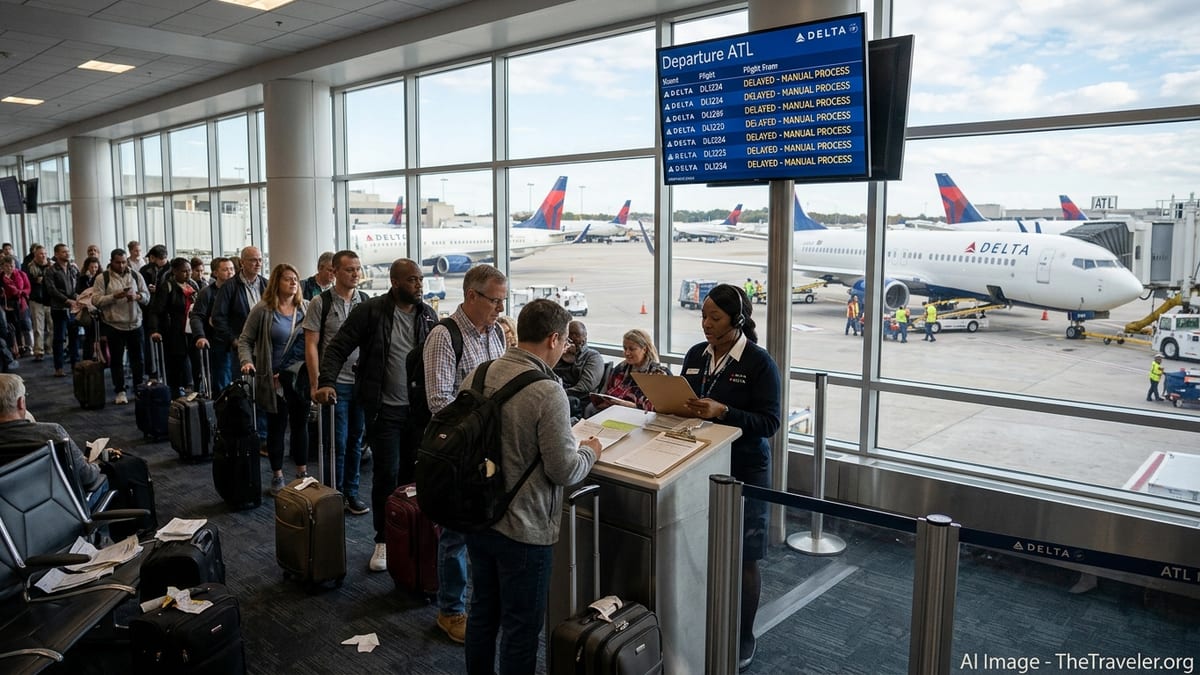
Delta Air Lines says it has restored the automated system it uses to calculate aircraft weight and balance after a technical problem on Sunday, 22 November 2026, triggered a ground stop for Delta flights bound for Atlanta and caused hundreds of delays across the United States at the start of the busy Thanksgiving travel period.
Get the latest news straight to your inbox!
What happened to Delta’s system and how long it lasted
The disruption began on Sunday morning, 22 November 2026, when the Federal Aviation Administration issued a ground stop for Delta and Delta Connection flights heading to Hartsfield-Jackson Atlanta International Airport. According to FAA advisories, the stop applied specifically to Delta-operated services into Atlanta and was later converted into a ground delay program once limited operations resumed. Public FAA data indicate the initial ground stop at Atlanta started around 13:00 UTC and was lifted after just over 30 minutes, with the ground delay program continuing for several hours as Delta worked through the backlog.
Delta attributed the disruption to a problem with the automation it uses to generate weight-and-balance data for departing flights. The system, which feeds pilots and dispatchers the figures they need before pushback, stopped functioning normally, forcing the airline to fall back on manual calculations and workarounds. The airline has not publicly detailed the precise technical cause but confirmed that the outage affected multiple airports across its network, not only Atlanta, because flights could not depart until required performance data were confirmed.
By early evening Eastern time on Sunday, Delta said the automated tool for weight and balance was working again and described the system issue as resolved. Flight-tracking service FlightAware and airport operations reports indicated that delays persisted into Sunday night as aircraft, crews and passengers were repositioned, but there was no indication from the FAA or Delta of further knock-on disruption into midweek beyond the usual holiday congestion.
Scale of the disruption at Atlanta and nationwide
Hartsfield-Jackson is Delta’s largest hub and routinely the world’s busiest airport by passenger numbers, which amplified the impact of what was, in technical terms, a relatively short-lived outage. Around the middle of the afternoon on Sunday, FlightAware data showed close to 1,250 delayed flights into and out of Atlanta across all airlines. More than 1,000 of those delays were tied to Delta and its regional partners, while dozens of Delta flights were cancelled as the airline restructured its schedule for the rest of the day.
Delta said roughly 70 percent of its delays and cancellations reported on Sunday were directly connected to the weight-and-balance automation problem. The airline cited weather and related air traffic control programs in New York and the broader Northeast for much of the remaining disruption. Some major airports far from Georgia, including New York LaGuardia, Newark, Washington Reagan National, Washington Dulles, Boston, Baltimore, Miami, Minneapolis, Nashville, San Antonio and Birmingham, saw Delta departures held at the gate or on the tarmac while crews waited for revised paperwork.
Although the ground stop and subsequent ground delay technically applied only to Atlanta-bound Delta flights, knock-on effects rippled through the carrier’s network. Aircraft that could not depart their origin stations on time arrived late in Atlanta, where turnaround times then increased because of gate constraints. With longer boarding processes and dispatch delays, arriving aircraft often had to wait for gates to free up, temporarily reducing the airport’s effective capacity even after the FAA lifted its most restrictive measures.
Why weight and balance matter so much for flight departures
Modern airlines rely on software to calculate the weight and balance of each flight, drawing on data such as passenger counts, baggage loads, cargo, fuel and specific aircraft configuration. Regulators emphasize that staying within certified limits for both total weight and center of gravity is critical to structural integrity and controllability, particularly during takeoff and landing. If loads are miscalculated or a center of gravity falls outside the approved envelope, an aircraft may require a longer runway, perform poorly in an engine-out scenario or handle differently than pilots expect.
Because of these safety implications, airlines cannot simply estimate figures when automation fails. During Sunday’s outage, Delta said its staff used manual workarounds to generate the necessary data. That process typically involves dispatchers and load agents manually compiling weights, confirming passenger and bag counts and running performance checks using secondary tools or procedures. While this approach is designed precisely for situations where automation is degraded, it takes more time, especially when hundreds of flights are scheduled within a short peak period.
In practical terms for travelers, the system failure meant that even when aircraft and crews were ready to depart, they often remained at the gate while waiting for final paperwork. This in turn contributed to gate shortages at hub airports like Atlanta, limiting the number of arriving flights that could deplane and further slowing the network. Similar automation issues have affected other carriers in recent years; for example, United Airlines reported a weight-and-balance system problem in 2025 that contributed to more than a thousand delays, illustrating how a single software fault can have broad operational consequences.
How Delta and airports responded for passengers
Delta said on Sunday that it was rebooking affected customers onto the next available itineraries and offering meal vouchers and hotel accommodation where required, particularly for travelers who misconnected or faced overnight delays. The airline also reminded passengers that those whose flights were cancelled and who chose not to travel could request refunds. Given the timing ahead of the Thanksgiving holiday, many passengers are likely to have faced limited same-day alternatives, especially on heavily booked routes into Atlanta and across the East Coast.
Hartsfield-Jackson officials stressed that the incident was confined to Delta and its affiliates, rather than being an airport-wide infrastructure failure. Other airlines operating at Atlanta continued flying, although they were indirectly affected by airfield and gate congestion caused by Delta’s outsized presence at the hub. The airport’s general manager had already described a separate nationwide FAA ground stop earlier in November as a significant test of the aviation system in the run up to the holiday period, and Sunday’s carrier-specific disruption effectively added another layer of operational strain.
Across the network, airport social media channels and local news outlets reported lines at check-in counters and customer service desks as passengers sought rerouting options. Some travelers shared accounts of two- to three-hour departure delays from non-hub airports while crews waited on weight-and-balance clearance, and of missed connections in Atlanta that required rebooking for later in the day or the following morning. While these experiences were not universal, they highlight how a technical issue at a single airline can quickly turn into a daylong disruption for some individual itineraries.
Context: a rare nationwide stop and a busy holiday week
Sunday’s Delta-specific automation outage followed closely on the heels of a rare nationwide ground stop ordered by the FAA earlier in November 2026. That earlier event, which was tied to a modernization issue in air traffic systems rather than any one airline, led to more than 17,000 flights being delayed or cancelled across carriers and airports. Aviation authorities and analysts have noted that nationwide orders of that scale are uncommon and typically reserved for significant safety or system integrity concerns.
The proximity of the two events has fueled questions about the resilience of both airline and regulator technology as U.S. aviation enters one of its busiest travel periods. Industry data show that Thanksgiving week routinely ranks among the highest for passenger volumes, and many flights over the holiday period operate close to capacity. This reduces the margin for absorbing disruptions because fewer empty seats are available to accommodate stranded travelers, and crews often have tightly scheduled duty days that can be disrupted by long ground delays.
For travelers planning to fly in the days following the Delta outage, the airline and airport authorities have not reported any continuing system problems. By Monday, schedules at Atlanta and other major hubs appeared to have largely normalized, with delays more closely aligned to weather and usual peak-period congestion. However, the twin episodes of a nationwide ground stop and a large airline’s internal automation failure so close together are likely to feature in ongoing discussions about backup systems, staffing and contingency planning across the sector.
What affected travelers should do next
Delta has stated that its weight-and-balance automation is functioning again, and there is no indication from either the airline or the FAA of an ongoing technical issue linked to Sunday’s outage. Nonetheless, travelers with upcoming Delta itineraries, particularly those connecting through Atlanta during the Thanksgiving period, are advised to monitor their flight status closely through the airline’s official channels on the day of departure. Same-day operational adjustments remain possible if weather or crew availability compounds residual congestion.
Passengers whose Sunday flights were significantly delayed or cancelled and who have not yet rebooked or requested compensation should review the options offered by Delta. The airline has said that customers who no longer wish to travel after a cancellation may obtain refunds, while those who still need to complete their journeys can be moved to the next available flights. Travelers who incurred out-of-pocket costs for meals or overnight stays where the airline did not provide vouchers should retain receipts in case they are eligible for reimbursement under Delta’s customer service policies.
Looking ahead, the incident underscores the value of building extra time into tight connections during peak travel seasons and of considering travel insurance or flexible fares where timing is critical. While the specific automation issue at Delta appears to have been resolved, weight-and-balance systems and other operational software are now central to how airlines run their networks. When they fail, even briefly, hub airports like Atlanta can experience cascading disruption. For now, authorities and carriers say their focus is on keeping systems stable through the remainder of the holiday period and on reviewing what lessons can be drawn from the November disruptions for future planning.