


More news on this day
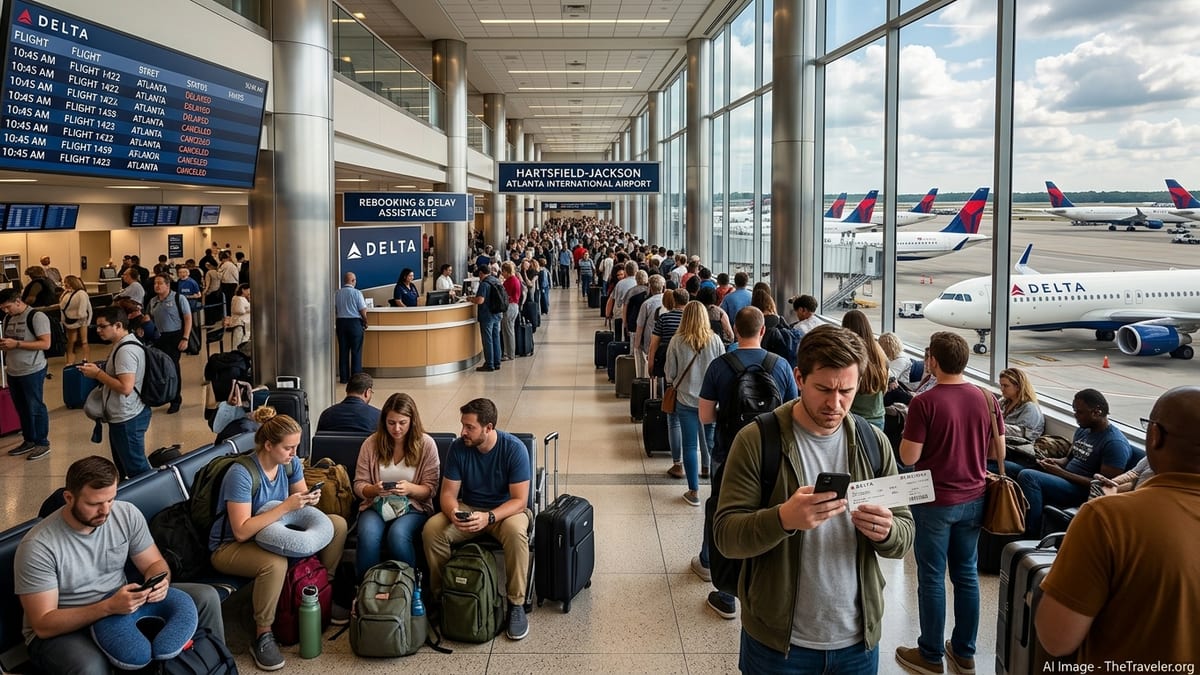
Delta Air Lines passengers at Hartsfield-Jackson Atlanta International Airport and across the United States faced cascading delays and cancellations on Sunday, November 22, after the carrier’s automated weight-and-balance system failed just as the busy Thanksgiving travel period was getting underway.
Get the latest news straight to your inbox!
Automation failure triggers targeted FAA restrictions
Delta said the problem involved the automation it uses to calculate aircraft weight and balance and related loading data, a safety-critical step before departure. Early Sunday, the carrier asked the Federal Aviation Administration to halt flights bound for its Atlanta hub while teams switched to manual workarounds. According to FAA summaries of the event and industry tracking data, the initial ground stop for Delta flights into Atlanta began around 7:45 a.m. Eastern time and was later converted into a ground delay program averaging close to an hour of extra waiting for affected departures.
Operational data compiled by flight-tracking services indicate that more than 1,400 to 1,600 Delta flights were delayed on November 22, with roughly 140 to 200 cancellations attributable to the outage as the day progressed. The carrier said in multiple statements that automation for departing flight weight-and-balance calculations was restored by Sunday afternoon and that there was no indication of a cyberattack. Until then, crews around the network were performing calculations manually, which slowed boarding and pushed back departure times, particularly on tightly banked hub schedules.
The impact was most visible at Hartsfield-Jackson Atlanta International Airport, where Delta accounts for roughly four out of every five passenger flights. Local airport officials stressed that the disruption was limited to Delta’s operations and did not represent an airport-wide shutdown, but the carrier’s dominance at Atlanta meant that long queues, gate holds and missed connections spread through much of the day’s schedule.
Residual disruption continues into Monday at Delta hubs
By Monday, November 23, Delta described its operations as largely stable, and flight-tracking snapshots showed its same-day delay rates closer to typical levels than during Sunday’s outage peak. Even so, local reporting from Atlanta and other Delta hubs such as Detroit and Minneapolis indicated ongoing knock-on delays and a smaller number of additional cancellations as crews and aircraft were repositioned and out-of-sequence rotas were brought back into alignment.
At Atlanta, one of the world’s busiest airports and the main connecting point for many of Delta’s domestic Thanksgiving itineraries, residual schedule disarray was concentrated in heavily banked morning and evening waves. Passengers reported queueing at ticket counters and service desks to secure new routings after missed connections, with some same-day rebooking options limited by already high load factors heading into the holiday. Airports and Delta advised travelers to arrive early, monitor their flight status through apps or airline notifications, and allow extra time between connections where possible.
Because the outage affected the system that ensures proper loading and balance rather than air traffic control, other U.S. carriers operated largely as scheduled on Sunday. However, shared use of gates, ramp space and security checkpoints at Delta-dominated hubs meant that travelers on other airlines in Atlanta and some connecting cities still encountered congestion and occasional knock-on delays, even if their own flights were technically unaffected by the system failure.
Delta glitch follows FAA and United system failures this month
The timing of Delta’s outage has amplified concern about the resilience of airline and aviation IT systems in the United States, coming just days after two separate high-profile disruptions. On Friday, November 13, the FAA ordered a rare nationwide ground stop after a malfunctioning router in its telecommunications network triggered intermittent communication and radar issues at multiple air traffic control centers. The agency later traced the problem to work by its network contractor involving a new router installation and stressed that the incident was not the result of a cyberattack.
That FAA telecommunications failure led to more than 12,000 flight cancellations across all U.S. carriers over the course of the disruption and its aftermath, as airlines struggled to reset schedules once the ground stop was lifted. While those cancellations were not concentrated at a single hub in the way Delta’s November 22 problem was, the memory of widespread disruptions a week earlier left many Thanksgiving travelers acutely sensitive to any sign of fresh instability in the system.
In between, on Monday, November 16, United Airlines experienced what it called a widespread system outage that temporarily halted many of its departures. The airline said that issue was linked to internal systems that include tools for calculating aircraft weight and balance, and it moved to delay flights while engineers resolved the problem. United and the FAA have both said their incidents were unrelated to each other and to the later Delta outage, and all three organizations have rejected suggestions of a coordinated cyberattack, instead pointing to distinct equipment or software failures in complex, aging infrastructures.
What Thanksgiving travelers should expect and how to plan
The latest disruption has come just as U.S. Thanksgiving air travel ramps up. Forecasts from national motoring and travel organizations point to roughly 6 million people expected to fly over the holiday period, which means spare seats for last-minute rebooking are limited even in normal conditions. For Delta customers affected by the November 22 outage and its aftermath, that tight capacity has translated into fewer same-day alternatives on popular routes and, in some cases, overnight stays when no suitable connections were available.
Delta has encouraged passengers to use its website and mobile app to check real-time flight status, change itineraries where permitted, and verify any flexible travel waivers it issues for specific dates and routes. Travelers whose plans depend on critical connections at Atlanta or other Delta hubs over the next couple of days may wish to build in longer layovers, consider earlier departures, or, where tickets and budgets allow, look at alternative routings on other carriers if they want to reduce the risk of knock-on delays from lingering schedule imbalances.
Looking ahead, airline and airport trade groups and U.S. regulators are already facing questions from Congress about the string of recent outages. The FAA has highlighted existing modernization funding requests for its communications network, and lawmakers have signaled that they will examine whether airlines should be required to invest in more resilient backup arrangements for critical systems such as weight-and-balance automation. Those discussions are at an early stage, and no specific new mandates have been adopted, but travelers can expect closer scrutiny of how both carriers and the FAA harden the digital backbone that underpins the U.S. air travel system.