


The 120-kilometer journey from Denver International Airport to Vail is one of North America’s classic ski transfers: a climb into the Rockies along Interstate 70, over the Continental Divide and across Vail Pass. In winter, it can be spectacular, slow, occasionally stressful, and surprisingly expensive if you pick the wrong option. This guide breaks down the main ways to travel between Denver and Vail for ski trips, what they really cost, and how to choose the best route for your group, budget, and risk tolerance.
Get the latest updates straight to your inbox!
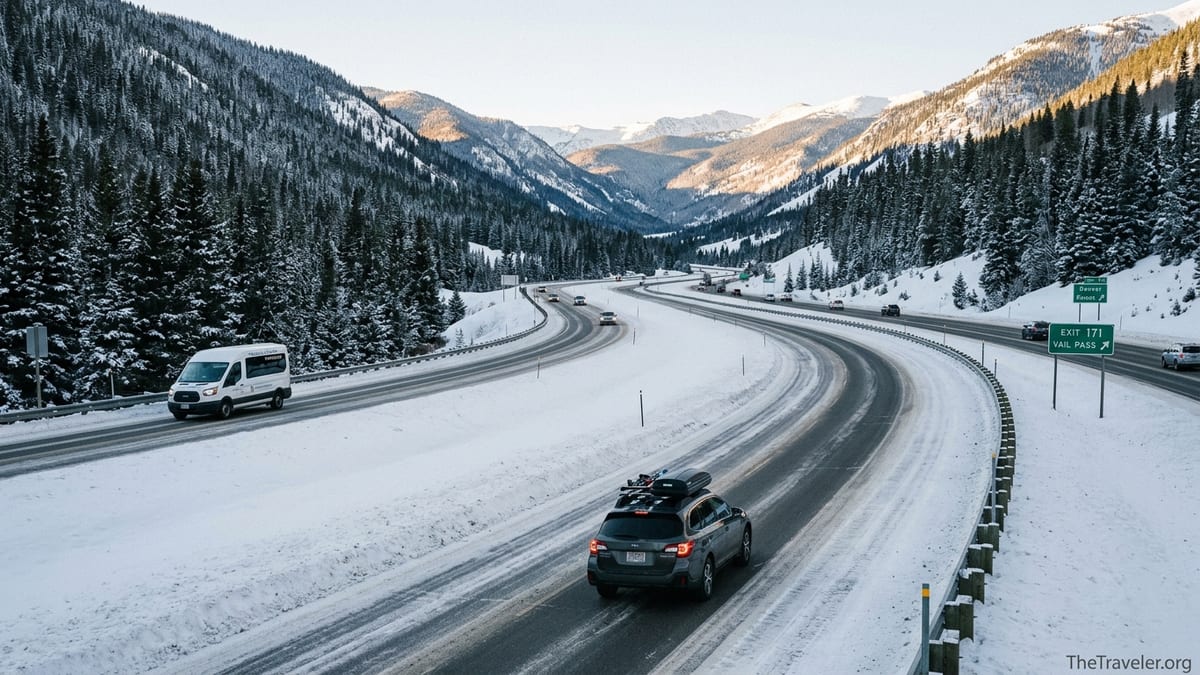
Understanding the Denver to Vail Route in Winter
Vail sits roughly 75 miles west of Denver as the crow flies, but the road journey from Denver International Airport, on the far eastern side of the metro area, to Vail is about 120 miles, or 190 kilometers. The route runs almost entirely on Interstate 70, the main east–west spine of the Colorado Rockies. From the airport you skirt Denver, climb past Idaho Springs and Georgetown, pass under the Continental Divide through the Eisenhower–Johnson Tunnels, then continue over Vail Pass before descending into Vail Valley.
In perfect conditions, the drive takes about 2 to 2.5 hours from the airport to Vail. In winter, you should realistically plan for 3 hours or more. Heavy ski traffic, accidents, chain law restrictions for trucks, and full closures over Vail Pass can quickly add 60 to 90 minutes to the journey, especially on Friday evenings, Saturday mornings, and Sunday afternoons during peak season.
Most visitors travel this corridor between late November and early April, when snow and ice are common at higher elevations even if Denver itself looks dry. You might land at Denver International on a bluebird day with bare pavement, only to encounter snow-packed roads and blowing snow above 10,000 feet. That is why your choice of transfer method and timing can matter as much as the distance itself.
The good news is that this is one of the best-served ski corridors in the United States. Multiple shuttle companies run frequent services, Vail has a busy private-transfer market, rental cars are plentiful, and there is even a growing network of regional buses. With some planning, you can match the route to your comfort with winter driving, your budget, and how much ski gear you are hauling.
Shared Shuttles: Epic Mountain Express, Peak 1 Express and Others
For many ski travelers, a shared airport shuttle is the sweet spot between price and convenience. The two biggest names for Denver to Vail are Epic Mountain Express, owned by Vail Resorts, and Peak 1 Express. Both operate scheduled winter shuttles from Denver International Airport to Vail, with drops in Vail proper and surrounding neighborhoods.
Epic Mountain Express typically offers its lowest prices on point-to-point services between Denver International and the Vail Transportation Center. Recent published transfer-center rates start around the high 50s to low 60s dollars per person one-way in value periods, rising toward or above 100 dollars on peak days and holidays. Door-to-door shared shuttles that take you directly to your lodge are usually slightly more. Epic Pass holders receive around 20 percent off certain Epic Mountain Express products, which can materially cut costs for families booking several seats.
Peak 1 Express operates a similar shared model, running daily scheduled shuttles from Denver International Airport to Vail, including East Vail, West Vail, and the central Vail Transportation Center. In the heart of winter, Peak 1 often runs hourly or near-hourly departures across the main part of the day. Pricing fluctuates by date and demand, but you can expect a general range similar to Epic Mountain Express. For a family of four traveling on a typical non-holiday weekend, a one-way shared shuttle bill from Denver to Vail often lands in the 260 to 360 dollar range for the whole group.
Smaller operators also serve this corridor, sometimes with slightly lower base fares or flexible pickup points. However, the big advantage of Epic Mountain Express and Peak 1 Express is scale: they run enough frequencies that if your flight is delayed a bit, they may be able to move you to a later shuttle, and they have on-the-ground airport desks or representatives to help rebook. For nervous winter travelers, having a large operation tracking your inbound flight and road conditions is a meaningful form of insurance.
Private SUVs and Vans: High Comfort at a Premium Price
If you value comfort, privacy, and control over your schedule, a private transfer can be a compelling option, especially for larger groups. Companies such as Epic Mountain Express (through its YourRIDE and Premier-branded services), Vail Mountain Express, and several independent Denver-based car services offer private SUVs and sprinter-style vans between Denver International Airport and Vail.
Pricing for private transfers varies widely by vehicle size, season, and demand, but a realistic winter range for a private SUV or van from Denver to Vail is roughly 550 to 1,200 dollars one way. For example, it is common to see winter quotes for a standard private shuttle in the 600 to 800 dollar bracket for up to 5 or 6 passengers, with luxury SUV or executive van services higher. Around major holidays and peak weekends in January and February, some operators push into four-figure territory.
For a group of six on a week-long ski trip staying in a single condo, the math can make sense. A 700 dollar one-way private transfer split six ways is about 117 dollars per person. Two such transfers, in and out, work out to roughly 235 dollars per person for the entire ground-transportation portion of the trip. Compared with six individually rented cars or multiple shared-shuttle tickets, the difference can be modest, especially once you factor in airport car-rental costs and Vail parking fees.
The qualitative benefits are also significant. A private driver meets your party, helps load ski bags and boot bags, allows time for a quick grocery stop in places like Silverthorne or Frisco, and can depart as soon as you are ready rather than waiting for a full shuttle. Importantly, most reputable mountain-transfer companies use all-wheel-drive vehicles equipped with winter tires or chains and employ drivers who spend the entire season shuttling this exact route. For visitors unfamiliar with high-altitude winter driving, that expertise alone can be worth the premium.
Driving Yourself: Rental Cars, Parking and When It Makes Sense
Renting a car at Denver International and driving yourself to Vail appeals to travelers who value flexibility, are comfortable with winter roads, or plan to visit multiple ski areas. Every major national rental brand has a presence at the airport, and four-wheel-drive SUVs are widely available in winter, usually at a premium compared with compact cars.
On a mid-season weekend, it is common to see Denver International rentals for standard SUVs priced somewhere in the 80 to 150 dollar per day range before taxes and fees, though prices can spike higher over holidays or drop lower midweek. By the time you add insurance, extra drivers, and winter-specific surcharges, a seven-day SUV rental can easily land in the 800 to 1,200 dollar bracket. Fuel costs for the round trip between Denver and Vail are relatively modest, often under 100 dollars even at mountain fuel prices, but you must also factor in potential tolls if you use express lanes closer to Denver.
Parking in Vail is where many self-drivers get an unpleasant surprise. In winter, structured parking at Vail Village or Lionshead often costs in the neighborhood of 35 to 60 dollars per day depending on day of week and length of stay, with some free or lower-cost options only available farther from the lifts or restricted by time limits. If you are staying in a condo or hotel that includes parking, this may not be an issue, but properties that charge daily parking fees can quickly erase the cost advantage of a rental car.
For a family staying slopeside in Vail and skiing every day, a rental car may simply sit in a garage unused. Vail’s in-town bus network is free and frequent during the ski season, and many lodges run their own shuttles to the lifts. In that scenario, a shared shuttle or private transfer from Denver often makes more financial sense than renting a car. On the other hand, if your plan includes day trips to Beaver Creek, Copper Mountain, or backtracking to Summit County, having your own vehicle can be liberating, provided you are genuinely comfortable with winter mountain driving.
Winter Road Conditions, Safety and When Not to Drive
The Denver to Vail corridor has a reputation for challenging winter conditions, and that reputation is deserved. Interstate 70 climbs quickly from around 5,000 feet near Denver to more than 11,000 feet at the Eisenhower–Johnson Tunnels, then crosses Vail Pass, which tops out above 10,600 feet. Snowstorms can roll in quickly, visibility can drop to near zero in blowing snow, and steep grades test both traction and braking.
Colorado enforces traction and chain laws on this stretch of I-70 during storms. At certain times, passenger vehicles are legally required to have adequate snow tires, four-wheel drive, or chains to proceed. Rental cars marketed as “mountain-ready” are usually equipped to meet these rules, but visitors need to read the fine print. Simply having an SUV does not guarantee winter tires, and all-season tires can still struggle on packed snow and ice.
Practical examples underscore the risk. On a typical big weekend storm in January, it is common to see reports of multi-vehicle crashes near Georgetown, spin-outs on Vail Pass, and intermittent interstate closures while plows and tow trucks work. During such events, a 2.5-hour drive can inflate to five hours or more, or become impossible for several hours at a time. Travelers who scheduled a tight connection from Vail back to Denver for a morning flight are often the ones sprinting through the airport, or rebooking at walk-up fares.
For visitors with limited winter-driving experience, especially those used to sea-level cities, the combination of altitude, traffic, and weather is a serious consideration. A good rule of thumb: if the weather forecast calls for accumulating snow on Vail Pass during your arrival window, or if you are landing after dark, lean toward a shuttle or private transfer rather than a self-drive. Let professional drivers, in vehicles built for the route, handle the conditions while you adjust to the altitude and time zone.
Budgeting Your Transfer: Realistic Cost Comparisons
To understand how the main options stack up, it helps to run through a few real-world cost scenarios for a mid-season 6-night ski trip, excluding airfare and lodging. Prices below are illustrative ranges based on recent winter patterns rather than fixed guarantees, and actual quotes will vary by date.
Consider a solo skier arriving on a Saturday afternoon and leaving the following Friday morning. A shared shuttle seat on Epic Mountain Express or Peak 1 Express might run roughly 80 to 140 dollars each way on non-holiday dates, so 160 to 280 dollars total. A week-long SUV rental in winter could easily cost 900 to 1,000 dollars including taxes and basic insurance, plus perhaps 60 dollars in fuel and, say, 240 dollars in parking if you pay around 40 dollars per day. In that scenario, a shuttle clearly wins on cost unless you have a specific reason to need a car.
For a family of four, the math is closer. Four shared-shuttle tickets at 100 dollars each way would total about 800 dollars for round-trip transfers. A private shuttle quoted at 700 dollars each way would total 1,400 dollars, or 350 dollars per person. A week-long SUV rental at 1,000 dollars, plus 300 dollars in parking and 80 dollars in fuel, might total about 1,380 dollars. In other words, all three options land in a similar range, but the private shuttle offers door-to-door convenience without the stress of driving, while the rental car offers freedom to explore beyond Vail.
Large groups can often justify private transfers easily. Take eight adults sharing a slopeside house. A single private van at 900 dollars each way is 1,800 dollars total, or 225 dollars per person. If they instead booked shared shuttles at 110 dollars each way, the group would pay 1,760 dollars, with less flexibility on timing and multiple vehicles involved. In that case, the convenience of riding together and controlling departure times often makes private service the obvious choice.
The key takeaway is that “cheapest” depends heavily on group size and itinerary. Solo travelers, couples, and small families usually save with shared shuttles. Larger groups, especially those valuing comfort and time savings, often find that private transfers cost only marginally more per person than shared options or self-drive once parking is considered.
Timing, Traffic Patterns and Flight Planning
One of the most overlooked aspects of planning a Denver to Vail transfer is timing. Interstate 70 operates almost like a tide during ski season, with predictable surges that can dramatically affect transfer times, regardless of whether you are in a shuttle, private SUV, or rental car.
On typical winter weekends, eastbound traffic toward Denver spikes on Sunday afternoons as skiers head home, while westbound traffic toward the mountains builds on Friday evenings and Saturday mornings. If your inbound flight lands late Friday afternoon and you hit the road by early evening, you may encounter stop-and-go traffic for long stretches between Denver and the Eisenhower Tunnel, extending your transfer by an hour or more. Similarly, leaving Vail at noon on a bluebird Sunday after a busy storm cycle is an almost surefire way to spend extra time on the interstate.
Whenever possible, align your flights to land in Denver by late morning on your arrival day and to depart Denver after midday on your way home. That allows you to travel against the heaviest peaks, gives you buffer time for weather or accidents, and increases your chances of catching a later shuttle if your inbound flight runs late. Many shuttle operators also have final daily departures in the early evening, so arriving after dinner time can limit your options or force an overnight near the airport.
Travelers on tight schedules should also factor in security and check-in times at Denver International, which is a large and busy airport. For morning flights to the East Coast or overseas, early departures from Vail are wise, especially in winter. Whether you are self-driving or booked on a shuttle, building in a generous buffer for unexpected slowdowns over Vail Pass and around the tunnels can be the difference between a relaxed airport experience and an expensive missed flight.
The Takeaway
Choosing the best route from Denver International Airport to Vail is ultimately about balancing three things: your comfort with winter mountain driving, your group size, and your budget. The shared shuttles operated by outfits such as Epic Mountain Express and Peak 1 Express offer a strong middle ground, combining predictable pricing with frequent departures and vehicles designed for snowy conditions. For most solo travelers and small families who plan to stay in or near Vail Village, they are often the most practical choice.
Private transfers come into their own for larger groups, travelers with substantial luggage, or anyone prioritizing a seamless door-to-door experience. While the headline prices can look steep, the per-person cost often compares favorably with rental cars and paid parking once you run the full numbers. Meanwhile, renting a car at Denver International offers unmatched flexibility for those planning to ski multiple mountains or explore beyond the resort, but it carries added risk on stormy days and the hidden costs of parking.
Whichever option you choose, plan with winter in mind. Check long-range forecasts before locking in tight flight connections, allow extra time for the climb over the Continental Divide, and respect the reality that even world-class interstate highways can slow to a crawl in big storms. With realistic expectations and a transfer plan matched to your needs, the journey from Denver to Vail can be part of the adventure rather than a source of stress.
FAQ
Q1. How long does it usually take to get from Denver International Airport to Vail in winter?
In good conditions, the drive is around 2 to 2.5 hours from the airport to Vail. In winter, you should plan on 3 hours or more to account for traffic, weather, and potential slowdowns over the Eisenhower Tunnel and Vail Pass.
Q2. Is it safe for first-time visitors to drive from Denver to Vail in snowy conditions?
It can be safe for confident drivers in properly equipped vehicles, but the high-altitude grades and changing weather challenge many visitors. If you have limited winter-driving experience or arrive after dark during a storm, using a shuttle or private transfer is generally the safer choice.
Q3. What do shared shuttles from Denver to Vail typically cost?
Shared shuttle fares commonly range from roughly 60 to 140 dollars per person one-way, depending on operator, date, and demand. Peak holiday periods and last-minute bookings can push prices to the upper end of that range.
Q4. When is a private SUV or van transfer worth the extra money?
Private transfers make the most sense for groups of four or more, travelers with a lot of gear, or anyone who values door-to-door service on a fixed schedule. Once you divide the cost among several people and factor in rental-car and parking expenses, the per-person difference is often smaller than it first appears.
Q5. Do I need a four-wheel-drive vehicle to drive from Denver to Vail?
You are not always legally required to have four-wheel drive, but during winter storms Colorado’s traction laws may require snow-rated tires or chains. In practice, a four-wheel-drive or all-wheel-drive vehicle with proper winter tires significantly improves safety and confidence on this route.
Q6. How bad can traffic get on I-70 between Denver and Vail?
On busy winter weekends or during storms, traffic can be heavy and slow, especially Friday evenings heading west and Sunday afternoons heading east. Travel times can double during severe conditions, so building in extra time and avoiding peak periods when possible is important.
Q7. Is there public bus service between Denver and Vail?
There are regional bus services that connect Denver to mountain towns along I-70, sometimes including stops near Vail. However, schedules and pickup locations are less tailored to flight arrivals than dedicated airport shuttles, and connections may be required, so most air travelers still prefer shuttle companies or private transfers.
Q8. How expensive is parking in Vail if I rent a car?
In winter, structured parking near Vail Village and Lionshead is often charged at daily rates that can be in the tens of dollars per day, sometimes higher on peak days. Lodging properties may include parking or charge their own fees, so checking parking costs in advance is essential when comparing against shuttle or private-transfer options.
Q9. Can I rely on ride-hailing services like Uber or Lyft for the full trip from Denver Airport to Vail?
While some drivers do accept long-distance trips, availability is inconsistent, and pricing can spike substantially in winter or during storms. Most visitors find that prebooked shuttles or private transfer companies provide more reliable service and clear, upfront pricing for this specific route.
Q10. What is the best option for a family of four on a week-long ski trip to Vail?
For many families of four staying mostly in Vail, a shared shuttle from the airport is the most balanced choice on cost and convenience. If you prefer extra comfort and have several large bags, a private SUV transfer can be worthwhile. Renting a car makes more sense if you plan to visit other resorts frequently and are confident driving in winter conditions.