


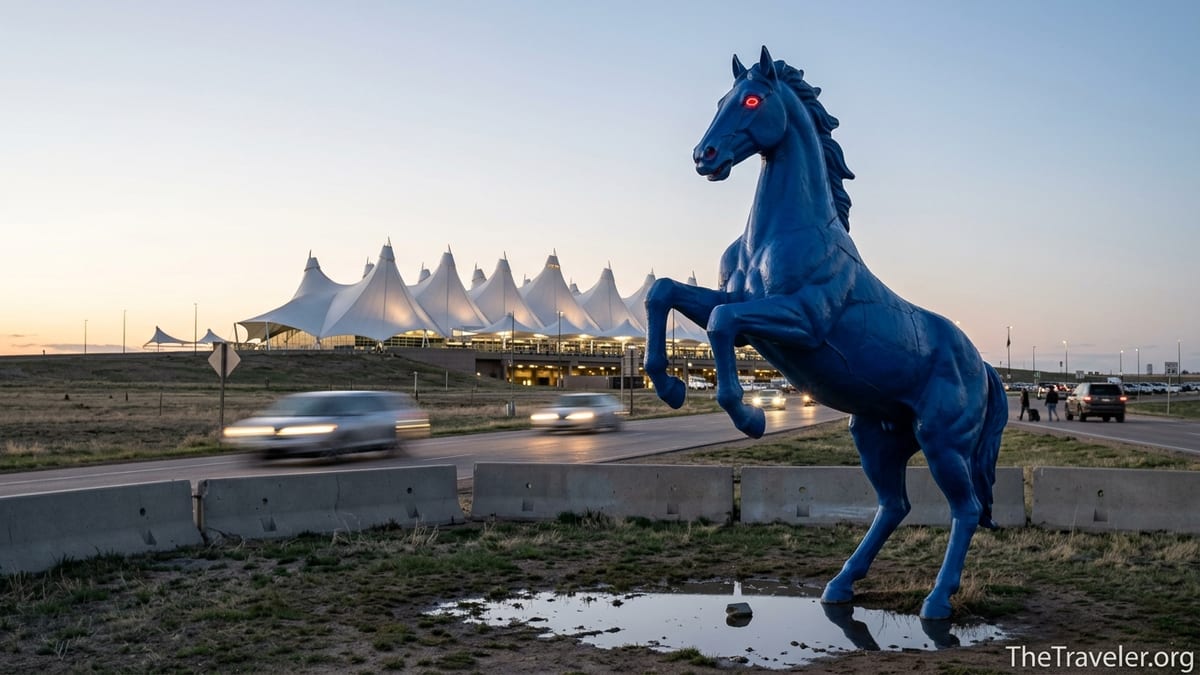
You do not even have to step inside Denver International Airport before the weirdness begins. As your rideshare glides along Peña Boulevard toward the terminal, a 32–foot cobalt horse rears above the highway, eyes glowing a menacing red against Colorado’s high plains sky. Locals call him Blucifer, and his origin story includes a real-life death. Inside, travelers find murals that look like scenes from a dystopian graphic novel, a Freemason plaque referencing a mysterious “New World Airport Commission,” and rumors of miles of tunnels under the runways. It is no wonder DEN has become the internet’s favorite airport conspiracy playground.
Get the latest updates straight to your inbox!
How a Normal Airport Became an Online Urban Legend
Denver International Airport, or DEN, opened in 1995 after a famously troubled construction period. The project ran late and notoriously over budget, sparking criticism across Colorado and headlines in national newspapers. Instead of the old Stapleton Airport tucked into Denver’s suburbs, the city now had a futuristic white-tented terminal surrounded by open prairie, 25 miles from downtown. It was a big, bold piece of infrastructure, and from the start it seemed to invite big, bold theories.
Those early headaches planted the seeds. Cost overruns, shifting opening dates, and images of earthmoving equipment carving deep trenches into the plains left many locals wondering what was going on beneath the surface. When aerial photos of the runway layout circulated, some viewers thought the pattern looked suspiciously like a crooked swastika. Combine that with faraway location, empty surrounding land, and endless sky, and conspiracy-minded travelers began to imagine the airport as something more than a place to catch a flight.
By the late 1990s and early 2000s, internet message boards and later YouTube videos began to knit these bits together into a mythology. Stories spread that DEN concealed massive underground bunkers for political elites, that it was a secret headquarters for the New World Order, or even that it sat atop alien tunnels. As social media matured, photos of the airport’s strangest features, especially its public art, let those rumors leap from niche forums into mainstream travel chatter.
Today, the airport itself plays along. During recent terminal renovations, construction walls have been covered with tongue-in-cheek posters joking about lizard people, Illuminati headquarters, and secret tunnels. Travelers waiting in the security line snap and share these signs alongside selfies with gargoyle statues and the infamous horse. For many visitors, especially on long layovers, hunting for the “creepy” parts of DEN has become a scavenger hunt as much as a journey through an airport.
The Murals: Apocalyptic Art or Hidden Messages?
No single element of Denver International Airport has generated more speculation than the murals painted by Chicano artist Leo Tanguma. The best known works, “Children of the World Dream of Peace” and “In Peace and Harmony with Nature,” once greeted passengers near the baggage claim in the Jeppesen Terminal. To a tired traveler stepping off a late-night flight, the first impression could be jarring: vivid scenes of soldiers in gas masks, children weeping over dead animals, and a sinister figure wielding a sword and rifle.
Conspiracy videos freeze-frame those images and spin elaborate interpretations. Some claim the murals outline a plan for global depopulation, a road map for a future one-world government, or coded references to biological warfare. In one panel of “Children of the World Dream of Peace,” a menacing soldier looms over sleeping children while a city burns behind him. In another, kids from different nations stand together, beating swords into ploughshares and dismantling weapons. Without context, it can feel like whiplash: apocalypse on one wall, utopia on the next.
The artist and the airport offer a much more straightforward explanation. According to Denver’s public art program, the murals are part of a tradition of social realist art that grapples with war, environmental destruction, and the hope for healing. In “In Peace and Harmony with Nature,” the first section shows forests burning, animals lying dead, and indigenous people mourning the loss of their lands. The companion section shows children from around the world celebrating a restored, green planet. The narrative flows from suffering to recovery, not from domination to control.
For visitors, the effect depends heavily on how you encounter the work. Someone hustling past the carousel to catch an Uber may only glimpse the gas mask and flames. A traveler with a long layover might stand in front of the full sequence and read the explanatory plaque, which frames the murals as a plea for peace and environmental responsibility. That split experience helps explain why the murals are both official civic art and inexhaustible fuel for TikTok videos that frame them as a prophecy of doom.
Blucifer: The Blue Horse That Killed Its Creator
Even among people who know little about Denver, the airport’s massive blue mustang has become a viral icon. Officially titled “Blue Mustang,” the 32–foot fiberglass sculpture by artist Luis Jiménez rears on its hind legs in a median along Peña Boulevard. The horse’s muscles are exaggerated, its veins bulge, and at night its neon red eyes glow with an intensity that startles first-time visitors driving in from Interstate 70. Locals, with some combination of affection and unease, nicknamed it “Blucifer.”
The statue’s backstory adds a very real macabre twist. Jiménez was a respected sculptor known for bold, larger-than-life works across the United States. While working on the mustang at his New Mexico studio in 2006, a large section of the sculpture came loose, crushing the artist and severing an artery in his leg. He died from his injuries. His family and studio assistants later completed the piece, and Blue Mustang was installed at DEN in 2008. That tragic accident, combined with the horse’s already intense appearance, helped cement the idea that the sculpture was cursed.
Travelers encounter Blucifer in a particularly liminal moment. You often see it through a car window while jet-lagged or preoccupied with flight delays, framed by the distant Rockies or a brewing thunderstorm. On social media, photos exaggerate its scale by shooting from a low angle, making the horse loom against stormy skies. Videos circulate with captions about a demon guardian of a secret underground base, or joking claims that the statue demands sacrifices in the form of lost luggage.
In practice, Blue Mustang serves as a very practical landmark. Rental car shuttles and hotel vans use it as a visual cue for drop-off zones, and locals tell visiting friends to “watch for the giant blue horse” as a sign they are almost there. You can safely pull off Peña Boulevard at a nearby cell phone waiting lot, then walk to the edge of the parking area and photograph the sculpture without blocking traffic. Whether you see Blucifer as folk horror, folk hero, or just a very memorable public artwork, it has become inseparable from the airport’s larger mythology.
The Underground Tunnels and the Baggage System Failure
If there is a beating heart to the Denver Airport conspiracies, it lies underground. Everyone can see the fiberglass horse and the murals, but the tunnels below the concourses are largely invisible to passengers. Officially, those spaces house a train system that shuttles people between the terminal and the three concourses, plus service roads and utility corridors. The airport also built an ambitious automated baggage system that was supposed to whisk bags directly from check-in to aircraft holds using a network of conveyors and carts.
That baggage system famously failed. Shortly after opening, television news segments showed suitcases launching off tracks, skis and golf clubs spilling everywhere, and jammed carts piling up like a slow-motion crash. Years of tinkering could not make the system work reliably for the entire airport, and much of it was eventually shut down. Today, DEN relies heavily on more conventional belt conveyors and human baggage handlers, although remnants of the original machinery still exist below the floors.
To conspiracy theorists, the idea of miles of barely used tunnels and mechanical infrastructure beneath a remote, over-budget airport was irresistible. Stories spread that the baggage conveyors were always just a cover for underground bunkers. Others say the tunnels connect to military facilities buried in Colorado’s Front Range, forming a hidden evacuation route for elites in the event of catastrophe. Internet posts describe secret railways under the plains, or claim that the constant construction around the terminal is an excuse to expand the hidden network.
For most travelers, the only visible evidence of these subterranean spaces appears when you ride the airport train between concourses. As the car glides through the tunnel, you can glimpse maintenance doors, ventilation shafts, and modern art installations using hanging metallic propellers and colored lights. The atmosphere is industrial but not quite cinematic. Still, combine the hum of the train, occasional flicker of fluorescent light, and the knowledge that there are sealed levels you will never see, and the mind begins to wander. A simple ride to your gate becomes a journey through one of the most theorized basements in the world.
The Freemason Plaque and the “New World Airport Commission”
Near the south entrance of the Jeppesen Terminal, set into a wall of polished stone, sits one of the most photographed objects at DEN: a bronze dedication capstone. It lists the names of civic leaders who oversaw the airport’s construction, includes the date of a time capsule burial, and bears a prominent symbol of the Freemasons’ square and compass. The inscription also credits a “New World Airport Commission” as part of the project, a name that has never corresponded to any known formal organization.
For Freemason skeptics, that combination is rocket fuel. Screenshots of the plaque appear in documentary-style videos with ominous music and voiceovers about secret societies orchestrating world events. The phrase “New World Airport Commission” sounds, to many ears, uncomfortably close to “New World Order,” a concept that already sits at the center of countless global control conspiracies. Viewers connect that wording to the war-and-peace murals and the apocalyptic online lore grows thicker.
Local historians and airport officials offer a more workaday explanation. The commission name, they say, referred to a promotional group formed in the early 1990s to celebrate Denver’s emergence as an international aviation hub, inspired by “a new world of air travel” marketing language. Freemason symbols appear on public buildings across the United States, especially where local lodges contributed to civic projects. In this telling, the capstone is not a secret code but a fairly standard piece of late twentieth century boosterism with a ceremonial flair.
Regardless of intent, the plaque has taken on a second life as an attraction in its own right. Travelers on long layovers often follow online guides to seek it out, snapping photos while security officers and airline staff roll suitcases past them. If you visit, you will likely see at least one person crouching to get the Freemason symbol perfectly centered in their frame. For many, it becomes the final piece of a personal tour: you land, ride under the tunnels, spot Blucifer, find the gargoyles and murals, then cap the experience with a selfie beside the “New World Airport Commission.”
Gargoyles, Talking Statues, and DEN’s Self-Aware Marketing
One of the airport’s subtler oddities sits at baggage claim: bronze gargoyles perched inside open suitcases, hunched like mischievous guardians of your luggage. Traditional gothic gargoyles were meant to ward off evil spirits from cathedrals. At DEN, they are tongue-in-cheek protectors of lost bags, keeping watch as carousels send duffels and ski cases rumbling by. For a traveler whose suitcase has just gone missing on a winter ski trip, the effect can feel a little too on the nose.
In recent years, the airport has leaned fully into its spooky reputation. During major renovation phases, temporary walls in the terminal have been decorated with posters that wink at the rumors. One showed a reptilian eye peeking through cracked drywall with copy about construction delays “caused by lizard people.” Another featured a triangle and all-seeing eye riffing on Illuminati symbolism, promising that the new concourse would bring “more space for our secret meetings.” Far from denying the conspiracies, DEN’s own marketing team has turned them into a brand asset.
Perhaps the clearest example of that self-awareness is the animatronic “talking gargoyle” the airport unveiled for an anniversary promotion. Hidden cameras and microphones allowed a performer behind the scenes to control the gargoyle’s movements and respond in real time to passersby. As travelers walked past, the statue would suddenly come to life, making quips like “Welcome to Illuminati headquarters” or “Do not be alarmed, but you have triggered the secret portal.” Videos of startled passengers laughing, swearing, or backing away quickly racked up millions of views online.
For visitors, this self-parody softens the edge of the airport’s stranger elements. When an institution jokes about its own urban legends, it signals that, at least officially, there is nothing to hide. At the same time, the jokes keep the story alive. A teenager who sees the lizard-people construction banner might search for “Denver airport conspiracy” on their phone, fall down an online rabbit hole, and spend the rest of their layover hunting for murals and plaques. The line between genuine belief and playful participation blurs, and the conspiracies become part tourism, part folklore.
Why Denver’s Weirdness Works: Myth, Place, and Passenger Experience
Plenty of airports feature public art, but few have inspired such a dense thicket of stories as Denver. Part of the answer lies in the setting. The terminal’s peaked white roof evokes both the Rocky Mountains and tipis of the Great Plains, giving the building a distinctive silhouette that feels theatrical as you approach. At night, spotlights cast deep shadows into the fabric “tents,” and in winter, the whole structure rises out of blowing snow like a temporary research station in some remote landscape. That slightly surreal backdrop primes the imagination before you even reach security.
Another ingredient is the contrast between function and feeling. Airports are built for efficiency: you move from curbside to gate through a stream of check-in desks, security lanes, food courts, and glass-walled concourses. Most of it is deliberately generic so that global chains, from coffee brands to fast-casual restaurants, can plug in anywhere. Against that blandness, the intense imagery of Tanguma’s murals and the raw physicality of Blucifer stand out sharply. When something breaks the homogenous script of modern air travel, people remember it, talk about it, and post it.
There is also the simple fact of time. Denver is one of the busiest connecting hubs in North America, handling tens of millions of passengers per year. On any given afternoon, thousands of people are stuck in long security lines or waiting out delays at the gate. Idle curiosity and smartphone cameras are a powerful combination. A traveler killing two hours before a red-eye to New York can wander the terminal, stumble onto a gargoyle or mural, and share it instantly with a global audience. Each individual post may be casual, but together they build an enormous archive of images that keep the myths in circulation.
For the airport and the city, this eerie reputation is a mixed blessing that mostly works in their favor. On one hand, staff occasionally have to reassure nervous visitors who have read about underground bunkers or demonic horses. On the other, the conspiracies give DEN a distinct identity in a world of interchangeable terminals. Travel magazines publish explainer pieces, tourism boards fold the art into their marketing, and local tour companies include airport art walks or drive-by Blucifer photo stops in their itineraries. In a crowded travel landscape, being the strangest airport in America is a surprisingly effective calling card.
The Takeaway
Walk through Denver International Airport with your eyes open and you will quickly see why it fascinates so many people. The place is undeniably odd: a monumental blue horse with a tragic backstory rears over the only road in, murals wrestle with war and ecological collapse in vivid color, a Freemason capstone hints at forgotten committees, and subterranean machines from a failed baggage system rattle in the dark beneath your feet. Add a self-aware marketing team that jokes about lizard people and secret societies, and you have all the ingredients of a modern folk tale.
Whether you treat the conspiracies as tongue-in-cheek entertainment or as something more serious, they change how you experience the airport. Many travelers arriving in Denver for a ski trip or a national park road journey now plan a few extra minutes to detour past the murals, spot the suitcase gargoyles, or photograph Blucifer against the sunset. Instead of being just another layover, DEN becomes a story to tell when you get home, a place where the internet’s wildest rumors brush up against the practical business of catching a flight.
In the end, the strangest thing about Denver International Airport may not be its art, tunnels, or plaques, but the way it shows how quickly a public space can become a canvas for global imagination. A late and over-budget project on the Colorado plains has, in less than three decades, become a stage where travelers, artists, marketers, and conspiracy theorists all play a part. If you pass through, take a moment to look around. You might not uncover a hidden bunker, but you will see one of the most peculiar and talked-about airports in the world.
FAQ
Q1. Where can I see the famous murals at Denver International Airport?
The murals by Leo Tanguma have historically been displayed in the Jeppesen Terminal near baggage claim areas. Because DEN is regularly renovating and rotating art, their exact placement can change. Once in the terminal, follow signs toward baggage claim and keep an eye out for large wall panels depicting children, doves, and environmental scenes, or ask an information desk agent to point you to the current location.
Q2. Is Blucifer really dangerous or cursed?
The statue’s reputation comes from the tragic accident that killed its creator, sculptor Luis Jiménez, while he was working on it in his studio. Since its installation at the airport, Blue Mustang has stood without incident apart from routine maintenance. It looks intimidating, especially at night when the red eyes glow, but for visitors it is simply a dramatic piece of public art that has acquired an eerie nickname and a larger-than-life story.
Q3. Can regular passengers visit the tunnels under Denver Airport?
No, the tunnels and most underground spaces are restricted areas used for the train system, baggage handling, and utilities. Passengers only experience a small portion when they ride the underground train between the terminal and concourses. There are no public tours of the baggage tunnels or any alleged bunkers, so views of those areas mostly come from behind-the-scenes photos, news footage, or staff accounts shared over the years.
Q4. What is inside the Freemason time capsule at DEN?
The time capsule under the dedication capstone near the south entrance is scheduled to be opened decades in the future, so its current contents are not on public display. Contemporary reports at the time of burial described typical civic items such as local newspapers, artwork, and memorabilia rather than secret documents. For now, it functions more as a symbol and photo backdrop than as an accessible exhibit.
Q5. Did the runways at Denver Airport really form a swastika?
Aerial photos taken shortly after the airport opened showed a runway layout that some viewers thought resembled a crooked swastika. Aviation planners point out that the crisscrossing pattern is designed to allow planes to take off and land from multiple directions in Denver’s often gusty winds. Over time, additional runway work and expansion have made the resemblance less striking, and the design is explained as a product of efficiency rather than symbolism.
Q6. Why did the automated baggage system fail so badly?
The system at DEN was one of the most ambitious ever attempted for a commercial airport when it was installed in the 1990s. Complex software, long distances between check-in and gates, and the harsh realities of bulky ski bags and irregular luggage created far more glitches than anticipated. After years of costly adjustments and public embarrassment, most of the automated network was abandoned in favor of simpler conveyor belts and manual handling, leaving unused machinery underground and plenty of material for conspiracy stories.
Q7. Are the gargoyles and talking statues permanent features?
The bronze suitcase gargoyles at baggage claim are part of the permanent art collection and remain on display. The animatronic “talking gargoyle” that surprised travelers during a promotional campaign was a temporary installation used for a limited run of live performances and recordings. While the talking version may reappear for special events, the everyday gargoyles you see quietly watching over carousel areas are regular fixtures.
Q8. Does the airport officially acknowledge the conspiracy theories?
Yes, in a tongue-in-cheek way. Denver International Airport’s communications and marketing teams have created posters, social media content, and temporary exhibits that reference lizard people, secret societies, and underground bases with humor. Official statements emphasize that DEN is just an airport with an unusual art program and a complicated construction history, but they also recognize that the myths have become part of its public identity.
Q9. Can I take a tour focused on the art and conspiracies at DEN?
The airport periodically offers guided public art tours that highlight major installations, including murals, sculptures, and architectural features. These tours focus on the artists and civic programs behind the works rather than promoting conspiracies, but a well-informed guide will usually acknowledge the stories visitors have heard. If no official tour is available during your visit, you can create your own by planning extra time to see Blue Mustang outside, the murals and capstone in the terminal, and the gargoyles at baggage claim.
Q10. Should nervous flyers avoid Denver because of its spooky reputation?
For most travelers, Denver International Airport functions like any other large hub: flights arrive and depart, luggage appears on carousels, and long lines form at coffee counters. The eerie art and rumors can feel unsettling if you focus on them, but they are separate from the airport’s strong safety and operational record. If you are an anxious flyer, it may help to treat the conspiracies as stories and curiosities, then concentrate on standard calming routines like arriving early, finding a comfortable seat, and having a good book or playlist for your flight.