


Landing at Denver International Airport with Breckenridge ski days on the horizon is an exhilarating feeling. The only thing between you and the slopes is a 100‑mile journey over Colorado’s I‑70 mountain corridor, a stretch that can be effortless in bluebird weather or slow and stressful in a storm. Choosing the right transfer option is one of the most important decisions of your trip, especially in mid‑winter when traffic, snow and chain laws can turn a straightforward drive into a multi‑hour ordeal.
Get the latest updates straight to your inbox!
Understanding the Route and Realistic Travel Times
Denver International Airport sits on the plains east of the city, while Breckenridge is tucked into the Rockies at over 9,600 feet. The usual route runs from the airport onto Peña Boulevard, then I‑70 west through the foothills, over or near key passes like the Eisenhower–Johnson Memorial Tunnel, before exiting onto Colorado Highway 9 south to Breckenridge. In clear weather and light traffic, shuttle companies typically quote 2 to 2.5 hours from Denver International Airport to Breckenridge, and this is achievable on early‑morning weekday departures outside peak holidays.
Winter reality often looks different. On busy Saturdays in January or February, when Front Range locals and visitors all head to the slopes, that same trip can stretch to 3 or even 4 hours if there are minor accidents or slow‑moving traffic on the I‑70 climbs. A traveler arriving on a 9 a.m. flight and boarding a noon shuttle might reach their Breckenridge condo by mid‑afternoon in good weather, but in an active snowstorm the arrival could easily slip to early evening. It is wise to build an extra hour of margin into any afternoon or evening arrival.
Colorado’s traction and chain laws also affect timing. Between roughly September and May, authorities can activate traction requirements on I‑70 when conditions deteriorate, meaning vehicles must have proper winter or mud‑and‑snow‑rated tires, adequate tread, or chains. When these rules go into effect, traffic often slows dramatically, and drivers in under‑equipped vehicles may be stopped or even turned around. Even if you never touch a chain yourself, you will feel the delay in your transfer time.
The return trip to Denver International Airport often surprises visitors even more. It is possible for an early‑morning Sunday departure from Breckenridge to reach the airport in about 2 hours. Yet there are many real‑world stories of travelers leaving at 10 a.m., only to sit in a miles‑long queue east of the Eisenhower Tunnel and miss a late‑afternoon flight. Planning backwards from your departure time and allowing 4 hours door to door, especially on weekends or powder days, is the safest strategy.
Shared Shuttles: The Workhorse Option for Most Ski Travelers
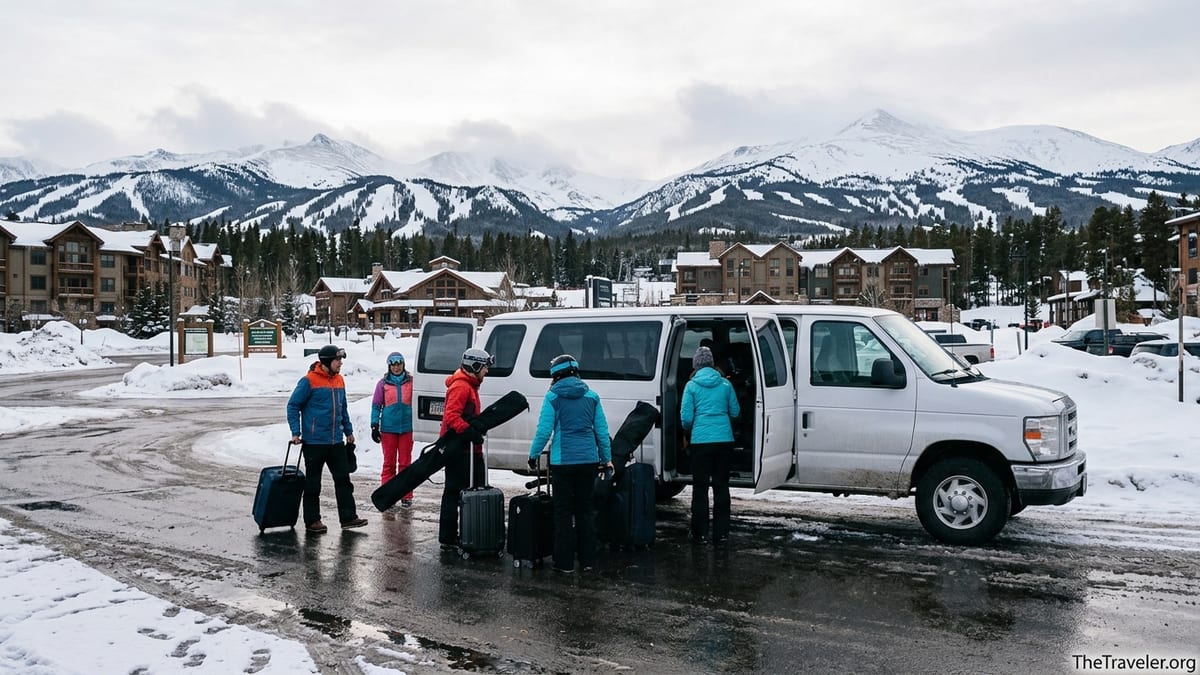
For many visitors, a shared airport shuttle is the most convenient balance of price, comfort and peace of mind. Major operators run frequent services between Denver International Airport and Breckenridge during the ski season, using winter‑equipped vans and minibuses driven by local professionals who know I‑70’s quirks. These services typically meet passengers at clearly marked airport counters in the terminal, then group travelers heading to the same resorts and towns.
Pricing is competitive and usually charged per person. As a ballpark example, a shared shuttle from Denver International Airport to Breckenridge’s main transit hubs or gondola stations often runs around 75 to 85 US dollars one way per adult when booked in advance, with slightly higher rates, often around 85 to 95 dollars, for direct door‑to‑door service to condo complexes and hotels. Children’s fares and discounts for certain ski pass holders can bring the price down a bit for families. For a couple or solo traveler, this usually undercuts the cost of renting an SUV for several days once insurance, fuel and resort parking are factored in.
To see how this works in practice, imagine a family of four landing at Denver International Airport around midday on a Saturday in January. They pre‑book a shared shuttle with door‑to‑door service to a slopeside lodge near the BreckConnect Gondola. Their total one‑way transfer might fall in the 320 to 360 dollar range for the family. In return, they roll their ski bags directly from baggage claim to the shuttle desk, board a van with other Breckenridge‑bound passengers, and spend the drive watching the mountains appear rather than scanning for black ice or brake lights.
Shared shuttles also include useful luggage allowances for ski travelers. Many operators permit at least one large suitcase and a ski or snowboard bag per person before any extra fees apply. Walls and floors are protected with rubber mats, and racks or interior rails are designed to hold hard ski cases and board bags. If you are traveling with bulkier equipment such as multiple pairs of skis, boot bags and a week’s worth of outerwear, a shuttle can save you the worry of trying to pack everything into a compact rental car trunk.
Private Shuttles and SUVs: Comfort and Flexibility at a Price
Private transfers appeal to groups that value door‑to‑door convenience, privacy and control over timing. These services typically use late‑model SUVs, sprinter vans or small coaches equipped for winter, with a driver dedicated exclusively to your party. Rates are quoted per vehicle, and while they are meaningfully higher than shared shuttle fares, they can become cost‑effective when split among several travelers or for those carrying significant luggage.
As a real‑world reference, one‑way private SUV transfers for 3 to 5 passengers from Denver International Airport to Breckenridge commonly range somewhere between 450 and 650 dollars in regular winter conditions. Larger sprinter vans accommodating 8 to 12 passengers often start around 700 dollars and can climb toward 1,000 dollars during peak holiday weeks or for late‑night arrivals. Some premium services add amenities such as bottled water, in‑vehicle Wi‑Fi and child seats on request, though these may carry small surcharges.
Consider a group of eight friends sharing a large ski house in Breckenridge over New Year’s week. If they choose a private van at 900 dollars each way, their per‑person cost is around 112 dollars, not dramatically more than a high‑season shared shuttle seat. Yet they gain a dedicated vehicle that can wait if their flight is slightly delayed, stop at a grocery store in Frisco or Silverthorne to stock up on supplies, and drop them directly at the driveway of their rental home without multiple stops around town.
Private transfers also make sense for families traveling with young children or older relatives who might find the logistics of shared shuttles tiring. Having a driver meet you with a name sign, assist with bags and whisk you straight to a warm vehicle can feel worth the premium after a long flight. Just remember that private services book up quickly for Christmas, New Year and Presidents’ Day weekends, so locking in your times several weeks or even months in advance is wise.
Renting a Car: Independence vs Winter Driving Reality
Renting a car at Denver International Airport can be enticing if you plan to explore beyond Breckenridge, ski multiple resorts like Keystone and Arapahoe Basin, or prefer not to rely on fixed shuttle timetables. The airport hosts more than 10 major rental brands, and on a typical winter day you will see rows of SUVs, crossovers and sedans available for walk‑up and pre‑booked customers. Daily rates can look reasonable at first glance, especially if you visit midweek, but the full cost picture includes insurance, fuel, tolls and parking at your lodging.
The bigger question is suitability for winter mountain driving. A basic front‑wheel‑drive sedan with standard all‑season tires may be the cheapest option on the rental website, but it is not ideal for navigating I‑70 in a snowstorm. Colorado’s traction laws can require vehicles on key stretches of I‑70 to be all‑wheel or four‑wheel drive with adequate winter or mud‑and‑snow‑rated tires, or else be equipped with approved chains or alternate traction devices. If your rental car does not meet those requirements when conditions deteriorate, you could be forced to stop, add chains at a cold roadside area, or risk fines and getting stuck in dangerous conditions.
Because of this, many ski travelers deliberately book mid‑size or full‑size SUVs that are clearly marked as all‑wheel or four‑wheel drive. A typical example might be a 5‑passenger SUV from a major rental firm at Denver International Airport, priced around 80 to 120 dollars per day in mid‑season before taxes and fees, compared to 40 to 60 dollars per day for a compact sedan. Over a 7‑night stay, that difference can add several hundred dollars to your transport budget, but you gain significantly more traction, ground clearance and cargo space for ski equipment.
Packing should also factor into your decision. A family of four with two adults, two children, four large suitcases and two ski bags may find that a basic sedan simply cannot swallow the gear without awkward stacking that blocks rear visibility. Many visitors end up folding rear seats and wedging ski bags diagonally through the cabin, which is uncomfortable on a three‑hour drive. An SUV or crossover, ideally with a roof box if you are renting locally in Denver rather than at the airport, makes it easier to separate wet boots and snow‑covered skis from passengers and electronics.
Winter Driving and Safety on I‑70 and Highway 9
If you are considering renting a car for the Denver to Breckenridge trip, it is crucial to have a realistic view of winter driving on I‑70 and Highway 9. The corridor climbs quickly from the plains into high‑altitude terrain, with long grades, sharp curves and stretches that are prone to rapid changes in weather. You can leave Denver under blue skies and dry pavement only to encounter blowing snow, black ice and poor visibility near the Eisenhower Tunnel less than two hours later.
Colorado transportation authorities emphasize several key winter driving practices: slowing down well below posted limits during storms, leaving much larger following distances, and avoiding sudden braking or steering inputs on packed snow. A four‑wheel‑drive SUV will help you get moving, but it will not shorten your stopping distance on ice. Rental vehicles sometimes come with tires that are legal but not optimized for severe winter conditions, so if you arrive in December or January and see shallow tread on an all‑season tire, it is worth asking the rental desk for a vehicle with better rubber or clearly winter‑rated tires.
Legal requirements can also affect your plans. During the core winter season, traction rules are frequently activated on I‑70 west of the Denver suburbs, including the key segment leading toward the Eisenhower Tunnel. When active, they require vehicles to have adequate tires and tread or carry chains. Though rental companies at Denver International Airport rarely provide chains as standard equipment, you can purchase or rent approved traction devices from outdoor retailers or auto shops in the Denver area if you are determined to drive yourself. However, many visitors find that the stress of monitoring road alerts, fitting chains at high‑elevation chain stations and driving in heavy traffic simply outweighs the convenience of having their own vehicle.
Real‑world experiences illustrate the stakes. It is common for I‑70 to slow to a crawl on Sunday afternoons when a snowstorm coincides with weekend skiers returning to the city, with some drivers reporting travel times of 4 to 5 hours between Summit County and Denver International Airport. Spin‑outs by under‑equipped vehicles can trigger temporary closures, which in turn cascade into missed flights. If you lack mountain winter driving experience or are traveling with children, the most conservative choice is often to use a professional shuttle service and leave the high‑altitude navigation to local drivers.
Luggage, Ski Gear and How Each Option Handles Your Bags
Breckenridge visitors rarely travel light. A typical ski party might arrive with large rolling suitcases, dedicated ski or snowboard bags, helmet packs and boot bags, plus groceries or baby gear picked up along the way. How your transfer option handles this pile of equipment can greatly affect comfort and cost. Shared shuttle companies usually include at least one checked‑size suitcase and one ski or snowboard bag per passenger in the base fare, with modest fees for extra or oversized items such as double ski cases or bulky sports equipment.
In practice, this means that a couple traveling with two suitcases and two single ski bags can board a shared van without worrying about surcharges, while a group bringing multiple pairs of skis in large hard cases might pay a small extra fee per case. Shuttles are designed with low floors and wide side doors, so drivers can load and secure gear quickly at the airport curb. On arrival in Breckenridge, skis and boards are typically unloaded directly at your lodging’s front door or at central hubs like the BreckConnect Gondola parking area, making it easy to roll equipment a short distance on snow‑cleared paths.
Private SUVs and vans, on the other hand, offer maximum flexibility. Because you are booking the entire vehicle, the focus shifts from per‑item fees to simple capacity. A luxury SUV can comfortably swallow the bags of a family of four, including two to three ski bags, as long as the third‑row seats are folded down. Larger sprinter‑style vans can handle full race‑team style quivers and even bulky items like boot heaters or tuning benches. If your group is traveling with unusually large or heavy gear, advising the private transfer company in advance allows them to assign an appropriately sized vehicle and, if needed, a small enclosed trailer.
Rental cars present the biggest packing challenge. A compact sedan trunk may technically fit a couple of medium suitcases, but hard ski cases often do not pass through the trunk opening. Soft ski bags can snake through folded rear seats into the cabin, but they reduce seating capacity and comfort. For a week in Breckenridge, many self‑drivers deliberately book a mid‑size or full‑size SUV and still plan to keep boots and helmets inside the passenger compartment where they stay warmer and dry. If you are traveling at peak times, it is worth reserving a specific size category well ahead of time rather than hoping to be upsold at the counter.
Costs, Convenience and Choosing the Right Option
When you line up all the options side by side, the best transfer choice from Denver International Airport to Breckenridge comes down to your priorities: budget, comfort, autonomy and risk tolerance. A solo traveler or couple on a week‑long trip who plan to stay in town and use Breckenridge’s free local bus network will usually find a shared shuttle to be the most economical door‑to‑door solution. For around 150 to 200 dollars total per person for a round trip in typical pricing, they gain a professional winter driver and do not have to think about road conditions.
Families and groups need to do a bit of arithmetic. A family of five booking shared shuttle seats from Denver International Airport to a condo just off Peak 9 could easily approach or exceed 500 to 600 dollars round trip in total fares. At that point, a private SUV or van quoted at, say, 900 to 1,200 dollars round trip starts to look more competitive, especially once you factor in the convenience of custom pick‑up times, grocery stops and no extra waiting at the airport. Conversely, a week‑long SUV rental might also land in the 800 to 1,200 dollar range after taxes, parking and fuel, but comes with the added responsibility of winter driving.
Another consideration is how central your Breckenridge lodging is. If you are staying near the BreckConnect Gondola, along Main Street or in a large slopeside complex serviced by the town’s free bus, you may not need a car at all. In that scenario, a shuttle or private transfer that drops you at your door is ideal, and the vehicle can leave town with no further thought. If, however, you are in a more secluded rental home up the hill, or you intend to ski Keystone, Copper Mountain and Arapahoe Basin on different days, a rental car starts to offer more value despite the added stress.
Finally, consider weather flexibility. Shuttles and private transfer companies monitor I‑70 conditions throughout the day and adjust schedules when necessary. On a day when authorities anticipate heavy snowfall and chain‑law conditions, operators might cluster departures earlier or later to avoid the worst windows. As a self‑driver, you will be making those decisions yourself using road condition websites and apps, which can be empowering for experienced winter motorists and intimidating for those new to mountain driving. Honestly assessing your comfort level before you book is one of the smartest steps you can take.
The Takeaway
Traveling from Denver International Airport to Breckenridge is a classic part of a Colorado ski trip, but it is not a trivial commute, especially in the heart of winter. The two to two‑and‑a‑half‑hour transfer that appears on booking websites is realistic only in favorable conditions. When snow, traction laws and weekend traffic enter the picture, the journey can stretch considerably, and the consequences of a misjudged departure time may include missed ski days or missed flights.
Shared shuttles remain the best all‑around option for most visitors, delivering strong value, solid luggage capacity and the reassurance of a professional mountain driver at a per‑person price that generally undercuts renting an SUV plus paying for parking. Private shuttles and SUVs add comfort and flexibility for groups, often at a similar or even lower per‑person cost once enough seats are filled. Rental cars offer unmatched independence but demand realistic winter driving skills and careful attention to traction rules, tire quality and rapidly changing road conditions.
When planning your own trip, start with a few key questions: How comfortable am I driving icy mountain passes in the dark or during a storm? How much gear are we bringing, and how central is our lodging in Breckenridge? Are we content skiing one resort, or do we plan to roam? Answering these honestly will quickly point you toward the transfer option that makes the most sense for your group. With the right choice locked in, the journey from Denver to Breckenridge becomes less of a logistical puzzle and more of a scenic prologue to the ski days ahead.
FAQ
Q1. How long does it really take to get from Denver International Airport to Breckenridge in winter?
In light traffic and dry conditions, many travelers make the trip in about 2 to 2.5 hours. On busy weekends, holidays or during storms, it is common for the journey to stretch to 3 or even 4 hours, especially if traction laws are in effect or there are minor accidents on I‑70.
Q2. Is it worth renting a car instead of taking a shuttle?
It depends on your plans and comfort with winter driving. Renting an SUV can make sense if you will ski multiple resorts or stay in a remote rental home, but you will be responsible for navigating snow, ice, traffic and traction laws. For visitors staying near central Breckenridge who mainly plan to ski in town, a shared or private shuttle is usually simpler and often cheaper overall.
Q3. Do I need a four‑wheel‑drive vehicle to drive from Denver to Breckenridge?
You do not always need four‑wheel drive, but it is strongly recommended in winter. Colorado traction rules can require vehicles on parts of I‑70 to have all‑wheel or four‑wheel drive with proper winter or mud‑and‑snow‑rated tires, or else carry chains. A basic front‑wheel‑drive sedan with standard all‑season tires may be legal in good weather but can struggle badly when conditions deteriorate.
Q4. How much does a shared shuttle from Denver International Airport to Breckenridge cost?
Prices vary by operator and season, but many shared shuttles charge roughly 75 to 95 US dollars per adult one way, depending on whether you are dropped at a central transit hub or directly at your lodging. Children, groups and certain ski pass holders may be eligible for discounted fares.
Q5. What does a private SUV or van transfer typically cost?
As a broad guide, one‑way private SUV transfers for up to 5 passengers often fall somewhere between 450 and 650 dollars, while larger sprinter‑style vans for 8 to 12 passengers can range from around 700 dollars into the 900‑plus dollar range during peak weeks. Splitting the cost among several travelers usually makes private transfers more reasonable per person.
Q6. Can I bring my skis and snowboard on airport shuttles?
Yes. Most shuttle companies are set up specifically for ski travelers and include at least one suitcase and one ski or snowboard bag per person in the base fare. Extra or oversized items such as double ski cases may incur small additional fees, so it is wise to check luggage policies when booking.
Q7. How early should I leave Breckenridge for a flight out of Denver in winter?
Many seasoned visitors plan on at least 4 hours door to door between Breckenridge and Denver International Airport during the winter season, particularly on weekends or after fresh snow. This allows for typical travel time plus a buffer for slow traffic or minor incidents on I‑70, helping reduce the risk of missing your flight.
Q8. Is there any reason to stay overnight near the airport instead of going straight from Breckenridge?
Some travelers with very early morning flights or those traveling during an active storm choose to spend their last night at a hotel near Denver International Airport. Driving down from Breckenridge the afternoon before reduces the risk posed by overnight snow, early‑morning ice and unexpected I‑70 closures, and can make departure day far less stressful.
Q9. Do I need chains if I am driving a rental car?
If your vehicle is all‑wheel or four‑wheel drive with good winter or mud‑and‑snow‑rated tires and adequate tread, you generally will not be required to use chains during traction law periods. However, if you are driving a two‑wheel‑drive car in winter, carrying approved chains or alternate traction devices is often the only way to remain legal and safe when conditions degrade, though many visitors prefer to avoid this scenario entirely by booking shuttles instead.
Q10. Is Breckenridge easy to get around without a car once I arrive?
Yes. Breckenridge has a free local bus system that connects most lodging areas with the ski base areas, Main Street and grocery stores. Many condo complexes and hotels are also within walking distance of the BreckConnect Gondola or a bus stop. If you plan to stay mostly in town and ski Breckenridge itself, you can comfortably rely on shuttles and local transit rather than renting a car.