


More news on this day
Air travel through Dubai and other key Gulf hubs is once more being thrown into turmoil as renewed attacks and rising US–Iran tensions trigger flight cancellations, diversions and fresh safety warnings across the Middle East.
Get the latest news straight to your inbox!
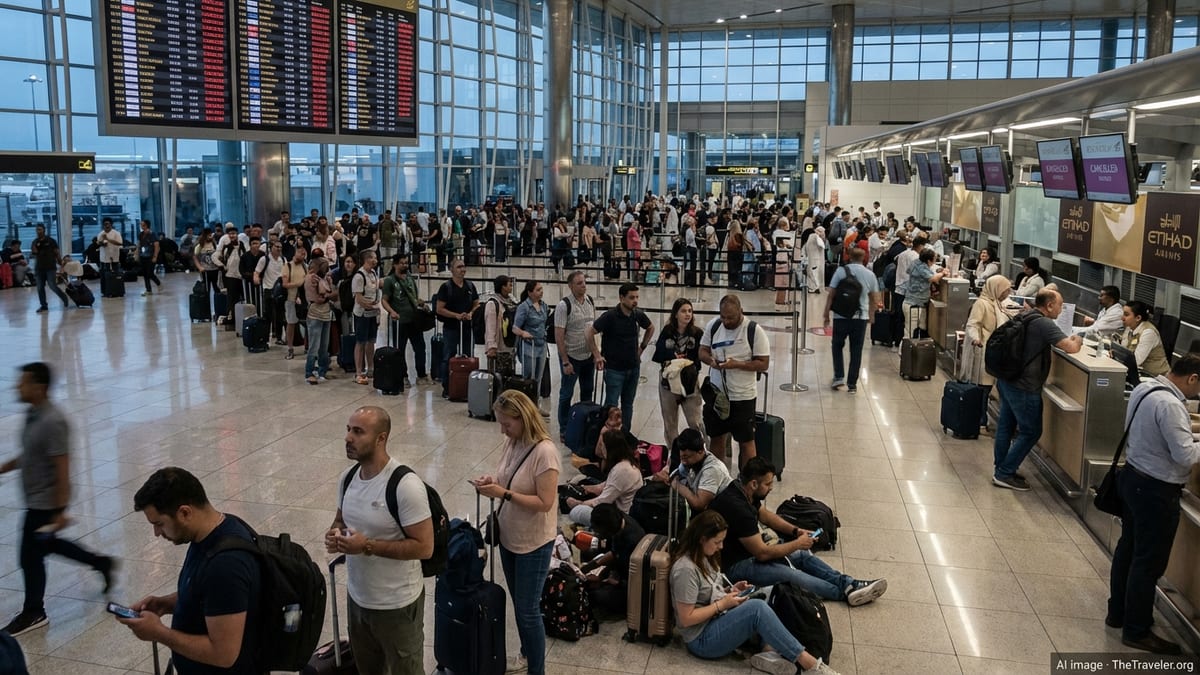
New attacks revive fears over Gulf aviation safety
Published coverage indicates that the latest spike in tension follows a new round of exchanges between the United States and Iran, including strikes on military facilities and critical infrastructure around the region. These developments come on top of months of conflict that has already damaged airports and fuel depots from Dubai to Kuwait, leaving aviation networks in the Gulf particularly exposed.
Reports from regional media describe a pattern of drone and missile activity aimed at infrastructure in and around major cities, including previous incidents near Dubai International Airport and Abu Dhabi. Even when attacks fall short of terminals and runways, operators have repeatedly halted takeoffs and landings as a precaution, forcing aircraft to divert to airports in Oman, Saudi Arabia and beyond.
International analysis notes that the conflict has widened beyond Iran’s territory to include strikes and counterstrikes on Gulf states that host foreign forces. This has increased perceived risk around some of the world’s busiest aviation corridors, where aircraft movements traditionally criss-cross between Europe, Asia and Africa via hubs such as Dubai, Doha and Abu Dhabi.
Industry assessments suggest that each fresh round of attacks resets recovery timelines for airline schedules. Carriers that had been rebuilding networks and restoring frequencies through the Gulf now face renewed uncertainty over airspace access, crew routing and insurance costs.
Dubai flight schedules under renewed strain
Dubai, which operates the world’s busiest international airport by passenger traffic, has already endured several rounds of suspensions and capacity cuts since the outbreak of the 2026 Iran conflict. Publicly available information shows that previous missile and drone incidents near Dubai International Airport led to temporary closures, damage to airport fuel infrastructure and lengthy backlogs for airlines and passengers.
Several Gulf-based news outlets now report a new wave of disruption, with flights from Dubai and Sharjah cancelled or retimed following attacks on airports in neighboring countries and continued uncertainty over regional airspace. Flight-tracking data cited in recent coverage shows aircraft from Emirates, flydubai and other carriers routing further south or west to avoid perceived hot spots, extending flight times on services linking Europe and Asia.
Travel advisories issued by foreign governments earlier in the year had already warned of “significant disruptions” to commercial flights in and out of the United Arab Emirates due to the risk of drone and missile activity. Those alerts remain a reference point for many airlines and travelers as the security situation fluctuates, with operators generally taking a conservative approach when new incidents occur.
For passengers transiting Dubai, the renewed tension translates into longer connection windows, higher chances of missed onward flights and a greater likelihood of last-minute schedule changes. Advisories from airports and airlines consistently urge travelers to check flight status before leaving for the terminal and to prepare for possible delays.
Regional airspace closures ripple across Middle East routes
The flight disruption is not confined to the United Arab Emirates. According to regional and international aviation coverage, several Middle Eastern states have intermittently closed sections of their airspace this year in response to missile overflight risks and nearby strikes. Earlier phases of the conflict saw Iraq, Jordan, Qatar and Bahrain impose broad restrictions, effectively creating a patchwork of no-fly zones across the heart of the region.
These measures have forced airlines to redraw long-established east–west corridors, in some cases pushing traffic over the eastern Mediterranean, Egypt or the Arabian Sea. Analysts note that such diversions add hundreds of kilometers to certain routes, increasing fuel burn and costs while reducing the number of flights an airline can operate with a given fleet.
European regulators have also tightened guidance. Recent advisories from the European Union Aviation Safety Agency, as reported by Gulf-based outlets, recommend that carriers avoid the airspace of the UAE, Bahrain, Kuwait and Qatar due to a perceived high risk to civil aviation. While these notices are not binding, many European airlines treat them as strong guidance and adjust their flight plans accordingly.
The result is a fragmented operating environment in which some carriers continue to serve Gulf hubs under strict risk controls, while others reduce frequencies, reroute via alternative stops or suspend certain destinations entirely. For travelers, this translates into fewer nonstop options, more complex itineraries and growing uncertainty around ticketed journeys.
US–Iran confrontation reshapes travel risk calculations
The underlying driver of the aviation turmoil remains the deepening confrontation between Washington and Tehran. Recent reporting describes a steady escalation from maritime clashes in the Strait of Hormuz to direct attacks on bases hosting US troops, as well as a partial blockade aimed at constraining Iranian shipping. Each escalation has potential spillover effects on nearby civilian infrastructure and commercial routes.
Think-tank assessments and policy analyses characterize the Strait of Hormuz as both an energy chokepoint and an aviation crossroads, with conflicts there reverberating across oil markets and airline operations. Disruption in the strait contributes to higher fuel prices and heightened insurance premiums, which then filter through to airline budgets and, ultimately, ticket prices for passengers using Gulf hubs.
Past ceasefires in this conflict offered brief windows of stability in which airlines attempted to restore capacity and reconnect disrupted city pairs. However, the collapse of the most recent truce and the resumption of long-range strikes have undermined confidence that any recovery will be durable. Aviation analysts argue that until a sustained de-escalation is achieved, route planners will assume intermittent shocks as a baseline condition.
This environment is prompting some airlines outside the region to reconsider their strategic reliance on Gulf transfer hubs. While carriers based in the UAE, Qatar and neighboring states remain committed to their networks, foreign airlines have greater flexibility to reroute flows through alternative hubs in Europe or Asia if security risks remain elevated.
Travelers face higher costs, longer journeys and shifting advice
For individual travelers, the most immediate effects of the renewed disruption are practical. Published travel industry briefings describe a sharp rise in the number of rebookings and missed connections linked to Gulf airspace restrictions since late February, along with increased use of alternative routings through Istanbul, Cairo and major European airports.
Corporate travel managers and tour operators are reviewing itineraries that pass through Dubai and other Gulf hubs, often building in extra connection time or recommending routings that avoid the most volatile areas. Insurance providers are also updating their risk assessments, which can influence whether certain policies cover trip interruption or evacuation linked to regional conflict.
Experts note that while aviation safety regulators and airlines remain focused on keeping civilian aircraft away from known threats, the dynamic nature of the situation means advice can change quickly. Travelers are encouraged by public guidance to monitor airline alerts, sign up for notifications from their carriers and, where applicable, follow official travel advisories issued by their home governments.
Despite the turbulence, analysts point out that Gulf hubs retain significant advantages, including extensive global networks and modern infrastructure. The pace at which Dubai and its neighbors can normalize flight operations once tensions ease will be a key indicator of how resilient the region’s role in global aviation has become in the face of sustained geopolitical strain.