


More news on this day
Las Vegas visitors expecting a routine getaway on Friday instead found themselves at the heart of a rare nationwide flight disruption, as a Federal Aviation Administration ground stop rippled through Harry Reid International Airport and stranded thousands of travelers across the United States.
Get the latest news straight to your inbox!
Nationwide Halt Follows Air Traffic Communications Failure
Publicly available information from the Federal Aviation Administration and major news outlets indicates that the ground stop began on Friday afternoon after a widespread communications issue affected multiple Air Route Traffic Control Centers. The FAA ordered a pause on most departures nationwide while technicians worked to stabilize radar and radio links used to manage high altitude traffic. The action effectively froze much of the U.S. air network for several hours, a measure observers note has been used only a handful of times in modern aviation.
Coverage from national outlets describes the disruption as the most extensive since January 11, 2023, when a failure in the FAA’s Notice to Air Missions system triggered a morning ground stop and led to thousands of delays and cancellations. In the latest incident, tracking data compiled by aviation analytics services showed more than 4,000 flights already airborne when the stop took effect, forcing controllers to focus on landing those aircraft safely while preventing new departures from adding to congestion.
According to published coverage from aviation specialists, medical, military and certain law enforcement flights were permitted to continue operating, but commercial passenger services bore the brunt of the shutdown. Airlines began posting rolling delays across their networks, and several carriers issued flexible travel waivers that allowed passengers to rebook without change fees once operations resumed.
Reports also note that the timing compounded the impact. The stop began late on a Friday, when leisure travelers, business passengers and college and professional sports teams were all on the move. College football programs attempting to reach their Week 11 games, as well as NBA and NHL clubs, were among those affected, with several teams either delayed at their departure cities or turning to last minute charter adjustments and long-distance bus trips.
Las Vegas Departures Frozen as Airport Screens Fill With Red
At Las Vegas’s Harry Reid International Airport, one of the nation’s busiest leisure gateways, the effect of the federal order was immediate. Flight status boards that typically show a mix of on time departures and scattered delays quickly turned into fields of red as departures to major hubs such as Los Angeles, Denver and Dallas shifted to delayed or remained at scheduled times with no boarding in progress.
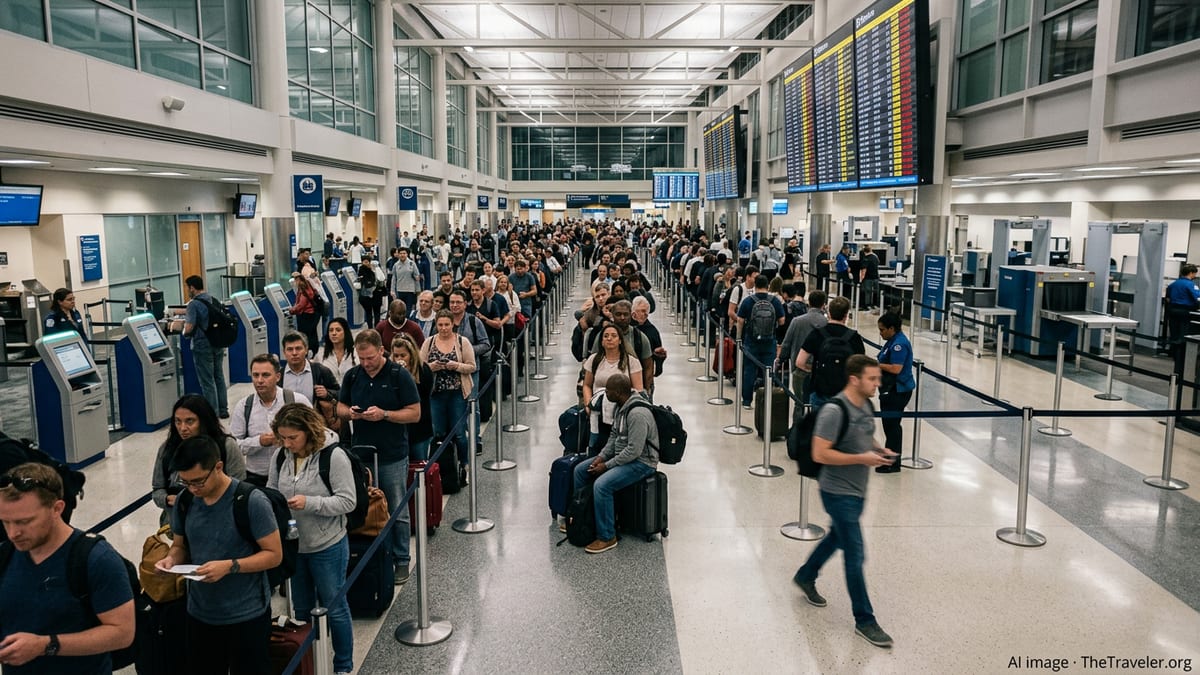
Local and national reports describe long lines forming at check in counters and rebooking desks as inbound and outbound passengers sought clarification. Visitors wrapping up convention trips and midweek vacations faced extended waits on concourses, while those arriving in Las Vegas during the stoppage often found their aircraft parked on remote stands until gates became available. Some travelers reported on social media that they were advised to expect several hours on board before being allowed to disembark.
Airport operations data referenced in aviation coverage show that Harry Reid International handles well over 500 departures on a typical busy day, many of them banked around afternoon and evening peaks. With new takeoffs frozen, aircraft that had already landed could not vacate gates as planned, which added a parking challenge to the traffic control issues. Ground handling crews were forced to juggle arriving jets, towing them to remote positions to free space for priority flights once the ground stop began to ease.
For visitors, that meant a sharp contrast to the city’s usual promise of nonstop action. Casino and resort districts only a short drive from the terminal remained busy, but a significant number of would be guests instead spent their evening in terminal seating areas, walking concourses, or searching airline apps for alternative routings that would get them home before the end of the weekend.
Ripple Effects: Missed Connections, Sports Travel and Weekend Plans
Because the ground stop applied nationwide, Las Vegas passengers were affected even on flights that technically originated elsewhere. Travelers attempting to connect through hubs such as Phoenix, Salt Lake City or San Francisco reported missed onward flights into Las Vegas, while those departing the city found that their destination airports had limited arrival slots available as controllers sequenced traffic.
Reports from sports and travel outlets highlight that multiple college football teams, some of which had planned to transit through Western hubs, faced uncertain arrival times. Conference organizers publicly acknowledged they were monitoring the situation and in at least one case adjusted kickoff times to account for delayed travel. While Las Vegas was not hosting a major college game tied directly to the disruption, fans connecting through the city to reach other stadiums were among those caught in the operational snarl.
Leisure travelers felt the impact in more familiar ways. Public information from consumer advocates and airline policy trackers notes that, in cases where the FAA orders a ground stop for safety reasons, the disruption is generally categorized as outside airline control. That classification means carriers are not required under U.S. rules to provide hotel rooms or meal vouchers, leaving many Las Vegas visitors to cover their own overnight expenses if a same day departure was no longer possible.
At the same time, airlines began issuing systemwide waivers that allowed passengers booked through the weekend to move their trips without additional change fees, subject to availability. For some Las Vegas visitors with flexible plans, that created an opportunity to shift departures to less congested time slots later in the weekend, although published accounts indicate that remaining seats on alternative flights filled quickly on many routes.
How the Ground Stop Fits Into FAA’s Modernization Struggle
The incident has again focused attention on the resilience of the U.S. air traffic system. Government accountability reports and recent technology coverage describe a patchwork of aging hardware and software that the FAA is working to replace over the remainder of the decade. A Government Accountability Office review released in 2024 found that more than one third of the agency’s 138 critical systems were categorized as unsustainable, with another large share flagged as potentially unsustainable without targeted investment.
Following the 2023 Notice to Air Missions outage, the Department of Transportation directed the FAA to establish a formal task force to strengthen that system and develop contingency tools that could keep safety information flowing even in the event of a main database failure. Subsequent technical documentation from the agency outlines a backup “candidate NOTAM” platform and plans to retire some of the oldest storage technologies in favor of centralized, cloud supported services by 2028.
Aviation analysts quoted across multiple outlets point out that while the latest disruption does not appear to involve the same system as the 2023 outage, it underscores the complexity of connecting modern flight tracking, radar and voice communications tools to decades old infrastructure. When one component fails in an environment that handles tens of thousands of daily movements, the safest short term option can be to slow or halt departures until technicians can verify that data is flowing and controllers have a clear picture of the skies.
For travelers in Las Vegas and around the country, that reality translates into a form of safety margin that is both reassuring and highly disruptive. In the wake of the ground stop, policy experts are again calling for clear public timelines on modernization projects and for closer coordination between the FAA, airlines and airport operators to reduce the likelihood that a single point of failure can strand passengers nationwide.
What Stranded Las Vegas Travelers Can Do Next Time
For visitors caught at Harry Reid International during this latest event, the experience serves as a real world case study in managing major air travel disruptions. Consumer travel guidance compiled after previous nationwide issues suggests several practical steps: confirm flight status directly through airline apps rather than relying solely on terminal display boards, register for text alerts, and, when possible, avoid checking bags until a confirmed departure time appears.
Publicly available advice from the U.S. Department of Transportation emphasizes that passengers are entitled to a cash refund if an airline cancels a flight or makes a significant schedule change and the traveler chooses not to proceed. That right applies regardless of the reason for the cancellation, including a federal ground stop, although additional compensation such as hotel stays remains at the airline’s discretion when the cause is outside carrier control.
Travel experts also recommend that visitors to major leisure destinations like Las Vegas consider booking flights earlier in the day, when there is more slack in the schedule to absorb delays, and leaving additional connection time when itineraries involve multiple segments. In the event of a nationwide issue, those cushions can make the difference between reaching a destination the same day or facing an unplanned night at an airport hotel.
While the FAA’s system modernization efforts continue, large scale ground stops are expected to remain rare. For the thousands of travelers whose Las Vegas plans were upended this weekend, however, the event is a reminder that even in a city built on calculated risk, the biggest gamble may be taking smooth skies for granted.