


São Paulo/Guarulhos International Airport (GRU) is Brazil’s busiest international gateway and a major South American hub. It has three passenger terminals that look close together on the map but feel far apart when you are jet-lagged, carrying bags, and worried about missing a connection. Understanding how Terminals 1, 2, and 3 actually work in real life can save you time, stress, and in some cases a missed flight.
Get the latest updates straight to your inbox!
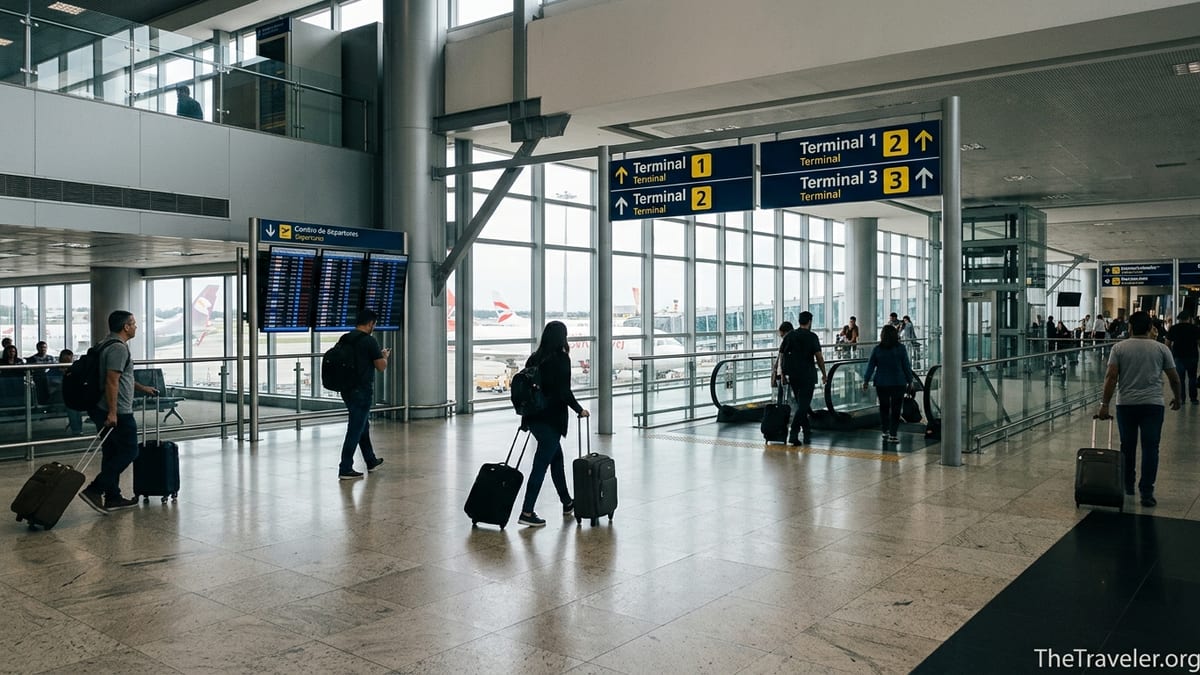
Overview: How GRU’s Three Terminals Really Work
Guarulhos has three passenger terminals in use today: Terminal 1, Terminal 2, and Terminal 3. They serve different mixes of airlines and routes, and they are not interchangeable. Terminal 1 is the smallest and serves mainly domestic low‑cost and regional flights. Terminal 2 is the workhorse for most domestic traffic and many regional international services within South America. Terminal 3 is the flagship long‑haul international terminal, used by most intercontinental airlines and premium carriers.
Physically, the terminals sit in a line along the same access road, but airside they are separated. You cannot simply stroll from a domestic gate in Terminal 1 to an international gate in Terminal 3 without exiting, taking the shuttle or people mover, and then going through security again. In practice, that means your checked baggage and boarding pass determine which building you need to be in, and you should always confirm your terminal on your booking, airline app, or departure screens before you get in a taxi or rideshare.
The airport operator and airlines occasionally reassign flights between terminals during renovations or seasonal peaks. For example, GOL has advised that some international flights may depart from Terminal 3 during works in Terminal 2. That means the information below is a reliable guide, but you should still verify your exact terminal in the 24 hours before travel.
As a rule of thumb, think of Terminal 1 as “mostly Azul and some regional flights,” Terminal 2 as “the big domestic and regional workhorse with LATAM and GOL heavily present,” and Terminal 3 as “long‑haul international to North America, Europe, the Middle East, and beyond.” Once you know that, the rest of the airport layout starts to make sense.
Terminal 1: Compact Domestic Hub and Common Connection Trap
Terminal 1 is the smallest of the three terminals and serves a lower volume of passengers than Terminals 2 and 3. It is heavily used by Azul for domestic flights and by some low‑cost or regional carriers operating within Brazil and to nearby countries. Gates are mostly ground‑level, with remote stands that require a short bus ride to the aircraft, which is one reason some travelers describe it as more basic than the newer buildings.
In real life this matters most to connecting passengers. Imagine you arrive from New York on a LATAM flight into Terminal 3 and then connect to an Azul service to Porto Alegre from Terminal 1. After immigration and customs in Terminal 3, you must collect your checked luggage, exit into the public arrivals hall, walk or ride to the Terminal 1 area using the free shuttle or people mover, and then check in again with Azul. With lines, traffic around the terminals, and security screening, travelers often report that this process can easily take an hour or more.
Facilities in Terminal 1 are more limited compared with Terminals 2 and 3. You will still find basic cafés, convenience shops, and ATMs, but fewer brand‑name restaurants or large duty‑free options. Lounge availability is also more restricted, so frequent flyers sometimes choose routings that keep them in Terminal 2 or 3 if they plan longer layovers. On the plus side, security lines can be shorter at off‑peak times, and the compact layout means walking distances from check‑in to the gate are relatively short.
One frequent mistake is assuming that “all domestic flights are in Terminal 2” and going there by default. Many domestic Azul flights are in Terminal 1, and some travelers only realize this when they see “Terminal 1” printed on a departures screen or boarding pass. Correcting the mistake at the last minute involves rushing back outside, taking the shuttle, and sometimes missing bag‑drop cut‑off times. Always check your airline and flight number before you commit to a terminal.
Terminal 2: Main Domestic Workhorse and Regional International Hub
Terminal 2 is the busiest part of Guarulhos and handles a large share of Brazil’s domestic air traffic as well as many regional flights around South America. LATAM and GOL both have a strong presence here on routes such as São Paulo to Rio de Janeiro, Brasília, Salvador, and dozens of other Brazilian cities, along with regional destinations like Buenos Aires, Santiago, and Lima. For many Brazilians, Terminal 2 is the primary gateway to the rest of the country.
The terminal has multiple check‑in islands labeled by letters and two main pier areas for boarding, with separate sections for domestic and international departures. Within domestic operations, there is a wide range of aircraft sizes and boarding types, from jet bridges serving Airbus and Boeing narrow‑bodies to remote stands accessed by buses. Because of the mix of carriers and destinations, departure boards in Terminal 2 can look overwhelming at peak times, and lines at popular check‑in counters, particularly LATAM, are often long during morning and evening “bank” periods.
From a traveler’s point of view, Terminal 2 is where you will find the broadest range of services. There is a dense cluster of food outlets offering everything from quick espresso and pão de queijo to full meals at chain restaurants, plus pharmacies, mobile phone shops selling local SIM cards or eSIM support, currency exchange counters, and multiple VIP lounges. There are also paid rest areas and co‑working lounges in the public zone where passengers on long domestic layovers can shower or nap for a fee charged by the hour.
Terminal 2 is also where many intercity bus services depart, including buses to other cities in the São Paulo region and beyond. This makes it a practical starting point if you are landing in GRU and continuing your journey by road. However, the crowds and layout can be confusing. Travelers sometimes disembark from a domestic flight, follow the wrong corridor, and end up heading toward international connections instead of baggage claim. Watch the signs carefully, and if in doubt ask airport staff which direction leads to domestic arrivals baggage carousels for your airline.
Terminal 3: Long‑Haul International Gateway
Terminal 3 is the newest and most modern passenger terminal at Guarulhos. It was built to handle long‑haul international flights and to bring the airport up to the standard expected by global carriers and alliances. Today it hosts most services to North America, Europe, the Middle East, and some to Africa and Asia, operated by airlines such as LATAM on long‑haul routes, American Airlines, Delta, United, Air France, KLM, Emirates, Qatar Airways, and several European and regional partners.
The experience in Terminal 3 feels noticeably different from the older parts of the airport. Check‑in halls are higher and brighter, with large digital displays and dedicated premium check‑in areas for some airlines. After immigration and security, passengers enter a spacious duty‑free and retail zone with international brands, followed by branches of global coffee chains, sit‑down restaurants, and an array of airline and independent lounges. For instance, American Airlines operates its Admirals Club here, and there are premium independent lounges where walk‑in entry is possible for a fee or via lounge membership programs such as Priority Pass, depending on current policies.
From a practical standpoint, Terminal 3 is where almost all travelers arriving in Brazil on intercontinental flights will go through immigration and customs. That includes passengers who will then connect to domestic flights in Terminals 1 or 2. After landing, you will pass border control, collect your luggage, and pass customs inspection. Only then can you exit into the arrivals hall, where you decide whether to stay in Terminal 3, move to another terminal, or head into São Paulo. This is also the point where travelers changing from one ticket to another must re‑check bags with their next airline.
Because Terminal 3 caters to long‑haul flights arriving and departing in waves, lines for immigration, customs, and security can fluctuate dramatically. For example, arriving early in the morning when multiple flights from Europe land at similar times can mean longer waits. If your onward domestic connection is relatively tight, a delay at immigration followed by the need to change terminals and re‑check luggage can turn into a missed flight. Many experienced travelers flying into GRU on international services build at least three hours of connection time before any separate domestic ticket, especially when Azul flights in Terminal 1 are involved.
Domestic vs International: Who Flies Where and Why It Matters
At Guarulhos, domestic and international operations are split both by airline business models and by terminal design. Terminal 1 is overwhelmingly domestic, mainly serving Azul and a few additional carriers on internal Brazilian routes. Terminal 2 offers a mixture of domestic and shorter international flights within Latin America, especially by LATAM, GOL, and other regional airlines. Terminal 3 is designed around long‑haul international and alliance connectivity, with most flights crossing oceans or connecting major hubs.
This division matters whenever you plan a connection that crosses the domestic and international boundary. For example, a traveler flying from Porto Alegre to São Paulo on Azul and then continuing to Toronto on a separate ticket with an international airline will likely arrive in Terminal 1, then need to transfer to Terminal 3 and check in again for the long‑haul flight. Even with carry‑on only, they will still face security screening in Terminal 3, and with checked baggage they must complete the full process of bag drop and document checks.
Another common scenario is a domestic connection after an international arrival. A passenger flying from Miami to São Paulo on American Airlines will land at Terminal 3, clear immigration and customs, and then connect to a LATAM or GOL domestic flight in Terminal 2. If both flights are on a single ticket and interline baggage rules apply, bags may be tagged through to the final destination but will still usually need to be picked up at GRU for customs inspection before being handed back to the airline at a special re‑check desk. That process adds time and requires walking through the arrivals hall to the domestic check‑in area.
Regional international flights within South America can depart from either Terminal 2 or Terminal 3 depending on the airline. For example, certain flights to Buenos Aires, Santiago, or Lima may leave from Terminal 2 with carriers that focus on regional connectivity, while long‑haul connections to Europe or North America remain concentrated in Terminal 3. The practical takeaway is that the label “international” alone does not tell you which building you need. Only your specific airline and route combination will do that.
Transfers Between Terminals: Times, Routes, and Realistic Connections
Moving between terminals at GRU is straightforward in theory but can take longer than many travelers expect. The airport now offers a people mover service, often referred to locally as the AeroGRU or airport train connection, that links the airport complex with the nearby metropolitan rail station. It also connects the terminals themselves in a loop that includes Terminals 1, 2, and 3, in addition to the train station. Operating hours, which have recently included late afternoon to midnight service, can change, so check the latest schedule if you plan to rely on it.
For most passengers, the more common option remains the free shuttle bus that circulates between the terminals and the airport train station. This bus typically follows a loop such as Train Station to Terminal 1 to Terminal 2 to Terminal 3 and back. In light traffic, the ride between adjacent terminals may take around 5 to 10 minutes, but at busy times and during construction works you should allow significantly more. Many travelers report that the entire process of waiting for the bus, boarding with luggage, and navigating traffic between Terminal 3 and Terminal 1 can easily stretch to 30 minutes or more.
Walking between terminals is technically possible between Terminals 2 and 3 via pedestrian routes, but distances are longer than they appear on a map, and you are still outside security, so this is not a true airside connection. With heavy luggage or in bad weather, the shuttle or people mover is more realistic. Terminal 1, which sits slightly apart and relies more heavily on bus access, is the most inconvenient of the three for those making tight connections.
When deciding if a connection is feasible, base your calculations on the slowest realistic path, not the best‑case scenario. A domestic‑to‑domestic connection within Terminal 2, on a single ticket and with hand luggage only, might be comfortable with 60 minutes. By contrast, an international arrival into Terminal 3 with full immigration and customs, followed by a terminal change and domestic check‑in with Azul in Terminal 1 on a separate ticket, can require well over two hours, and even that can be tight in peak periods. If you are risk‑averse, especially with separate tickets, build in three hours or more.
Baggage Claim, Re‑Check, and Immigration: What Actually Happens
Baggage procedures at GRU vary depending on whether you are arriving from abroad or from within Brazil, and whether your onward flight is on the same ticket. For purely domestic journeys, such as Recife to São Paulo to Porto Alegre all on one airline in Terminal 2, your bags are usually checked through to your final destination. You simply collect them at the end of your journey from the domestic baggage claim carousel indicated for your flight.
International arrivals are more complex. Almost all passengers arriving from outside Brazil will collect luggage in the terminal where they land, usually Terminal 3 for long‑haul, and pass through customs with it. Even when your bag tag shows a final domestic destination, Brazilian regulations typically require that bags be claimed at the first point of entry for customs inspection. After exiting the customs area, if your onward domestic flight is on the same through‑ticket, your airline will normally direct you to a transfer or re‑check counter where bags are accepted again without needing to queue in the main check‑in lines. However, these counters may have specific opening hours and may not operate around the clock.
On separate tickets, the process is less forgiving. A traveler who buys a promotional international fare to São Paulo on one airline and then a low‑cost domestic ticket on another must usually treat GRU as a complete stop. After customs, you take your bags into the public area, find the check‑in desks for your domestic carrier in the relevant terminal, and queue as any origin passenger would. If a delay in immigration or baggage claim pushes you past the bag‑drop closing time for your domestic flight, the second airline will generally treat you as a no‑show, and any goodwill rebooking will depend on its policies and staff discretion.
Because of these realities, experienced travelers often make very conservative assumptions about baggage and terminal changes at GRU. Anecdotally, people describe times ranging from under an hour to nearly two hours between leaving an aircraft and reaching a domestic check‑in desk, depending on lines, time of day, and random factors such as how quickly bags appear on the carousel. If you must make a self‑connection, assume the slower end of that spectrum and build a generous safety margin into your itinerary.
Common Wrong‑Terminal Mistakes and How to Avoid Them
Despite clear signage, some of the most stressful moments at Guarulhos happen before passengers even enter the correct building. Taxi and rideshare drivers often ask “Terminal 2 or 3?” out of habit, because those are the busiest, and travelers unfamiliar with GRU sometimes pick one at random, assuming it will be easy to switch later. That assumption can be costly when bag‑drop deadlines are close.
One frequently reported mistake is arriving at Terminal 2 with a domestic Azul ticket that actually departs from Terminal 1. Passengers walk into the bustling Terminal 2 hall, search in vain for Azul check‑in counters, then only realize the error when they check a departure board more carefully. By the time they reach Terminal 1 by shuttle bus and locate the correct counter, check‑in may be closed. A similar problem arises when travelers see “Guarulhos” printed prominently on their ticket and overlook the small “T3” or “Terminal 3” notation that indicates their actual gate area.
Another issue involves misinterpreting domestic versus international labels. Some regional flights within South America leave from Terminal 2, while most long‑haul international routes use Terminal 3. A traveler might assume that any flight crossing a border means Terminal 3, show up there with a ticket for a regional service in Terminal 2, and lose valuable time moving back across the airport. Because both airside zones are secure and separated, there is no quick shortcut once you are in the wrong place.
The most reliable way to avoid these problems is to verify your terminal in three independent places: your booking confirmation or e‑ticket, your airline’s app or website on the day of travel, and the airport’s departure boards or information service when you arrive at GRU. If any of these show a change in terminal, trust the most recent information. When in doubt, ask airline staff or the official information desk rather than relying on generic online maps or old blog posts, which may not reflect current construction or temporary relocations.
The Takeaway
Guarulhos International Airport can feel intimidating at first glance, but its logic becomes clearer once you understand the roles of each terminal. Terminal 1 is small and focused on domestic and regional operations, especially for Azul. Terminal 2 is the busy, mixed‑use hub for most domestic services and several regional international flights, dominated by LATAM and GOL. Terminal 3 is the modern long‑haul international gateway, where most passengers entering or leaving Brazil on intercontinental routes will start or end their journeys.
The key to a smooth experience is to know your exact terminal and airline in advance, build realistic time buffers for any connection that involves changing terminals or clearing immigration and customs, and be prepared for the possibility that temporary construction or operational changes may shift some flights between Terminals 2 and 3. Use the free shuttle or people mover, follow signage carefully, and do not hesitate to ask staff if anything looks unclear.
If you treat GRU as three related but distinct airports sharing the same address, you will be less likely to end up in the wrong building, miss a bag‑drop cut‑off, or sprint through crowded concourses with minutes to spare. With a bit of preparation and situational awareness, São Paulo’s main hub becomes a manageable, if busy, gateway to Brazil and the wider region.
FAQ
Q1. How can I find out which terminal my flight uses at Guarulhos?
Check your booking confirmation, your airline’s app or website within 24 hours of departure, and the airport’s departure boards when you arrive. The terminal is usually printed next to the flight number and destination; if you still are not sure, ask airline staff at any information counter.
Q2. How long does it take to transfer between terminals at GRU?
In light traffic, the shuttle or people mover between adjacent terminals can take around 10 to 15 minutes, but you should allow at least 30 to 45 minutes door to door, especially between Terminals 1 and 3. This includes waiting for the shuttle, walking inside each terminal, and passing security again if you are entering the departures area.
Q3. Is one hour enough to connect from an international flight in Terminal 3 to a domestic flight?
One hour is generally not enough, especially if you need to clear immigration, collect your luggage, pass customs, change terminals, and re‑check bags. For a safe connection, particularly on separate tickets, plan for at least two to three hours between scheduled arrival in Terminal 3 and departure on a domestic flight.
Q4. Which terminal do Azul, GOL, and LATAM usually use?
Azul primarily uses Terminal 1 for its domestic flights at GRU. GOL and LATAM are heavily present in Terminal 2 for domestic and some regional international routes, while many long‑haul LATAM flights operate from Terminal 3. Operational changes can occur, so always confirm your specific flight in advance.
Q5. Can I walk between Terminals 2 and 3 instead of taking the shuttle?
Yes, there are pedestrian routes between Terminals 2 and 3 in the public area, but distances are longer than they appear on a map, and you are still outside security. For travelers with heavy bags, limited mobility, or tight connections, the free shuttle or people mover is usually more practical.
Q6. Do I have to collect my luggage at GRU if I am connecting from an international to a domestic flight?
In most cases, yes. Brazil generally requires passengers to collect checked luggage at their first point of entry for customs inspection, even when the bag tag shows a final domestic destination. After customs, you hand your bag back at a transfer desk or regular check‑in counter, depending on your ticket and airline.
Q7. Are there good food and lounge options in all three terminals?
Terminal 2 and Terminal 3 offer the widest range of food outlets, from quick snacks to sit‑down meals, as well as multiple airline and independent lounges. Terminal 1 has more limited choices but still provides basic cafés and shops. If you value lounge access or a broad selection of restaurants, try to plan longer layovers in Terminals 2 or 3.
Q8. What should I do if I arrive at the wrong terminal?
Stay calm and check the nearest departure screen to confirm where your flight really departs from. Then follow signs to the free terminal shuttle or people mover, or ask staff for the quickest route. If bag‑drop time is close, go straight to your airline’s counter at the correct terminal and explain the situation; they may still be able to accept your bag or rebook you if you miss the flight, depending on availability and fare rules.
Q9. Is it safe to book separate tickets with a connection at GRU?
Many travelers do this, but it carries more risk than a single through‑ticket. If your first flight is delayed and you miss the second, the onward airline is not always obliged to rebook you. If you choose separate tickets, especially when changing terminals or switching between international and domestic services, build in at least three hours, and consider travel insurance that covers missed connections.
Q10. How early should I arrive at Guarulhos before my flight?
For domestic flights, arriving about two hours before departure is usually sufficient, though three hours is safer at peak times or during holidays. For international flights from Terminal 3, plan on arriving three hours ahead, and consider adding extra time if you need to return a rental car, check in special baggage, or navigate between terminals before reaching your airline’s check‑in area.