


Dolmabahçe Palace is one of Istanbul’s most impressive landmarks, sitting right on the Bosphorus between Kabataş and Beşiktaş. It combines late Ottoman glamour with a deeply personal connection to modern Turkey, since Mustafa Kemal Atatürk used it as his Istanbul residence. This guide brings together the latest information on tickets and opening hours, explains what to see inside, and shows you how to turn a palace visit into a relaxed walking day around Beşiktaş with good coffee, food and waterfront views.
Get the latest updates straight to your inbox!
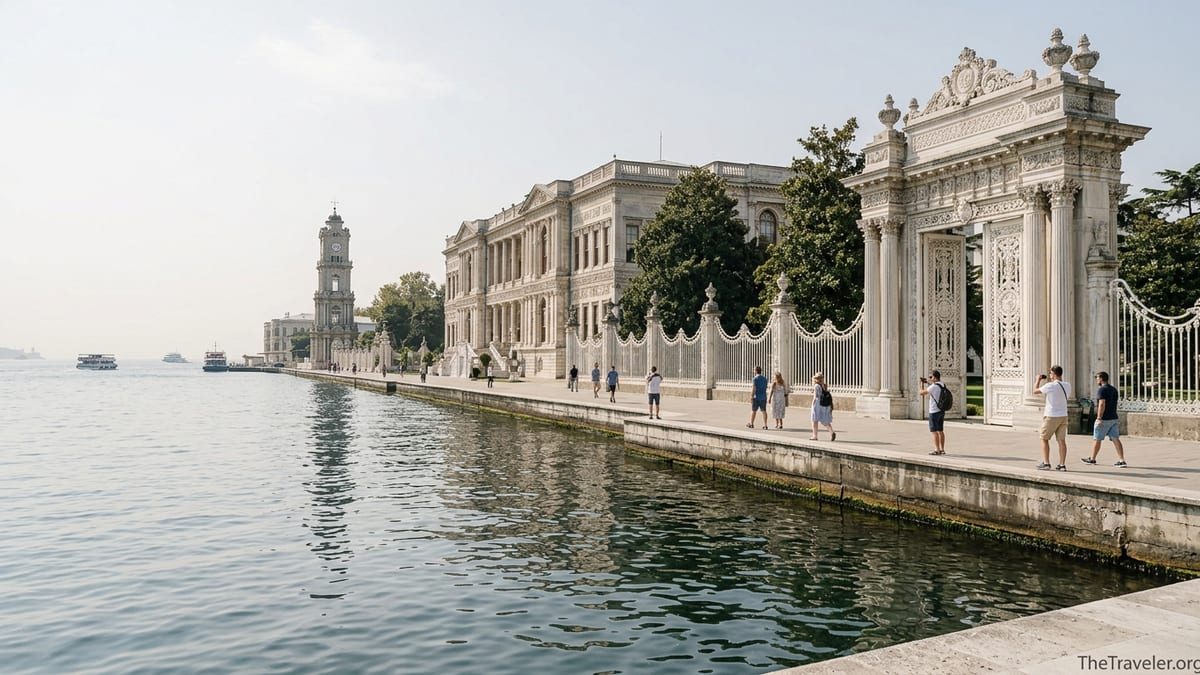
Where Dolmabahçe Palace Sits on the Bosphorus
Dolmabahçe Palace lies on the European shore of the Bosphorus, just north of the Kabataş tram and ferry hub and south of central Beşiktaş. The long waterfront facade, with its ornate gates and clock tower, runs parallel to the main coastal road that continues on toward Ortaköy and Bebek. For most visitors staying in Sultanahmet or Karaköy, it is one of the easiest major sights to reach without needing a taxi.
If you arrive by tram, the T1 line ends at Kabataş. From there, the palace entrance is a flat five to ten minute walk along the water, passing ferry piers and small kiosks until you reach the ornate main gate. Many travelers also walk downhill from Taksim through Gümüşsuyu in about twenty minutes, or follow the shore from Karaköy in roughly twenty to twenty five minutes, which offers a relaxed introduction to the Bosphorus.
The palace sits just below Beşiktaş’s stadium and transport hub, so you can easily combine it with time in Beşiktaş Çarşı, the lively market district, or continue north on foot toward Ortaköy. The location makes Dolmabahçe an ideal starting point for a day focused on Istanbul’s European waterfront rather than crisscrossing the city.
Because the complex is long and narrow along the water, most of the walking inside is on a single axis. You will move from the entrance and ticket area through gardens, into the main Selamlık wing, and then either out to the Bosphorus terrace or onward to the Harem and Painting Museum, depending on your ticket.
Opening Hours and When to Visit
Dolmabahçe Palace is managed by Turkey’s National Palaces administration, and at the time of writing it normally opens from around 9 am until late afternoon, with final entry usually one to two hours before closing. The palace is closed one day per week, which in recent years has generally been Monday. Times can shift slightly with seasonal changes or public holidays, so it is worth checking the official Dolmabahçe information page the week you travel or asking your hotel to confirm the closing day.
In practice, crowds peak between about 10:30 am and 2:30 pm, especially in spring and autumn when international tour groups are most active. If you prefer a quieter visit and cooler rooms, aim to arrive just before opening. Independent travelers who reach the ticket area between 9 am and 9:30 am often report moving through the Selamlık halls in a calmer flow, with more space to look at details like the Crystal Staircase or the giant Bohemian crystal chandelier in the Ceremonial Hall.
Late afternoon can also be pleasant, particularly in summer when the light softens over the Bosphorus. However, you must watch the last entry time carefully. Security staff will stop new visitors at the gate once the daily limit is close to capacity or final admission time has passed. On busier Saturdays and Sundays in April, May, September and October, it is wise not to leave your visit until the last hour.
Try to avoid arriving on major national holidays or during the middle of large international events in Istanbul, when both domestic visitors and tour groups swell the lines. On those days, even entering the grounds can involve a long queue at security and the ticket booths, and you may end up shuffling through the main halls in a dense crowd.
Tickets, Prices and Museum Pass Rules
Ticketing at Dolmabahçe Palace can be confusing because there are separate sections and various cards on offer in Istanbul. As of mid 2026, foreign visitors typically face a set of palace specific ticket options rather than a single citywide pass. There is usually a combined ticket that covers the main Selamlık section, the Harem and the Painting Museum at a single price, plus occasional special tickets or guided packages sold by tour agencies.
The most important point is that the popular Museum Pass Istanbul and Museum Pass Turkey, which cover many Ministry of Culture museums such as Topkapı Palace’s main courtyards and the Archaeology Museums, are generally not valid for Dolmabahçe Palace’s main Selamlık wing. Some passes have limited validity for certain National Palaces sections like the Harem or Painting Museum, but at Dolmabahçe itself you should expect to buy a dedicated ticket at the official ticket booths or via the National Palaces online system.
Prices for foreign visitors have been adjusted several times in recent years to keep pace with inflation, so you will see older guidebooks quoting figures that may be far below what you pay in 2026. Use any printed prices you see online only as a ballpark reference, and rely on the official Dolmabahçe ticket page or the signboards at the entrance for the current rate in Turkish lira. Card payment is widely accepted at the ticket windows, which is convenient if you are trying to conserve cash.
If you are planning to visit several National Palaces sites such as Beylerbeyi Palace, the Beykoz Glass and Crystal Museum or the small pavilions along the Bosphorus, investigate whether a National Palaces combined pass is available during your dates. Travelers who visit three or more of these landmarks within a few days often find that a combined pass works out cheaper than buying individual tickets, although exact savings depend on current pricing.
Inside Dolmabahçe: Selamlık, Harem and Painting Museum
The main palace building has three principal parts: the Selamlık (also called the Mabeyn), which housed the official state rooms and reception halls; the Muayede or Ceremonial Hall, where formal events were held; and the Harem, which contained the private living quarters of the sultan and his family. Modern visitors experience these as the Selamlık tour route and the separate Harem section, often linked by a long corridor within the building.
The Selamlık is usually the first part you see. After passing through the Medhal Hall, you move into a series of increasingly ornate rooms where grand staircases, crystal balustrades and gold leaf are everywhere. The famous Crystal Staircase and the monumental Ceremonial Hall, with its enormous chandelier and soaring dome, are highlights. This side of the palace feels like a stage for imperial diplomacy, with many European style details that reflect the 19th century Ottoman desire to align with Western courts.
The Harem has a different atmosphere. Rooms are smaller in scale and feel more intimate, with spaces such as the Blue and Pink halls, the Valide Sultan’s apartments, the suites of the sultan’s wives and princes, and Atatürk’s bedroom, where the clocks are stopped at the hour of his death in 1938. This section helps you imagine daily life inside the palace and gives a stronger sense of the people who lived here, beyond the ceremonial glamour.
Next door, the Painting Museum occupies a separate but adjacent building within the Dolmabahçe complex. It holds one of the most important collections of 19th and early 20th century paintings in Turkey, including works that show the Ottoman court’s growing interest in European art. Some visitors choose to begin with the Painting Museum to get an overview of the art and then enter the main palace, while others treat it as a quieter stop at the end of their visit when crowds in the main halls are heavier.
Practical Crowd, Security and Photography Tips
Security at Dolmabahçe Palace starts at the outer gates, where bags pass through X ray machines and visitors walk through metal detectors. This first checkpoint can form a visible queue on weekends and high season mornings, so allow extra time if you are on a tight schedule. Large suitcases are not allowed inside and can make your entry slower, so it is better to come with a small daypack.
Inside the palace building, movement is generally one way along roped routes. In peak hours, you may advance slowly through the Selamlık halls in a line of visitors. To make this more comfortable, wear light, breathable clothing in summer and comfortable shoes, since the floors are hard and you are unlikely to find places to sit. If you have mobility concerns, ask at the entrance about accessible routes and whether any parts of the palace are off limits due to stairs.
Photography rules are strictly enforced in the interior rooms. In recent years, taking photos and videos inside the main palace halls has frequently been prohibited, or allowed only in limited areas, to protect the collections and keep traffic moving. Staff will often ask visitors to put phones away and can be quite firm if they see people filming. Plan to experience the rooms with your eyes rather than your camera, and save your photography for the exterior courtyards, gardens, Bosphorus terrace and the clock tower area, where photos are normally allowed.
To avoid the densest crowds, arrive near opening time, move briskly through the ticket area, and complete the Selamlık first. If you have a combined ticket, you can then slow down in the Harem and Painting Museum, which are often a little less congested than the main state rooms. Weekdays in winter and early spring usually see fewer tour buses, so if your dates are flexible and you are sensitive to crowds, plan Dolmabahçe for one of those quieter days.
Nearby Cafés, Palace Tea Gardens and Beşiktaş Walking Route
Within the palace grounds, there is usually at least one café or tea garden where you can sit close to the water with views across the Bosphorus to Üsküdar and Kadıköy. Prices are higher than in the backstreets of Beşiktaş, but many travelers find it worthwhile to enjoy a tea, Turkish coffee or simple dessert in such a setting. The palace cafés tend to serve classic options like Turkish tea in small glasses, Turkish coffee, soft drinks and light snacks or cakes.
Just outside the palace, the walk toward Beşiktaş takes you past the modern stadium, small parks and a cluster of local businesses. In Beşiktaş Çarşı, the dense market area around Barbaros Square and the ferry piers, you will find many casual breakfast spots and third wave coffee shops. Places change names and ownership fairly often, but you can expect to find Turkish breakfast plates with eggs, cheeses, olives and simit, as well as specialty coffee bars on side streets leading inland.
A simple half day route might start at Karaköy, follow the shore past Kabataş to Dolmabahçe for a morning palace visit, then continue on foot to Beşiktaş for lunch in the market streets. From there you could either climb up toward Yıldız Park for greenery and city views, or keep walking along the waterfront road to Ortaköy for its famous mosque and kumpir baked potatoes by the water. Travelers who like longer walks sometimes extend this route even further to Arnavutköy and Bebek along the Bosphorus.
If you are staying in the historic peninsula around Sultanahmet or in the Fatih district, you can still use this Beşiktaş oriented day without much effort. Take the T1 tram to Kabataş in the morning, walk to Dolmabahçe, then end your day in Beşiktaş or Ortaköy and return by bus or a combination of ferry and tram. This allows you to experience a more local, less touristy part of the city after the formality of the palace.
Is Dolmabahçe Palace Worth Visiting?
Dolmabahçe Palace is widely considered one of Istanbul’s must see sights, especially for travelers interested in Ottoman history, architecture or the story of modern Turkey. Compared with Topkapı Palace in the historic peninsula, Dolmabahçe offers a more unified 19th century European style interior, with dense decoration and large ceremonial spaces that feel closer to palaces in Vienna or Saint Petersburg. Many visitors describe it as the most visually spectacular palace they see in Turkey.
The palace is also deeply connected to Mustafa Kemal Atatürk, founder of the Turkish Republic. He used Dolmabahçe as his official Istanbul residence, and he died in one of the Harem bedrooms in November 1938. Seeing this room and the stopped clocks often adds emotional weight to a visit, especially for Turkish visitors and those who have read about the early republican period.
On the other hand, Dolmabahçe can feel overwhelming if you are not particularly interested in palaces or interior decoration. The visit follows a fixed route with little opportunity to wander, and the no photography rules inside mean you must be content to simply look. Ticket prices for foreign visitors are relatively high compared with some other Istanbul attractions, and in peak season the crowds can be intense.
As a rule of thumb, Dolmabahçe is very much worth visiting if you enjoy architecture, history, or grand interiors, and if you are planning at least three full days in Istanbul. For ultra short stays of one or two days, you may prioritize the core historic peninsula sights first. For repeat visitors, combining Dolmabahçe with a slow Bosphorus side walking day through Beşiktaş, Ortaköy and beyond can offer a fresh perspective on the city after earlier trips focused mainly on Sultanahmet.
Planning Your Visit: Timing, Clothing and Nearby Logistics
Plan to spend at least two to three hours inside the Dolmabahçe complex if you have a combined ticket for the Selamlık, Harem and Painting Museum. Travelers who linger over details or take a break at the palace café can easily extend this to half a day. Allow additional time for security, ticketing and any queues, especially in busy months. If you want to fit in another major sight the same day, pairing Dolmabahçe with a Bosphorus cruise from nearby Kabataş or with a relaxed afternoon in Beşiktaş generally works better than trying to add multiple museum visits across town.
Inside the palace, floors can be polished and slightly slippery, so wear comfortable, non slippery shoes. In summer, interior rooms can feel warm despite high ceilings, and the walk between sections may expose you to full sun, so light clothing, sunscreen and a hat are helpful. In winter, the Bosphorus wind can make the palace gardens feel colder than the inland streets, so bring an extra layer even if the city center feels mild.
Food options immediately around the palace are decent but not exceptional, with a mix of fast food outlets and small eateries along the main road. For a more atmospheric meal, plan either a simple tea or coffee within the palace grounds followed by a proper breakfast or lunch in Beşiktaş Çarşı, or save your appetite for Ortaköy’s waterfront cafes later in the walk. Public toilets are available inside the palace complex; it is wise to use them before you leave, as options on the street can be limited or require small cash payments.
Finally, keep in mind that Dolmabahçe is an active national heritage site. Sections may occasionally close for restoration, state events or security reasons. If seeing a specific area, such as the Harem or Painting Museum, is essential for you, check the official announcements close to your travel dates or ask at the ticket window if any parts of the complex are closed on the day of your visit.
FAQ
Q1. What are the current opening hours of Dolmabahçe Palace?
The palace generally opens in the morning around 9 am and closes in the late afternoon, with last entry typically one to two hours before closing. Hours and the weekly closed day can change, so always confirm on the official Dolmabahçe or National Palaces information page for the exact times during your visit.
Q2. Is Dolmabahçe Palace open on Mondays?
In recent years, Dolmabahçe Palace has usually been closed one day each week, most often on Monday. However, operational days may shift around public holidays or special events, so check the official schedule shortly before your trip instead of relying on older guidebooks.
Q3. How much does it cost to visit Dolmabahçe Palace?
Ticket prices for foreign visitors have been updated frequently due to inflation, and older sources often list outdated figures. Expect to pay a separate Dolmabahçe ticket in Turkish lira, with a higher price for a combined ticket that includes the Selamlık, Harem and Painting Museum. For the most accurate cost, refer to the price boards at the ticket office or the official online ticketing system shortly before your visit.
Q4. Is the Museum Pass Istanbul valid at Dolmabahçe Palace?
As of 2026, the popular Museum Pass Istanbul and Museum Pass Turkey are generally not valid for the main Selamlık section of Dolmabahçe Palace. Some passes may include access to certain National Palaces sections in limited ways, but you should plan to buy a dedicated Dolmabahçe ticket at the official ticket booths or online. Always double check current conditions, as pass rules can be revised.
Q5. How much time should I plan for a visit?
If you purchase a combined ticket for the Selamlık, Harem and Painting Museum, allow at least two to three hours inside the complex. This gives you time to move through security, follow the main route without rushing, and take a short break in the gardens or café. Travelers who like to read every panel or study the paintings in detail may want closer to half a day.
Q6. Can I take photos inside Dolmabahçe Palace?
Photography and video inside the palace interiors are often restricted or fully prohibited, especially in the Selamlık halls, to protect the collections and keep visitor flow moving. Staff members typically monitor visitors closely and may ask you to put cameras and phones away. Exterior areas such as the gardens, waterfront terrace and clock tower zone are usually more relaxed, and many visitors take photos there instead.
Q7. What is the best way to get to Dolmabahçe Palace by public transport?
The simplest route for most visitors is to take the T1 tram to its Kabataş terminus, then walk five to ten minutes along the Bosphorus to the palace gate. From Taksim, you can either walk downhill through Gümüşsuyu in roughly twenty minutes or use the funicular to Kabataş and continue on foot. Ferries to Kabataş and Beşiktaş also work well if you are staying in areas like Kadıköy or Üsküdar on the Asian side.
Q8. Is Dolmabahçe Palace suitable for children and families?
Families with children do visit Dolmabahçe, and the grand interiors and enormous chandelier can be memorable for older kids. However, the route is linear and can feel slow and crowded, with limited opportunities to sit or move freely. Younger children may become restless, especially because touching exhibits and running are not allowed. Consider pairing the palace with time in nearby parks or along the Bosphorus so kids can burn off energy before or after the visit.
Q9. What should I wear when visiting Dolmabahçe Palace?
There is no strict dress code, but modest, comfortable clothing is recommended. Shoulders and knees do not need to be fully covered as in some religious sites, yet it is respectful to avoid very revealing outfits. Wear comfortable shoes with good grip, since floors can be polished and slightly slippery, and bring a light layer for the Bosphorus breeze, especially in cooler months.
Q10. Can I combine Dolmabahçe Palace with a Beşiktaş walking route?
Yes, Dolmabahçe is perfectly placed for a Beşiktaş and Bosphorus focused day. Many travelers visit the palace in the morning, then walk north past the stadium into Beşiktaş Çarşı for lunch in the market streets and coffee at a local café. From there, you can continue along the coast to Ortaköy, or head uphill to Yıldız Park for greenery and views. This route gives you both imperial history and everyday city life in a single, walkable itinerary.