


More news on this day
Travelers using Singapore Changi Airport are facing renewed disruption as Gulf Air, Qatar Airways and other carriers cancel or reshape a cluster of key routes linking the city-state to Bahrain, Doha and Manila, prompting warnings of further schedule volatility in the weeks ahead.
Get the latest news straight to your inbox!
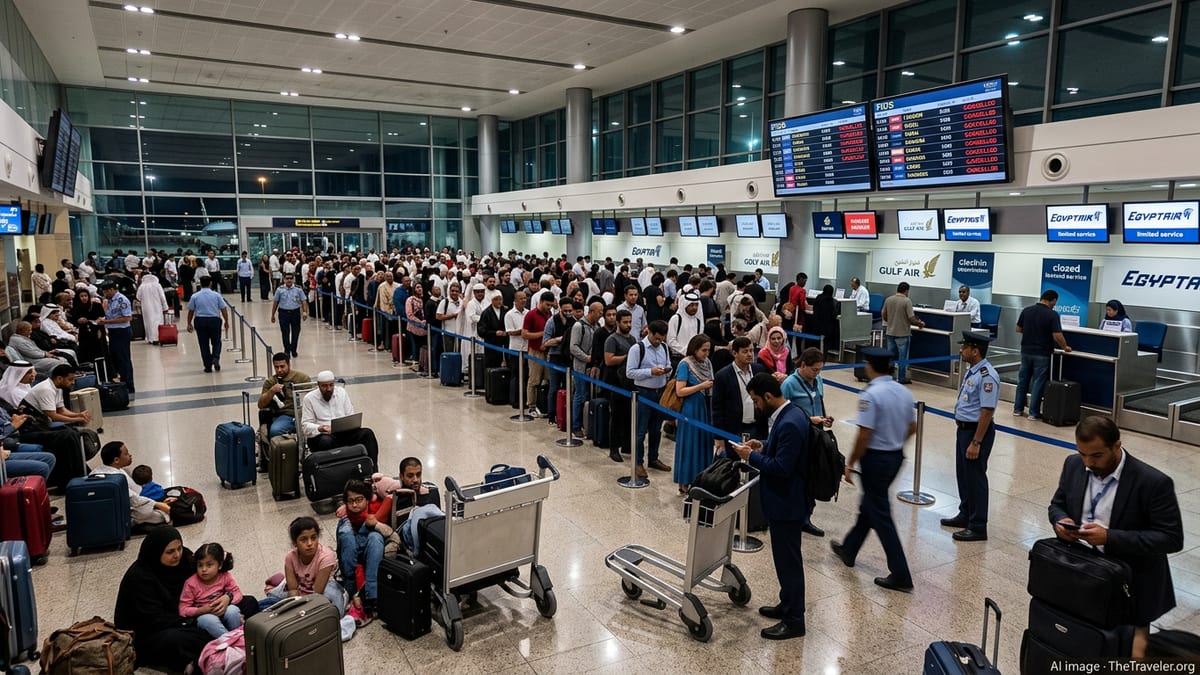
Seven Key Flights Pulled From Schedules at Short Notice
Publicly available schedule data and flight-tracking platforms show that at least seven regular services touching Singapore have been removed or repeatedly cancelled in recent days, concentrating the impact on links to Bahrain, Doha and onward connections to Manila. Gulf Air’s Singapore–Bahrain pairing, previously the only nonstop option between the two cities, has seen its GF165 and GF166 rotations cut back or suspended on multiple dates, leaving gaps in what had been a daily or near-daily pattern.
On the Qatar Airways side, reports indicate that several Doha–Singapore frequencies, including services marketed around the QR947 pairing, have been temporarily withdrawn or downgraded from daily to more limited operation. These adjustments reduce the number of one-stop options from Singapore to the Gulf and to European destinations that rely on Doha as a hub, particularly for itineraries continuing to the Middle East and beyond.
At the same time, regional and Philippine operators have trimmed or cancelled select Singapore–Manila flights that connect via Gulf hubs, eroding a web of routings that previously allowed travelers to move between Singapore and Manila using Bahrain or Doha as intermediate points. Combined, these moves amount to a sharp reduction in available seats on what are normally high-demand corridors for business travel, migrant workers and leisure passengers.
Airspace Closures and Operational Pressures Behind the Cuts
The latest wave of cancellations comes in the wake of airspace closures and security-related restrictions affecting parts of the Gulf region earlier this year. Industry coverage and airline advisories describe how those events triggered wide-ranging detours, extended flight times and an initial round of mass cancellations, particularly for services traversing Bahrain’s airspace and key corridors around Doha.
As airspace has gradually reopened, airlines have been working to rebuild schedules, but the process has not been uniform. Gulf Air has focused on phased restoration from its Bahrain hub, with some long-haul links, including Singapore, reappearing only to be pulled again as fleet availability, demand forecasts and routing constraints are reassessed. Travel industry monitoring suggests that these stop-start resumptions have left core markets vulnerable to further tactical cuts.
Qatar Airways, meanwhile, has publicized a broader network rebuild and summer expansion, yet continues to flag that individual flights remain subject to change or cancellation in response to operational and regulatory conditions. Schedule changes affecting Singapore appear to be part of this fine-tuning, as the carrier balances its hub bank structure in Doha with evolving overflight permissions and aircraft utilization plans.
How Travelers to Bahrain, Doha and Manila Are Being Affected
The immediate impact for passengers in Singapore is a higher risk of last-minute disruption on journeys that previously relied on predictable Gulf connections. With Gulf Air’s nonstop Bahrain link curtailed and select Qatar Airways services from Doha reduced, many travelers bound for Bahrain or onward to Europe are being pushed onto alternative routings via Dubai, Abu Dhabi or other regional hubs, sometimes adding many hours and additional stops.
For those traveling between Singapore and Manila, the ripple effects are also being felt. Although direct Singapore–Manila flights continue to operate on several carriers, the loss or downgrading of Manila services that used Gulf hubs for one or both legs has narrowed options for passengers combining Southeast Asian and Middle Eastern itineraries. Migrant workers, in particular, may face higher fares and longer travel times when previously convenient Bahrain or Doha connections are no longer available on the desired dates.
Travel forums and booking data reviewed by analysts point to a growing number of cases where multi-sector tickets involving Gulf Air or Qatar Airways segments through Singapore have been partially cancelled, leaving passengers searching for last-minute alternatives. Some have reported rebookings offered on partner or rival airlines, while others have been left to claim refunds and arrange their own replacement travel at short notice.
Limited Clarity on When Full Service Will Resume
One of the biggest challenges for travelers and the wider industry is the limited visibility on how long the current pattern of cancellations will continue. Official schedules can show flights as operating weeks or months in advance, only for selected dates to be removed or marked as cancelled as the departure approaches. This has already occurred several times on the Singapore–Bahrain route and on Doha–Singapore services that feed long-haul networks.
Airline advisories reviewed in recent days continue to emphasize that timetables are subject to change for reasons ranging from airspace restrictions to broader operational considerations. Industry observers note that carriers are still recalibrating after the initial airspace crisis earlier in the year, and that spare aircraft capacity remains tight due to earlier disruptions and ongoing maintenance and delivery bottlenecks.
For now, analysts expect that Gulf Air will continue to treat Singapore as a variable long-haul destination rather than a guaranteed daily link until Bahrain’s hub operations fully stabilize. Qatar Airways, while operating a larger and more flexible network, is also expected to keep adjusting capacity on routes like Singapore in response to shifting demand and route profitability, which means further short-notice changes cannot be ruled out.
What Passengers Should Do Before They Fly
Given the heightened risk of disruption, travelers planning trips that involve Singapore, Bahrain, Doha or Manila are being advised by consumer advocates and travel industry commentators to monitor their bookings closely. Checking flight status regularly in the days leading up to departure, and again on the day of travel, can provide early warning of schedule changes that may not be immediately communicated through every sales channel.
Passengers with complex itineraries involving multiple carriers or separate tickets may face particular vulnerability if one segment is cancelled while others remain in place. In such cases, independent experts recommend reviewing fare rules and change conditions in advance, as well as considering travel insurance that explicitly covers missed connections or schedule disruptions outside the traveler’s control.
For those yet to book, a growing number of travel planners suggest considering routings that offer more than one daily frequency on the same city pair or hub, providing additional fallback options if a particular flight is pulled. In the current environment, flexibility in travel dates, willingness to consider alternative hubs and careful attention to booking conditions are emerging as key strategies for reducing the risk of being stranded when key Gulf and Manila-linked flights from Singapore are suddenly cancelled.