


I thought I knew what an "ancient civilization" was supposed to look like. In my mind it meant marble columns, desert pyramids, or mossy stone temples half-swallowed by jungle. That idea unraveled slowly, sunburned and wide-eyed, as I hiked through canyons and mesas in the American Southwest, tracing the homes and ceremonial spaces of the Ancestral Puebloan people. What I found in places like Bandelier, Hovenweep, Bears Ears, and Mesa Verde did more than fill in a gap in my historical knowledge. It completely changed how I think about complex societies, resilience, and what it means to live in balance with a harsh but beautiful landscape.
Get the latest updates straight to your inbox!
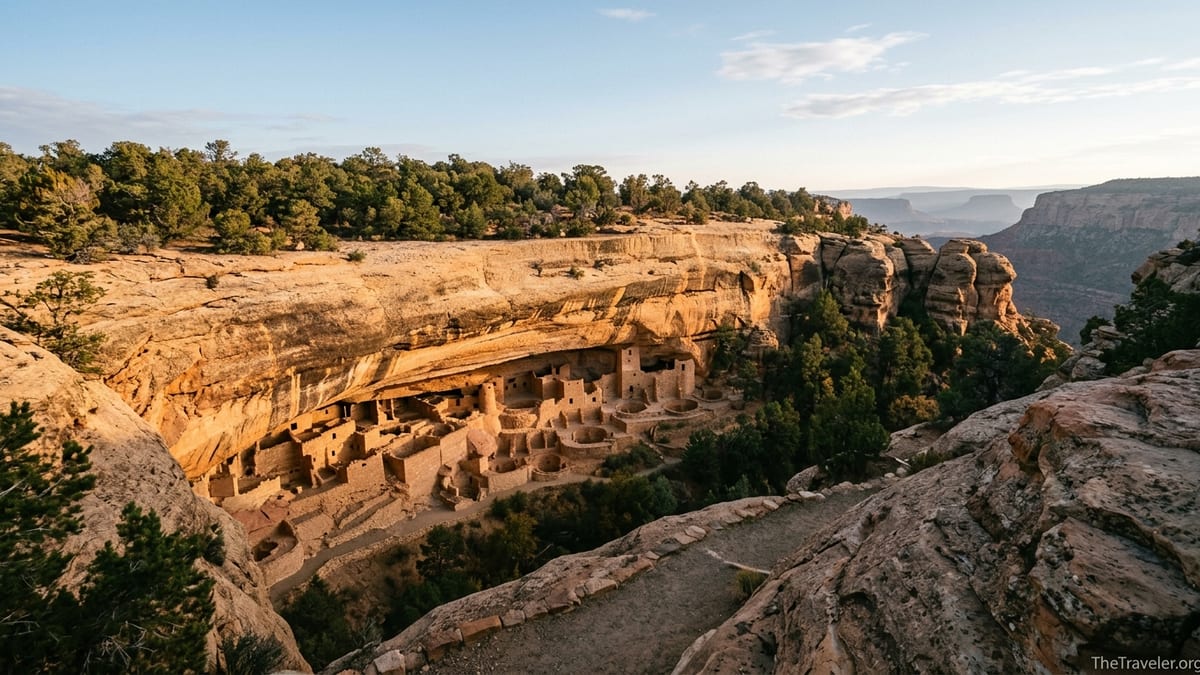
Meeting an Ancient Civilization in the American Southwest
The first time I stepped into an Ancestral Puebloan dwelling, it was not through a grand stone gate or a museum entrance. It was up a ladder, through a narrow opening in a soft volcanic cliff at Bandelier National Monument in northern New Mexico. The room I pulled myself into was small, smoke-stained, and unexpectedly intimate. A faint smell of dust and piñon drifted through the opening. Outside, the modern parking lot and ranger station felt suddenly very far away.
At Bandelier, the cliff faces of Frijoles Canyon are pocked with cavates, the carved-out rooms that once formed part of larger multi-story communities. Archaeologists estimate that Ancestral Pueblo people lived here from roughly the 12th to 16th centuries, building homes in the soft tuff rock and farming corn, beans, and squash on the mesa tops above. Walking the Main Loop Trail today, you pass not a single ruin but the footprint of an entire community: a large circular village called Tyuonyi at the canyon floor, rows of rooms etched into the rock, and high ladders leading to elevated dwellings that would have required both agility and trust to access.
Standing there, I realized that my old mental picture of ancient complexity had been far too narrow. These were not isolated huts on a lonely hillside. They were carefully planned villages tied into trade networks that stretched for hundreds of miles, part of a cultural world as sophisticated in its own way as any city of stone on another continent.
Stone Towers and Canyon Rims: Hovenweep’s Lesson in Adaptation
If Bandelier showed me the intimacy of daily life, Hovenweep National Monument on the Colorado–Utah border showed me something else: just how inventive Ancestral Puebloan architecture could be when pushed by terrain and climate. At Hovenweep’s Square Tower Group, a 2-mile loop trail runs along the rim of Little Ruin Canyon. The canyon itself is modest in scale, but its edges are crowded with stone towers that seem to grow out of the rock: Hovenweep Castle balanced on a promontory, Square Tower tucked deep in the canyon bottom, Twin Towers clinging near the rim like sentries.
Visitors today pay a modest national monument entrance fee or use an interagency pass, fill their water bottles at the small visitor center, and set out along a rock-lined path. Interpretive signs explain how, centuries ago, families here shifted from scattered farmsteads into more compact, defensible communities along canyon heads. The towers are not random curiosities. Many are carefully oriented, some likely used to store food, others as living or ceremonial spaces. A few show alignments with solstices and equinoxes, reinforcing that this was a culture intimately attuned to the movement of the sun in a landscape with few other navigational markers.
Before Hovenweep, I might have described ancient innovation in terms of inventions like the wheel or monumental stone blocks. After an afternoon tracing the curve of Little Ruin Canyon, I started to see technological genius instead in the perfect placement of a tower above a seep spring or the design of check dams that captured scarce rainwater. The engineering here is low-profile, embedded in the land, its success measured in centuries of corn harvests rather than in conquering armies.
Bears Ears and the Scale of an Ancestral Landscape
In Bears Ears National Monument in southeastern Utah, the idea of a singular “site” all but dissolves. Instead, you are traveling through a cultural landscape so dense with traces of past lives that you begin to look at every alcove and bench with new attention. Rock art panels appear beside dirt tracks; the curved wall of a masonry room peers from beneath a sandstone overhang; pottery sherds, which you must not disturb, glint quietly in the dust along a wash.
Bears Ears is managed jointly by federal agencies and a coalition of Native nations that trace ancestry to this region. The result, for a traveler, is a place where you are repeatedly reminded that these are not “ruins” in the purely archaeological sense but part of living stories and ongoing ties. Before heading down a canyon like Kane Gulch or exploring Butler Wash, you are asked to watch orientation materials, follow strict “visit with respect” guidelines, and often obtain permits for overnight trips. Rather than being inconveniences, these requirements reframed the experience for me. They emphasized that I was a guest in someone else’s ancestral home, not a treasure hunter in an open-air museum.
Spending several days camping on the mesa tops, driving slow dirt roads, and hiking to small, unnamed sites changed my sense of scale. I had grown up thinking of ancient history in terms of isolated wonders: a single pyramid, a single coliseum. Bears Ears taught me to think instead in terms of entire cultural landscapes that once functioned as continuous homelands. The cliff dwelling I visited in one canyon was not an anomaly; it was one node in a web that once connected farming plots, shrines, kivas, and gathering places stretching across much of the Colorado Plateau.
From Abandonment Narratives to Stories of Movement and Continuity
In textbooks, the story of the Ancestral Puebloans is often condensed into a single arc: people flourished in places like Mesa Verde and Chaco Canyon, then “mysteriously disappeared” after years of drought. Visiting the sites themselves complicates that tidy narrative. At Mesa Verde National Park in southwestern Colorado, ranger talks emphasize that the dramatic cliff dwellings you tour, like Cliff Palace and Balcony House, were occupied only for a few generations toward the end of a much longer history in the region. Before that, people lived on the mesa tops for centuries, building villages and tending fields that are far less photogenic but no less important.
Standing in the reconstructed Great Kiva at Aztec Ruins National Monument in New Mexico, or peering into a partially restored kiva at Mesa Verde, you feel continuity rather than disappearance. These circular ceremonial spaces echo those still used in modern Pueblo communities along the Rio Grande and elsewhere. The park signs and visitor center exhibits carefully note that many present-day Pueblo peoples consider these places part of their own migration histories. The “abandonment” often described in older literature is, from this perspective, a series of purposeful moves and adaptations, not an inexplicable vanishing.
That shift changed the way I look at ancient civilizations far beyond the Southwest. Instead of asking why people failed or disappeared, I now find myself asking where they moved, who their descendants are, and how their knowledge flowed into new places. It also made me more skeptical of narratives that paint complex societies as static until catastrophe strikes. On the ground, you see a long pattern of adaptation: fields shifted, villages moved from mesa tops into cliffs and canyons, regional centers rose and fell. The story is dynamic, not frozen in stone.
Everyday Life, Up Close: Bandelier, Navajo National Monument, and Beyond
In some of the best-known ancient sites around the world, tourists are often kept at arm’s length from the structures themselves. In the Southwest, access is still carefully managed, but there are places where you can step quite literally into the doorways of the past. At Bandelier, sections of the Main Loop Trail allow you to climb wooden ladders into small cavate rooms carved directly into the canyon wall. You see soot patterns above the old hearths and the impressions where roof beams once sat. Outside, the outlines of multi-room complexes spread across the canyon floor, their defining walls now only knee-high but still clearly organized around plazas and kivas.
At Navajo National Monument in northern Arizona, short trails lead to overlooks above two vast cliff dwellings, Betatakin and Keet Seel. In summer, with advance reservations, guided hikes descend into the canyons for closer looks at these multi-story sandstone cities tucked under overhangs. Rangers talk not in abstract about “ancient peoples” but about how water, sunlight, and seasonal winds informed every decision: where to plant fields on the mesa tops, how to orient rooms, how to store grain so that a multi-year drought could be survived.
Experiences like these chipped away at my earlier, romanticized ideas of ancient life as either primitively simple or overwhelmingly ceremonial. The grindstones and storage rooms, the turkey pens and small household kivas, were reminders that any complex civilization rests on thousands of daily acts: grinding corn before dawn, hauling water, maintaining check dams after a flash flood. Far from making these places feel less impressive, the evidence of daily labor made them more so. It is one thing to marvel at a great stone wall; it is another to imagine, grain by grain, the food that had to be grown to feed the hands that built it.
Traveling Responsibly in Living Cultural Landscapes
Coming away from these sites, I was struck by how much my behavior as a traveler mattered. On the ground, the difference between a respectful visitor and a careless one can be a single footprint or a hand on a fragile wall. In Hovenweep, for example, trails are lined with rocks not for decoration but as boundaries. Rangers explain that stepping off the path, even a few feet, can crush centuries-old architectural remnants or damage the thin biological soil crust that helps hold the desert together. At Bears Ears, you are asked not to share precise locations of sensitive sites online and to refrain from approaching or entering any structures, even if there is no rope or railing to stop you.
This experience changed how I think about visiting ancient places everywhere. Rather than assuming that a lack of signage means “access allowed,” I have learned to see it as a moment to pause. Is this a burial site? A shrine that descendants still regard as sacred? Is my presence, or my camera, appropriate here? Across the Southwest, informational materials increasingly emphasize Indigenous perspectives, reminding visitors that these are not anonymous ruins but parts of ongoing community identities.
Concretely, traveling responsibly in Ancestral Puebloan country has meant simple choices: staying on marked trails even when a social path tempts a shortcut, leaving every pottery sherd where it lies, camping only in established sites rather than in alcoves that may hide unrecorded structures, and choosing guided visits when available to deepen understanding. It also means listening to the stories told by modern Pueblo, Navajo, and Ute voices whenever they are offered, whether in a park film, a cultural center, or a community-run tour.
The Takeaway
Exploring Ancestral Puebloan sites reset my mental compass for what an ancient civilization looks like. Instead of marble and massive statues, I found small doorways, stone towers balanced on canyon rims, and villages carved into soft cliff faces. I found evidence of sophisticated water management systems in a place where a single summer storm can make the difference between a good harvest and hunger. I found communities that moved and adapted over centuries, leaving behind not an empty mystery but a trail that leads directly to present-day Pueblo and other Native nations.
Perhaps most importantly, walking these trails shifted my sense of time. The centuries between a 13th-century cliff dwelling and a modern Pueblo plaza are suddenly not an abstract number but a lived continuity. The lesson carries far beyond the canyons of the Southwest. When we look at any ancient site now, whether in the Americas, Africa, Europe, or Asia, the questions I carry with me are different. Who calls this place home today? How do they tell its story? And how can my visit, however brief, honor the depth of that connection rather than treating the past as something safely sealed behind glass?
FAQ
Q1. What exactly does “Ancestral Puebloan” mean, and why is that term used?
Ancestral Puebloan is a term used to describe the ancestors of today’s Pueblo peoples of the American Southwest. Many communities and researchers prefer it to older labels because it emphasizes continuity and living descendants rather than treating the past as belonging to a separate, vanished group.
Q2. Which Ancestral Puebloan sites are most accessible for a first-time visitor?
For a first trip, many travelers start with Bandelier National Monument near Santa Fe, Mesa Verde National Park in Colorado, and Aztec Ruins National Monument in northwestern New Mexico. All offer paved access roads, established campgrounds or nearby lodging, visitor centers with exhibits, and well-marked trails to major dwellings and kivas.
Q3. Do I need special permits to visit these sites?
Most major national parks and monuments, such as Mesa Verde, Bandelier, Hovenweep, and Navajo National Monument, can be visited with a standard entrance fee or interagency pass. However, some backcountry areas, especially in places like Bears Ears and Cedar Mesa, require day-use or overnight permits, and guided hikes to certain cliff dwellings may have limited, reservation-only access.
Q4. How physically demanding are the hikes to Ancestral Puebloan ruins?
Difficulty varies widely. Short, mostly level trails at sites like Aztec Ruins or the overlooks at Navajo National Monument are suitable for many visitors. In contrast, hikes into canyons at Bears Ears or ladder climbs into cliff dwellings at Bandelier and Mesa Verde require good mobility, comfort with heights, and the ability to handle uneven terrain and desert heat.
Q5. What is the best season to explore these areas?
Spring and fall are generally the most comfortable, with cooler temperatures and more moderate sun. Summer can be very hot, especially in exposed canyons, and afternoon thunderstorms are common. In winter, some roads, trails, or ranger programs may be limited by snow or ice, so it is wise to check current conditions before you go.
Q6. How can I visit respectfully from a cultural perspective?
Visiting respectfully means treating these places as living cultural landscapes. Stay on marked trails, do not touch or enter structures unless specifically invited, leave pottery sherds and artifacts where they lie, and avoid sharing precise locations of fragile or unmarked sites. When possible, seek out Indigenous-led programs or materials to hear how descendant communities describe and relate to these places.
Q7. Are guided tours worth it, or can I explore on my own?
Self-guided exploration on marked trails is rewarding, but guided tours often add crucial context and stories you would otherwise miss. Ranger-led walks at Mesa Verde, Aztec Ruins, Hovenweep, and Navajo National Monument, as well as tours offered by nearby Native communities, can deepen your understanding of architecture, astronomy, agriculture, and ongoing cultural connections.
Q8. Can children enjoy visiting Ancestral Puebloan sites?
Yes, many children find these places fascinating. Short loop trails, ladder climbs at Bandelier, and hands-on exhibits in visitor centers can be particularly engaging. Parents should closely supervise kids near cliff edges, towers, and fragile walls, and help them understand why artifacts must be left in place and structures not climbed on.
Q9. What should I pack for a day of exploring in these landscapes?
At minimum, plan on sturdy footwear with good grip, a wide-brimmed hat, sunscreen, and more water than you think you will need, especially in dry, high-altitude air. Light layers help adjust to temperature changes between sunny canyon bottoms and breezy mesa tops, and a small daypack makes it easy to carry snacks, maps, and a basic first-aid kit.
Q10. How did visiting Ancestral Puebloan sites change the way you see other ancient places?
These visits taught me to look beyond isolated monuments and see the larger cultural landscapes that sustained them. They emphasized continuity between past and present Indigenous communities and showed me that sophisticated engineering can take the form of check dams and kivas as much as temples and palaces. Now, wherever I travel, I ask who still claims a living connection to the ruins I am admiring and how my presence can support, rather than overshadow, those ongoing stories.