


Haneda is Tokyo’s closest and most convenient airport, yet the maze of train lines, buses and taxis can still feel overwhelming when you land after a long flight. The good news is that with a little planning, getting between Haneda Airport and central Tokyo can be quick, simple and surprisingly affordable. This guide walks you through each option using up-to-date information, real-world routes and concrete price ranges so you can pick the route that actually fits your hotel location, budget and arrival time.
Get the latest updates straight to your inbox!
Know Your Options Before You Land
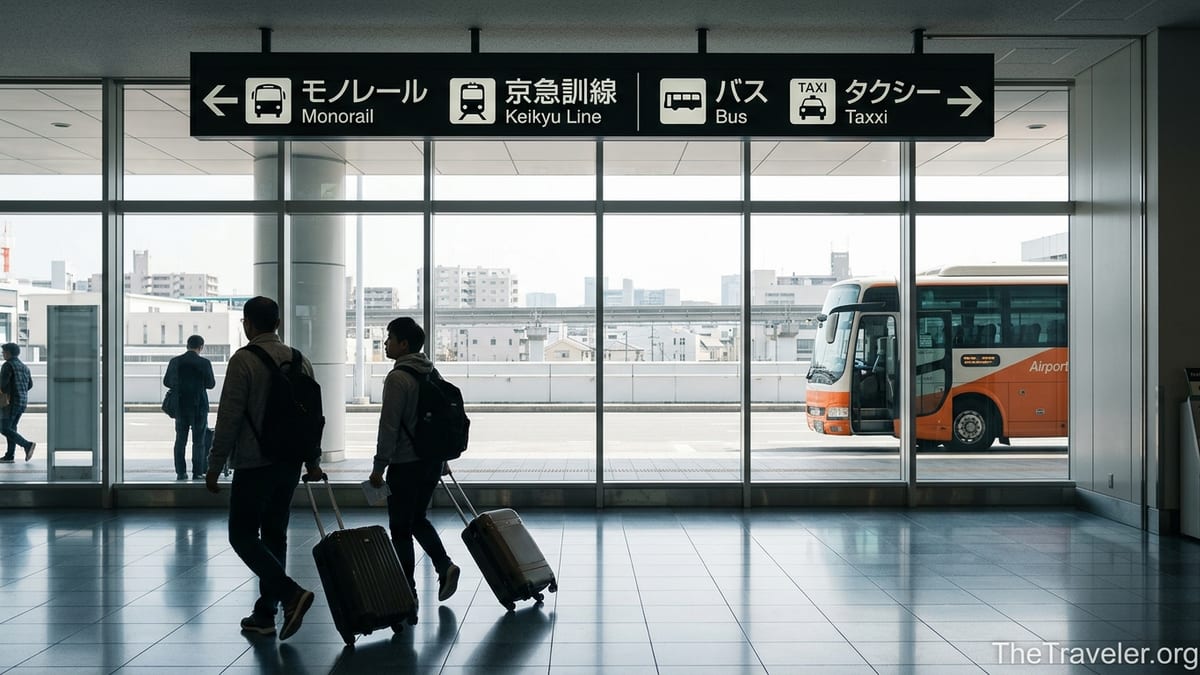
Haneda Airport sits about 15 kilometers from central Tokyo, which means you have several viable ways to reach the city in under an hour. In 2026, the main choices are the Tokyo Monorail, the Keikyu Airport Line, the Airport Limousine Bus network, regular metered taxis and prebooked private transfers. All three terminals at Haneda are connected to rail stations and bus stops, so you can use any of these options regardless of whether you arrive at Terminal 1, 2 or 3.
As a ballpark guide, trains from Haneda into central Tokyo usually cost between 300 and 600 yen per adult and take 15 to 30 minutes, depending on where you are heading. Limousine buses to major hubs such as Tokyo Station, Shinjuku or Shibuya generally cost around 1,000 to 1,600 yen and take 30 to 70 minutes depending on traffic. Taxis from the airport to central neighborhoods like Ginza or Shinjuku are typically in the 6,000 to 10,000 yen range plus tolls, and can be cost effective for families or late-night arrivals when trains and many buses have stopped.
Choosing the “best” route is less about which option is absolutely fastest and more about where you are staying and how tired or loaded with luggage you are. For example, a solo traveler with only a backpack heading to a hotel near Hamamatsucho might prefer the Tokyo Monorail, while a family of four with two large suitcases heading to a Shinjuku hotel door would likely find the Limousine Bus or a taxi far less stressful, even if the trip takes a bit longer.
If you already know your arrival time and hotel neighborhood, it is worth deciding on a primary plan and a backup before you fly. That way, when you walk into the arrivals hall you are simply following signs rather than comparing maps on your phone after a twelve-hour flight.
Tokyo Monorail: Fast and Friendly for JR Connections
The Tokyo Monorail runs directly from all Haneda terminals to Hamamatsucho Station on Tokyo’s JR Yamanote Line. Trains are frequent, typically every 4 to 5 minutes at busy times, and the ride to Hamamatsucho takes about 13 minutes on the fastest services. A one-way adult fare to Hamamatsucho is usually around 500 yen, making it an affordable and quick choice for many central destinations.
From Hamamatsucho, you can transfer to the Yamanote Line or Keihin-Tohoku Line and continue to hubs such as Tokyo Station, Shimbashi, Shibuya, Shinjuku and Ueno. For example, reaching Tokyo Station via the monorail plus JR transfer usually takes about 25 to 30 minutes in total: around 13 minutes on the monorail, a 5-minute walk and transfer, and another 5 to 10 minutes on the JR train depending on the connection.
In practice, the monorail is especially handy if you are staying in areas along or near the Yamanote Line’s eastern arc. A traveler whose hotel is near Shimbashi could ride the monorail from Terminal 3 to Hamamatsucho, tap through the gates, and be at Shimbashi in just two more minutes on the JR line, all for well under 1,000 yen. Travelers holding a Japan Rail Pass should also note that the pass covers the Tokyo Monorail, making this route very attractive if you activated your pass for the same day.
There are two details to keep in mind. First, Hamamatsucho Station can feel busy and a bit confusing, especially when changing from the monorail to JR lines with luggage. Signs are clear in English, but you will need to pass through ticket gates when you leave the monorail area and enter JR, which can be stressful if your group gets separated. Second, late at night the monorail’s last trains are usually just before midnight, so if your flight is heavily delayed you may need to switch to Keikyu, a bus or a taxi.
Keikyu Airport Line: Cheapest Train and Great for Asakusa Area
The Keikyu Airport Line is the other main rail link from Haneda, running from stations connected to each terminal into Shinagawa and then on to the Asakusa Line network. It is often the cheapest rail option, with fares to Shinagawa starting from around 300 yen for an adult, and typical travel times of 13 to 20 minutes depending on the train type. From Shinagawa, you can connect to JR trains including the Yamanote Line and Tokaido Shinkansen.
Where Keikyu really shines is for travelers heading to the eastern side of Tokyo, especially neighborhoods such as Asakusa, Nihonbashi, Higashi-Ginza or Sengakuji, because many Keikyu trains run through onto the Toei Asakusa Line subway. In practice, this means that someone staying near Asakusa can often board a through train at Haneda and stay on the same carriage all the way to Asakusa Station in roughly 40 to 45 minutes, without changing trains or lugging bags up and down stairs.
Keikyu also stays open slightly later than the monorail, with last trains around midnight most nights. This makes it an important fallback if you land late or spend longer than expected at immigration. For example, a traveler arriving around 22:45 and cleared through the airport by 23:30 could still catch a Keikyu train to Shinagawa and be at a hotel near Shinagawa Station before 00:15, whereas the monorail options might already be thinning out.
On the downside, Keikyu trains can be quite crowded during the morning and evening commuter peaks, and navigating Shinagawa Station with luggage is not always relaxing. If you are connecting to a Shinkansen there, allow generous time, especially on your first visit. For many visitors, a practical compromise is to use Keikyu when heading to or from Asakusa and nearby areas, and choose the monorail or a Limousine Bus when staying around Tokyo Station, Shinjuku or Shibuya.
Airport Limousine Bus: Doorstep Access to Major Hubs and Hotels
Airport Limousine buses are bright orange coaches that link Haneda with major Tokyo train stations and large hotels. In 2026, typical one-way fares to big hubs such as Tokyo Station, Shinjuku or Shibuya are around 1,000 to 1,600 yen per adult, often with discounted fares for children. Travel time ranges widely because of traffic, but a Haneda to Tokyo Station run can be as quick as 30 minutes in light traffic or closer to 60 minutes at peak times.
The main advantage of the Limousine Bus is comfort and simplicity. You wheel your luggage directly from arrivals to the bus counter or ticket machines, buy a ticket for your specific destination, and staff guide you to the correct boarding bay outside each terminal. Your suitcase goes into the bus hold and you ride in a large, air-conditioned coach with assigned seats. When you arrive, you step off very close to your final stop’s exits, which is a big relief in rain or heat.
For example, a family of four arriving at Haneda in the afternoon and staying near Shinjuku Station might choose the Limousine Bus direct to Shinjuku. Instead of wrestling strollers and suitcases through Keikyu and JR transfers, they pay around 1,400 yen per adult and somewhat less per child, sit together on the bus, and get dropped near the station or even in front of a partner hotel. Many visitors with large suitcases also choose the bus to reach Tokyo Station, then walk or take a short taxi ride to a nearby Marunouchi or Nihonbashi hotel.
The main thing to watch is the timetable. Not every route runs late into the night, and some hotel-specific services operate only every hour or two. Seats are normally available on the day, but during busy holiday periods or at peak times around early evening it can be wise to buy tickets as soon as you exit customs. If your flight arrives after about 22:00, check in advance whether there is still a bus for your destination; otherwise, be ready to switch to a train route or taxi if the last bus has already left.
Taxis and Private Transfers: Easiest but Not Always Expensive
Because Haneda is so much closer to central Tokyo than Narita, taxis are a realistic option here, especially for small groups or late-night arrivals. A regular metered taxi from Haneda to central districts like Ginza, Tokyo Station or Shibuya typically costs around 6,000 to 7,000 yen in base fare, plus expressway tolls of about 1,000 yen depending on the route and time of day. Travel time is usually 25 to 45 minutes, with the shorter end of the range late at night when roads are quiet.
For neighborhoods farther from the bay, such as Shinjuku, Ikebukuro or parts of northern Tokyo, the fare can rise closer to 8,000 to 10,000 yen including tolls. However, if you are a group of three or four adults splitting the cost, the share per person may end up close to or even below the price of separate Limousine Bus tickets, with the benefit of being dropped right at your hotel door.
Tokyo also offers fixed-fare taxi schemes from Haneda to many central wards. These give you a predetermined price to specific city zones as long as the driver uses the standard expressway route. In practice, this can reduce the worry that a traffic jam might inflate the bill. Some very close districts do not fall under the fixed-fare system and instead run on the meter, so if you want certainty, ask the taxi staff at the official rank which applies to your hotel address before you get in.
Prebooked private transfers are another option, especially for families with young children or travelers carrying sports gear or extra-large luggage. With these, a driver meets you in the arrivals hall with a sign and escorts you directly to a waiting vehicle. Prices are higher than regular taxis but can be worth the premium when you want the smoothest possible arrival after a long international flight or are arriving very late at night when regular bus routes are thin.
Real-World Route Examples for Popular Tokyo Areas
Understanding abstract options is helpful, but concrete examples make planning much easier. Imagine you are booked at a hotel near Tokyo Station. If you arrive at Haneda around midday with a single suitcase, one common approach is to take the Tokyo Monorail from your terminal to Hamamatsucho, then change to the JR Yamanote or Keihin-Tohoku Line to Tokyo Station. The entire trip often costs under 700 yen and takes about 25 minutes if connections are smooth. If you prefer fewer transfers and do not mind spending more, you can instead ride the Limousine Bus directly to Tokyo Station for about 1,000 yen and expect a journey of 30 to 60 minutes depending on traffic.
For travelers staying in Shinjuku, a typical daytime plan might be the monorail to Hamamatsucho followed by the JR Yamanote Line around to Shinjuku, taking about 35 to 45 minutes in total and costing under 800 yen. A more luggage-friendly alternative is the Limousine Bus from Haneda to Shinjuku, often around 1,400 yen and 40 to 70 minutes in travel time depending on the time of day. Families often report that the bus feels less stressful, as there is no need to navigate crowded transfer stations with suitcases.
If your hotel is in Asakusa, the Keikyu route usually makes the most sense. You can board the Keikyu Airport Line at your terminal, staying on a through train that continues onto the Asakusa Line. In many cases you can ride all the way to Asakusa Station without changing trains in about 40 to 45 minutes, paying roughly 500 to 600 yen. This is simpler than taking the monorail and then crossing Tokyo to the Asakusa area by JR and subway.
Heading straight out of Tokyo by bullet train is also straightforward. For example, someone landing in the morning and connecting to a Shinkansen for Kyoto from Shinagawa can ride the Keikyu Airport Line to Shinagawa in around 15 to 20 minutes for about 300 yen, then walk upstairs to the Shinkansen gates. With luggage and a first-time visit, it is wise to allow at least 30 minutes at Shinagawa to find your platform, use restrooms and buy snacks before boarding.
Late-Night, Early-Morning and Luggage Considerations
Many flights to Haneda arrive very early in the morning or late at night, which can complicate ground transport. In broad terms, trains from the airport into the city start running around 5:00 in the morning and continue until close to midnight. The Tokyo Monorail’s last trains are generally just before midnight, while Keikyu’s last trains are usually around 00:00. Airport Limousine Bus routes vary more, with some early and late services but fewer departures in the small hours.
If you land at Haneda close to midnight, it is essential to have a backup plan in case immigration and baggage claim take longer than expected. For instance, a traveler scheduled to land at 22:45 might comfortably plan to catch a Keikyu train into central Tokyo. But someone with an arrival time of 23:30 should strongly consider booking a hotel near the airport for the first night, or budgeting for a taxi into the city if trains or buses are no longer running by the time they exit customs.
Luggage and mobility needs also shape the best route. Couples or solo travelers with only carry-on bags usually find trains easy and fastest. But if you are pushing a stroller, guiding an older relative or hauling two large suitcases per person, making multiple transfers through stations like Shinagawa or Shinjuku can be exhausting. In these cases, the Limousine Bus or a taxi is often worth the extra cost. For example, a group of three adults and one child each with a large suitcase may decide to split a taxi from Haneda to a hotel in Ginza, paying a total of around 7,000 to 8,000 yen but avoiding any stairs or crowds.
It is also wise to think about your return journey before departure day. Morning trains into Haneda can be busy with commuters, especially between 7:30 and 9:00, and roads into the airport can slow down in rush hour. If you have a morning international flight, aim to leave central Tokyo at least three hours before takeoff when using trains, and even earlier if you rely on a taxi or bus that may meet traffic. Many hotels with lots of international guests can recommend specific departure times and routes for Haneda based on your airline and terminal.
The Takeaway
Getting between Haneda Airport and Tokyo does not need to be complicated. The key is matching your route to your destination, arrival time and energy level rather than chasing the single theoretical “best” option. The Tokyo Monorail is fast and convenient for JR connections, especially around Tokyo Station and the eastern side of the Yamanote Line. The Keikyu Airport Line is excellent value and particularly good for Asakusa and other eastern neighborhoods, with slightly later last trains that help for late arrivals.
Airport Limousine Buses trade a bit of speed for comfort and simplicity, especially when you are heading to major hubs like Shinjuku, Shibuya or Tokyo Station with heavy bags or children. Taxis and private transfers cost more but can be surprisingly reasonable from Haneda compared with many global cities, especially when you share the fare among several travelers or are arriving at an hour when other public transport is thin.
If you take a few minutes before your trip to map your hotel location to one of these main routes and note rough fare ranges, you can walk off your flight at Haneda ready to follow signs instead of scrolling through apps. With that small amount of preparation, your first journey into Tokyo becomes part of the adventure rather than a stressful hurdle.
FAQ
Q1. What is the fastest way from Haneda Airport to central Tokyo?
The quickest options for most travelers are the Tokyo Monorail to Hamamatsucho or the Keikyu Line to Shinagawa, each taking around 15 to 20 minutes before transfers.
Q2. What is the cheapest way to get from Haneda to Tokyo?
The Keikyu Airport Line is usually the cheapest, with fares to Shinagawa starting at around 300 yen and through services to Asakusa-area stations still well under 1,000 yen.
Q3. How much does a taxi from Haneda Airport to Tokyo Station cost?
A regular taxi from Haneda to the Tokyo Station or Ginza area generally costs around 6,000 to 7,000 yen plus about 1,000 yen in expressway tolls, depending on traffic and time of day.
Q4. Is the Airport Limousine Bus worth it compared with trains?
For travelers with heavy luggage, small children or hotels near bus stops, the Limousine Bus can be worth the extra cost because it avoids transfers and crowded platforms, even if it is a little slower than trains.
Q5. Can I use my Japan Rail Pass from Haneda Airport into Tokyo?
Yes, the Japan Rail Pass covers the Tokyo Monorail between Haneda and Hamamatsucho, and then JR trains onward, making that route excellent value if your pass is active for the same day.
Q6. What should I do if my flight arrives at Haneda after trains stop?
If you land close to or after midnight, be ready to use a taxi or prebooked transfer, or consider staying at an airport hotel for the first night and taking trains into the city the next morning.
Q7. How long should I allow to travel from central Tokyo back to Haneda?
For international flights, plan to arrive at the airport about two hours before departure and work backward, typically leaving central Tokyo at least three hours before your flight, more if traveling in rush hour or by bus or taxi.
Q8. Which route is best if my hotel is in Shinjuku?
Most visitors either take the Tokyo Monorail to Hamamatsucho and then JR to Shinjuku for a fast, inexpensive trip, or choose the Limousine Bus direct to Shinjuku for fewer transfers and easier luggage handling.
Q9. Is it difficult to change from the monorail to JR trains at Hamamatsucho?
The transfer is well signed in English, but you must pass through ticket gates and use escalators or elevators, which can feel busy with luggage. Allow a few extra minutes if you are unfamiliar with the station or traveling in a group.
Q10. Should first-time visitors to Tokyo prebook a private transfer from Haneda?
Prebooking is not essential for most people, but a private transfer can be a good idea if you arrive late at night, are nervous about trains or are traveling with family members who would struggle with crowds and stairs.