


Rome Fiumicino, officially Leonardo da Vinci International Airport, is one of Europe’s busiest hubs and a common waypoint between continents. A layover here does not have to mean plastic chairs, overpriced snacks and clock-watching. With a bit of planning, you can turn a few spare hours at FCO into a genuinely enjoyable break, whether you stay in the terminal, explore nearby Fiumicino town or make a quick dash into Rome itself.
Get the latest updates straight to your inbox!
Understand Your Real Layover Time Before You Commit
Before you start dreaming about a plate of cacio e pepe in Trastevere, calculate how many hours you truly have. Your “layover” is the time between scheduled arrival and departure, but what matters is usable time once you factor in immigration, security and boarding. On an international arrival, you might spend 30 to 60 minutes clearing passport control and walking between gates. You should be back at the airport and through security at least 2 hours before a Schengen flight and around 3 hours before a long-haul departure, especially in busy periods like summer and Christmas.
As a rough guide, less than 4 hours usually means you should stay airside, within the secure part of the terminal. Between about 4 and 7 hours, you have enough time to enjoy the airport more fully, maybe book a lounge or even slip into nearby Fiumicino town for a quick meal, provided you are already checked in and traveling hand luggage only. From roughly 7 to 10 daylight hours, a focused hop into central Rome by train becomes realistic, as long as you are disciplined with time and keep a close eye on the clock.
It also matters which terminal you use. Most full-service international airlines now operate out of the renovated Terminal 1 and Terminal 3. Connections within Terminal 1 are usually faster than switching between terminals, but you should still budget at least 20 to 30 minutes to move between distant gates, particularly if you land at a Schengen gate and depart from a non-Schengen area or vice versa. Always confirm your gate on the airport screens before leaving your departure area for any longer excursion.
Finally, consider your luggage. If it is checked through to your final destination, your options increase dramatically. If you need to collect and re-check bags, add at least an hour, sometimes more, which can make the difference between a relaxing lunch on the seafront and nervously rejoining the security queue.
Make the Most of Fiumicino’s Terminals: Lounges, Showers and Quiet Corners
Even if you never leave the secure zone, Fiumicino offers more than many travelers expect. In Terminal 1 and Terminal 3 you will find several pay-per-use lounges, some operated by ITA Airways and others by independent companies. Prices vary, but expect roughly 40 to 60 euros for a three-hour stay that typically includes comfortable seating, snacks and hot meals, an open bar with wine and prosecco, Wi-Fi and access to showers. For a long-haul traveler arriving from North America and facing another overnight flight to Asia, a shower in a lounge with fresh towels and basic toiletries can be worth every euro.
Many lounge desks sell access directly at the door, even if you are not flying business class and do not hold elite status, although entry can be restricted in peak hours. If you hold a Priority Pass or similar membership, you can often use lounges like the Prima Vista-operated spaces in Terminal 3, which provide a mix of cold buffet, a few hot dishes and a staffed bar. For a short layover, this can be a far better investment than scattering purchases across multiple cafés in the public areas.
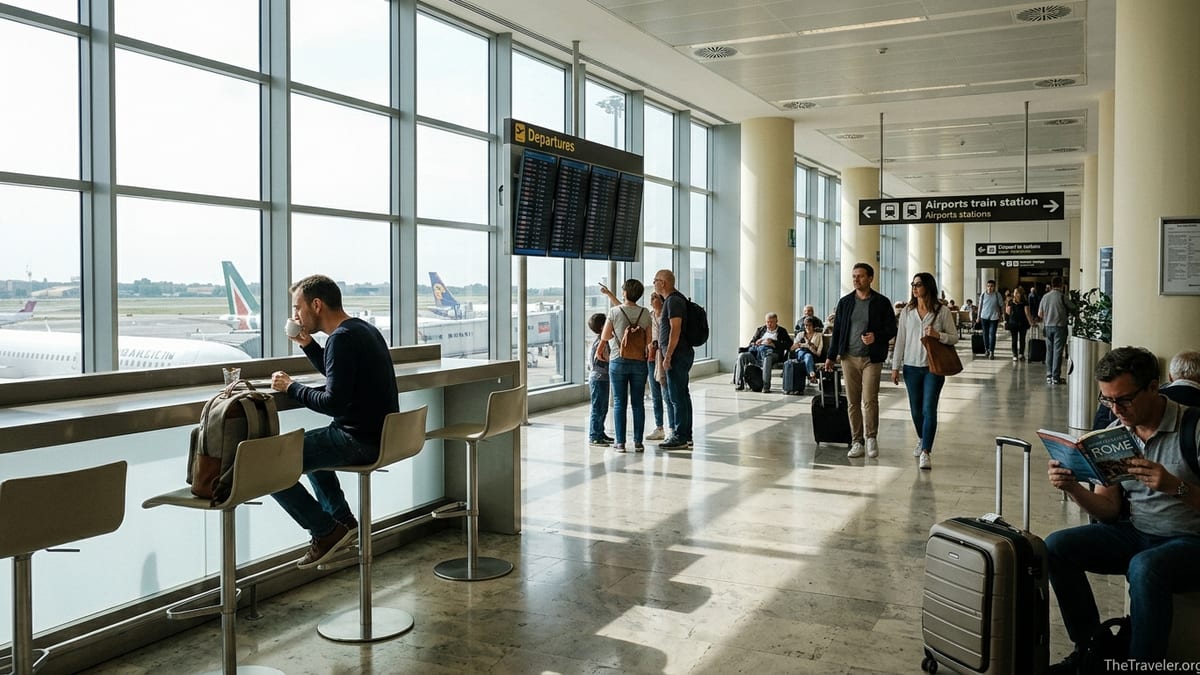
If a lounge is not in your budget, you can still upgrade your experience by seeking out quieter corners. Terminal 1’s newer sections, serving many Schengen flights, tend to have brighter spaces with more natural light and power outlets. Some gates near the far ends of the concourses are noticeably calmer than the central shopping areas. It is worth walking an extra five minutes to find a seat near a window with views of the runways rather than staying in a crowded food court.
Freshening up is also possible without lounge access. Toilets throughout Terminal 1 and Terminal 3 are generally well maintained, and there are a few shower facilities tied to certain lounges and airside hotels. If you have a very long layover and want real rest, look at the airport hotel connected to the terminal complex, where day rooms are often sold in blocks of six to eight hours. A mid-range day room here typically costs less than a full night in central Rome and lets you sleep horizontally, charge electronics and shower in privacy.
Eat and Shop Like a Local, Not a Captive Passenger
Rome Fiumicino has improved its food and retail offerings in recent years, with a clear push toward Italian brands and regional specialties. Instead of defaulting to the first global coffee chain you see, look for Italian operators serving proper espresso, cappuccino and pastries at prices not much higher than in the city. A typical espresso at a standing bar in the terminal may cost around 1.30 to 1.50 euros, while a cornetto or pastry runs roughly 1.50 to 2.50 euros, far more reasonable than the five-euro coffees common at some European hubs.
For something more substantial, you can find trattoria-style menus and pizzerias offering Roman-style thin crust slices, as well as panini counters slicing prosciutto and pouring glasses of Lazio wine. A basic pasta dish will usually be in the 12 to 16 euro range, while a glass of house wine is often 5 to 7 euros. If you have a couple of hours and want to feel as though you have actually arrived in Italy, sit down for a proper meal instead of eating standing up. Terminal restaurants closer to the boarding areas often have runway views, which adds a pleasant backdrop while you recover from jet lag.
Shopping can be tempting but does not have to be mindless. Look past the predictable luxury labels and focus on Italian products that are easy to pack and genuinely useful as gifts. Think small tins of high-quality olive oil, Italian chocolate, regional cookies such as cantucci, or compact jars of truffle salt. Wine shops around the airport usually stock bottles from well-known producers in Tuscany, Piedmont and Lazio. Prices will rarely beat a supermarket in the city, but you gain the convenience of travel-safe packaging designed for carry-on.
If you are buying food to eat on your next flight, keep security and customs rules in mind. Solid cheeses sealed in vacuum packs generally travel well, but fresh soft cheeses and large amounts of liquids can be problematic for certain destinations. Pre-packed sandwiches and salads from airport delis are fine for most flights, but always check your airline’s rules before bringing anything particularly pungent on board a tightly packed long-haul route.
Short Layover, Big Ambitions: When a Dash into Rome Makes Sense
Many travelers wonder whether they can “do Rome” on a layover. The answer depends on daylight, your risk tolerance and your timetable. Fiumicino Aeroporto railway station is attached to the terminals and is linked to Roma Termini, the main central station, by the Leonardo Express, a non-stop train that generally takes around 30 to 32 minutes each way. Trains typically run about every 15 minutes during the day. Tickets usually cost in the mid-teens in euros per person one way, and you can buy them from machines or staffed counters at the station.
If your layover gives you a solid 7 to 10 hours on the ground, much of it during daytime, it can be reasonable to take the train into town. For example, imagine you land from New York at 8:00 in the morning and your onward European flight leaves at 18:00. Deduct an hour for immigration and walking to the station, an hour each way on the train including waiting time, and another 2.5 hours to be back in the airport and through security. You still have roughly 3 to 3.5 hours in central Rome. That is enough for a cappuccino near Termini, a metro ride or short taxi to the Colosseum, a walk through the Roman Forum area to Piazza Venezia, and a quick gelato before reversing the route.
In contrast, if you land late afternoon and depart late evening, your usable daylight hours shrink, and train frequencies may thin out. A 6-hour evening layover might only leave you an hour or so in the city after you subtract the round-trip transport and safety margins. In this case, it may be wiser to stay closer to the airport and visit nearby Fiumicino town instead of pushing as far as Termini. Also consider your energy level; an overnight flight followed by a rushed city sprint can leave you more tired than if you had rested in a lounge.
Practicalities matter. Keep your passport, boarding pass and train tickets organized and store crucial details, such as your departing gate and terminal, in your phone before you leave. Factor in the time to re-clear security, which can be unpredictable in high season. If you are not naturally time-conscious, set alarms on your phone for when you must start heading back to the station. Rome’s historic center is full of tempting detours, and missing a long-haul flight is a very expensive consequence of one extra coffee stop.
Fiumicino Town and the Coast: A Relaxed Alternative to the City Center
For many layover passengers, a calmer and often more realistic escape is the nearby town of Fiumicino itself. Only a short taxi or rideshare ride from the terminals, Fiumicino sits along the coast with a working fishing harbor and a waterfront lined with seafood restaurants, trattorias and gelaterias. If your layover is in the 4 to 7 hour range and you already have your onward boarding pass, Fiumicino town can offer a genuine Italian experience with far less transit stress than a dash to the Colosseum.
A common pattern for travelers with a mid-morning arrival and late-afternoon departure is to leave the airport after clearing immigration and head straight to the harbor area for lunch. Many local restaurants serve set menus featuring grilled fish, fried calamari, seafood risotto and carafes of white wine from the Lazio region. Expect to pay perhaps 20 to 35 euros per person for a full lunch with a starter, main and a drink, depending on how elaborate you go. Add a walk along the promenade or a coffee at a café facing the water, and you have transformed a generic layover into a coastal interlude.
If you prefer something quieter, there are modest hotels and guesthouses in Fiumicino that offer day-use rooms, particularly outside peak summer dates. This can be a smart move on very long daytime layovers of 8 to 10 hours where you do not feel like exploring Rome but still want natural light, a bed and a private shower. Taxis between the airport and the town typically cost less than the fixed fare into central Rome, and ride times can be as short as 10 to 15 minutes, depending on traffic.
Travelers with children often find Fiumicino town easier than central Rome during a layover. Strollers handle the flat waterfront promenade better than cobbled streets, and it is simple to cut a visit short and head back to the airport if anyone melts down. Just remember to leave enough time for the taxi ride plus security screening, and avoid planning a big sit-down meal if your onward boarding time is less than three hours away.
Sleep, Recharge and Stay Connected on Longer Layovers
For overnight or ultra-long daytime layovers, your primary challenge is often rest rather than sightseeing. Fiumicino is not the world’s most comfortable airport to sleep on the floor, but some areas are more forgiving than others. In general, seating in the newer parts of Terminal 1 and some corners of Terminal 3 provide padded benches without fixed armrests, where travelers can stretch out for a few hours. Bring an eye mask, earplugs and a lightweight travel blanket, because lights remain bright and announcements frequent.
If sleeping in public is not appealing, there are several hotels on or immediately adjacent to the airport grounds. These range from international chains connected to the terminal complex by covered walkways to budget hotels and bed-and-breakfasts in the nearby town with free or low-cost shuttle buses. Nightly rates fluctuate with season and demand, but it is often possible to secure a simple room for under what a last-minute business-class upgrade would cost, and the benefit of a proper bed and private bathroom can be immense before another long flight.
Power and connectivity are vital on a layover. Fiumicino provides free Wi-Fi throughout the terminals, although performance can vary at peak times. Power outlets are scattered through seating areas, but they are not at every seat, so if you see an open plug near your gate, it is worth charging while you can. A compact power strip or multi-port charger can be invaluable if you are traveling as a family or group and want to avoid taking turns.
Consider how you use your time mentally as well as physically. A long layover can be the perfect moment to reset your body clock: take a shower as soon as you land, then expose yourself to daylight near big windows if you are trying to adjust to European time, or close the blinds in a day room and nap strategically if you need to stay on a different schedule. Small routines such as brushing your teeth, changing into fresh clothes and doing a short stretch in a quiet corner can make the airport feel less draining.
Practical Time-Saving Tips So You Do Not Cut It Too Close
Regardless of how you choose to spend your layover, a few habits will help you avoid last-minute panic. First, keep an eye on your departure gate from the moment you land. Gates at Fiumicino can change, and some long-haul flights depart from satellite piers that require additional walking time or a short people mover ride. Make checking the screens and your airline app part of your routine each time you pass a display or sit down.
Second, treat all transport times as minimums, not guarantees. If the Leonardo Express train is scheduled to take about 30 minutes, mentally round it up to 40 or 45 when planning your back-in-the-terminal deadline. Do the same for security queues and passport control, particularly in the late morning when transatlantic arrivals and European departures overlap. Leave yourself at least one extra train or bus departure in hand; if you plan around the last possible connection back to the airport, you are building your day on fragile assumptions.
Third, pack a small “layover kit” in your personal item. Include a refillable water bottle to top up after security, a change of underwear and socks, travel-sized toiletries limited to security-friendly sizes, a universal adapter and any medication you might need. If your checked luggage is delayed or you choose to leave the terminal, you will still have the basics to be comfortable and safe. Many seasoned travelers also carry a compact foldable tote bag in case they pick up extra food or small souvenirs while in the city or town.
Finally, manage your money efficiently. ATMs are available in the airport, but withdrawing a small amount of cash at once can help avoid multiple fees if you plan to take a taxi, buy train tickets from a machine that does not accept foreign cards, or tip in a restaurant. Contactless payments are increasingly accepted across Rome and Fiumicino, but technology can fail at the most inconvenient moments. Having a mix of card and modest cash on hand makes your layover less vulnerable to one malfunctioning payment terminal.
The Takeaway
A layover at Rome Fiumicino Airport does not have to feel like lost time. With realistic expectations about how many hours you truly have, you can choose from a spectrum of options, from a quiet lounge session with a hot shower to a plate of seafood in nearby Fiumicino or a tightly timed train trip into the heart of Rome. The key is matching your plans to your schedule, energy level and risk tolerance, instead of forcing a whirlwind checklist that leaves you stressed and exhausted.
Even if you never leave the terminal, small decisions make a big difference: sitting near natural light, seeking out decent Italian coffee and food, and staying on top of gate changes and security queues. For those who do venture out, building generous buffers into your transport and security times ensures your memories of Rome are about gelato and sea air, not sprinting through the terminal as boarding closes. Used wisely, a layover at Fiumicino can be a memorable part of your journey rather than a gap between flights.
FAQ
Q1. Is my layover at Rome Fiumicino long enough to visit central Rome?
If you have at least 7 to 10 daylight hours between flights, are traveling with hand luggage only and your onward boarding pass is sorted, a quick visit can be realistic. You should allow about an hour each way for the Leonardo Express train plus waiting time, time to move through the station and get to a nearby sight, and at least 2 to 3 hours to be back at the airport, through security and at your gate before departure.
Q2. How do I get from Fiumicino Airport to Rome quickly during a layover?
The most straightforward option is usually the Leonardo Express train from Fiumicino Aeroporto station to Roma Termini, taking around 30 to 32 minutes in normal conditions with departures roughly every 15 minutes during much of the day. Taxis and car services offer a fixed fare to central Rome, which can be convenient if you have heavy luggage or are traveling in a group, but they are subject to traffic and often take longer at busy times.
Q3. Is it worth paying for an airport lounge at Fiumicino during a short layover?
If your layover is more than about three hours and you value quiet, Wi-Fi, food and the possibility of a shower, a lounge can be good value. Paying roughly 40 to 60 euros for a few hours of comfortable seating, reliable power outlets, a buffet and drinks is often cheaper and more relaxing than buying separate meals, coffee and water around the terminal while searching for a free chair.
Q4. Can I leave the airport during a layover if my luggage is checked through?
Yes, many passengers do this, but you must respect immigration rules and allow plenty of time for your return. If you are entering the Schengen Area for the first time on this trip, you will pass passport control, after which you may take a train or taxi into Rome or nearby Fiumicino town. Plan to be back inside the terminal and through security no later than 2 hours before a European flight and 3 hours before a long-haul departure, and adjust those margins upward in peak travel seasons.
Q5. Is Fiumicino town a realistic option for a meal on a medium layover?
Yes, the town of Fiumicino is quite close to the airport and makes a relaxed alternative to central Rome, especially on layovers of 4 to 7 hours. A short taxi or rideshare ride takes you to the harbor and seafront, where you can find seafood restaurants, cafés and gelato shops. This gives you a taste of Italy with less transit time and less stress about making it back to your gate.
Q6. What should I do on an overnight layover at Fiumicino?
On overnight layovers, consider booking an airport hotel or a nearby property in Fiumicino town that offers a shuttle. A proper bed, shower and a quiet environment can be far more restorative than trying to sleep on benches in the terminal. If your budget is tight and you plan to stay inside, look for quieter corners in the newer terminal areas, bring an eye mask and earplugs, and keep valuables on your person while you rest.
Q7. Are there showers available at Rome Fiumicino Airport?
Yes, several lounges in Terminal 1 and Terminal 3 include showers for guests, and some airport hotels connected to or near the terminals offer day rooms or short-stay packages with full bathroom access. If you hold a lounge membership such as Priority Pass, check which FCO lounges you can enter and whether showers are included, then time your visit so you can freshen up without rushing.
Q8. How early should I be back at Fiumicino before my next flight?
As a guideline, aim to be back in the terminal at least 2 hours before a Schengen or short European flight and 3 hours before a long-haul flight, even if you are already checked in and traveling only with carry-on. This buffer covers potential queues at security and passport control, unexpected gate changes and the time needed to walk to a distant gate. In peak summer, school holidays or during disruptions, adding another 30 minutes of margin is sensible.
Q9. Is it safe to sleep in Rome Fiumicino Airport during a long layover?
Fiumicino is generally considered reasonably safe for sleeping in public areas, especially in well-lit, busier sections of the terminals. However, you should take the same precautions you would in any large transport hub: keep your passport, money and electronics close to your body, use luggage locks where possible, and choose a spot where other travelers are present. If you are traveling alone or feel uneasy, an airport hotel or day room offers a more secure and restful option.
Q10. What is the best way to manage my time so I do not miss my connection?
Start by setting clear “turnaround times” for whatever you plan to do, whether that is leaving a lounge, heading back from Fiumicino town or catching the train from central Rome. Use alarms on your phone as reminders, monitor your flight status through airline apps and departure boards, and always assume that transport and security might take a little longer than scheduled. Building in generous buffers and resisting last-minute detours is the most reliable way to enjoy your layover without risking a missed flight.