


Rome Fiumicino, officially Leonardo da Vinci Airport, has become one of Europe’s more pleasant hubs to eat in, whether you want an early-morning espresso, a proper sit-down plate of pasta or a last glass of Franciacorta before boarding. The challenge is less finding food and more knowing where to go in your specific terminal, how early places open, and which options are actually worth your pre-flight time and money.
Get the latest updates straight to your inbox!
Getting Oriented: Terminals, Time and What You Want to Spend
Fiumicino’s food scene is concentrated in Terminals 1 and 3, where most Schengen and long-haul flights depart. Terminal 1 is largely used by ITA Airways and SkyTeam partners, with a growing cluster of bars, cafes and branded restaurants along Boarding Area A. Terminal 3 handles many non-Schengen and intercontinental departures, with a sizeable food court and bars dotted along Boarding Area E. Knowing your departure terminal and gate range before you start hunting for food will save you from a frustrating cross-airport dash with a cooling slice of pizza.
Prices at Fiumicino are generally in line with other major European hubs. Expect to pay around 1.50 to 2.00 euros for a basic espresso at a standing bar, 3.50 to 5.00 euros for a cappuccino, and 5.00 to 8.00 euros for a filled panino. A sit-down pasta dish in a mid-range restaurant can run 14 to 20 euros, while a glass of decent Italian wine often starts around 7 to 9 euros. Lounges that sell access typically charge from about 50 to 70 euros per visit, usually including food and drinks.
Time also shapes your options. If you have less than an hour before boarding, you are better off at a bar or casual counter close to your gate, where food arrives in minutes and you can keep an eye on screens. With 90 minutes to two hours, you can consider a relaxed plate of cacio e pepe or seafood and still stroll to your gate at an easy pace. For very early or very late flights, check opening hours: many airport venues now open around 4:30 to 5:00 in the morning and close around 10:00 or 11:00 at night, but true 24-hour options are limited to a handful of counters.
Finally, be realistic about queues. At busy waves, especially peak summer mornings and late afternoon bank departures, even simple bar counters can develop lines. If you are checking bags and clearing security at Fiumicino, try to be landside no less than two hours before a European flight and three hours for a long-haul, so you have time to clear formalities and still eat without watching the clock.
Quick Coffee, Breakfast and Snacks Before You Fly
If you land at Fiumicino before dawn or are boarding one of the many early-morning departures, your first priority will likely be coffee and something quick. Bars such as Briciole Bar in Terminal 1, including a mezzanine-level outlet after security, typically open around 4:30 and serve the staples of an Italian breakfast: espresso or macchiato at the counter, cappuccino, and a choice of pastries like cornetti filled with jam, cream or chocolate. Standing at the bar and drinking your coffee in a few sips is not only authentically Italian but usually cheaper and faster than sitting down.
In Terminal 3, similar counters are spaced along the departures area, where you can pick up a cappuccino and a simple panino with prosciutto and cheese or a slice of focaccia in under ten minutes. If you prefer something a bit lighter, many venues now stock yogurt cups, fruit salads and pre-packed salads to cater to health-conscious travelers. Prices are predictably higher than in central Rome, but you can still keep a simple breakfast under 10 euros if you skip branded juices and stick to coffee and pastry.
For a sweet pre-flight treat, Venchi, the Italian chocolatier and gelato brand, has become a favorite recommendation among frequent flyers. A small gelato cup or cone costs more than what you would pay in a neighborhood gelateria in Rome, but many passengers report that it is one of the more consistent and satisfying options airside. If you are connecting and short on time, a Venchi gelato or a few pieces of chocolate can be a stress-free way to get a taste of Italy without a full meal.
Travelers with dietary restrictions will find that the selection is improving, though still uneven. Some bars at the end of Boarding Area A have expanded their range of plant-based and gluten-free snacks, including vegan sandwiches and pastries, but you may need to look beyond the first counter you see. If you have time, walk a few minutes along your concourse and scan the glass cases before committing; the variety between kiosks can be surprisingly wide.
Where to Find a Proper Sit-Down Italian Meal
For many travelers, a last plate of pasta in Italy before departure is more than a meal; it is a ritual. Fiumicino has been investing in restaurant-style spaces where you can sit down, order from a menu and linger over a glass of wine. One example in Terminal 1 is Farinella, an Italian restaurant concept known for its pizzas baked in a visible oven and classic dishes like spaghetti alle vongole or eggplant parmigiana. Portions are airport-generous, sauces are generally well seasoned, and the buzzy, open-kitchen layout makes it feel closer to a city restaurant than a food court.
Another recent arrival is the Amore restaurant, a flexible concept opened in 2026 that combines a bar area, quick-service options and a casual dining zone with table service. Designed for travelers with different time budgets, Amore lets you grab a slice of warm focaccia or a salad from the counter, or sit down with a menu that might include risottos, meat dishes and seasonal specials. Self-order kiosks mean you can place your order quickly even when the dining room is busy, and staff bring plates to your table, which is helpful if you are traveling with children and luggage.
In Terminal 3, the main food court overseen by large operators such as Autogrill offers several branded restaurant corners where you can get regional Italian cooking. While the atmosphere is more open and mall-like, you can still settle in at a proper table with real plates and glassware. Dishes like rigatoni all’amatriciana, lasagna or grilled sea bass typically sit in the 14 to 22 euro range, with bottles of still or sparkling water and a glass of house wine adding another 6 to 8 euros. Service is geared to airport timing, so even a three-course meal rarely takes more than an hour.
Because these restaurants are often just a few minutes’ walk from the gates, they are a realistic option even with children or elderly relatives. High chairs are common, staff are used to storing cabin bags by tables, and menus are usually available in English in addition to Italian. For a smoother experience, glance at the time printed on your boarding pass, set an alarm for 45 minutes before, and ask your server when you sit down how long dishes typically take. They are accustomed to giving honest guidance to catch a flight.
Eataly and Specialty Spots for a Last Taste of Italy
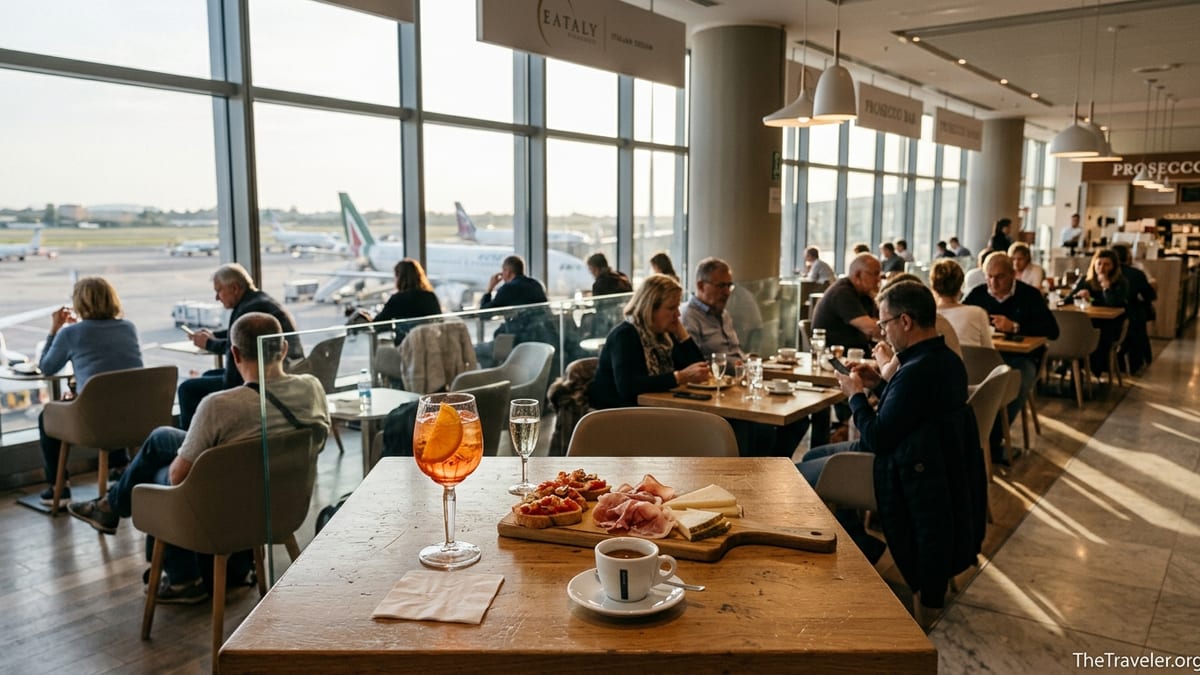
Perhaps the most high-profile name at Fiumicino is Eataly, the Italian marketplace and restaurant brand that has outposts in major cities around the world. At the airport, Eataly operates a large space connected to the departures area, often near Boarding Area A and linked to the main flow of Terminal 1 traffic. The concept blends a gourmet grocery with counters for coffee, pastries, pizza al taglio, pasta and wine. Travelers praise it as one of the few airport venues where you can both eat reasonably well on the spot and pick up quality food souvenirs like artisanal pasta, jars of pesto or hazelnut spreads.
Prices at Eataly are above supermarket level but competitive with other airport venues. A slice of pizza al taglio might cost around 6 to 8 euros depending on toppings, while a plate of fresh pasta with seasonal sauce can range from 14 to 18 euros. A glass of wine from a reputable producer might start around 8 euros, and you can often order tasting-sized pours if you simply want a sip of Barolo or a local Lazio white. Because service is counter-based for many items, you can eat quickly if needed, yet still enjoy higher-quality ingredients than at many generic fast-food stands.
For something more celebratory, Prosecco and sparkling-wine bars have re-emerged in the terminals. The Bottega Prosecco Bar, for example, offers glasses of Italian bubbly alongside cicchetti-style small plates, from crostini with regional salumi to simple seafood bites. Sitting at the counter with a flute of Prosecco and a plate of snacks can turn the often-dull wait at the gate into a pleasant aperitivo. Expect to pay similar prices to a wine bar in central Rome: a glass of Prosecco often starts around 7 or 8 euros, with small plates in the same range.
Seasonal pop-ups also appear, especially in summer. In recent seasons, brands such as Aperol have launched immersive “summer terrace” activations within the terminal, complete with branded bars serving spritzes and DJs or live music at peak times. While these are first and foremost marketing exercises, they can be a lively way to mark the start or end of a holiday, particularly on evening departures when you have time to linger over an aperitivo before heading to security or your long-haul gate.
Lounges and Premium Spaces for Grazing and Relaxing
If you prefer to eat in a quieter environment, Fiumicino’s lounges have stepped up both design and food quality. The new Plaza Premium First lounge in Terminal 1, which opened in late 2025, illustrates how far things have moved from the days of plastic-wrapped sandwiches. Located on a mezzanine level near gates in Boarding Area A, this pay-per-use lounge offers a la carte dining, a curated buffet and a bar pouring Italian and international wines. Travelers without elite status or business-class tickets can buy access at the door or online, with recent price examples around 70 euros for a two-hour visit including food and beverages.
Inside such lounges you will typically find hot dishes like fresh pasta, regional stews, antipasti spreads with cheeses and cured meats, and a selection of desserts. While the food will not rival Rome’s best trattorie, it is usually markedly better than grabbing a random pre-packed sandwich in the main concourse. The ability to sit at a proper table, plug in your devices and eat in relative calm can be worth the premium, especially if you are working on the road or recovering from a long connection.
Beyond Plaza Premium, Fiumicino hosts several other lounges run by private operators and airlines, many of which you can access with membership programs or paid passes. Some focus more on snacks and drinks, with soups, salads and small hot dishes rather than full meals. If you are choosing between them based on food, look for lounges with freshly prepared counters and visible kitchens rather than those relying solely on industrial catering trays. Recent traveler reports suggest that, when food is a priority, it can sometimes be better value to skip an uninspiring lounge and instead eat at an airport restaurant like Eataly or Farinella.
Before paying for lounge access purely to eat, do a quick calculation. If access costs 60 to 70 euros and you only have an hour, you may be better off spending 25 to 30 euros on a good meal and an extra drink in the main terminal. On the other hand, if you have a three- or four-hour layover and need a quiet place to eat, work and recharge, a premium lounge with solid dining can be a smart investment.
Eating on a Budget Without Feeling Shortchanged
Although Fiumicino’s upgrades have boosted its reputation, it is still an airport where you can easily overspend if you are not paying attention. To keep costs under control, start by seeking out venues that display menu boards with clear prices before you sit down. This is common at the larger bars and food-court outlets. Look for simple offers like “menu colazione” or breakfast sets, which might bundle a cappuccino and pastry for a small discount compared to ordering separately.
In both Terminals 1 and 3 you can find standing-room areas with more modestly priced panini, pizza al taglio and salads. An uncomplicated margherita slice and a bottle of water can usually be kept under 10 euros, while cold sandwiches or tramezzini make for a portable option you can carry to the gate. If you are traveling as a family, sharing larger items like a whole pizza or mixed platter rather than ordering individual plates can meaningfully reduce the total bill without leaving anyone hungry.
Another tactic is to eat your main meal in Rome before heading to the airport, then treat Fiumicino as a place for a final coffee or light snack. Central Rome offers far better value in both quality and price, whether it is a plate of pasta in Trastevere or a slice of pizza bianca near the train station. If you follow this strategy, leave enough buffer for potential delays on the way to the airport, particularly when train services have disruptions and taxi queues at Termini grow long, as sometimes happens in peak travel periods.
Finally, remember that tap water in Italy is generally safe to drink. While you cannot bring liquids through security, many passengers carry an empty bottle and refill it at water fountains airside, then spend their money on coffee or food rather than on marked-up bottled water. Not every concourse has clearly signposted fountains, so if you do not immediately see one, ask staff at the bar or information desk.
Special Diets, Families and Other Practical Considerations
Travelers with special dietary needs should plan ahead a bit more at Fiumicino. Vegetarian options are easy to find, from margherita pizzas and tomato-based pastas to grilled vegetables and salads. Vegan, gluten-free or low-lactose options exist but are less systematically labeled. Some bars and restaurants have started flagging plant-based dishes and gluten-free products on menus, but signage can be inconsistent. When in doubt, ask staff directly about ingredients; many are accustomed to answering questions in English and can point out suitable dishes.
Families will usually find Fiumicino manageable. High chairs are available at most sit-down restaurants and large food-court outlets, and children’s meals or smaller-portion dishes can often be improvised even if they are not explicitly listed. A practical strategy with younger children is to choose a venue where you can see the kitchen or food-preparation area, so they stay entertained while waiting. Airport restaurants are used to strollers and luggage, and servers are typically efficient at bringing children’s dishes out first if you request it.
If you are working around limited mobility or heavy baggage, prioritize restaurants and bars close to your gate to avoid long walks. Screens in the terminals often list approximate walking times to gate ranges, and some of the newer food outlets are clustered near these signboards. If you are connecting through Fiumicino and changing from Schengen to non-Schengen or vice versa, allow extra time to clear passport control before settling into a restaurant on the far side.
Lastly, be prepared for small variations in service culture. Italian bar service can feel abrupt if you are used to more chatty interactions, and self-service or self-ordering kiosks are increasingly common in newer concepts. Having a few basic phrases such as “un espresso, per favore” or “posso vedere il menù, per favore?” makes interactions smoother. Tipping is not expected, but rounding up the bill or leaving a euro or two for good service at a sit-down restaurant is appreciated.
The Takeaway
Rome Fiumicino has evolved into an airport where you can eat well if you know where to look and are clear about how much time and money you want to spend. From quick early-morning cappuccinos at Briciole Bar and gelato at Venchi, to proper sit-down meals at Farinella or Amore, to a glass of Franciacorta at a prosecco bar or full a la carte dining in a premium lounge, the range is wide enough to turn a layover into a small part of your Italian journey rather than a purely functional pause.
The key is to match your choice to your circumstances. Short on time and budget. Stick to bars and counters near your gate. Long layover or premium cabin. Consider a restaurant or lounge where you can relax over a full meal. Traveling with children or specific dietary needs. Give yourself extra time, walk a few minutes beyond the first venue you see and do a quick scan of menus before sitting down.
With a bit of planning, eating at Fiumicino can be a pleasant final chapter to your stay in Italy, whether you are savoring a last espresso at dawn or raising a spritz as the sun sets over the runways. Treat the airport not only as a point of departure but as one last chance to enjoy Italian flavors before you step on board.
FAQ
Q1. Are there good places to eat in Rome Fiumicino Airport early in the morning.
Yes. Several bars in Terminal 1 and Terminal 3, such as Briciole Bar, typically open around 4:30 to 5:00, serving espresso, cappuccino and pastries for early departures.
Q2. Where can I get a proper sit-down Italian meal before my flight.
Look for restaurants like Farinella in Terminal 1 or full-service venues within the Terminal 3 food court, where you can order pizzas, pasta and main courses with table service.
Q3. Is Eataly at Fiumicino worth the higher prices.
Many travelers feel it is, because Eataly combines better-quality ingredients, varied counters for pizza, pasta and pastries, and a gourmet shop where you can buy Italian food gifts.
Q4. Can I find vegetarian or vegan food options at Fiumicino.
Vegetarian choices are common in pizzas, pastas and salads. Vegan options exist, especially at some bars in Boarding Area A and in the food courts, but labeling can be inconsistent, so it is best to ask staff.
Q5. Are there gluten-free options in the airport restaurants.
Some venues stock gluten-free snacks and a limited number of dishes, and Italy’s general awareness of celiac needs helps, but availability varies, so travelers with strict requirements should ask specifically at each venue.
Q6. Is lounge food at Fiumicino better than eating in the main terminal.
In newer lounges like Plaza Premium First, the food is usually better than typical terminal snacks, with hot dishes and a la carte options, but quality varies, and some travelers prefer well-rated restaurants like Eataly instead.
Q7. How much should I expect to pay for a meal at Fiumicino.
A quick snack of coffee and pastry might cost 5 to 8 euros, while a sit-down pasta dish with a drink typically runs 20 to 30 euros per person; lounge access costs more but includes food and drinks.
Q8. Are there bars where I can enjoy a drink before my flight.
Yes. Wine and prosecco bars, including branded concepts such as Bottega Prosecco Bar, offer glasses of sparkling wine and small bites that work well as a pre-flight aperitivo.
Q9. How much time should I allow if I want a full meal before boarding.
Plan at least 90 minutes between clearing security and boarding if you want a relaxed sit-down meal, or around 45 minutes if you are only grabbing a quick plate or snack.
Q10. Can I eat cheaply at Fiumicino or is everything expensive.
While many venues are pricey, you can still eat relatively cheaply by choosing simple items like pizza al taglio or panini at standing bars, looking for set menus and avoiding the most branded or elaborately themed outlets.