


Teno Rural Park is one of Tenerife’s wildest corners, and it is possible to reach it without renting a car. Doing so, however, demands time, patience and some flexibility. From the island’s main resort and city bases you should expect journeys of roughly one and a half to three hours each way, usually involving one or two bus changes and, in some cases, a short taxi ride or walk to reach trailheads. Rural bus frequencies are limited, and services can be disrupted by roadworks or rockfalls, so planning and same-day checks are essential.
Get the latest updates straight to your inbox!
Understanding How Teno Works Without a Car
Teno Rural Park sits in the far north-west of Tenerife, away from the island’s fast motorways. Public transport reaches the fringes of the park and key villages, but not every viewpoint or trailhead. For most visitors staying in Costa Adeje or Los Cristianos, Puerto de la Cruz, Santa Cruz or Puerto de Santiago and Los Gigantes, the journey will involve combining interurban buses with a local connection and often a short walk. The upside is that services are reliable when they run, and the main gateways are well established.
The principal public transport gateways into the wider Teno area are Buenavista del Norte on the north coast, Santiago del Teide inland above the south-west resorts, and Icod de los Vinos, which links the north and west. Smaller stops such as Garachico and Los Silos can also be useful, but most visitors will change buses at the larger hubs where timetables are better coordinated and there is shelter while you wait. From these hubs you can reach villages such as Masca and El Palmar that sit inside or on the edge of the park, either by local bus or by taxi.
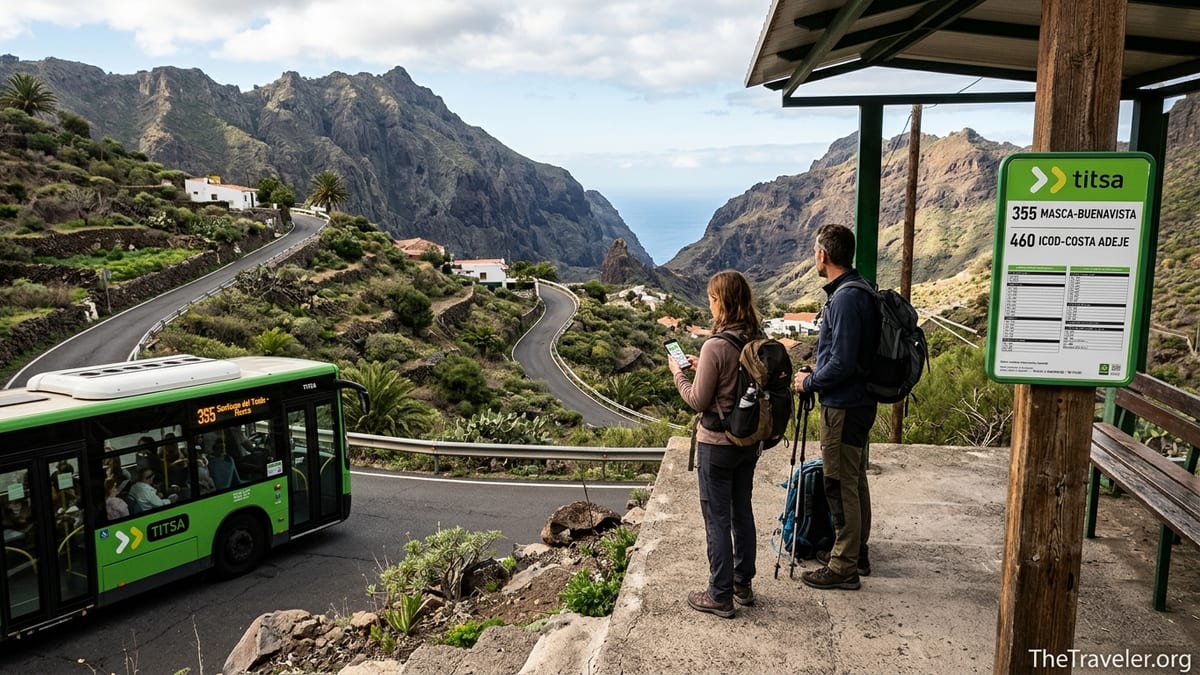
As of November 2026, the island-wide bus company TITSA continues to operate the backbone interurban lines that make car-free access possible. Services along the west of the island such as lines 460 and 464 link Costa Adeje with Icod de los Vinos via Guía de Isora and Santiago del Teide, while dedicated rural line 355 links Buenavista del Norte, El Palmar, Masca and Santiago del Teide. Typical total journey times from the south-west resorts to Teno villages are around two to three hours including changes, and from Puerto de la Cruz or Santa Cruz around one and a half to two and a half hours, depending on connections on the day.
For payment, contactless options are the simplest. The ten+ travel card and associated app are widely promoted on the island, and many visitors now rely on contactless bank cards or mobile payments on board rather than handling cash. No reservations are currently required for regular TITSA buses to Teno or Masca, although seats on rural services can fill at peak times and it is sensible to arrive at the stop a little early, especially in high season weekends.
Main Bus Gateways and Typical Routes From Key Bases
From Costa Adeje and Los Cristianos, the most important bus hub is the Costa Adeje bus station, which is linked to other parts of the island by frequent express lines such as 110 and 111 to Santa Cruz and airport routes from Tenerife Sur. To go towards Teno, visitors normally use line 460 or its faster variant 464, which run between Costa Adeje, Guía de Isora, Santiago del Teide and Icod de los Vinos. From Santiago del Teide you can connect directly to Masca and Buenavista on line 355, while from Icod you can continue along the north coast to Buenavista on other regional lines. Allow around two hours to reach Masca or Buenavista from Costa Adeje when connections line up, and longer if you have to wait between buses.
From Puerto de la Cruz and the northern resort towns, buses along the TF-5 north coast corridor make Teno relatively straightforward to reach in one direction. Regular services link Puerto de la Cruz with Icod de los Vinos and on towards Buenavista del Norte along the north-west coast, passing places such as Garachico and Los Silos. Travel times from Puerto de la Cruz to Buenavista are typically around one and a half hours, depending on the stopping pattern, with a simple change in Buenavista to reach El Palmar, Masca or Teno Alto.
From Santa Cruz and nearby La Laguna, the usual pattern involves first travelling west along the TF-5 towards Icod de los Vinos, then changing to a coastal bus towards Buenavista or a cross-island route towards Santiago del Teide. Express services such as line 110 and 112 link Santa Cruz with Costa Adeje, but for Teno it is often quicker to stay on the north side via Icod. On a good day the journey from Santa Cruz to Buenavista or to Santiago del Teide by bus, with one change, is around two hours; onward connections to Masca or El Palmar then add additional time.
For Puerto de Santiago and Los Gigantes, the closest inland gateway is Santiago del Teide. Local buses link the coast to Santiago del Teide, where you can transfer to line 355 for Masca, El Palmar or Buenavista. The climb from sea level to the mountain pass is short in distance but winding, so services are slower than the map might suggest, and queues for taxis can form at busy times if several hikers finish hikes simultaneously and want to return to the coast.
Reaching Masca Village Without a Car
Masca is one of the most requested destinations in Teno, and its access has been tightly managed in recent years to reduce traffic and improve safety. As of November 2026, TITSA line 355 runs between Buenavista del Norte, El Palmar, Masca and Santiago del Teide, forming the essential public transport link into the village. This bus allows visitors to approach Masca from either the north coast via Buenavista or from the south-west resorts via Costa Adeje and Santiago del Teide.
From Costa Adeje or Los Cristianos, a common route is to take line 460 or 464 up to Santiago del Teide and then change to line 355 for the final descent into Masca. Total one-way travel time is usually around two hours, assuming a reasonably smooth change between buses in Santiago del Teide. From Puerto de la Cruz or Santa Cruz, visitors often travel first to Icod de los Vinos, continue along the north coast to Buenavista, then use line 355 from Buenavista to Masca. This longer route can take closer to two and a half to three hours from the capital, so it is important to start early.
Because line 355 is relatively infrequent and can be busy at popular times, many visitors choose to use taxis for one leg of the journey, especially from Santiago del Teide. Taxi drivers in this area are used to carrying hikers between Santiago, Masca and the south-west resorts, and fixed or guideline prices are often displayed at taxi ranks, although they can vary with fuel costs and demand. It is advisable to ask the driver about the price before starting the journey and to clarify whether a return trip or later pick-up is possible if you plan to finish a hike in a different village.
For hikers descending the Masca gorge on the regulated trail, access rules can change and booking systems may apply for both the path and boat transfers from the coast. These regulations are separate from the bus network and should be checked in advance for your chosen date. Even if you are only visiting the village and local viewpoints, last-return buses on line 355 can be relatively early, so always plan to be back at the stop in good time.
El Palmar, Teno Alto and Bus Friendly Hikes
El Palmar lies in a green valley above Buenavista del Norte and acts as a quieter gateway into Teno’s rural landscapes. TITSA line 355 links Buenavista with El Palmar as part of its circuit, which means that from any major base you can usually reach El Palmar by first travelling to Buenavista and then taking the local bus. From Costa Adeje this often means using line 460 or 464 via Santiago del Teide and changing to 355 at Santiago or Buenavista; from Puerto de la Cruz or Santa Cruz you normally follow the north coast via Icod and Garachico to Buenavista and then change there.
Once in El Palmar, a number of signposted trails climb onto the surrounding ridges and towards Teno Alto, a high plateau village known for its rural landscapes and cheese producers. Some local buses have in the past linked Buenavista, El Palmar and Teno Alto, but frequencies are typically very low and subject to change, so at present visitors often combine the bus with a short taxi ride up the final stretch of the valley if they are staying in accommodation or starting a walk on the plateau. As always, clarify the fare in advance and ask about options for a return journey from less frequented spots.
Several rewarding hikes are feasible from bus accessible trailheads in this area. Common options include circular walks from El Palmar up to nearby viewpoints and back down into the valley, ridge hikes that link El Palmar and Teno Alto, and longer traverses that connect Teno Alto with Buenavista or Masca. None of these routes require a car if you are comfortable with a few extra kilometres on foot to and from the bus stops, but you must factor in the timing of the last buses and the fact that weather in Teno can be cooler and cloudier than on the coasts.
Trail conditions and any temporary closures within Teno Rural Park are managed by the island authorities and can change after storms or high winds. Before committing to a long linear hike that depends on a specific bus at the far end, always check both the latest park information and the current bus service notices. In November 2026 the general network around El Palmar and Masca is operating, but extra caution is needed for anything that would normally continue to Punta de Teno, given the current road closure there.
Punta de Teno: Current Situation and What Non Drivers Should Expect
Punta de Teno, with its lighthouse and small rocky coves, is one of Tenerife’s most iconic sea and cliff viewpoints. Access has been regulated for several years along the TF 445 road from Buenavista del Norte to protect a fragile environment and to manage traffic on a narrow, exposed route. Ordinarily this has meant that at set daytime hours private cars are not permitted, with access limited to a dedicated public bus service, authorised taxis and specific permit holders.
As of late November 2026, however, the situation is more restrictive than usual because of a significant rockfall on 29 October 2026 that deposited debris on the TF 445 and damaged protective netting. The island bus company has formally suspended all services on line 369, the Buenavista to Punta de Teno bus, until further notice, and official notices from the island authorities indicate that the TF 445 itself is currently closed while repairs are carried out. Local reporting suggests that remedial works may take several months, during which time road access for visitors, including organised tours, remains impossible or severely limited.
For non drivers, this means that at the time of writing there is effectively no practical way to reach Punta de Teno on a normal day using public transport or taxi, because both depend on the TF 445 being open. In normal circumstances the process would involve taking a bus to Buenavista del Norte, walking or transferring to the line 369 shuttle near the bus station, riding the shuttle along the TF 445 to the Punta de Teno stop, then walking the last short stretch to the lighthouse and bathing areas. Taxis would follow a similar pattern, with drivers only entering the regulated section at permitted times and subject to the same safety rules.
Because the situation can change as engineering work progresses, anyone planning a future trip that includes Punta de Teno should check, shortly before the visit, whether the TF 445 is open at all, whether any time-based restrictions on private traffic are in force, if line 369 is running again and from where it departs, and whether taxis are allowed to enter. These details are updated by local authorities and TITSA and may be revised seasonally or as works advance. If you are already on the island, the simplest approach is to check the latest information at a bus station information desk or tourist office and to treat Punta de Teno as a “maybe” rather than a guaranteed highlight.
Until the road fully reopens, it is wise to plan your Teno days around Masca, El Palmar, Teno Alto and the north coast viewpoints between Buenavista, Los Silos and Garachico, which remain accessible by bus. These areas offer excellent hiking and scenery in their own right, and they are less vulnerable to complete closure than a single narrow road to a headland.
Public Transport or Organised Tour: Choosing the Right Approach
For visitors who prefer not to drive, there are two main ways to experience Teno Rural Park: relying on scheduled buses and occasional taxis, or joining a guided excursion that includes transport. Public transport offers flexibility and low cost, along with a certain satisfaction in reaching a remote area under your own steam. It suits travellers who are confident in reading timetables, do not mind early starts or long days, and are happy to adapt their plans around bus times and weather.
Organised day tours, by contrast, remove most of the logistical effort. A wide range of excursions typically includes Masca or Teno as part of broader itineraries, such as coach tours that combine Masca with Mount Teide viewpoints, small group hiking transfers that drop walkers at trailheads and collect them later, or themed rural tours that include local food tastings in El Palmar or Teno Alto. Availability and exact itineraries change frequently, and in the current context of roadworks and access rules, operators also adjust routes at short notice.
The main advantage of an organised tour is predictability. Your pick up and drop off are fixed, there is no need to worry about missing the last bus or negotiating taxi prices, and guides can explain local history and nature along the way. The trade offs are less freedom to linger where you like, potentially crowded viewpoints if you travel in a large coach group, and the need to fit your dates around scheduled departures. Prices vary widely, from relatively simple coach excursions to premium small group hikes, so you should compare what is included before booking.
A hybrid approach is also possible. Some visitors use public buses to reach a base like Puerto de la Cruz or Santiago del Teide for a few nights, then join a local hiking transfer or guided walk from there. Others may take the bus one way and a taxi or pre arranged transfer back after a long hike, which reduces the pressure of catching the last bus from a remote stop.
Planning, Safety and Practical Tips for Car Free Teno Days
When travelling into rural Tenerife by bus, generous planning buffers are essential. Services like line 355 between Buenavista, El Palmar, Masca and Santiago del Teide are reliable but infrequent, and missing a connection can add an hour or more to your day. Aim to build in extra time when changing buses at hubs such as Costa Adeje, Icod or Buenavista, especially early in the outbound journey when a missed link could make it unrealistic to complete your intended hike before dark.
Carry enough water and food for your time in the park, particularly if your plan involves long walks between villages. Small shops and bars exist in Masca, El Palmar and other settlements, but opening hours can be irregular in low season and prices are higher than in the resorts. In strong sun or low cloud, Teno’s rugged terrain can feel remote, and relying on finding supplies en route is not sensible if you depend on a specific bus for your return.
Last return buses from villages such as Masca or El Palmar are often in the late afternoon rather than evening, which can be surprising for visitors used to urban timetables. Always note the time of the final departure in both directions when you arrive, and set a reminder that allows at least one bus earlier as a safety margin. For very quiet spots or evening returns, discuss options with local taxi drivers in advance, as arranging pick ups by phone can be difficult if mobile coverage is patchy.
Finally, remember to check both transport notices and park advisories for the same date. The suspension of line 369 and the closure of the TF 445 are current examples of how infrastructure issues can entirely change what is realistically achievable in a day trip. Weather forecasts, particularly wind and rain warnings, also matter in Teno, where trails can become slippery and cloud can reduce visibility.
Which Visitors Are Best Suited to Car Free Teno Trips
Teno Rural Park rewards visitors who enjoy the journey as much as the destination. If you are comfortable with early starts, multi leg bus journeys and some uncertainty around exact timings, then travelling from bases like Costa Adeje, Puerto de la Cruz or Santa Cruz to Masca, El Palmar or Teno Alto by bus and taxi can be a memorable part of your Tenerife stay. Independent hikers, budget conscious travellers and longer stay visitors who can choose the best day for weather and transport conditions are especially well placed to make the most of the car free options.
By contrast, if you only have a short holiday, dislike long bus journeys or are travelling with very young children, the realities of a full Teno day from the main resort belts may feel tiring rather than enjoyable. In these situations, a guided excursion that includes transport and a clear schedule, or even an overnight stay in or near Buenavista, El Palmar or Santiago del Teide, can make more sense than trying to compress everything into a single complex day on public buses.
At present, with Punta de Teno inaccessible due to the TF 445 closure, expectations also need to be realistic. Masca, El Palmar, Teno Alto and the north-west coast villages still offer dramatic scenery, rewarding hiking and a sense of Tenerife’s traditional landscapes, even without reaching the lighthouse itself. For many non drivers, focusing on these accessible highlights and leaving Punta de Teno for a future visit when conditions improve will lead to a more relaxed and satisfying experience.
Whichever option you choose, treat the trip as an adventure rather than a simple excursion. Check the latest bus schedules and road news shortly before travelling, carry what you need for a full day out, and allow Teno’s slow rhythms and dramatic terrain to set the pace.
Quick Comparison of Bases and Gateways
For south west resorts such as Costa Adeje and Los Cristianos, the main bus gateways to Teno are Costa Adeje bus station, Santiago del Teide and Icod de los Vinos. A typical one way journey to Masca or El Palmar involves two buses, usually Costa Adeje to Santiago del Teide or Icod on line 460 or 464, then line 355 or a coastal service onwards, and takes in the region of two to three hours depending on waiting times. Some visitors reduce stress by using a taxi for the final leg from Santiago del Teide or Buenavista, especially on the return.
From Puerto de la Cruz and the north coast, Puerto de la Cruz bus station and Icod de los Vinos are the primary gateways, with onward connections to Buenavista del Norte. Most travellers heading for El Palmar, Teno Alto or bus based hikes use a coastal service from Puerto de la Cruz to Buenavista via Icod, then continue on line 355 or a short taxi ride. One way travel times to El Palmar are usually around one and a half to two hours, with a single change, assuming timetables mesh well.
For Santa Cruz and La Laguna, the key gateways are the Santa Cruz interchange and Icod de los Vinos. Travellers first head west along the TF 5 corridor to Icod, then either stay on a bus along the coast to Buenavista or cross the island via Santiago del Teide. Expect one or two changes and around two to two and a half hours to reach Masca or El Palmar. Because these journeys are longer, building a generous buffer into your return, especially if you have evening plans back in the capital, is advisable.
In all cases, the pattern is similar: one interurban bus to a major hub such as Icod, Buenavista or Santiago del Teide, then a rural service or taxi into the heart of Teno. Understanding this structure will help you read timetables and make realistic plans, even as specific departure times and service patterns evolve over time.