


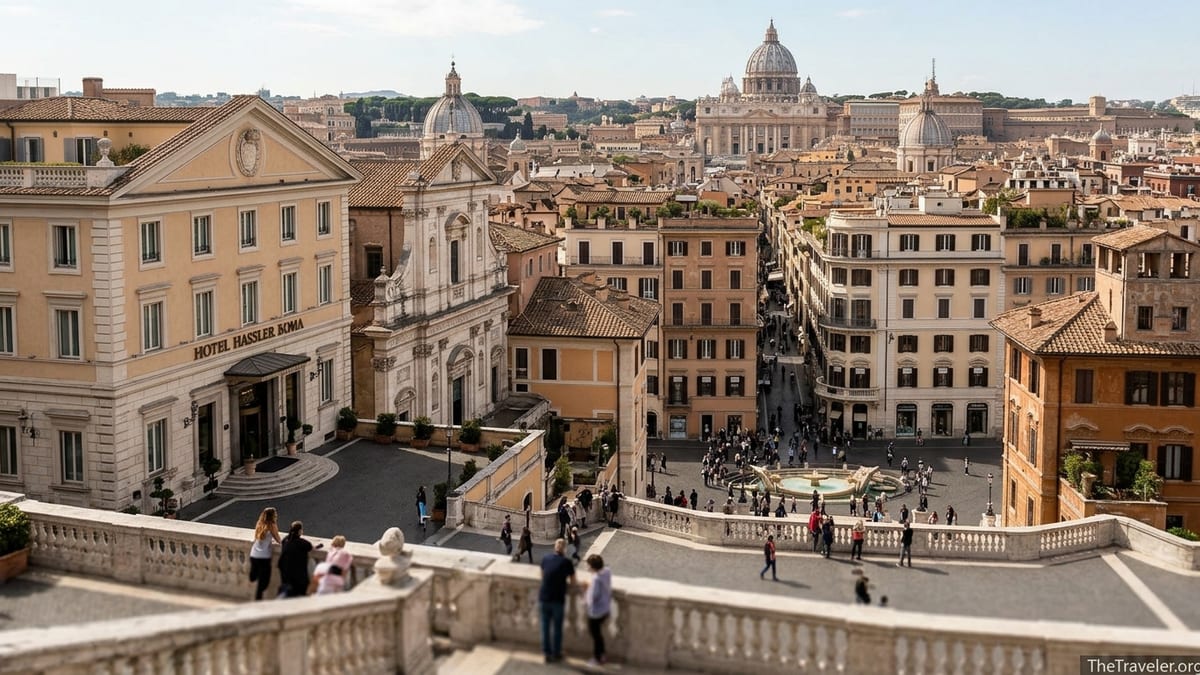
Hotel Hassler Roma occupies one of the most recognisable positions in Rome: an independent, family-owned five-star luxury hotel perched at the top of the Spanish Steps, with the city’s domes and rooftops spread out below. Long managed by the Bucher Wirth family and recognised by publications such as Forbes Travel Guide and Condé Nast Traveller for its Old World style and personalized service, it has become a byword for classic Roman glamour rather than a branded, corporate stay. For high-end travelers weighing whether to reserve the Hassler or book another central luxury property, the question is not about naming a single "best" hotel in Rome, but about understanding which address best matches their priorities, style, and budget.
Get the latest updates straight to your inbox!
How the Hassler Fits Into Rome’s Luxury Hotel Landscape
Hotel Hassler Roma is an independent, family-run property with around 87 rooms, including 21 suites, according to its press material. It stands directly beside the church of Trinità dei Monti at Piazza Trinità dei Monti, crowning the Spanish Steps in the heart of the historic center. Official fact sheets emphasize its heritage as one of the city’s longstanding luxury hotels, operated for generations by the Bucher Wirth family rather than by a multinational group. Its membership in consortia such as The Leading Hotels of the World and recurring coverage in international travel media underscore its position among Europe’s notable independent grand hotels.
To understand whether the Hassler is the right choice, it helps to compare it with a small set of true peers: central, five-star luxury hotels operating at similar price points and service levels. For this article, we look at three such properties whose current five-star status, central locations, and upscale positioning can be verified as of mid-November 2026: Hotel de Russie and Hotel de la Ville, both part of Rocco Forte Hotels, and Bvlgari Hotel Roma, opened in 2023 by the Roman jewelry house and already noted by sources such as the MICHELIN hotel selection and fashion and lifestyle publications for its high design, expansive spa, and premium pricing.
All four properties sit within or just at the edge of Rome’s historic core and typically command some of the city’s highest nightly rates. Yet they deliver very different experiences: the Hassler and Hotel de Russie lean into heritage and lush urban oasis settings, Hotel de la Ville blends maximalist color with Grand Tour flair and lively public spaces, while Bvlgari Hotel Roma offers contemporary Italian luxury in a monumental 1930s building overlooking the Mausoleum of Augustus. Deciding whether the Hassler is “worth it” therefore depends on how you value its singular location, traditional style, service culture, and comparatively intimate scale relative to these alternatives.
Location and Views: Hilltop Icon vs Garden Oasis vs Rooftop Panoramas vs Monumental Piazza
Location is where the Hassler’s case is strongest. The hotel sits literally at the summit of the Spanish Steps, above Piazza di Spagna. Official descriptions and independent reviews consistently highlight the way the city unfurls from its entrance and upper floors, with direct sightlines to landmarks such as the Villa Borghese gardens and St. Peter’s dome. Guests step out onto a small piazza relatively shielded from through traffic, yet descend a few dozen steps to be on Via dei Condotti and the surrounding luxury shopping streets. Taxi access is straightforward to the hotel’s rear entrance, and the Spagna metro stop is just below, though crowds on the Steps can be intense through most of the day.
Hotel de la Ville shares the same general hilltop setting at the top of the Spanish Steps, a short stroll from the Hassler. Official materials describe it as occupying an 18th-century palazzo with sweeping city views, and its rooftop Cielo Bar is promoted for panoramic vistas across Rome’s domes. Compared with the Hassler, De la Ville tends to feel a touch more embedded in the bustle of the upper Steps area, with a livelier rooftop scene that attracts non-resident guests for aperitivo. In practical terms, both hotels offer similar advantages in terms of walking access to the historic center and proximity to taxis and metro; the main difference is atmosphere rather than convenience.
Hotel de Russie, by contrast, sits between Piazza del Popolo and the lower end of the Spanish Steps, along the Via del Babuino corridor. Its official fact sheet describes it as “hidden in plain sight” with a multi-terraced secret garden climbing toward the Pincian Hill. This location trades the literal top-of-the-steps drama for easier car access and a slightly less frenetic street environment. You are still in the fashionable Tridente district, within an easy walk of the Steps and Via dei Condotti, but buffered by the garden from much of the street noise. Views here are more inward looking toward greenery and courtyard life, though top suites offer city and garden vistas.
Bvlgari Hotel Roma occupies a large 1930s building on Piazza Augusto Imperatore, across from the recently restored Mausoleum of Augustus and just off Via del Corso. Reviews and the MICHELIN hotel listing note its rooftop terraces and bar with wide-ranging views over Rome’s rooftops, as well as its proximity to both the River Tiber and central shopping streets. Compared with the Hassler, the immediate area is less of a postcard icon than the Spanish Steps, but it is still very central, and the broader square is in the midst of an ongoing urban renewal that lends a grand, somewhat theatrical backdrop with fewer tourist bottlenecks right on the doorstep.
Style and Atmosphere: Old World Grande Dame or Contemporary Italian Glamour
The Hassler’s public materials and recent profiles by outlets such as Condé Nast Traveller and Forbes Travel Guide describe its interiors as classically elegant, with marble, antiques, and a distinctly Old World, residential feel. Renovations over the past decade have refreshed rooms and suites while maintaining traditional detailing. The overall mood is that of a discreet grande dame: polished but not ostentatious, with muted tones, heavy fabrics, and framed art. For travelers who equate “Roman luxury” with historic interiors, white-gloved service, and a sense of continuity with past decades of celebrity guests, this atmosphere is a core part of the hotel’s appeal.
Hotel de Russie offers a different take on heritage. Rocco Forte’s branding and independent reviews often describe it as a historic grande dame with a more contemporary, cosmopolitan layer. Guest rooms typically feature a calm, modern-classic palette, while public spaces lean into the drama of the tiered garden and open-air dining terraces. The overall mood is elegant but relaxed, with a social scene that mixes hotel guests, locals, and international visitors in the bar and restaurant areas, especially in good weather. If you prefer greenery and alfresco energy to the Hassler’s more formal, enclosed salons, de Russie may feel more atmospheric.
Hotel de la Ville is intentionally bolder. Its design, overseen by Rocco Forte’s team and often described in travel features as “vibrant” or “Roman maximalist,” mixes patterned textiles, strong colors, curated art, and playful nods to the 18th-century Grand Tour. Rooms and corridors showcase richly layered fabrics and artwork, while the rooftop Cielo Bar and terraces create a see-and-be-seen environment that feels younger and more fashion-forward than the Hassler’s salons. Guests who find the Hassler’s decor too traditional may gravitate toward De la Ville’s more theatrical styling.
Bvlgari Hotel Roma, meanwhile, is positioned by the MICHELIN hotel guide and design media as a showcase of contemporary Italian luxury. Expect sleek marble, polished metals, custom furnishings, and substantial art and design details referencing Bvlgari’s jewelry heritage and Roman antiquity. Public spaces, including the dramatic spa and indoor pool area, aim for cinematic impact. The ambience is high-gloss and design-driven rather than nostalgic. Travelers drawn to cutting-edge interiors, a fashion-world clientele, and brand-name glamour may find Bvlgari more compelling than the Hassler’s quietly patrician style.
Rooms and Suites: Scale, Views, and Signature Accommodations
According to Hotel Hassler’s recent press kit, the property offers 87 rooms including 21 suites. Several of these suites, such as the Hassler Penthouse and the Penthouse Villa Medici, feature spacious terraces with panoramic views across Rome’s skyline, often highlighted in media coverage as some of the city’s most dramatic hotel viewpoints. Even some non-penthouse categories offer balconies or small terraces overlooking the Spanish Steps or toward St. Peter’s dome, though entry-level rooms may face the internal courtyard or side streets and feel relatively compact by international standards.
Hotel de Russie is a larger property. A 2026 factsheet and independent hotel guides report roughly 120 rooms, with around 34 suites and junior suites, depending on the source and recent reconfigurations. Signature accommodations such as the Nijinsky Suite and the Valadier Suite offer generous terraces overlooking the secret garden and toward the Pincian Hill, creating a rare combination of outdoor space and central-city privacy. Many standard rooms face either the internal garden or the street; garden-facing rooms are often prized for their tranquility, though some bathrooms in lower categories remain on the smaller side according to guest feedback compiled by specialist review sites.
Hotel de la Ville, based on Rocco Forte documentation and third-party factsheets, falls somewhere between the Hassler and de Russie in capacity, with on the order of 100 to 120 rooms and several dozen suites and junior suites. Top-tier suites such as the De La Ville, Canova, and Roma Suites include expansive terraces with near-360-degree views of Rome’s roofs and domes, which travel writers frequently describe as among the city’s most spectacular private vantage points. Many standard rooms are more compact, particularly those under the eaves, but benefit from the property’s strong design and, in some categories, skyline views.
Bvlgari Hotel Roma is relatively intimate given its footprint, with widely cited figures in travel press and booking platforms suggesting under 120 rooms and suites in total. The room inventory emphasizes generous square footage, high ceilings, and substantial suites, many with views over Piazza Augusto Imperatore, the Tiber, or Rome’s rooftops. Signature suites and corner rooms often incorporate Juliet balconies or full terraces, while interior design details such as marble bathrooms and bespoke furnishings align with the brand’s ultra-luxury positioning. For guests prioritizing large, new-build-style rooms over historic quirks, Bvlgari and de Russie may feel more spacious on average than the Hassler’s entry-level categories, though the Hassler’s top-floor penthouses rival any in the city for drama.
Dining and Bars: Imàgo’s Michelin Star vs Rooftop Scenes and Garden Dining
Dining is where the Hassler has a clear, verifiable edge: Imàgo, its flagship rooftop restaurant, holds one Michelin star in the 2027 MICHELIN Guide Italy. The official description highlights its setting as one of Rome’s iconic rooftop dining rooms, reached by elevator to a recently renovated space with an open kitchen and carefully designed lighting. The guide and independent reviewers emphasize both the refined contemporary Italian cuisine and the extraordinary views over landmarks such as the Spanish Steps and St. Peter’s dome. Within the hotel, guests also find more casual options, including a bistro-style venue and the intimate Hassler Bar, though these are not Michelin-listed.
Hotel de Russie’s primary restaurant, Le Jardin de Russie, is not currently starred by MICHELIN but is well known in Rome for its terrace set within the hotel’s multi-level garden. This unusually lush setting in the heart of the city is often cited by lifestyle and interior design outlets as one of the most attractive hotel gardens in Europe, and the restaurant and Stravinskij Bar draw a mix of hotel guests and locals for upscale but relaxed dining and cocktails. While the gastronomic ambition may be less formal than at Imàgo, the garden setting can be more appealing for travelers who prefer al fresco evenings among greenery rather than a dressy tasting menu.
Hotel de la Ville positions itself as a social, food-forward property. Its rooftop Cielo Bar is regularly singled out in travel guides as one of Rome’s standout terraces for aperitivo, with an expansive sixth-floor terrace and live panoramas over the city. Inside, the property offers multiple dining options, including a main restaurant and bar spaces that reflect the hotel’s colorful design ethos. At the time of writing, none of these venues hold a Michelin star, but their combination of setting and atmosphere positions De la Ville as a strong choice for guests who enjoy in-house nightlife and vibrant communal spaces more than destination fine dining.
Bvlgari Hotel Roma hosts Il Ristorante – Niko Romito, named after the acclaimed Italian chef associated with several Michelin-starred ventures. The restaurant has been profiled by MICHELIN’s hotel platform and design media for its sophisticated Italian menu and elegant dining room, and the hotel’s rooftop bars and lounges are frequently highlighted for their city views and fashionable clientele. As of November 2026, Il Ristorante – Niko Romito in Rome is not listed as starred in the Italy 2027 MICHELIN restaurant guide, but it is often mentioned alongside other high-end dining addresses in the city. Guests considering Bvlgari for gastronomy should check for the most current accolades around their planned travel dates.
Service, Amenities and Spa: Intimate Hospitality vs Large-Scale Wellness
Service is one of the Hassler’s defining attributes. Interviews with the owning family and coverage in outlets such as Gio Journal and Forbes Travel Guide repeatedly underline the hotel’s emphasis on personalized, long-tenured staff and a hands-on, family-run management style. The concierge team is affiliated with Les Clefs d’Or in Rome, signaling a high level of expertise in arranging bespoke experiences. Guests often describe the mood as "old school" hospitality: attentive, formal by contemporary standards, and oriented toward remembering repeat visitors and tailoring stays to individual preferences.
On the wellness side, the Hassler’s Amorvero Spa is located on an upper floor and, according to the hotel’s wellness page and Italian-language fact sheet, offers a fitness center, massage and beauty treatments, and a sauna with panoramic views, along with a small wellness area and solarium. In 2026 the hotel has also been developing an expanded, roughly 800-square-metre spa, which official text describes as a forthcoming “sanctuary of relaxation” with state-of-the-art facilities. At present, travelers should think of the Hassler’s spa offering as intimate and treatment-focused rather than a resort-style complex, and confirm the status of the expanded facility near their travel dates.
Hotel de Russie features the Irene Forte Spa, which hotel information pages describe as a full-service wellness center with treatment rooms, a mosaic-lined indoor pool, a sauna and steam facilities, and a fitness area equipped with contemporary machines. A 2025 refurbishment introduced a refreshed pool and upgraded spa spaces. For guests who place a high value on hydrotherapy and a comprehensive spa within the city center, de Russie generally offers more extensive facilities than the Hassler’s current set-up.
Hotel de la Ville also houses an Irene Forte-branded spa, positioned as a Sicilian-inspired wellness retreat within the hotel. Official descriptions note multiple treatment rooms, a hydrotherapy pool, sauna and steam areas, and even features such as a salt room and cryotherapy chamber. Combined with a fitness center and thermal circuit, this creates a notably robust wellness offering for a city-center property, appealing to travelers who want serious spa time without leaving the top-of-the-Spanish-Steps location.
Bvlgari Hotel Roma’s spa has already gained a reputation as one of Rome’s most elaborate hotel wellness spaces. The MICHELIN hotel listing and fashion magazines describe an expansive spa with a dramatic indoor pool lined in Bisazza mosaic, a vitality pool, various thermal features, and a full menu of treatments incorporating high-end skincare brands such as Augustinus Bader. For spa-focused travelers, Bvlgari and the Rocco Forte properties clearly outpace the Hassler in terms of square footage and facilities, though some guests may prefer the Hassler’s quieter, more private wellness environment and its emphasis on in-room or boutique-style treatments.
Price and Value: Where the Hassler Sits in the Rate Spectrum
Rates at all four hotels fluctuate significantly by season, lead time, and room category. As of mid-November 2026, sample searches on major booking engines and the hotels’ own channels for random midweek dates in late November and early March suggest the following very approximate ranges for entry-level rooms: Hotel Hassler Roma and Hotel de Russie often begin somewhere in the high hundreds to low four figures in euros per night, Hotel de la Ville in a similar bracket, and Bvlgari Hotel Roma significantly higher, frequently starting above the equivalent of 1,800 to 2,000 US dollars per night once taxes and fees are included for standard rooms.
Because rates can shift quickly and many luxury travelers book higher categories or suites, the most reliable way to compare value is to price equivalent dates and similar room types across all properties, ideally on both official websites and through a trusted advisor. The key pattern that emerges from recent publicly available pricing is that the Hassler generally sits in the upper tier of Rome’s rates but not necessarily at the absolute top, with Bvlgari often commanding a clear premium and the two Rocco Forte hotels overlapping with or slightly undercutting the Hassler depending on demand and room category.
To illustrate relative positioning, the following simplified table summarizes approximate starting points for entry-level rooms, along with each hotel’s flagship restaurant status and presence of a significant spa or pool. These ranges are indicative only and based on sample checks in November 2026; travelers should verify live rates for their specific dates.
Hotel | Typical entry-level nightly rate range (sample checks, late 2026) | Signature restaurant recognition | Spa / pool
Hotel Hassler Roma | Approximately high-hundreds to low four-figure euro range, depending on season and availability | Imàgo with one Michelin star in the 2027 MICHELIN Guide Italy | Boutique Amorvero Spa with fitness room and sauna, expanded spa in progress, no large pool
Hotel de Russie | Broadly comparable to the Hassler, sometimes slightly below or above depending on dates | Le Jardin de Russie, not Michelin-starred but widely covered for its garden dining | Irene Forte Spa with indoor mosaic pool and full wellness facilities
Hotel de la Ville | Similar bracket to de Russie and Hassler, occasionally offering more aggressive entry rates in shoulder seasons | Multiple lively dining venues and Cielo rooftop bar, no current Michelin star | Irene Forte Spa with hydrotherapy pool, thermal circuit, and treatment rooms
Bvlgari Hotel Roma | Often significantly higher than the others, with entry-level rooms frequently above roughly 1,800–2,000 USD equivalent including tax on peak dates | Il Ristorante – Niko Romito, highly profiled but not starred in the 2027 MICHELIN list as of publication | Large, design-led spa with extensive thermal facilities and dramatic indoor pool
In value terms, the Hassler tends to justify its rates through its combination of iconic location, heritage, Michelin-starred dining, and personalized service rather than through sheer room size or spa scale. For some guests, especially those staying in view suites or penthouses, that package feels well worth the premium. Others may find that a similarly priced garden suite at de Russie or a spa-focused stay at De la Ville or Bvlgari better matches their personal definition of “worth it.”
Who Should Choose Which Hotel?
For travelers drawn to historic character, long-standing reputation, and the romance of the Spanish Steps, Hotel Hassler Roma will be hard to beat. It suits guests who appreciate traditional decor, intimate public spaces, and a service culture rooted in family ownership and continuity. If your dream is a terrace breakfast looking down over the Steps, a tuxedoed dinner at a Michelin-starred rooftop restaurant, and evenings in a classic hotel bar, the Hassler’s particular mix of elements justifies both the rate and the slightly smaller spa and room footprints in lower categories.
Hotel de Russie is an excellent choice for those who value a lush, resort-like oasis in the middle of the city. Its terraced garden, relaxed yet polished atmosphere, and full-scale spa and pool appeal to couples, families, and design-conscious travelers who prefer greenery and open air to dramatic hilltop views. If you plan to spend significant downtime on property between sightseeing or want a visually memorable outdoor setting for meals and events, de Russie may offer better day-to-day enjoyment than the Hassler, especially in warm weather.
Hotel de la Ville is best suited to guests who want both the top-of-the-Spanish-Steps location and a more contemporary, social vibe. Its bold interiors, lively rooftop bar, and extensive spa facilities make it a natural fit for style-focused travelers, multigenerational groups, and friends’ getaways who enjoy in-house buzz and are less attached to the stricter formality of a classic grande dame. If you like the idea of stepping out onto the same hilltop as the Hassler but spending your evenings in a more high-energy environment, De la Ville is a compelling alternative.
Bvlgari Hotel Roma, finally, will appeal most to travelers prioritizing cutting-edge design, large and exceptionally finished rooms, and a destination spa. It is a logical choice for brand-loyal Bvlgari clients, fashion insiders, and guests for whom price is a secondary consideration to having Rome’s newest, most visually dramatic urban resort at their disposal. The trade-off is that while the hotel is central, it lacks the emotionally resonant image of the Spanish Steps or secret garden, relying instead on monumental architecture, interiors, and facilities to deliver its sense of place.
In the end, whether Hotel Hassler Roma is “worth it” comes down to how much value you place on its singular combination of heritage, intimate scale, and views. If your priorities skew toward historic ambiance, a family-run ethos, and a one-Michelin-star rooftop restaurant overlooking Rome, the Hassler remains one of the city’s most compelling choices. If, however, your idea of Roman luxury centers on expansive modern spa facilities, resort-like gardens, or cutting-edge design, you may find a closer fit at Hotel de Russie, Hotel de la Ville, or Bvlgari Hotel Roma. By clarifying these priorities and checking live rates for your specific dates, you can choose the property that feels truly "worth it" for your own Roman holiday.