


Tucked into the remote canyons of Utah’s Bears Ears region, Junction Ruin sits at the meeting point of sandstone walls, cottonwoods and flowing water. It is not a place you stumble upon by accident. Reaching this Ancestral Puebloan cliff dwelling requires hours of driving, a wilderness mindset and a willingness to walk several miles through a rugged desert gulch. For hikers and history lovers who make the journey, the obvious question becomes whether Junction Ruin is really worth all the effort. The answer, according to recent visitors and backcountry rangers, is a qualified but enthusiastic yes.
Get the latest updates straight to your inbox!
Where Exactly Is Junction Ruin and What Is It?
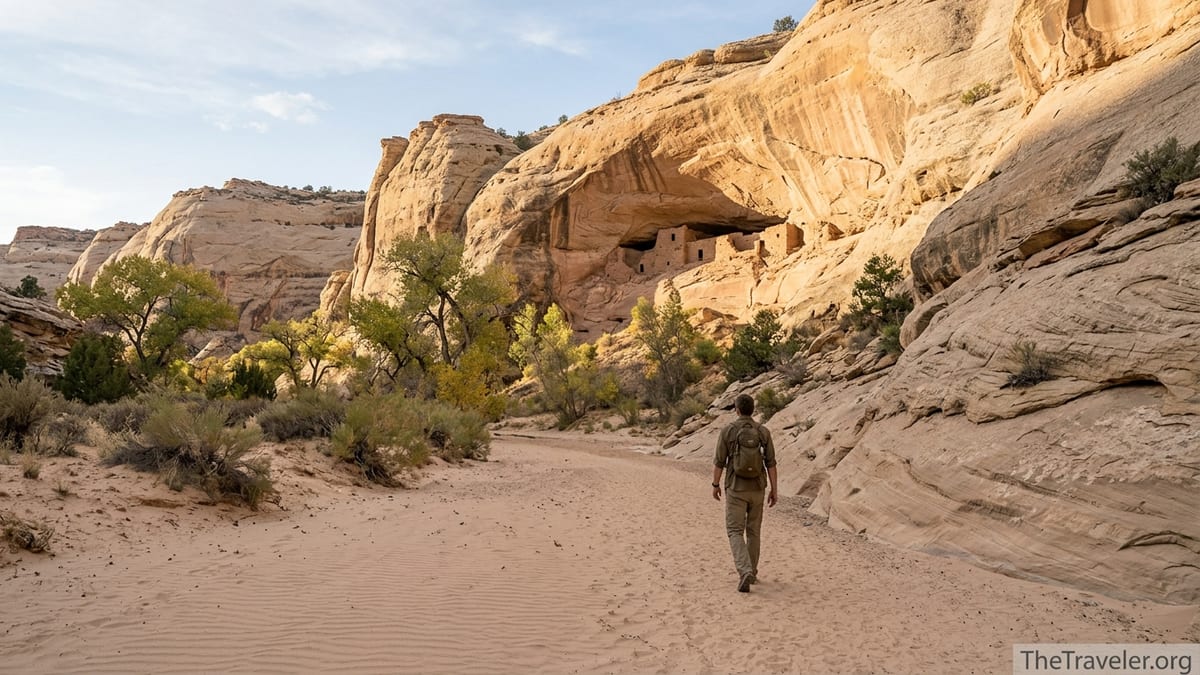
Junction Ruin lies in Grand Gulch, a tributary canyon system on Cedar Mesa in southeastern Utah, within the Bears Ears National Monument landscape. It sits near the confluence of Kane Gulch and the main Grand Gulch drainage, roughly 4 miles from the Kane Gulch Ranger Station on Utah Highway 261. The ruin itself is an Ancestral Puebloan site built into alcoves along the canyon walls, with masonry rooms, storage spaces and associated rock art visible from the canyon floor. Visitors come not for a developed museum experience, but to see these features in situ, in the same landscape that sustained their builders centuries ago.
Grand Gulch is famous among archaeologists and backpackers for its density of cliff dwellings, granaries and kivas. The Bureau of Land Management and conservation groups describe this area as one of the richest concentrations of Ancestral Puebloan sites in the American Southwest. Junction Ruin is often suggested as an introductory hike because it combines a reasonably moderate day outing with the chance to see a substantial ruin complex, instead of just a single granary or isolated wall. Hikers typically pair it with nearby features like Turkey Pen Ruin and Stimper Arch for a full day in the canyon.
Unlike destinations such as Mesa Verde National Park or Aztec Ruins National Monument, which offer paved paths, ranger tours and visitor centers, Junction Ruin remains a backcountry site. There are no signs in the canyon telling you where to stand for a photograph or which wall to examine first. The experience is closer to a desert exploration than a formal heritage attraction. That rawness is precisely what many visitors value.
What the Hike Actually Involves
The classic way to reach Junction Ruin starts at the Kane Gulch Ranger Station, a small outpost north of Mexican Hat and south of Natural Bridges. From the trailhead, hikers descend Kane Gulch for roughly 4 miles to the junction with Grand Gulch. Route descriptions from backcountry guide services and trip reports suggest most reasonably fit hikers complete the out and back in 4 to 6 hours, depending on side explorations and conditions. Elevation change is moderate by mountain standards, but the walking is on sandy wash, bedrock, and occasionally uneven boulders rather than manicured trail.
Recent guide write ups describe the initial descent as straightforward, with cairns and a well used path leading into the canyon. As you drop, the landscape shifts from open pinyon juniper woodland to steepening sandstone walls and shady cottonwood groves. In spring, small streams and pools often linger along the canyon bottom, which can mean mud and shallow wading in places. In late summer, the wash can be mostly dry, making for easier footing but a hotter, dustier hike. Temperatures in this part of Utah can exceed 90 degrees Fahrenheit on sunny days from late May through early September, so many hikers aim for April, early May, late September or October.
Time estimates alone do not capture the character of the hike. Unlike a quick roadside stop at a ruin overlook, hiking to Junction Ruin requires route finding attention. There are sections where social trails braid through willows, and GPS tracks can appear offset by tens of meters under steep canyon walls. Experienced visitors often recommend carrying a printed topographic map of Grand Gulch, a GPS app with an offline map, and the exact mileage notes from a trusted guide description rather than relying solely on one digital track.
First Impressions: What Hikers Say on Arrival
Hikers who have written recent trip reports tend to describe the approach to Junction Ruin as subtle rather than dramatic. From below, you first see hints of masonry tucked high in an alcove, then additional rooms and storage structures become visible as the light shifts and your eyes adjust. Some visitors mention walking past the main cluster on their first visit, only realizing they had overshot when looking back from further down canyon. On a return pass, the ruin suddenly appears obvious against the patinaed rock, framed by cottonwoods.
Once you identify the main complex, the scale becomes more apparent. Instead of a single doorway, you see multiple rooms, collapsed walls and intact ledges that once held timber roofs. On the canyon floor below there are often potsherds, worked stone flakes and other cultural materials scattered in the sand. Responsible visitors are careful not to touch or move anything, but simply note the density of artifacts as a sign of how intensively this area was used. Many hikers describe sitting quietly in the shade, listening to canyon wrens and imagining what daily life might have sounded like when the site was occupied.
The emotional response varies. Some visitors emphasize the thrill of discovery, especially compared with heavily interpreted sites. They talk about spotting a faint handprint or the ghost of a painted spiral on a shaded wall and feeling like they have stumbled into a secret. Others focus on the solemnity of the place. They point out that these are not “ruins” in the theme park sense, but the remnants of homes and community spaces belonging to the ancestors of living Native peoples. For travelers accustomed to bus tours and gift shops, that quiet, unscripted encounter can be the most powerful part of the visit.
Why History Lovers Consider Junction Ruin Special
From a historical perspective, Junction Ruin is valuable because it sits within a broader network of Ancestral Puebloan sites across the Four Corners region. Grand Gulch, Cedar Mesa, Bears Ears and nearby canyons preserve structures dating primarily from the late Pueblo periods, roughly between the 11th and 13th centuries. Archaeologists see this as a time of both innovation and instability, with communities building increasingly complex cliff dwellings and towers while also facing environmental and social pressures that eventually led to regional population movements.
At Junction Ruin, you see some of these characteristics up close. The masonry shows careful stone selection and tight joint work in places, while other walls look hastier or heavily repaired, hinting at different construction phases. Storage rooms high on narrow ledges suggest an emphasis on protecting food supplies, something that appears at other sites like Citadel Ruin and Split Level Ruin elsewhere in the Bears Ears landscape. When you compare these details with better documented sites such as Hovenweep’s tower communities or the Great Houses at Aztec Ruins National Monument, you start to appreciate Junction Ruin as part of a sophisticated cultural world rather than an isolated curiosity.
For visitors with an interest in Indigenous history, Junction Ruin also offers a chance to reflect on continuity. Many present day Pueblo and other Native communities maintain cultural and spiritual connections to this region. While Grand Gulch itself does not have the formal interpretive exhibits of a national park, you can bring that context with you by reading tribal perspectives on Bears Ears before your trip. Travelers who do this homework often report a more nuanced appreciation of what they are seeing. They talk less about “lost cities” and more about ancestral homes and enduring relationships with place.
Is It Worth It for Casual Hikers?
Whether Junction Ruin is “worth it” depends heavily on your expectations and experience level. For seasoned day hikers or backpackers who already enjoy desert routes in places like Escalante, Canyonlands or Grand Staircase, the 8 mile round trip is a moderate outing with a substantial reward at the turnaround point. The combination of canyon scenery, reliable solitude outside peak holiday weekends, and the chance to explore a significant ruin complex makes it an easy yes for many in this group.
For more casual hikers who are used to short, paved loops at national parks, the calculus is different. The hike demands comfort with uneven footing, potential water or mud, and limited shade. Summer heat adds another layer of challenge. Some travelers who try to fit Junction Ruin into a fast paced road trip through Monument Valley, Arches and Mesa Verde discover that the outing takes longer and feels more committing than expected. A few online reviewers mention turning around early due to time or energy, even though the trail itself is not technically difficult.
If you are relatively new to hiking but curious about Grand Gulch, there are ways to stack the odds in your favor. Start very early in the morning to avoid midday heat. Carry more water than you think you will need, at least 2 to 3 liters per person in cool weather and more in the warm season. Consider using trekking poles for stability in the sandy wash. Perhaps most important, treat the day as a dedicated Junction Ruin experience rather than an extra stop on a long driving day. When approached as the main goal, the hike feels much more rewarding and far less rushed.
Logistics, Permits and Realistic Costs
Junction Ruin is managed as part of the Grand Gulch area by the Bureau of Land Management. As of mid 2026, day hiking in Kane Gulch to Junction Ruin typically requires a self issue permit obtained at the Kane Gulch Ranger Station or nearby kiosks. There may be a modest per person or per group fee that helps fund trail maintenance and cultural resource protection, so travelers should budget for that in addition to the cost of reaching this remote part of Utah. Regulations can change, so it is wise to check the latest guidance from local land managers or visitor centers in Blanding or Bluff before your trip.
Reaching the trailhead involves significant driving. From Moab, expect roughly 2.5 to 3 hours of travel time, largely on paved highways but with the final approach on Utah 261 across Cedar Mesa. From Flagstaff or the Grand Canyon region, travelers often overnight in Page, Kayenta, Bluff or Mexican Hat before tackling the hike. Fuel, groceries and gear are limited once you leave the larger towns; many visitors stock up in Moab, Cortez or Farmington before heading into the Bears Ears backcountry.
Costs beyond fuel and permits are flexible. Budget travelers often camp on nearby public land, using free or low cost dispersed sites on Cedar Mesa or along Highway 95, while others choose simple motels in Blanding or Bluff. Guided outings with professional backcountry companies based in Utah, Colorado or New Mexico generally start in the low hundreds of dollars per person for a full day, which includes transportation, navigation, safety gear and interpretation. For visitors unfamiliar with desert travel or uneasy about route finding, that expense can be a worthwhile investment in both safety and understanding.
How Junction Ruin Compares to Other Southwestern Ruin Sites
Travelers often weigh Junction Ruin against more famous destinations when planning limited vacation time. Compared with Mesa Verde National Park in Colorado, Junction Ruin offers far more solitude and a sense of raw discovery, but far less detailed on site interpretation and no ranger led tours through kivas or multi story dwellings. At Aztec Ruins National Monument in New Mexico, you can walk through reconstructed Great House rooms, see original timber beams and explore a rebuilt great kiva in under two hours. Junction Ruin, by contrast, requires a half to full day just to reach a single complex, and you will mostly observe it from the canyon floor or distant ledges.
Within Bears Ears and Cedar Mesa itself, Junction Ruin is sometimes compared to sites like Citadel Ruin, Moon House, or the cliff dwellings off Butler Wash. Each has its own character. Citadel Ruin sits at the end of a narrow sandstone fin with sweeping canyon views, making it especially dramatic for photographers. Moon House is known for its intricate interior walls and painted motifs, but it is currently managed with a permit quota and stricter seasonal access. Junction Ruin’s strengths are its location at a major canyon junction and the way it anchors a longer hike through classic Grand Gulch scenery.
If your primary goal is to see the most elaborate architecture with the least walking, developed parks like Mesa Verde, Wupatki or Aztec Ruins may serve you better. If you are seeking a blend of immersion in wild canyon country and respectful, low key encounters with ancestral sites, Junction Ruin stands out as a compelling choice. Many experienced desert hikers who have visited a broad range of sites rank it as one of the better introductory day hikes in the Bears Ears region.
Respecting a Living Cultural Landscape
Any discussion of whether Junction Ruin is “worth visiting” has to acknowledge the responsibilities that come with visiting sacred ancestral places. Local land managers and Native advocacy groups emphasize that sites in Grand Gulch are not simply attractions but part of a living cultural landscape. That means following both the law and good etiquette: staying on durable surfaces, not entering or climbing on dwellings, never touching rock art, and leaving any artifacts exactly where you find them, even if they seem like small, unimportant fragments.
In practical terms, respect also looks like traveling in small groups, keeping noise levels low, and giving other visitors space for quiet reflection when they are observing a site. Some hiking trip reports describe informal group agreements to spread out along the canyon rather than bunching up directly below the ruin, so each party can experience a few minutes of relative solitude. Others mention taking time, before or after the hike, to learn from Native led organizations or published statements about Bears Ears and why communities advocated so strongly for its protection.
For many travelers, this ethic of respect actually enhances the sense of reward. The act of approaching slowly, observing carefully and leaving no trace can feel like a form of participation rather than restriction. Hikers who return to Grand Gulch several times often describe how their behavior evolved: from early, enthusiastic photography and close inspection of walls to later visits where they sit farther back, taking in the entire canyon and imagining Junction Ruin as one node in a much larger story.
The Takeaway
For hikers and history lovers willing to put in the effort, Junction Ruin is very much worth visiting. It offers a combination of moderate, engaging hiking, evocative canyon scenery and meaningful encounters with Ancestral Puebloan architecture that is hard to replicate at more developed sites. The journey from the Kane Gulch Ranger Station into Grand Gulch frames the ruin as part of a living landscape rather than a standalone exhibit behind a fence.
That said, Junction Ruin is not for everyone. Travelers who prefer short, paved walks, structured tours and extensive interpretive displays may find more satisfaction at national parks and monuments designed around easy access. Junction Ruin rewards those who are comfortable with route finding, prepared for desert conditions, and interested in doing a bit of homework about Bears Ears and its cultural significance before they arrive. Approach it with realistic expectations, good preparation and deep respect, and you are likely to leave feeling that the long drive and dusty miles were more than justified.
FAQ
Q1. How long does the hike to Junction Ruin take for most visitors?
Most day hikers should plan on 4 to 6 hours for the out and back from the Kane Gulch Ranger Station, including time to explore the area around the ruin and take breaks in the shade.
Q2. Do I need a permit to visit Junction Ruin in Grand Gulch?
Yes, you should expect to obtain a permit for day hiking in Kane Gulch and Grand Gulch, usually at the Kane Gulch Ranger Station or nearby self issue kiosks, and there may be a modest fee to support site protection.
Q3. What is the best season to hike to Junction Ruin?
Spring and fall are generally considered the best times, with April, early May, late September and October offering cooler temperatures and more comfortable hiking conditions than the peak summer heat.
Q4. Is the trail to Junction Ruin suitable for beginners?
The route is not technical, but it does involve uneven terrain, sand, possible water or mud, and limited shade, so it is better suited to hikers with at least some prior experience on desert or backcountry trails.
Q5. Can I visit Junction Ruin on a quick road trip through Utah’s parks?
You can include Junction Ruin in a broader itinerary, but it is best treated as a dedicated half day outing, as the remote drive, permit process and 8 mile round trip hike can be tiring if squeezed between long driving days.
Q6. Are guided tours available for Junction Ruin?
Yes, several regional outfitters and backcountry guide services offer day hikes and multi day trips into Grand Gulch, often including Junction Ruin, with prices typically starting in the low hundreds of dollars per person for a full day.
Q7. How does Junction Ruin compare with Mesa Verde or Aztec Ruins?
Junction Ruin is far more remote and undeveloped, with no paved paths or ranger led tours, but it offers greater solitude and a stronger sense of discovery than the more structured experiences at Mesa Verde or Aztec Ruins National Monument.
Q8. Is camping allowed near Junction Ruin?
Backcountry camping is allowed in parts of Grand Gulch under specific regulations, but camps must be set up away from archaeological sites, and overnight use requires additional permits and careful adherence to leave no trace practices.
Q9. What gear should I bring for a day hike to Junction Ruin?
At minimum bring sturdy hiking shoes, 2 to 3 liters of water per person in cool weather, sun protection, snacks or lunch, a detailed map or GPS with offline maps, a small first aid kit and layers for changing conditions.
Q10. Is it acceptable to approach or enter the rooms at Junction Ruin?
No, visitors are asked to stay off walls, avoid entering rooms or climbing into alcoves, never touch rock art, and leave all artifacts in place, treating Junction Ruin as a sacred ancestral site rather than a playground.