


Planning a trip to Japan in 2027 now requires careful attention to passport type, nationality and how you intend to enter the country. Japan has restored and expanded visa exemptions for many visitors, introduced an official eVISA system for others, and relies heavily on online arrival procedures. This guide brings together the latest official rules to help you understand whether you can visit visa free, when you must apply for a visa, and how real travelers from different countries should prepare before boarding a flight to Tokyo, Osaka or beyond.
Get the latest updates straight to your inbox!
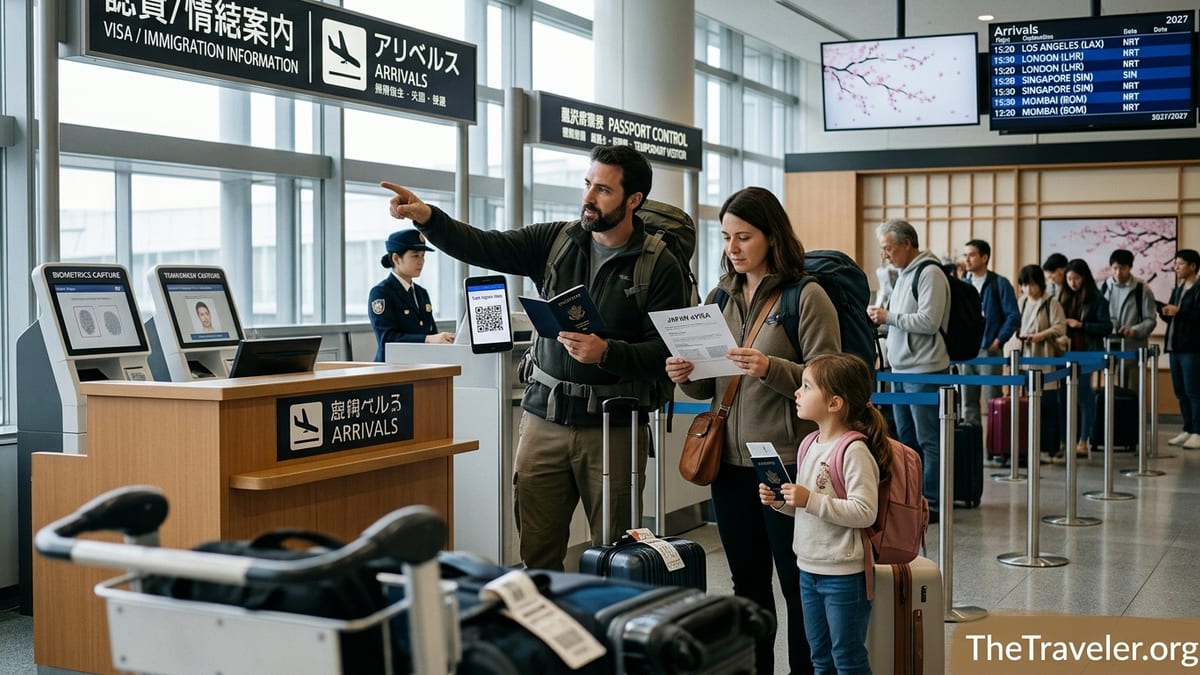
Verification date and overview of Japan’s 2027 visa landscape
This guide is based on information published by Japan’s Ministry of Foreign Affairs and Japanese consulates, reviewed against official material most recently available as of November 13, 2026. Japan’s visa exemption list for short stays currently covers 74 countries and regions, according to the Ministry of Foreign Affairs’ visa exemption page and recent consular summaries. That list has been stable through 2025 and 2026, and no concrete legal changes taking effect in 2027 have yet been announced. Travelers booking for 2027 should therefore plan using the rules described here, but should re-check the Ministry of Foreign Affairs and their nearest Japanese embassy site shortly before departure in case of last-minute diplomatic or security changes.
Japan distinguishes sharply between short-term visitors and people coming to work or reside long-term. Visa-exempt tourists and business travelers are usually admitted under a “Temporary Visitor” status for a fixed number of days, most often up to 90 days. A few nationalities enjoy up to 90 days on arrival with a possible extension inside Japan, while some territories and special passport arrangements receive shorter allowances, such as 15 or 30 days. Even if you do not need a visa before you travel, border officers still decide at the airport how long you may stay up to the legal maximum for your nationality.
For visitors who are not on the visa exemption list, Japan now operates the official JAPAN eVISA system for certain travelers, alongside traditional sticker visas issued at consulates. Separately, the Visit Japan Web service is increasingly used to speed up immigration and customs procedures through QR codes, but it does not replace a visa and does not itself grant permission to enter. Understanding the interaction between these systems is crucial for a smooth trip in 2027.
Across all categories, Japan’s fundamental rule is that you must hold a valid passport, satisfy the conditions of stay, and convince immigration that you will leave before your authorized period expires. There is no general six-month passport-validity rule in Japanese law for ordinary passports, but airlines and transit countries on your route may impose their own stricter standards, which you must also respect.
Visa-exempt visitors: major passport groups and stay durations
Citizens of the United States, Canada, the United Kingdom, Australia, New Zealand and all European Union member states are among the most common visa-exempt visitors to Japan. Ordinary passport holders from these countries can typically enter Japan without a visa for up to 90 days for tourism, business meetings, or visiting friends and relatives, provided they do not engage in paid work in Japan. For example, an American family flying from Los Angeles to Tokyo for a 14-day holiday in April 2027 can usually rely on visa-free entry, receiving a Temporary Visitor stamp for 90 days at Narita or Haneda airport, as long as their passports remain valid for their full stay.
Several other economically advanced or tourism-partner countries also enjoy 90-day visa-free stays. These include Singapore, Hong Kong SAR (with its own passport), South Korea, Israel and most of the visa-exempt countries in Oceania, the Middle East and Latin America. The Ministry of Foreign Affairs’ exemption table notes that some nationalities have bilateral arrangements that, in practice, allow an initial 90-day stay with the possibility of extending to up to 6 months by applying to a regional immigration bureau from inside Japan. This is a legal nuance that matters mostly to long-stay visitors, such as retirees spending an extended spring and summer in Kyoto, and it always requires official approval before the original 90 days run out.
At the other end of the spectrum, a small number of visa-exempt passports receive shorter entry periods. Examples that appear on the official exemption list include certain countries or regions that receive 15-day or 30-day permissions. These shorter stays often reflect reciprocal agreements or concerns about overstays and may also interact with requirements for electronic or biometric passports. For instance, some Middle Eastern travelers must hold an ePassport and complete a simple preregistration with Japanese authorities to enjoy their short visa-free window.
Regardless of the allowed maximum, visa-free entry never allows you to work in Japan in the ordinary sense. Tourists from Canada operating a remote online business for overseas clients from their hotel in Shinjuku for two weeks will typically not run into issues, but a British traveler teaching English in person for pay, or an Australian bartender taking shifts in a Sapporo bar during the ski season, would be acting outside the rules of a Temporary Visitor status and risk deportation and bans.
Key nationalities compared: US, Canada, UK, Australia, EU, India, China and ASEAN
For ordinary passport holders from the United States, Canada, the United Kingdom, Australia, New Zealand and the European Union, the position in late 2026 is clear: short-term tourist and business visits of up to 90 days are generally visa-exempt. A typical example is a couple from Toronto planning a 10-day Golden Week trip to Tokyo, Kyoto and Hiroshima in May 2027: they can usually board their direct flight with only a valid Canadian passport, confirmed accommodation for their first nights and proof of a return ticket. At Osaka Kansai airport, immigration will normally stamp them in for 90 days, even though they are staying much less.
Indian, Chinese, Indonesian, Vietnamese and Philippine ordinary passport holders are in a more complex situation. As of late 2026, most of these travelers continue to require some form of visa to enter Japan as tourists, although over the last decade Japan has created programs that ease travel for certain subgroups, such as holders of multiple-entry visas or residents of third countries. For example, India is a key market for Japan’s tourism strategy, but ordinary Indian passport holders typically need a short-stay visa, which they may now apply for through JAPAN eVISA if they reside in certain jurisdictions such as India, the United States or the United Arab Emirates.
Chinese tourists similarly remain subject to visa requirements, though Japan has experimented with multi-entry visas and facilitated schemes for affluent independent travelers and organized tour groups. In practice, a Chinese family living in Shanghai and booking a 7-day Tokyo and Osaka trip for October 2027 will almost certainly need to obtain a Japanese tourist visa in advance, either via the traditional consulate route or through a designated travel agency if local rules require it. If that same family holds permanent residence in Singapore or Hong Kong and travels from there, they might instead fall under eVISA-eligible categories, illustrating how residence can matter as much as nationality.
Within Southeast Asia, Indonesia, Vietnam and the Philippines have seen frequent adjustments to Japanese visa policy, sometimes expanding multi-entry visa availability, sometimes tightening conditions. Ordinary passport holders from these countries should not assume visa-free entry in 2027. Instead, they should check the eVISA eligibility list and consular instructions in their city of residence. For example, an Indonesian software engineer living in Jakarta but holding long-term residence in Singapore might find that she can apply online through JAPAN eVISA using her Indonesian passport and Singapore ID, complete biometric collection on arrival, and still enjoy a straightforward two-week holiday.
Special passport arrangements, biometric conditions and territorial nuances
Japan’s visa-exemption framework does not always map neatly to political nationality. Certain territories, types of passports and passport technologies have special conditions. For example, some Gulf states are visa-exempt only if the traveler holds a biometric ePassport and completes an electronic preregistration that must be approved before travel. In one widely discussed case, citizens from a Middle Eastern country must hold an ePassport and receive a confirmed QR-style approval email that airlines verify at check-in, in exchange for a short, typically 30-day, visa-free stay in Japan.
Other countries are visa-exempt only for ordinary machine-readable or ICAO-compliant passports, meaning that older non-machine-readable booklets may not qualify. Certain African states have bilateral exemptions for holders of special or diplomatic passports, but not for ordinary tourists, which can cause confusion. For instance, a senior official traveling on a diplomatic passport might enter Japan visa-free for official meetings in Tokyo, while his spouse holding an ordinary national passport must apply for a visa in advance.
Territorial distinctions also appear. Hong Kong and Macau residents holding their own Special Administrative Region passports can enjoy visa conditions different from those of mainland Chinese nationals, often with full 90-day visa-free entry. Similarly, British nationals must pay close attention to their precise passport type. Holders of a standard British citizen passport are generally visa-exempt for 90 days, while those traveling on other British nationality passports, such as British National (Overseas) or British Overseas Territories passports, may fall under different rules and should confirm their status with the Ministry of Foreign Affairs and the nearest Japanese embassy before purchasing non-refundable tickets for 2027.
Electronic passports can also determine eligibility for some tailored programs within the broader exemption regime. For example, citizens of one Gulf country became eligible for short-term visa-free travel to Japan only when using an ePassport and receiving a pre-departure email authorization attached to their passport number. Travelers planning a multi-country Asia itinerary in 2027 should confirm that the passport they carry for Japan is the same one used to obtain any electronic approvals, as changing to a newer passport between authorization and travel can invalidate their exemption.
Japan eVISA: who can apply, how it works and real-world timelines
Japan now operates an official JAPAN eVISA system that allows eligible travelers who still require a visa to complete much of the process online. According to the Ministry of Foreign Affairs, as of mid-2026 eVISA applications are open to foreign nationals residing in specific locations such as India, Indonesia, Hong Kong, Macau, Mongolia, South Korea (with some exceptions), Singapore and the United Arab Emirates, provided they are not already eligible for visa-free entry. Only ordinary passport holders traveling by scheduled international flight or passenger ferry can use the eVISA system, and applicants must still satisfy all usual documentary requirements.
In practice, an Indian software engineer living in Bengaluru who plans a 10-day cherry blossom trip to Tokyo in March 2027 may apply through JAPAN eVISA, uploading a scanned passport, a recent photograph, a detailed itinerary and proof of flights and accommodation. She might also need evidence of employment and bank statements to show sufficient funds. Several consulates report that eVISA processing times for straightforward tourist applications can range from about five working days to several weeks in busier seasons. Fees are usually similar to traditional paper visas and are typically collected online or at a designated bank, depending on consular practice in the applicant’s jurisdiction.
Some Japanese embassies in major cities, such as those in the United States and the Gulf, now explicitly direct many short-term tourist visa applicants to the JAPAN eVISA website, emphasizing that it is the only official online portal and warning against third-party sites that charge extra fees. Travelers should be wary of private agencies that advertise “guaranteed” Japanese eVisas or charge suspiciously high service fees. While legitimate travel agents in places like Manila, Hanoi and Jakarta may help prepare documentation, the visa decision is always taken by Japanese officials, and no agent can shorten official queues or promise approval.
It is important to distinguish eVISA from local consular procedures. Some nationalities and residents remain required to submit applications in person, especially for multi-entry, long-stay or non-tourist categories. Others may be able to submit documents through accredited agencies even if the final visa is stored electronically. By 2027, it is reasonable to expect that JAPAN eVISA coverage may expand to more countries and regions, but until new official announcements appear, travelers must rely on the currently published eligibility lists and check for updates before applying.
Visit Japan Web vs visa exemption: QR codes, biometrics and arrival steps
Visit Japan Web is an online system run by the Japanese government that streamlines airport procedures by allowing travelers to pre-register immigration, customs and sometimes quarantine information. It has become increasingly common for airlines such as Japan Airlines and All Nippon Airways to recommend that passengers create a Visit Japan Web account before flying, but it is essential to understand that this platform does not issue visas or change your underlying immigration status. A traveler who needs a visa must still obtain one separately, whether via eVISA or a consulate, even if they also use Visit Japan Web.
In practical terms, a typical arrival in 2027 at Tokyo Haneda might unfold as follows for an American tourist. Before departure, she enters her passport details, flight information, accommodation for the first night and customs declarations into Visit Japan Web, generating QR codes for immigration and customs. On arrival, she presents her physical passport at an automated gate or manned booth, lets the officer take a facial photograph and fingerprints where required, answers a few questions about the purpose and length of stay, and then shows her immigration QR code. After collecting luggage, she shows her customs QR code at a designated lane, where officers may still choose to inspect bags.
For travelers who do not or cannot use Visit Japan Web, paper Disembarkation Cards and customs forms remain available at airports and on inbound flights. In Osaka Kansai or Sapporo New Chitose, for example, you can still line up at a staffed immigration booth with your completed card, passport and return ticket printout. Officers will ask broadly similar questions: why you are visiting, where you will stay and when you intend to leave. Visit Japan Web does not grant any right to enter Japan; it only pre-fills these answers for faster processing.
Families traveling with children should register each child in their Visit Japan Web account or be ready to complete paper forms on arrival. Parents may be asked to present birth certificates or consent letters when one parent travels alone with a minor, particularly for children with different surnames, as part of standard anti-trafficking checks. The underlying immigration status, however, still depends on the child’s nationality and visa or exemption, exactly as for adults.
Passport validity, onward travel, funds and repeat entries
Unlike many destinations, Japan does not impose a universal rule that your passport must be valid for six months beyond your stay. Multiple Japanese consulates, including those in the United States, state that for ordinary passports used for tourist or business visits, the requirement is that the passport be valid for the intended period of stay in Japan, with at least one blank page for entry stamps or visa stickers. Some categories of travel documents, such as refugee travel documents or certain re-entry permits, may still face a six-month validity expectation, so holders of those documents must follow consular guidance carefully.
Despite Japan’s relatively flexible legal rule, travelers must consider airline policies and the passport rules of transit and onward destinations. For example, a U.S. citizen flying from Seattle to Tokyo and then onwards to Bangkok might technically be allowed to enter Japan on a passport that expires two months after her planned stay. However, her airline or the Thai authorities might require six months of validity. Airlines sometimes deny boarding for Japan flights when they believe a passenger may be refused onward travel from Japan, so it is wise to renew any passport with less than six months left before a complex 2027 Asia trip.
Proof of onward travel and sufficient funds are standard expectations on arrival. Japanese immigration or airline check-in staff may ask to see a return or onward ticket dated within your permitted stay, along with evidence that you can cover your expenses. Real-world examples include American backpackers asked to show a credit card and a recent bank statement at Narita, or European travelers showing prepaid hotel bookings in Shibuya and Kyoto as proof of accommodation. Cash is still common in some parts of Japan, but immigration does not require a specific minimum amount; officers assess your situation holistically.
Repeat entries and long regional itineraries raise additional questions. A British traveler who spends 80 days in Japan, leaves for a one-week trip to South Korea and then tries to re-enter Japan for another 80 days in the same year may face extra scrutiny. There is no formally published limit on how many times you can enter on visa exemption, but immigration can suspect de facto residency without proper status if they see a pattern of “visa runs.” Travelers planning extended time in the region, splitting their months between Tokyo, Taipei and Seoul, should consider proper long-stay visas where appropriate rather than relying on repeated short stays.
Dual citizens, children, emergency passports and changing documents
Dual citizens and people who can travel on more than one passport must pay close attention to Japan’s expectations. Japanese law generally requires Japanese citizens, including dual nationals, to enter and leave Japan using a Japanese passport. A dual Japanese–American living in New York who wishes to visit family in Osaka in 2027 should therefore renew and travel on her Japanese passport, not rely on U.S. visa exemption, even if airline online check-in systems sometimes appear to accept only one nationality.
For non-Japanese dual citizens, consistency is crucial. If a traveler uses a French passport to check in for a Paris–Tokyo flight and then presents a Canadian passport on arrival, immigration officers may question the mismatch. It is usually safest to use the same passport throughout your trip for tickets, Visit Japan Web, visas or eVisas, and border control. If you must change passports between booking and travel, for example after a lost passport incident, you should update airline records and carry both the old and new passports, especially if a visa or electronic registration is tied to the old number.
Emergency passports and temporary travel documents can be used to enter Japan in some circumstances, but the rules are stricter. For instance, a U.S. citizen who loses her passport in Seoul and obtains an emergency passport from the U.S. embassy may still be able to fly to Japan for a pre-booked three-day Tokyo business meeting, but the Japanese authorities and airline must accept that document. Some Japanese consulates explicitly require at least six months validity when the traveler is using a refugee travel document or similar paper, so anyone relying on these should obtain written confirmation from the Japanese embassy or consulate before travel.
Children follow the same visa rules as adults based on their nationality and passport type. A Brazilian child traveling with parents on an ordinary Brazilian passport may need a tourist visa in advance, potentially via eVISA if the family qualifies. Conversely, a child with dual Brazilian and Italian citizenship could travel on the Italian passport and enter visa-free for up to 90 days. Parents should ensure each child has their own passport; family entries in a parent’s passport are not accepted for Japanese entry formalities.
Worked examples and passport-by-passport comparison
Consider a two-week holiday in October 2027 for different nationalities. A couple from Seattle using U.S. passports books round-trip flights to Tokyo Haneda, a Shinjuku hotel and rail passes. They use Visit Japan Web to pre-register, arrive with passports valid through March 2028 and a printed itinerary. At immigration they are stamped in for 90 days without needing a visa. A similar British couple from London, traveling on standard British citizen passports, experiences nearly identical procedures and outcomes.
Now imagine an Indian family of four living in Mumbai planning the same two-week itinerary. They first check the Ministry of Foreign Affairs site and find that Indian ordinary passport holders still require a visa. Because they reside in India, they are directed to use JAPAN eVISA, gathering employment letters, school certificates for the children, bank statements and hotel and flight confirmations. They apply online about six weeks before departure, receive their eVisas after three weeks, and then check in with their eVisa confirmations and passports. On arrival in Tokyo, they pass through the same immigration and customs counters as visa-exempt travelers but show their eVISA status when requested.
For a longer stay, say 75 days in spring 2027, a Canadian digital nomad might plan to base herself in Fukuoka while taking weekend trips around Kyushu. She enters visa-free for up to 90 days but does not work for Japanese clients. By contrast, a Brazilian freelancer wanting the same 75-day stay must likely secure a visa in advance, possibly a short-term tourist visa or another category if he intends to work with Japanese companies. Without it, he would be refused boarding or denied entry at the airport. In some bilateral cases, long-stay-friendly exemptions and extensions may allow certain nationalities to apply for extra time at a regional immigration bureau, but this is discretionary and never guaranteed.
A simplified comparison table can help clarify the situation for common passports as of late 2026, with rules expected to remain broadly similar into 2027, subject to confirmation before travel. Ordinary U.S., Canadian, British, Australian, New Zealand and EU passports are generally visa-exempt for up to 90 days for tourism and business, with no six-month validity rule beyond covering the stay. Japanese consular sources indicate that Singapore, South Korea, Hong Kong, Israel and several other nations also fall into this 90-day visa-free group. By contrast, ordinary Indian, Chinese, Vietnamese, Indonesian and Philippine passports usually require a visa, with many residents of listed countries eligible to use JAPAN eVISA. Brazilian passports usually require a visa as well, although Brazil–Japan agreements have occasionally created multi-entry and special arrangements for certain travelers. Travelers from countries not mentioned here must consult the Ministry of Foreign Affairs exemption list.
Because detailed numerical tables can quickly become outdated when governments change policy, readers planning 2027 trips should treat this comparison as a high-level map and always verify their own nationality and residence status with current official sources. When in doubt, contacting the Japanese embassy or consulate responsible for your place of residence and describing your passport type, planned travel dates and itinerary is the most reliable way to avoid last-minute surprises.
Concluding advice and official verification for 2027 trips
Japan in 2027 will remain one of the world’s most attractive destinations, from Tokyo’s neon corridors and Osaka’s food alleys to the quiet temples of Kyoto and the powder snow of Hokkaido. Yet the country’s border rules are nuanced, dividing travelers by passport nationality, place of residence, passport technology and purpose of stay. The restoration of Japan’s 74-country visa-exemption framework, combined with the rollout of JAPAN eVISA and widespread use of Visit Japan Web, means that preparing the right documents in advance is more important than ever.
To plan a smooth trip, start by confirming whether your nationality appears on Japan’s visa exemption list and, if not, whether you qualify for JAPAN eVISA from your place of residence. Next, ensure your passport will remain valid at least through your intended stay and preferably several months beyond, taking into account airline and transit-country rules. Prepare concrete evidence of onward travel, accommodation bookings and sufficient funds that you can show at the border if asked. Families, dual citizens and holders of emergency or special passports should double-check their particular circumstances with the nearest Japanese mission.
Finally, remember that visa exemption or an approved eVISA does not guarantee entry. Japanese immigration officers at Narita, Haneda, Kansai and regional airports make the final decision case by case, with the authority to limit stays or refuse admission. As of November 13, 2026, however, travelers who understand these rules, apply through official channels, ignore unofficial “guaranteed visa” offers, and arrive with honest answers and well-organized documents can expect an efficient welcome, leaving more time for real travel priorities like riding the Shinkansen, soaking in an onsen and exploring Japan’s cities and countryside.