


Taking a child abroad within Europe when only one parent or legal guardian is present is not just a question of buying tickets and packing a passport. Each European country sets its own rules on parental consent, airlines may add extra checks, and authorities often treat children who hold that country’s citizenship differently from visiting tourists. Understanding these distinctions before you travel can prevent distressing scenes at check-in or the border, including denied boarding or refusal of entry.
Get the latest updates straight to your inbox!
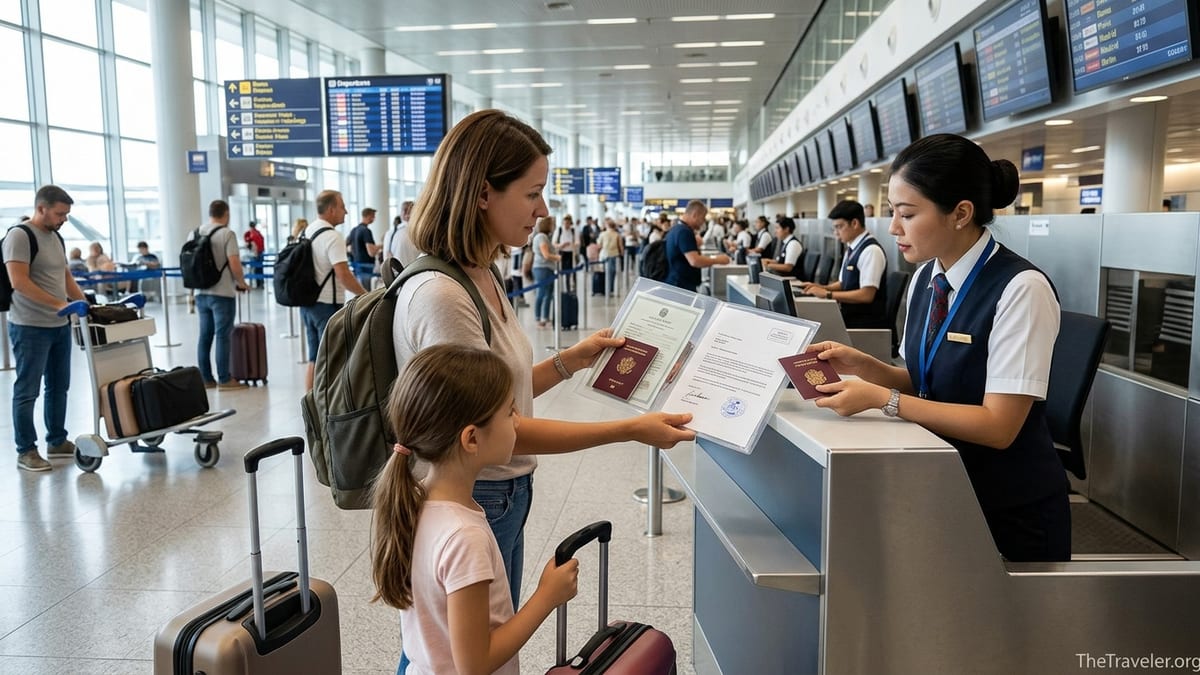
Why there is no single European rule
The European Union does not operate one universal rule on parental consent letters for children. There is no EU regulation that says every child must carry a notarised letter when travelling with one parent. Instead, each country keeps its own rules for how its nationals, including dual nationals, may leave or enter the territory. On top of that, airlines apply their own risk-based policies to prevent disputes and potential parental abduction cases.
The practical result is that an Italian border officer, a Romanian border police unit and a French prefecture may all approach the same family situation differently. In Romania, strict legislation governs how Romanian minors may leave the country and usually requires a notarised declaration of consent from the non-travelling parent when a child travels with one parent or another adult. In France, a specific exit authorisation form is compulsory only when a French minor leaves France without any parent, while a child leaving with one parent is not subject to the same formal requirement.
Airlines overlay these national rules with internal policies. For example, some large carriers that fly holiday routes into Spain and Greece routinely request proof of relationship, such as a birth certificate, where the accompanying adult has a different surname from the child. Low cost airlines sometimes include warnings in booking confirmations urging solo parents to bring a consent letter, even where not legally mandated, because carrier staff may be held responsible if they transport a child in a way that breaches local exit controls.
This fragmented landscape means parents should always check three separate sets of rules for each trip: exit rules of the child’s country of nationality and residence, entry rules of the destination country, and any documents specifically required by the airline. The safest assumption is that a child’s passport alone may not be sufficient when only one parent is travelling.
Who is travelling with the child and why it matters
Border authorities and airlines distinguish carefully between different types of accompanying adult. A child travelling with both parents who clearly share the same surname and present matching passports generally attracts the fewest questions. In contrast, a child travelling alone, with one parent only, with a grandparent, with another relative, or with an unrelated adult such as a coach or family friend may be asked to show additional evidence of consent, even on ostensibly routine holiday routes within Europe.
When a child travels only with one parent, officials focus on whether the non-present parent has agreed to the trip. In practice this can mean requests for an original or certified copy of the child’s birth certificate to prove parentage, plus a signed consent letter from the absent parent. Where parents are separated or divorced, a copy of any custody order can help demonstrate which parent holds decision making authority. For blended families, a step-parent’s surname mismatch often triggers extra questions at check-in, particularly on flights into the United Kingdom and Ireland.
For grandparents or other relatives, many European countries treat them as “other accompanying adults” rather than quasi-parents for border purposes. Ireland’s immigration service, for instance, notes that letters of consent should generally come from a child’s parents or guardians even if the child is travelling with an older sibling or another family member. In Romania, the law explicitly requires a declaration from the parents when a minor travels with another adult, and that declaration must identify the specific companion by name and document details.
When a child travels with an unrelated adult, such as a sports coach or host family, authorities usually expect more formal paperwork. Ireland can require background vetting of adults hosting a child arriving on a long-stay permission, while Romanian rules oblige the named companion of a Romanian minor to carry the notarised parental declaration and may even be checked for criminal records. For unaccompanied minors flying under an airline’s escort service, carrier-specific consent forms and handling documents will sit alongside any state requirements.
Italy, France, Spain and Germany: contrasting approaches
In Italy, the key distinction is whether the child is an Italian citizen. Italian authorities expect all minors to hold their own travel document. For Italian minors under 14 travelling without a parent or legal guardian, a formal “accompanying declaration” must be lodged with the police identifying the accompanying adult or airline, who then becomes legally responsible during the trip. Italian parents can also ask judges to restrict a child’s ability to leave Italy if there is a risk of abduction, in which case carriers are expected to respect the court order and may request extra evidence, such as a specific authorisation to depart abroad.
France takes a different approach. Since 2017, a French minor leaving France without at least one parent must carry an “autorisation de sortie du territoire”, a pre-defined exit authorisation form signed by a parent or guardian and accompanied by a copy of that adult’s identification. This rule primarily targets French citizens and some foreign minors resident in France. If the child is travelling with one parent, the formal exit authorisation is not usually demanded, though border officers can still question the circumstances where there is an apparent dispute between parents or a concern about abduction, sometimes after one parent has lodged an opposition to the child’s departure.
Spain focuses its specific rules on Spanish minors departing the country. Spanish police issue a standard travel authorisation for minors who will leave Spain without one or both parents. The form lists the trip details, duration, destination and any adult who may accompany the child, and can be supported by additional documents such as proof of sole parenthood or a court custody order. A Spanish child living in Madrid and flying with one parent to Germany may be allowed to travel without the police form if the other custodial parent consents informally, but border officers retain discretion and may insist on the standard authorisation at busy departure points.
Germany does not lay down a national law forcing consent letters for outbound travel in ordinary cases, but both German federal police and foreign ministries strongly recommend that children travelling alone or with only one parent carry a written declaration of consent from the non-present parent along with a copy of the child’s birth certificate. German consular missions abroad often publish sample consent forms in German and English that airlines and border guards are accustomed to seeing. For a German child with divorced parents, carrying the custody judgment and a consent letter can significantly speed up checks when entering or leaving other Schengen countries.
Romania, Ireland and the United Kingdom: stricter exit checks
Romania applies some of the most detailed exit rules in Europe to Romanian minors. Law 248 of 2005 requires that a Romanian child who leaves the country accompanied by only one parent or another adult generally present a notarised declaration of consent. This declaration sets out the destination country or countries, the travel period, the purpose of the trip and, where relevant, whether the child will remain abroad or return with a specified person. Romanian border police officers check these details carefully before allowing a child to board a flight or cross a land border. There are narrow exceptions, such as travel for essential medical treatment proved by official documents, or travel to join a parent who already has lawful residence in the destination state.
The Romanian rules apply regardless of any additional foreign nationality the child may hold. A child who is both Romanian and Italian but lives in Bucharest remains subject to Romanian exit law when departing Romania, even if they intend to use an Italian passport on arrival. As a result, a solo Italian parent flying from Romania with a Romanian child usually needs to present the notarised consent of the non-travelling parent or evidence of sole parental authority, such as a final custody judgment or a death certificate.
Ireland does not prescribe a single mandatory consent letter format for all cases, but immigration authorities make clear that a child travelling to or from Ireland with only one parent may be asked to show evidence that the other parent agrees to the journey. The Irish immigration service suggests carrying a letter of consent that names the child and travelling adult, travel dates, destinations and contact details for the non-travelling parent, along with supporting documents such as birth or adoption certificates. For visa-required nationals under 18, Irish visa guidance expressly lists a parental consent letter among the mandatory documents, and where a child will live with another adult in Ireland, that adult may need to undergo police vetting.
The United Kingdom also does not impose a universal statutory requirement for a consent letter, but border officers can and do ask for proof that the travelling adult has the right to take the child abroad. Official guidance recommends that a solo parent carry a signed letter from the other parent, or proof of sole responsibility, and warns that additional documents such as a birth certificate, divorce order, or adoption paperwork may be requested. Anecdotally, parents report that UK officers focus especially on children whose surname differs from the accompanying adult’s or where the family situation appears complex, such as separated parents meeting at the arrival airport.
Documents you may need beyond a child’s passport
Across Europe, several categories of document commonly arise in mixed family travel. The first is proof of the legal relationship between adult and child, usually an original or certified long-form birth certificate that lists both parents. This is particularly important when surnames differ or where the child uses a different nationality passport from the accompanying parent. For adopted children, certified adoption orders or new birth certificates are relevant, especially where the original parentage details are sealed.
The second category covers evidence of parental consent and custody. This can include a simple signed consent letter from the absent parent, more formal notarised declarations required by countries like Romania and Spain, and court orders allocating sole or joint parental responsibility. A parent with sole custody after divorce may need to show the final court judgment to explain why no consent is available from the other parent. If a parent has died, an official death certificate can substitute for consent and usually removes the need for an additional letter.
Third, travellers sometimes need to show documents proving the right of the accompanying adult to care for the child, especially when they are not a parent. For example, a British grandparent flying from London to Dublin with a grandchild might carry a copy of the parents’ consent letter that clearly names the grandparent, plus a photocopy of the parents’ passports. A Romanian coach leading a youth sports team out of Romania must hold notarised parental declarations that list each child, the route and destination, and confirm whether the child will return with the group.
Some situations also call for translations, notarisation, or even apostilles under the Hague Convention to ensure documents are accepted abroad. For instance, a Romanian notarised declaration intended for use at a border in Italy might be more readily accepted if accompanied by an authorised translation into Italian and, where necessary, an apostille from Romania’s designated authority. Parents should check costs in advance, as notarisation and translations can easily reach the equivalent of tens of euros per document.
Complex families, dual nationality and real travel scenarios
Family realities are varied and border rules do not assume that one parent’s presence automatically removes all legal requirements. In cases of separated or divorced parents with shared custody, many authorities expect that major decisions such as international travel will involve both parents. If a French mother travels with a child who also holds Romanian nationality and lives in Paris, flying to Bucharest for the summer, the family must think about both French exit practices and any Romanian expectations when the child later departs Romania with relatives. Possession of two passports does not relieve the obligation to meet each state’s rules for its own nationals.
Consider an Italian parent based in Milan who intends to fly from Bucharest to Rome with a ten year old child who holds Romanian citizenship through the other parent. Romanian border police will treat the child as a Romanian minor leaving Romania, so they may ask for a notarised consent declaration from the absent Romanian parent even if the child will enter Italy on an Italian residence permit or as a family member of an EU citizen. An Italian consent letter written in informal language would not substitute for the specific Romanian-form declaration. Without it, boarding could be refused at the gate in Bucharest.
Another example involves an American parent flying with a US citizen child to France for a summer holiday. France does not systematically demand consent letters at the border when a child arrives with a parent, so in most straightforward cases the family presents US passports and is admitted as tourists. However, the airline at departure from the United States may still ask for a consent letter if the other parent is not present, and French authorities could intervene if they receive an alert from the non-travelling parent or if there are visible signs of conflict, especially where the child also holds French nationality and is subject to French child protection measures.
A British parent travelling from Manchester to Barcelona with a child who carries the other parent’s surname illustrates another common situation. At UK exit checks or on return to the United Kingdom, an officer may ask about the relationship because the surnames do not match. Having the child’s full birth certificate showing both parents’ names, a copy of the other parent’s passport and a signed consent letter can help resolve questions quickly. The airline may also note this documentation at check-in as protection against later allegations of wrongful removal.
Airlines, Schengen borders, EES and UK ETA
Airline procedures often go beyond the bare legal minimum. Check-in agents are trained to look for risk factors such as mismatched surnames, one-way tickets for a child, or visibly distressed minors. Carriers flying from Romania, Spain or Portugal are particularly alert to national rules on exit declarations for minors and may refuse boarding if required documents are missing, even if the destination country does not ask for a consent letter. In contrast, some low cost airlines on short intra-Schengen routes may perform only minimal checks and rely on the destination border police to enforce local rules.
Inside the Schengen Area, air and land border checks are normally abolished for routine travel between most member states, though carrier identity checks and random police controls remain possible. Once the new Entry/Exit System for non-EU nationals is fully operational, children who are not EU citizens will have their entries and exits electronically recorded at the external Schengen border. Parents should be prepared for officers to ask extra questions the first time a minor is enrolled in EES, particularly if the child is travelling with only one parent. However, EES does not in itself impose a consent letter requirement; it simply tracks movements more precisely, which may increase scrutiny in parental dispute cases.
For the United Kingdom, many non-visa nationals will soon need an electronic travel authorisation before boarding. Even when a child is visa exempt and only requires an ETA, the UK’s standard expectation that solo parents be able to show proof of consent still applies. An airline may refuse to carry a family if the child’s ETA has not been approved, regardless of what parental paperwork is available. Similarly, children who are EU citizens but live in the UK must still meet any EU state’s documentation expectations when departing that country as nationals, which can matter in dual nationality cases.
Because airline and border rules intersect but do not always match perfectly, families should treat carrier check-in as the first border. Bringing an organised folder that includes passports, identity cards, birth or adoption certificates, court orders, consent letters and translations can keep the process smooth. Some parents choose to carry digital scans on a secure device in addition to originals, which can assist if documents are mislaid during a multi-leg journey.
Consent letters, legal formalities and practical timelines
A parental consent letter is not a magic document that replaces official forms required by certain countries. When France demands its specific exit authorisation for a French minor leaving without parents, only that official form, completed and signed appropriately, will do. Romania’s legislation similarly requires a notarised declaration that follows national content rules, not a generic template printed from the internet. However, a well drafted consent letter can still be extremely valuable in countries where there is no fixed statutory form but officials retain discretion to question a child’s travel.
In practice, a comprehensive consent letter contains the full names, dates of birth and passport details of the child and accompanying adult; clear travel dates; destinations; itineraries; confirmation that the non-travelling parent or guardian consents to the specific trip; and contact details at which they can be reached. It can also reference any relevant court orders or sole custody arrangements. Some parents have the letter witnessed by a local notary to reinforce its credibility. Notarisation may be legally required in Romania or for certain Spanish authorisations, whereas in the United Kingdom or Ireland it is usually an extra precaution rather than a formal legal obligation.
Preparation should start several weeks before departure where notarised or translated documents are needed. Obtaining a Romanian notarised declaration can involve appointment fees for both parents and the presence of identity documents. Translating a custody judgment into another European language through a sworn translator can add further cost. Each of these steps can easily cost the equivalent of 20 to 50 euros, so families should budget accordingly and prioritise key documents if resources are limited. For an urgent medical trip, some countries allow exceptions, but proof such as hospital letters will be essential.
Parents should also be realistic about missing or unreachable parents. Where a parent’s location is unknown, where parental rights have been removed, or where a parent refuses consent, it may be necessary to seek a court order granting permission to travel or confirming sole parental responsibility. Border guards are unlikely to waive statutory requirements based purely on a verbal explanation that the other parent is uncooperative. Legal advice may be needed in such cases, especially if long term relocation rather than a short holiday is planned.
Country by country matrix, costs and final checks
For departures from Italy, families with Italian minors should verify whether the trip triggers the need for a police “accompanying declaration” when no parent travels or when the child is under 14. Arrivals into Italy for non-Italian minors, such as American or British children on holiday, usually only require a passport and, where applicable, Schengen visa or residence card. Italy does not routinely ask foreign tourists for consent letters at the border, but airline agents may still request them when a child travels with one parent.
From France, French minors need the official exit authorisation only when leaving without a parent, while non-French children departing France are mainly subject to their own country’s exit rules. Spain expects its own minors leaving without parents to hold the national police authorisation, whereas foreign children merely follow ordinary tourist entry and exit requirements. Germany places emphasis on recommended documentation rather than statutory forms, but German children travelling alone or with one parent are strongly advised to carry consent letters and proof of custody to satisfy both German police and foreign officers.
Romanian minors face the most prescriptive departure regime, centred on notarised declarations that name destinations, dates and accompanying adults. Foreign children simply transiting through Romania on holiday are subject instead to the normal Schengen entry and exit procedures that now apply at Romanian air and sea borders. Ireland and the United Kingdom give immigration officers wide discretion to ask for proof of relationship and consent, particularly where the child appears vulnerable or the family circumstances are complex. In all these countries, dual nationals must remember that exit rules often depend on the passport and nationality the authorities recognise for that journey.
A sensible working matrix for parents therefore looks like this: one, check the child’s nationality or nationalities and look up exit rules on the official government or border police sites of that country; two, look at the arrival country’s immigration guidance for children and family visitors; three, read the airline’s conditions of carriage and any child travel advisories; and four, assemble a document pack that covers proof of identity, proof of relationship and proof of consent. As of November 2026, these broad principles remain stable, though specific forms and procedures can change, so travellers should always recheck official sources closer to the departure date.
Conclusion: prepare early, carry more than you need
Travelling within Europe with a child when only one parent or guardian is present demands more than a valid passport and a relaxed attitude at the airport. The absence of a single EU-wide parental consent rule means that national exit controls, airline policies and individual family circumstances combine to create a patchwork of expectations. Families who treat documentation as a core part of trip planning, alongside tickets and accommodation, experience far fewer difficulties at check-in and the border.
Whether you are an Italian parent flying with a Romanian child, an American arriving in France for a holiday, or a British parent travelling with a child who has a different surname, the safest strategy is to over prepare. Collect original civil status documents, up to date consent letters and, where necessary, notarised declarations or certified translations. Start this process several weeks ahead of travel, especially where dual nationality, complex custody or missing parents are involved.
By understanding how each country you pass through treats minors at the border and how airlines interpret their own safeguarding duties, you can minimise the risk of last-minute shocks in the departure hall. Careful, country-sensitive preparation gives border officers and airline staff the reassurance they need to let you and your child move smoothly across Europe’s borders.