


Planning to hop from Split to Korčula is one of the most rewarding route decisions you can make on the Dalmatian coast. The journey is straightforward, but the details matter: fast catamarans vs car ferries, where on the island you arrive, whether to stop in Hvar on the way, and how summer schedules affect your plans. This guide walks you through the real-world options that travelers are using for the 2026 season, with concrete examples to help you choose the right route.
Get the latest updates straight to your inbox!
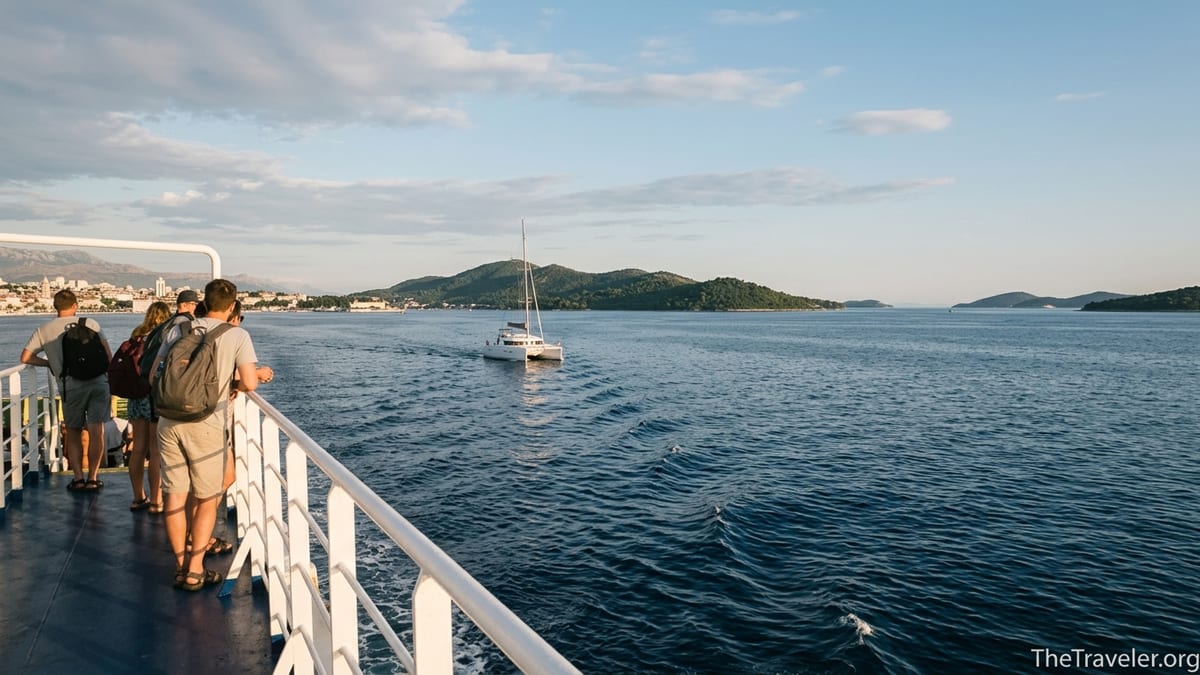
Overview: How Split Connects to Korčula in 2026
From Split, you can reach Korčula in two main ways in 2026: by direct passenger catamaran to Korčula Town and by a combination that uses the car ferry to Vela Luka on the western end of the island. On top of that, TP Line now operates a state fast passenger line linking Split, Hvar and Korčula, while Kapetan Luka–Krilo continues to run popular coastal catamarans that connect several islands in one journey.
In practice, this means that if you are traveling without a car, your easiest option is usually a direct catamaran from Split to Korčula Town, sometimes stopping in Hvar along the way. If you are driving, you will almost always use the Jadrolinija car ferry on the Split – Vela Luka – Ubli route and then cross the island by road.
Most services are heavily weighted to the main summer season, roughly late May to late September. Outside that window there are still ferries, but they run less frequently and often without the convenient midday timings that suit travelers connecting from flights or trains. Timetables can also vary slightly from year to year, so the examples below are based on current 2026 patterns and should be rechecked close to departure.
The key planning questions are: do you need to take a vehicle, which part of Korčula you are staying in, and whether you want to add Hvar or another island along the way. Once you answer those, the best route from Split becomes clear.
Direct Catamarans: Fastest Way to Korčula Town
For most foot passengers, fast catamarans are the simplest Split–Korčula option. Companies such as Kapetan Luka–Krilo and TP Line operate sleek, air-conditioned catamarans that cover the route in roughly 2.5 to 3 hours, often with one or two intermediate stops. A typical summer departure might leave Split mid-morning and arrive in Korčula Town around early afternoon, which is ideal for checking in to accommodation.
As a concrete example, a common pattern in peak season is a Kapetan Luka catamaran that sails Split – Milna (Brač) – Hvar Town – Korčula Town – Mljet – Dubrovnik. Travelers boarding in Split for Korčula simply remain seated as the boat calls at the intermediate islands. Another frequent pattern uses TP Line’s state fast line numbering, such as the Split – Hvar – Korčula route that serves islanders and visitors alike with at least one daily connection.
Tickets for these catamarans are usually bookable in advance through each operator’s website or app and are sold per seat, not per cabin. In high summer, especially July and August, departures to Korčula regularly sell out a few days ahead. For example, visitors staying in Split’s Old Town report turning up at the port and finding the next two days of late-morning catamarans fully booked. Buying tickets at least several days in advance is prudent if your itinerary is fixed.
On board, expect airline-style seating, luggage racks and a small bar selling coffee, soft drinks and basic snacks. Seating is not normally assigned; passengers choose any available seat after boarding. There is no option to bring a car on these services, and bicycles are often accepted only in limited numbers or not at all, so check the operator’s current policy if you plan to travel with a bike.
Car Ferries via Vela Luka: Best for Drivers
If you need your own wheels on Korčula, the key route from Split is the Jadrolinija car ferry that sails Split – Vela Luka – Ubli (Lastovo). This is a large, roll-on roll-off ferry used by locals, delivery trucks and tourists alike. The crossing between Split and Vela Luka usually takes around three hours, depending on the specific vessel and timetable, and generally operates year-round with extra sailings layered in during the summer months.
In a typical summer scenario, you might board a late-morning or early-afternoon ferry in Split, park your car on one of the vehicle decks and then spend the crossing in the passenger lounges or on the open deck. Real-world reports from recent seasons describe travelers paying a combined fare in the tens of euros for a standard car plus driver, with additional adult passengers ticketed separately. Exact prices change with Jadrolinija’s tariff updates, but expect the total for a family of four with a compact car to be a significant but manageable part of the travel budget.
On arrival in Vela Luka, you simply drive off the ferry and join the D118 road, which runs the length of Korčula from Vela Luka to Korčula Town. The drive across the island takes roughly 45 to 60 minutes, depending on traffic and photo stops. The road is scenic, with occasional pullouts overlooking vineyards and the Pelješac peninsula across the channel. Many visitors break the drive at Blato or Smokvica to buy local wine or olive oil before continuing on.
One critical operational detail is that, on some Jadrolinija car routes, tickets do not guarantee a specific sailing. For example, travelers have reported that while routes such as Sumartin – Makarska allow pre-booked vehicle spots on a specific departure, others like Split – Supetar operate on a first-come vehicle queue at the port. For Split – Vela Luka, policies can change with demand, so for 2026 it is wise to check whether your chosen departure accepts vehicle reservations or whether you must join the queue early, especially on peak changeover days such as Saturdays in July and August.
Stopping in Hvar on the Way: When It Makes Sense
Many of the catamarans linking Split and Korčula stop in Hvar Town, and some travelers deliberately structure their trip to spend one or more nights there. The classic pattern is to sail Split – Hvar Town on a morning catamaran, spend 1 to 3 days enjoying Hvar’s beaches, Pakleni Islands and nightlife, then continue Hvar – Korčula on a later sailing of the same or another line.
A practical example for summer could look like this: board a morning catamaran from Split to Hvar Town, arriving late morning. After two nights in Hvar, you take an early-afternoon TP Line catamaran from Hvar to Korčula Town, arriving in time for an evening stroll around the Old Town walls. Because several different lines serve both legs, you are not always locked into the same operator for the entire journey, but matching timings often works best when you stick with one company.
For day-trippers, trying to “do” Hvar and Korčula in a single day from Split is rarely realistic. Between sailing times, boarding procedures and the distance between islands, you would spend more time on boats and in queues than actually exploring. A more workable island-hopping day would be Split – Hvar and back, or Split – Brač and back, while giving Korčula at least one or two nights of its own later in the trip.
Those traveling with a car face additional complexity. There is no direct car ferry from Split to Hvar Town itself; instead, vehicles usually travel via Stari Grad on Hvar or via Sućuraj from the mainland near Drvenik. Combining a car trip to Hvar with an onward journey to Korčula by car from Split typically means returning to the mainland and then boarding the Split – Vela Luka car ferry. In practice, most visitors who want to island-hop Hvar and Korčula with a vehicle either keep the car on the mainland and travel as foot passengers between islands or accept that they will not be able to drive directly between them by ferry.
Summer Schedules, Booking Strategy and Luggage Tips
Summer schedules are denser and more convenient than off-season ones, but they also attract the biggest crowds. In July and August, it is common to see lines for catamarans forming 30 to 45 minutes before departure in Split’s port, with staff checking tickets and boarding passengers in waves. A good rule of thumb is to be at the catamaran pier at least 30 minutes before your scheduled sailing, and a full hour ahead if you are traveling on a peak weekend or with a group.
For booking, many experienced travelers treat catamaran tickets more like long-distance train tickets than casual commuter fares. For example, visitors heading from Split to Korčula to catch a pre-booked apartment stay and then an onward ferry to Dubrovnik will often buy their Split – Korčula catamaran tickets online several weeks out. On the other hand, travelers in May or late September, when demand is lower, sometimes report success simply buying tickets in Split a day or two before departure.
Luggage policies on fast catamarans are generally relaxed for normal suitcases and backpacks. Most vessels have dedicated luggage racks near the entrance, and passengers stow larger bags there before taking their seats. Small daypacks and handbags can usually be kept with you. There is rarely a formal weight check, but if you arrive with exceptionally bulky items, such as large sports equipment, staff may either charge a supplement or refuse carriage, so it is wise to check ahead if your luggage is unusual.
On car ferries, you can leave most of your luggage locked in the vehicle and bring only a small bag to the passenger decks. This is particularly useful on the Split – Vela Luka crossing, where space in the lounges and on the open deck can get busy at the height of summer. Remember that for safety reasons, access to the car decks is normally prohibited while the vessel is underway, so collect anything you might need before leaving your vehicle.
Arrival Points on Korčula: Korčula Town vs Vela Luka
Where you land on Korčula shapes the last leg of your journey. Fast catamarans from Split that are marketed specifically as Split – Korčula usually dock at or near Korčula Town on the eastern side of the island. This is convenient if you are staying in the Old Town, nearby suburbs like Medvinjak and Žrnovo, or resort areas such as Lumbarda, which is a short bus or taxi ride away.
By contrast, the car ferry from Split arrives in Vela Luka at the far western end of the island. Vela Luka itself is a pleasant harbor town, and some visitors choose to base themselves there for a quieter, more local feel. However, if your accommodation is in Korčula Town or Lumbarda, you should factor in the additional surface journey across the island. The main island road, D118, links Vela Luka and Korčula Town, and regular buses make the trip in roughly 45 minutes, with taxis and rental cars also available at the port in Vela Luka during the main season.
Real-world itineraries often combine both ends of the island. For example, a couple might arrive as foot passengers on a catamaran from Split directly to Korčula Town, spend three nights exploring the Old Town and nearby beaches, then pick up a rental car and drive to Vela Luka for a final two nights focused on swimming, hiking and visiting local konobas. From there, they would board the car ferry to Split for an easy return to the mainland.
It is important to check which “Korčula” your chosen ferry actually uses. Some lines serving the broader Split – Hvar – Korčula – Lastovo corridor stop only in Vela Luka, while others use Korčula Town, and a few connect via smaller island ports such as Prigradica. When you book, look carefully at the port name printed on your ticket to avoid surprises, especially if your accommodation host is arranging a pickup at a specific harbor.
Practical Island-Hopping Itineraries from Split
Because several ferry lines criss-cross the central Dalmatian islands, Split is a natural base for island-hopping that includes Korčula. A classic week-long itinerary might look like this in practice: arrive in Split by plane or train, spend one or two nights exploring Diocletian’s Palace, then board a morning catamaran to Hvar Town. After two or three nights on Hvar, continue by catamaran to Korčula Town for another two or three nights before taking a final catamaran onwards to Dubrovnik.
Another common pattern, especially for those renting a car, is to keep Split as the main mainland hub and use car ferries strategically. For example, you might rent a car in Split, take the car ferry to Vela Luka, spend several days exploring the length of Korčula by road, and then return to Split on a later sailing. Along the way, you could make day trips to Lumbarda’s sandy beaches, the vineyards of Čara and Smokvica, and the tiny islets off Korčula Town reached by local taxi boats.
Travelers who are comfortable planning on the fly sometimes mix and match operators. One realistic 2026 scenario could be taking a TP Line fast ferry from Split to Hvar, a Kapetan Luka coastal catamaran from Hvar to Korčula, and then a different fast ferry from Korčula to Dubrovnik, all booked individually. This gives flexibility to choose the most convenient departure times on any given day, but requires careful checking so that you do not accidentally pick a seasonal-only route that stops running before or after your travel dates.
When planning island-hopping, it is usually safer to travel “down the coast” from Split toward Dubrovnik rather than backwards. Coastal catamarans are often timed to move in that general direction during the day, which means you can string together Split, Hvar, Korčula and Dubrovnik more easily than trying to do the same stops in reverse within a tight timeframe.
The Takeaway
Getting from Split to Korčula is straightforward once you understand the key choices. As a foot passenger, your best bet is almost always a direct catamaran run by TP Line or Kapetan Luka–Krilo, which connects the two in a few comfortable hours and often offers the chance to stop in Hvar along the way. If you are bringing a car, the Jadrolinija car ferry to Vela Luka combined with a scenic drive across the island on the D118 road is the most practical route.
In summer, plan around busy schedules and full boats by booking catamaran tickets in advance, arriving at the port early, and double-checking whether your chosen “Korčula” port is Korčula Town, Vela Luka or another small harbor. Decide early whether Hvar is an overnight destination or simply a view from the catamaran as you pass through, and avoid trying to squeeze too many islands into a single day.
With a bit of forward planning and awareness of how the different ferry companies operate, you can turn the transfer from Split to Korčula into a highlight of your Croatian itinerary rather than just a logistical step. Clear sea views, relaxed deck time and an island arrival right in the heart of the Adriatic are all part of the journey.
FAQ
Q1. How long does the ferry from Split to Korčula take?
On a direct fast catamaran, the journey usually takes about 2.5 to 3 hours, depending on intermediate stops. The car ferry to Vela Luka takes roughly 3 hours, followed by about 45 to 60 minutes by road across the island to Korčula Town.
Q2. Do I need to book Split–Korčula catamaran tickets in advance?
In July and August it is strongly recommended to book several days ahead, as popular departures often sell out. In shoulder months such as late May, June or September, you may find tickets a day or two before departure, but advance purchase still gives peace of mind.
Q3. Can I take a car directly from Split to Korčula Town?
There is no direct car ferry to Korčula Town. With a vehicle you normally sail from Split to Vela Luka on Jadrolinija’s car ferry, then drive across the island on the D118 road to reach Korčula Town or other eastern settlements.
Q4. Is it worth stopping in Hvar on the way from Split to Korčula?
Yes, if your schedule allows. Many catamarans call at Hvar Town, so it is easy to spend one or more nights there before continuing to Korčula. Trying to visit Hvar only as a short stop on the same day you travel from Split to Korčula is usually rushed.
Q5. What happens if my catamaran is canceled due to bad weather?
In strong wind or rough seas, operators sometimes cancel or delay departures for safety. If this happens, passengers are typically offered a later sailing or a refund. On some routes, a slower car ferry may still operate when fast catamarans are canceled, but this is not guaranteed, so you should allow some flexibility in your plans.
Q6. How much luggage can I bring on the catamaran?
Most travelers bring one main suitcase or backpack plus a smaller daypack without any problem. Larger items are placed in luggage racks near the entrance, while small bags can be kept with you. Oversized or unusual items, such as sports equipment, may be subject to restrictions or extra charges, so check the operator’s current rules if you are unsure.
Q7. Are the Split–Korčula ferries suitable for families with children?
Yes. Fast catamarans and car ferries both carry many families, especially in summer. Car ferries offer plenty of space to move around, indoor seating and open decks, while catamarans provide comfortable seating and basic refreshments. Bringing snacks, water and some entertainment for younger children is a good idea.
Q8. Can I travel between Korčula and Dubrovnik after arriving from Split?
In summer, several fast ferries link Korčula Town and Dubrovnik, making it easy to continue your journey down the coast. Many travelers use a Split–Hvar–Korčula–Dubrovnik sequence, booking each leg individually. Schedules change outside the main season, so always check current timetables for your travel dates.
Q9. Is it possible to visit Korčula as a day trip from Split?
A same-day return from Split to Korčula is challenging and usually not recommended, because sailing times and boarding procedures eat into your available time ashore. Most itineraries that include Korčula give the island at least one night, and more commonly two or three nights, to justify the travel time.
Q10. Which port in Korčula should I choose for my accommodation?
If you want a lively atmosphere with easy access to restaurants and boat trips, staying near Korčula Town works best, and you should aim for a catamaran that docks there. For a quieter stay focused on local life and easy access to the car ferry, Vela Luka is a good choice. Both ends of the island are linked by buses, taxis and the main D118 road, so you can explore whichever base you choose.