


More news on this day
Hundreds of passengers at Boston’s Logan International Airport faced hours-long waits, missed connections, and overnight stays after a major wave of disruptions cascaded through the global air network on Wednesday.
Get the latest news straight to your inbox!
Local disruption at Logan triggers global knock-on effects
Published coverage and live flight-tracking data indicate that an intense round of schedule disruptions at Logan quickly spread beyond Boston, snarling operations for major US and international carriers. As flights departing Logan left late or were held on the ground, aircraft and crews scheduled to operate onward legs into Europe, the Caribbean, and the US West Coast failed to arrive on time.
The pattern mirrors other recent episodes in which problems at a single hub have destabilized airline timetables far beyond their origin. Aviation analysts note that, similar to disruptions currently reported at large connecting hubs such as Atlanta and Chicago, even a relatively small number of delayed departures at a heavily banked airport like Boston can upset tightly timed connection windows and crew duty limits across multiple continents.
By midafternoon, passengers flying through Logan were reporting missed transatlantic connections, diversions to alternative airports, and hours-long rebooking queues at customer service desks. Travelers connecting onward to destinations in Europe and the Middle East appeared particularly affected as evening long haul departures fell out of sync with feeder flights arriving from smaller US cities.
Publicly available airport and airline dashboards suggested that the disruption was not tied to a single carrier. Instead, multiple large operators at Logan experienced schedule pressure at the same time, increasing competition for limited gates, ground staff, and airspace slots and amplifying the delays.
Why one airport’s problems quickly become everyone’s
Transportation data from the United States Department of Transportation and the Bureau of Transportation Statistics consistently show that a majority of flight delays nationwide originate from a small number of congestion points. When one of those nodes experiences poor weather, ground stops, or operational constraints, the impact frequently spreads quickly through the system.
Logan’s role as both a transatlantic gateway and a growing domestic hub has increased the complexity of its daily schedule. The airport handles a dense mix of short regional hops and long haul international departures, which rely on precise timing to connect passengers and crews. If early wave departures run late, those aircraft often arrive behind schedule into their next station, where they are needed for another bank of flights.
Once that sequence begins to slip, airlines face a series of difficult tradeoffs. They may prioritize certain long haul flights and cancel lower demand regional routes, or they may consolidate services and rebook passengers. In either case, the ripple moves outward, affecting travelers who may be thousands of miles away from the original disruption and who never set foot in Boston.
Recent reporting on widespread disruptions at other US hubs shows similar patterns. When heavily used connecting airports experience summer thunderstorms or ground stops, hundreds of flights can be delayed or canceled on short notice, stranding passengers and crews around the world and highlighting how dependent global aviation remains on a handful of key chokepoints.
Stranded passengers face long waits and limited options
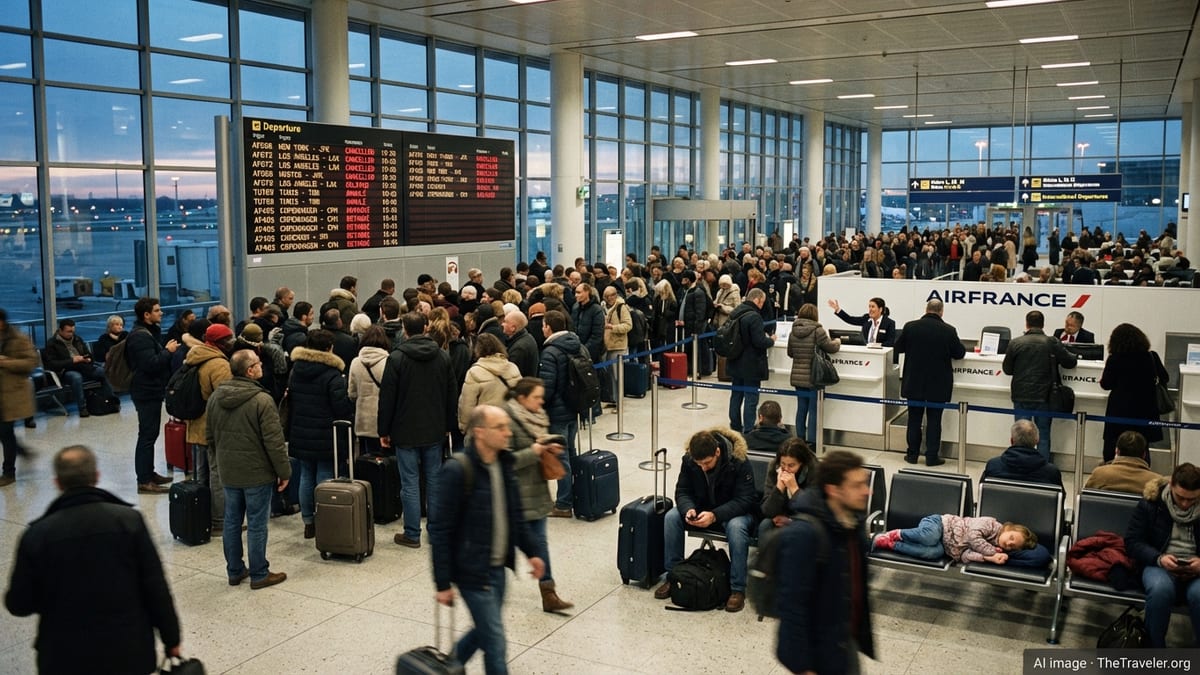
For travelers caught in Wednesday’s disruption, the immediate impact at Logan was visible in crowded departure halls and long lines at service counters. Social media posts from the airport described families sleeping in terminal seating, full hotels near the airport, and limited availability of alternative flights as the busy summer travel period ramps up.
Because many international departures from Boston leave in coordinated evening waves, a missed connection can mean a 24-hour delay when onward flights operate only once per day. Passengers who arrived too late to board those flights were left to compete for a limited number of remaining seats on other carriers or to accept rebookings for the following day.
Published consumer guidance from federal transportation agencies notes that passengers affected by delays and cancellations have differing options depending on whether their flight is canceled outright, significantly delayed, or simply rescheduled. In practice, when disruptions are widespread and seats are scarce, travelers often have little choice but to wait, reroute through multiple stops, or accept itineraries to nearby alternate airports rather than their original destination.
The disruption also created challenges for passengers beginning trips at other airports. As aircraft and crews failed to reach their next scheduled flights, travelers in smaller US cities and at overseas outstations found their departures delayed or canceled, even when local conditions seemed normal.
Infrastructure and capacity pressures at a growing gateway
The latest turbulence at Logan comes as the airport continues to expand its route network and experiment with new ways of managing congestion. Carriers have added seasonal and year round links to a growing list of North American and international cities, while new infrastructure projects and service innovations are being rolled out to accommodate increased demand.
In recent months, coverage of Logan has highlighted additions such as a remote terminal facility west of Boston and a Transportation Security Administration program designed to shift some screening away from crowded terminal checkpoints. At the same time, federal planning documents indicate that upcoming runway and airfield work later in 2026 is expected to temporarily reduce the airport’s capacity, with regulators modeling the likelihood of increased delay during those phases of construction.
These improvements and constraints are emerging against the backdrop of a national air system that is already stretched by staffing challenges, weather volatility, and surging leisure demand. As a result, periods of peak traffic at Logan can create pressure on taxiways, gates, and security lanes even on days with otherwise favorable flying conditions.
Travel industry observers note that while new technology and procedures have improved the flow of passengers through terminals, bottlenecks still arise when several large aircraft arrive or depart within a narrow window. When combined with airline schedules designed around precise connection banks, the margin for error can be slim, particularly at older airports surrounded by dense urban development.
What travelers can do as delays spread beyond Boston
With delays from Logan radiating outward through the global system, travel advisers are once again emphasizing preparation and flexibility for anyone flying in the coming days, whether or not Boston appears on their itinerary. According to widely shared consumer guidance, passengers with critical connections are encouraged to build in longer layovers, monitor flight status proactively, and consider travel insurance products that specifically address missed connections and overnight disruptions.
Public information from airport and airline apps increasingly offers real time data on security wait times, gate changes, and departure estimates. At Logan, a recently introduced tool provides live checkpoint wait estimates, which can help outbound travelers better time their arrival and reduce the risk of missing flights when traffic or check in queues are heavy.
Experts in transportation reliability also point out that travelers who are able to adjust departure times away from the busiest morning and afternoon peaks may reduce their exposure to cascading delays. Early morning flights are often less affected by knock-on disruptions from earlier in the day and can provide more rebooking options if problems arise.
For now, passengers stranded at Logan and at overseas airports affected by the same disruption are contending with the immediate realities of full flights and stretched airline resources. As operations gradually recover, the episode is likely to add to the growing body of evidence that even a single day of turbulence at a key hub can reverberate across the world’s air routes for days afterward.